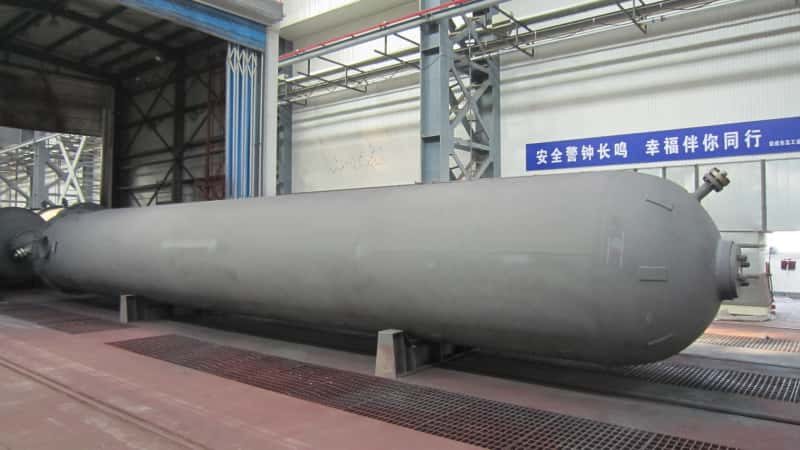

Purchasing the wrong pressure tank can result in dangerous pressure failures, reduced system efficiency, increased maintenance, and wasted investment. A mismatch between your application needs and tank specifications—such as pressure rating, material compatibility, or volume—can compromise safety, shorten equipment life, and even violate regulatory compliance. To prevent these costly errors, understanding the key specifications of pressure tanks is essential for engineers, procurement teams, and facility operators alike.
The key specifications when purchasing a pressure tank include working pressure, volume/capacity, material of construction, design code or standard (ASME, PED, etc.), temperature range, corrosion resistance, connection sizes, orientation (vertical or horizontal), and internal lining or coatings. Each of these parameters must align with the process fluid, pressure conditions, and installation environment to ensure safe and efficient performance.

By carefully matching these specifications to your operating conditions, you can maximize durability, safety, and compliance while minimizing downtime and maintenance costs. Let’s walk through these critical factors in detail.
What Is the Required Working Pressure and Why Is It Critical in Pressure Tank Selection?
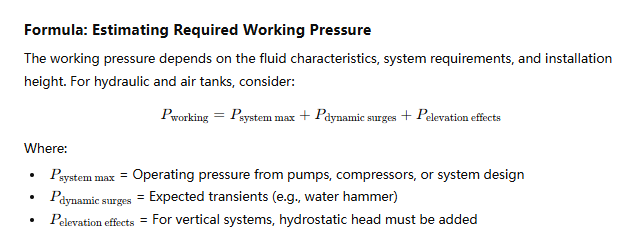
Incorrectly selecting a pressure tank for your system is more than a minor error — it can lead to tank failure, system shutdown, safety violations, or even catastrophic explosions. One of the most misunderstood but essential parameters in pressure tank design is the required working pressure. Many engineers and facility managers overlook this specification or apply generic assumptions without considering operational variances. In reality, working pressure is the cornerstone of tank safety, efficiency, and regulatory compliance. This article will explain what required working pressure really means, how to calculate it, and why it’s critical to pressure tank selection.
The required working pressure of a pressure tank is the maximum continuous pressure that the tank must withstand during regular operation, including all expected fluctuations. It is critical because it determines the tank’s wall thickness, material selection, safety factor, and certification compliance. A mismatch between working pressure and tank specification can cause structural failure, leaks, or explosions.
Whether you’re sourcing tanks for compressed air, water systems, chemical storage, or steam processes, ignoring proper working pressure guidelines exposes your equipment — and your personnel — to avoidable risks. Let’s delve deeper into how to accurately determine this parameter and how it affects tank selection, cost, and long-term performance.
Working pressure is the maximum pressure a tank is expected to operate under normal conditions.True
It represents the pressure the vessel must safely sustain continuously, excluding transient or emergency spikes.
Design pressure and working pressure are the same in pressure vessel specifications.False
Design pressure is typically higher than working pressure and includes a safety margin to accommodate pressure surges or abnormal operating conditions.
Understanding Key Pressure Terminology
1. Working Pressure (WP):
- The maximum pressure the tank is expected to experience during normal continuous operation.
- Specified in bar, psi, or MPa.
- Used as the baseline for material strength, wall thickness, and fatigue life.
2. Design Pressure (DP):
- A safety-rated pressure, typically 10–20% higher than working pressure.
- Accommodates transients, surges, and over-pressurization.
- Required by pressure vessel codes (e.g., ASME Section VIII).
3. Burst Pressure:
- The pressure at which the tank will catastrophically fail.
- At least 2 to 4 times the design pressure.

Why Working Pressure Is Critical to Tank Selection
1. Material and Wall Thickness Selection
The tank’s shell and head must be designed to safely resist internal pressure without yielding or fatigue. Higher working pressure demands thicker walls or higher-grade alloys.
| Working Pressure (bar) | Minimum Wall Thickness (Carbon Steel) |
|---|---|
| Up to 10 | 5 mm |
| 10–20 | 6–10 mm |
| 20–40 | 12–20 mm |
| 40–100 | 25+ mm (with special alloys) |
2. Safety Device Calibration
Pressure relief valves must be rated for design pressure — which depends on the working pressure. Incorrect ratings can cause premature venting or unsafe overpressurization.
3. Code Compliance (ASME / PED / ISO)
Certifying bodies such as ASME (USA), PED (Europe), and others use working pressure as a baseline for classification. Non-compliance can void warranties or legal operating permits.
4. Operational Reliability and Fatigue Life
Repeated pressure cycles near or beyond rated working pressure accelerate fatigue and cause micro-cracks, leading to leaks or ruptures over time.
Application-Based Working Pressure Ranges
| Application | Typical Working Pressure (bar) | Remarks |
|---|---|---|
| Compressed Air Storage (Industrial) | 6–12 | Must match compressor rating + surge buffer |
| Steam Boilers | 8–30 | Requires ASME Section I or VIII compliance |
| Water Booster Systems | 4–10 | Must include water hammer pressure in sizing |
| LPG Storage Tanks | 8–18 | Must meet PED/ASME pressure vessel codes |
| Chemical Reactor Vessels | 10–60 | Material must resist chemical attack and pressure |
| Hydraulic Accumulators | 100–300+ | Requires thick-wall design with safety margins |
Heat and Pressure Combined: Special Design Considerations
At elevated temperatures (>100°C), material strength reduces. This requires derating of allowable stress and may lead to increased thickness or switching to high-temperature alloys.
| Temperature (°C) | Carbon Steel Strength Reduction | Stainless Steel Adjustment Needed |
|---|---|---|
| 100 | ~0% | No |
| 300 | -15% | Moderate wall increase |
| 500 | -40% | Switch to 316Ti or Incoloy |
| 700 | Not usable | Use Nickel or Chrome-Moly steels |
Case Study: Incorrect Working Pressure Tank in Food Plant
Client: Beverage production facility
Installed Tank: 6 bar working pressure air tank
System Pressure Peaks: 8–10 bar due to compressor cycling
Issue: Tank ruptured safety valve repeatedly, internal corrosion
Analysis: Working pressure was underspecified by 40%
Solution: Replaced with 10 bar working pressure tank with corrosion-resistant liner
Result:
- Zero valve activations in 12 months
- Improved compressor efficiency
- Compliance with ISO 8573 standards
Pressure Tank Selection Checklist
| Factor | What to Specify |
|---|---|
| Operating Pressure Range | Include average and peak pressure |
| Surge/Transient Estimation | Add 10–15% for system variability |
| Working vs. Design Pressure | Design pressure = Working pressure × 1.1–1.2 |
| Temperature Impact | Derate material if >100°C |
| Material Selection | Based on corrosion, pressure, and temperature |
| Code Requirements | ASME, PED, CRN, API depending on region |
| Accessories and Fittings | Safety valves, gauges, and manways must match WP |
| Lifetime and Maintenance Goals | Higher WP = better fatigue resistance |
Summary: Pressure Determines Performance and Safety
The required working pressure is not just a number — it’s the core of pressure tank design. It defines:
- Wall thickness and material
- System compatibility and safety
- Regulatory compliance
- Operational reliability over time
A tank that’s under-specified in working pressure may cost less upfront — but it will always cost more in failures, downtime, or fines.
How Does Tank Volume or Capacity Affect System Performance and Sizing?
Selecting the wrong tank volume can cripple a fluid system — causing pumps to short-cycle, compressors to overwork, or pressure to fluctuate uncontrollably. Whether you’re sizing tanks for air, water, chemicals, or steam, volume is not just a storage metric — it directly determines stability, efficiency, energy consumption, and even equipment lifespan. Undersized tanks lead to frequent cycling, higher energy bills, and system instability. Oversized tanks cost more and may underperform due to thermal losses or slow response. This article breaks down how tank volume or capacity affects system performance and how to correctly size tanks for optimal operation.
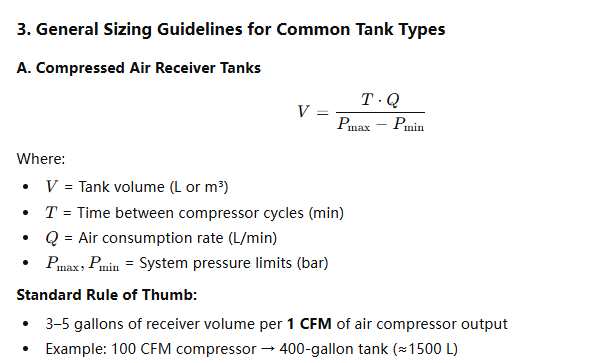
Tank volume or capacity determines how much fluid, gas, or thermal energy the system can store and buffer during operation. It directly affects pressure stability, cycling frequency of compressors or pumps, system response time, and overall energy efficiency. Correctly sizing tank capacity ensures smooth operation, extends equipment life, reduces wear, and prevents overpressure or vacuum conditions.
Whether you’re dealing with a pressure vessel in a water booster system, a compressed air receiver, or a thermal expansion tank in a heating loop, volume must match system dynamics, load variability, and application-specific demands. Let’s explore the critical performance effects and how to get tank sizing right.
Tank volume plays a central role in pressure stabilization and energy storage in fluid systems.True
Tanks act as buffers that smooth flow and pressure, reducing cycling of pumps or compressors.
Oversizing a pressure tank always leads to better system performance.False
While larger tanks reduce cycling, they increase system cost, footprint, and can slow pressure recovery or create thermal inefficiencies.
1. The Role of Tank Volume in Fluid and Gas Systems
A. Storage and Buffering
- Larger tanks store more volume, reducing the number of start/stop cycles for compressors and pumps.
- Buffering helps handle sudden demand spikes without immediate pump or compressor activation.
B. Pressure Stabilization
- Volume dampens pressure swings caused by flow demand changes.
- Helps maintain a consistent system pressure, especially in variable demand systems.
C. Thermal Storage (in Hot/Cold Water Systems)
- Volume acts as a thermal battery, storing energy to handle peak demands or system downtime.
- Reduces boiler/chiller cycling and improves fuel efficiency.
2. Tank Volume and Equipment Cycling
| Impact Factor | Undersized Tank | Oversized Tank |
|---|---|---|
| Pump/Compressor Cycles | Very Frequent (short cycling) | Infrequent, but slower response |
| Energy Consumption | High due to frequent starts | Lower per cycle, but increased standby |
| Equipment Lifespan | Reduced due to wear | Extended due to fewer cycles |
| Pressure Fluctuation | High | Low |
| System Responsiveness | Fast, but unstable | Stable, but slower to react |
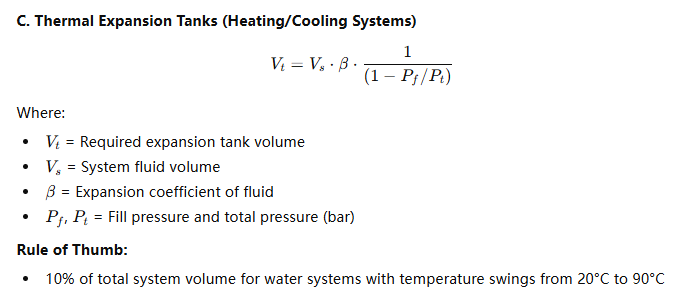
4. Real-World Performance Impact: Case Study
Industry: Food Processing Plant (Milk pasteurization)
Issue: Frequent compressor cycling — 45 starts/hour
Original Setup:
- Compressor: 60 CFM
- Receiver Tank: 150 L (undersized)
Symptoms:
- High energy bills
- Rapid wear on motor starters
- Pressure drops during peak demand
Upgrade:
- Replaced with 600 L vertical air receiver
- Added pressure transducer-controlled unloading
Result:
- Starts reduced to 12/hour
- Energy usage dropped by 18%
- Compressor maintenance interval doubled
5. Tank Volume vs. Cost and Footprint
| Tank Size (L) | Approx. Cost (USD) | Floor Space (m²) | Maintenance Frequency | Energy Savings Potential |
|---|---|---|---|---|
| 100 | $200–$350 | 0.3 | High (frequent cycling) | None |
| 500 | $700–$1,000 | 0.5 | Moderate | 10–15% possible |
| 1000 | $1,300–$2,000 | 1.0 | Low | 15–25% (longer runtime) |
| 3000+ | $3,000+ | 2.5+ | Low, but slow response | Diminishing returns |
Design Tip: Aim for the smallest volume that achieves target cycling rate and pressure stability, considering both CAPEX and OPEX.
6. Pitfalls of Poor Sizing
| Mistake | Consequence |
|---|---|
| Undersized for Compressor | Short cycling, energy loss, high wear |
| Oversized for Booster | Sluggish pressure rise, overrun cost |
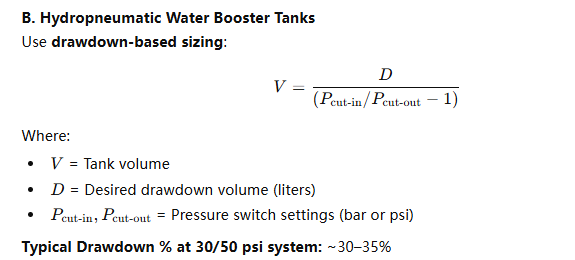
| Ignoring Drawdown Volume | Frequent pump starts even with a large tank |
| Incorrect Precharge | Loss of effective volume and pressure balance |
| Thermal Oversizing | Slow system temperature changes, overshoot |
Summary: Volume is Your System’s Buffer and Brain
Tank volume is not just about storage — it’s about balancing flow, pressure, thermal energy, and operating frequency.
Correctly sizing your tank means:
- Reducing system cycling
- Extending equipment life
- Saving energy and maintenance cost
- Stabilizing performance even under load changes
Oversize blindly, and you waste money and space. Undersize, and your system collapses under its own stress.
What Materials of Construction Are Best for Different Pressure Tank Applications?
Using the wrong material for a pressure tank can lead to catastrophic failure — including corrosion, bursting under pressure, cracking under thermal stress, or contamination of stored fluids. Every application, from compressed air storage to aggressive chemical containment, demands specific mechanical and chemical resistance properties from the tank material. Selecting the right material of construction (MOC) not only ensures safety and durability but also improves lifecycle cost and regulatory compliance. The problem is, many users base their material choice solely on price — a short-sighted approach that often results in excessive maintenance or complete tank replacement. This article offers a clear, expert-guided breakdown of the best materials for each type of pressure tank application.
The best material of construction for a pressure tank depends on the operating pressure, temperature, fluid type, corrosion risk, and regulatory requirements. Carbon steel is ideal for general compressed air and water applications; stainless steel is suited for corrosive, hygienic, or high-temperature environments; fiberglass-reinforced plastic (FRP) works well with aggressive chemicals and non-pressurized or low-pressure systems; and plastic or polyethylene is best for low-pressure, non-critical chemical storage. Choosing the correct material ensures safety, reliability, and optimal performance.
Below, we evaluate each major tank material across several applications — using real data, design considerations, and field experience to help you make an informed, cost-effective decision.
Carbon steel is the most commonly used material for industrial pressure tanks.True
Its high tensile strength, weldability, and cost-effectiveness make it ideal for compressed air, steam, and water-based systems.
Plastic tanks are suitable for high-pressure applications involving compressed gases.False
Plastic and polyethylene tanks are limited to low-pressure or atmospheric systems and are not safe for compressed gas storage.
Overview: Key Pressure Tank Materials and Their Properties
| Material | Max Pressure | Max Temp (°C) | Corrosion Resistance | Cost Level | Weldable | Typical Use |
|---|---|---|---|---|---|---|
| Carbon Steel | 200+ bar | 400°C | Low–Moderate (coated) | Low | ✅ Yes | Air, water, steam |
| Stainless Steel 304/316 | 100–150 bar | 600°C | High | Medium–High | ✅ Yes | Food, pharma, chemicals |
| Aluminum Alloys | 10–50 bar | 150°C | Moderate | Medium | ✅ Yes | Lightweight mobile units |
| FRP (Fiberglass) | <10 bar | 100°C | Very High | Medium | ❌ No | Chemicals, brine, wastewater |
| Polyethylene (HDPE) | <5 bar | 60°C | High (limited solvents) | Low | ❌ No | Low-pressure chemicals |
1. Carbon Steel – The Industrial Standard for Pressure Tanks
Best For:
- Compressed air
- Steam systems
- Fire suppression tanks
- Hydraulic accumulators
Strengths:
- High mechanical strength for moderate to very high pressures
- Cost-effective
- Excellent weldability and structural durability
Limitations:
- Prone to corrosion, especially with water and oxygen presence
- Requires internal coatings or linings for water or chemical service
- Not ideal for food, pharmaceutical, or hygienic environments
| Carbon Steel Grades | Typical Applications |
|---|---|
| ASTM A516 Gr. 70 | Steam boilers, air receivers |
| ASTM A36 | Low-pressure tanks, general water |
| ASTM A106 | Pipe-connected pressure systems |
Tip: Apply epoxy, rubber, or glass linings for aggressive or corrosive service.
2. Stainless Steel – For Corrosive, Clean, or Hygienic Applications
Best For:
- Pharmaceutical and food industries
- Corrosive chemicals (acids, chlorides)
- High-temperature water
- Seawater or brine systems
Strengths:
- Resistant to oxidation, chlorides, acids, and high temperatures
- Compatible with sanitary CIP (Clean-in-Place) systems
- Long service life in aggressive environments
Limitations:
- Higher cost than carbon steel
- Heavier than composite or plastic options
| Stainless Grades | Use Case Examples |
|---|---|
| 304 SS | General corrosive environments |
| 316 SS (with molybdenum) | Chloride-rich fluids, seawater |
| Duplex SS | High strength + excellent corrosion |
3. Fiberglass Reinforced Plastic (FRP) – For Aggressive Chemical Storage
Best For:
- Brines, acids, alkalis
- Industrial wastewater
- Chemical processing plants
- Non-pressure or low-pressure tanks
Strengths:
- Excellent resistance to a broad spectrum of corrosive media
- Lightweight and non-metallic (no rusting)
- Customizable resin systems (vinyl ester, epoxy)
Limitations:
- Limited to low-pressure applications (<10 bar)
- Not weldable — bonded with resin joints
- UV exposure can degrade outer surface (use gel coats)
| FRP Resin Type | Chemical Compatibility |
|---|---|
| Vinyl Ester Resin | Strong acids and bases |
| Polyester Resin | General chemical resistance |
| Epoxy Resin | Solvents, fuels, and high-performance |
4. Polyethylene (HDPE/LLDPE) – Low-Cost Tanks for Low Pressure
Best For:
- Low-pressure chemical storage
- Acid or alkali containers
- Agriculture and water treatment
Strengths:
- Very affordable and easy to install
- Resistant to many acids and bases
- Excellent for non-pressurized systems
Limitations:
- Cannot handle pressure or high temperature (>60°C)
- Weak mechanical strength; can deform under load
- Limited lifespan with UV exposure (use black or UV-stabilized grades)
| Application | Typical Tank Material |
|---|---|
| Acetic acid tank | HDPE with venting |
| Fertilizer storage | UV-stabilized polyethylene |
| Caustic soda solution | LLDPE with EPDM gasket |
5. Aluminum – Lightweight, Medium Strength Option
Best For:
- Mobile air compressors
- Breathing gas tanks (SCUBA, medical)
- Transportable pressure vessels
Strengths:
- Lightweight and non-magnetic
- Moderate corrosion resistance
- Easily machined and formed
Limitations:
- Fatigue-sensitive under cyclic loads
- Costly for high-pressure systems
- Not suitable for strong acids or alkalis
| Common Grades | Key Properties |
|---|---|
| 6061-T6 | High strength, weldable |
| 5083 | Marine grade, excellent for transport |
| 7075 | Aerospace grade, very strong |
Comparative Table: Best Material by Pressure Tank Application
| Application | Recommended Material(s) | Pressure Range | Special Considerations |
|---|---|---|---|
| Compressed Air Storage | Carbon Steel, Aluminum | 6–40 bar | Epoxy-coated interior for water resistance |
| Chemical Processing Tanks | Stainless Steel, FRP | 5–60 bar | Material must match chemical compatibility |
| Pharmaceutical CIP Vessels | 316L Stainless Steel | 4–20 bar | Requires sanitary finish and passivation |
| Seawater Storage | Duplex SS, FRP | 5–15 bar | Chloride-resistant alloys or resins |
| Thermal Expansion Tanks | Carbon Steel (coated), SS | 3–10 bar | Corrosion-resistant liners required |
| Wastewater/Brine Holding | FRP, HDPE | <5 bar | Not suitable for pressure unless reinforced |
| Portable Air or Gas Vessels | Aluminum, Carbon Steel | 10–300 bar | Must meet DOT/ISO transport codes |
Real-World Case Study: Corrosive Acid Tank Upgrade
Industry: Chemical blending
Original Tank: Carbon steel
Stored Fluid: 10% hydrochloric acid (HCl)
Problem: Severe internal corrosion, leaks within 6 months
Solution: Switched to FRP tank with vinyl ester resin lining
Results:
- 100% corrosion resistance for over 4 years
- Maintenance cost dropped by 80%
- Compliance with local environmental discharge rules improved
Summary: The Right Material = Performance + Safety + Longevity
Choosing the right material of construction is essential for:
- Mechanical pressure integrity
- Chemical resistance
- Compliance with ASME, PED, or other codes
- Sanitary or corrosion-free operation
- Cost-effectiveness over the tank’s life
Carbon steel works best for general duty. Stainless steel for corrosive or sanitary systems. FRP for aggressive chemicals. Plastic for non-pressurized storage. And aluminum for lightweight, portable use.
Why Are Design Codes and Certifications Like ASME or PED Important When Purchasing a Pressure Tank?
Purchasing a pressure tank without verified design codes or certifications is like buying a car without brakes — it may function, but it’s dangerously non-compliant. Pressure vessels operate under internal forces that, if poorly designed or manufactured, can lead to catastrophic rupture, environmental damage, regulatory fines, or even loss of life. That’s why international safety and engineering standards — such as ASME (American Society of Mechanical Engineers) and PED (Pressure Equipment Directive in the EU) — are non-negotiable when selecting a pressure tank. These codes are more than just paperwork; they’re legally required and provide assurance of mechanical safety, material integrity, inspection protocols, and manufacturing consistency.
Design codes and certifications like ASME (USA), PED (EU), and others are critical in pressure tank selection because they ensure the vessel is engineered, manufactured, inspected, and tested to meet internationally recognized safety and performance standards. Certified pressure tanks reduce risk of explosion or failure, comply with legal regulations, facilitate insurance approval, and guarantee compatibility with pressure systems across industries.
Whether you’re using tanks for air, water, steam, chemicals, or gas — if the pressure exceeds 0.5 bar, certification isn’t just important — it’s legally mandatory in most jurisdictions. Below, we explain in detail why these codes matter, what they include, and how they impact your purchasing decision.
ASME and PED certifications ensure that pressure vessels meet rigorous safety and manufacturing standards.True
They define required design calculations, material selection, testing methods, and inspection procedures to ensure structural integrity under pressure.
Non-certified pressure tanks can still be legally used in high-pressure industrial systems.False
Most countries prohibit the use of uncertified pressure vessels in regulated industrial environments, especially above 0.5 bar.
What Are Design Codes and Certifications?
1. ASME Boiler and Pressure Vessel Code (BPVC) – USA & International
- Section VIII (Div. 1, 2, and 3): Governs design, fabrication, inspection, and testing of pressure vessels.
- U-Stamp certification indicates full ASME compliance.
- Accepted worldwide in oil, gas, pharma, power, and food industries.
2. PED (Pressure Equipment Directive) – European Union
- Mandatory for pressure equipment operating above 0.5 bar in the EU.
- Requires CE Marking and compliance with categories I–IV depending on risk level.
- Focuses on design integrity, safety devices, material traceability, and conformity assessment.
3. Other Global Standards
| Standard | Region | Application |
|---|---|---|
| CRN (Canada) | All provinces | Each pressure vessel must be registered |
| GB (China) | GB150, GB151 | National standard for pressure equipment |
| AD 2000 (Germany) | Similar to PED | Legacy systems and harmonized PED tools |
| ISO 16528 | International | Broad framework for pressure vessel approval |
Why Certifications Matter: 7 Critical Reasons
1. Safety Assurance
Certified tanks are designed to withstand defined operating pressures and temperatures with built-in safety margins. This reduces risk of:
- Explosions or ruptures
- Leaks under cyclic pressure loads
- Structural fatigue over time
2. Regulatory Compliance
Most countries legally require certification for pressure equipment in regulated industries. Operating uncertified tanks can:
- Violate health and safety laws
- Lead to fines or plant shutdowns
- Invalidate insurance coverage
3. Quality Control and Traceability
Design codes ensure:
- Material certification and batch traceability
- Welding performed by qualified personnel (WPS/PQR)
- Non-destructive testing (NDT) like X-ray or ultrasonic inspection
- Final hydrostatic or pneumatic testing under controlled conditions
4. Design Integrity and Calculations
Codes mandate:
- Correct wall thickness calculations
- Stress analysis using defined formulas or FEA (for Div. 2/3 ASME)
- Proper selection of corrosion allowance, joint efficiency, nozzle reinforcement
5. Global Acceptance
A tank with ASME or PED certification:
- Can be installed across borders without redesign
- Speeds up permitting and approval processes
- Is often required by international EPC contractors
6. Insurance and Legal Protection
Insurance underwriters require code-compliant vessels to:
- Insure high-risk facilities
- Validate post-incident investigations
- Demonstrate due diligence during audits
7. Resale and Reuse
Certified tanks have stamped nameplates, documentation, and test records. This:
- Enhances resale value
- Allows repurposing across projects
- Ensures confidence in second-hand equipment
Table: Key Differences Between Certified and Non-Certified Tanks
| Feature | Certified (ASME / PED) | Non-Certified |
|---|---|---|
| Legal Use in Industrial Sites | ✅ Allowed | ❌ Often prohibited |
| Design Calculations | ✅ Code-based | ❌ Often missing or unverified |
| Material Traceability | ✅ Documented (MTRs) | ❌ Unknown origin |
| Weld Inspection | ✅ NDT (RT, UT, PT, etc.) | ❌ Rare or none |
| Testing Pressure | ✅ Code-specified (1.3x WP) | ❌ Inconsistent or skipped |
| Documentation | ✅ Full Dossier + Nameplate | ❌ No record or validation |
| Insurance Eligibility | ✅ Supported | ❌ Typically denied |
What’s Included in ASME and PED-Compliant Tanks?
| Component | Requirement |
|---|---|
| Design Calculations | Wall thickness, stresses, nozzle reinforcement |
| Material Certification | MTRs for all pressure-retaining parts |
| Welding Standards | WPS, PQR, WPQ (welder qualifications) |
| Inspection & Testing | NDT, visual inspection, hydrotest/pneumatic test |
| Nameplate & Stamp | U-Stamp (ASME), CE Mark (PED), CRN (Canada) |
| Third-Party Verification | Notified Body (PED), Authorized Inspector (ASME) |
Real-World Case Study: Uncertified vs. ASME-Certified Tank
Client: Agricultural chemical company
Original Setup: Non-ASME tank from local supplier
Issue: Internal rupture under 8 bar — caused by poor weld
Consequences:
- $270,000 in chemical loss
- Full production shutdown
- Investigation revealed lack of testing and welding traceability
Action Taken: Replaced with ASME Section VIII Div. 1 certified tank
Benefits:
- Passed hydrotest at 13 bar
- 10-year warranty
- Approved by insurance inspector
Choosing the Right Certification for Your Region
| Location | Mandatory Certification | Notes |
|---|---|---|
| United States | ASME (Section VIII) | U-stamped tank required |
| European Union | PED (97/23/EC or 2014/68/EU) | CE Mark required |
| Canada | CRN (provincial registration) | Must be registered in each province |
| Middle East | ASME or equivalent | Many EPCs demand U-stamp |
| China | GB150 / SELO Approval | Local manufacturing standards |
Summary: Certification Is the Foundation of Pressure Tank Safety
Without design codes and certification:
- You risk equipment failure
- You may violate legal regulations
- You lose insurance and liability protection
With ASME, PED, or equivalent certification:
- You gain a documented, proven, and traceable vessel
- You reduce risks and ensure long-term safety and compliance
- You build confidence for audits, clients, and insurers
Certified pressure tanks may cost slightly more upfront — but they save you exponentially in downtime, repair, and legal exposure.
How Do Temperature and Corrosion Conditions Influence Pressure Tank Specifications?
Failing to consider temperature and corrosion conditions when specifying a pressure tank is a recipe for disaster. High temperatures can weaken materials, increase internal pressure, and cause stress corrosion cracking. Corrosive environments silently degrade walls and welds, often unnoticed until sudden failure. Tanks not designed for these stresses may leak, rupture, or collapse — risking lives, production, and regulatory violations. For long-lasting, safe operation, temperature and corrosion must be primary drivers in tank specification — not afterthoughts. This guide explains how these two factors reshape the way tanks must be designed, built, and maintained.
Temperature and corrosion conditions directly affect pressure tank specifications by determining the required material selection, wall thickness, corrosion allowances, welding procedures, protective coatings, and design safety factors. High temperatures reduce the mechanical strength of metals, requiring thicker walls or alloy upgrades, while corrosive media necessitate the use of resistant materials, linings, or cladding to prevent deterioration and failure. Ignoring these factors leads to premature failure, loss of containment, and safety violations.
This article will help you understand exactly how to evaluate temperature and corrosion impacts during pressure tank design — with real calculations, material comparisons, and engineering best practices.
High operating temperatures reduce the allowable stress of pressure tank materials.True
At elevated temperatures, metals lose strength and require thicker walls or alternative alloys to maintain pressure integrity.
Corrosive fluids can be safely stored in standard carbon steel pressure vessels without any modification.False
Carbon steel rapidly degrades in corrosive environments and must be coated, lined, or replaced with corrosion-resistant materials.
1. Impact of Temperature on Pressure Tank Design
A. Reduction in Material Strength
As temperature increases, most metals — especially carbon steels — lose tensile strength and yield stress, lowering their ability to contain pressure safely.
| Material | Strength Reduction at 400°C | Use Above 400°C? |
|---|---|---|
| Carbon Steel (A516) | ~35% | ❌ Not recommended |
| Stainless Steel 304 | ~25% | ⚠️ Limited use |
| Stainless Steel 316Ti | ~20% | ✅ Up to 600°C |
| Inconel (Nickel Alloy) | ~5–10% | ✅ Up to 800–1000°C |
Design Codes React:
- ASME and PED adjust allowable stress values based on metal temperature
- Higher temperature → greater required wall thickness to maintain pressure integrity
B. Thermal Expansion and Stress
Different materials expand at different rates. Without proper allowances:
- Thermal expansion can cause warping, buckling, or gasket failure
- Multi-material systems (e.g., stainless + carbon) must use expansion joints or floating heads
C. Fatigue and Creep at Elevated Temperatures
At sustained high temperatures:
- Creep deformation becomes a failure mode (especially above 400°C)
- Materials must be tested for creep rupture strength, not just yield strength
| Temperature (°C) | Creep Risk Starts | Recommended Materials |
|---|---|---|
| < 300 | Low | Carbon steel, SS304 |
| 300–500 | Moderate | 316Ti, Duplex, Cr-Mo alloys |
| 500–750 | High | Incoloy, Hastelloy, Alloy 800 |
2. Influence of Corrosion on Tank Specification
Corrosion reduces wall thickness, introduces pitting and cracks, and can compromise weld integrity. It shortens life, increases inspection needs, and in severe cases, causes catastrophic rupture.
A. Material Selection Based on Corrosive Media
| Fluid Type | Recommended Material |
|---|---|
| Seawater | 316L, Duplex SS, Cu-Ni, FRP |
| Hydrochloric Acid | FRP with vinyl ester resin, PTFE liner |
| Sodium Hydroxide | Rubber-lined carbon steel, FRP, PE |
| Sulfuric Acid | 316Ti, Alloy 20, FRP |
| Nitric Acid | SS 316L, Tantalum |
| Ammonia | Carbon steel (dry), SS for moist NH₃ |
Design Tip: Always use a chemical resistance chart validated by temperature and concentration.
B. Corrosion Allowance (Extra Thickness)
- Typically 1.5 mm to 6 mm added to account for internal wall thinning
- Defined by ASME UG-25, PED Annex I, and ISO 16528
| Application | Typical Corrosion Allowance |
|---|---|
| Compressed Air (Dry) | 0 mm |
| Potable Water | 1.5 mm |
| Aggressive Chemicals | 3–6 mm or lining required |
3. Combined Effect: High Temperature + Corrosive Media
These are the most demanding design environments — common in:
- Refineries (acid + steam)
- Chemical reactors
- Power plant heat recovery tanks
- Food sterilization (heat + brine)
Required Specifications:
- Use nickel alloys (Hastelloy, Incoloy, Alloy 625)
- Avoid carbon steel even with coatings — coatings degrade under heat
- Cladded tanks: carbon steel with internal 3 mm stainless or alloy lining
| Environment | Safe Tank Specification |
|---|---|
| 10% HCl at 90°C | FRP tank with vinyl ester liner |
| Steam + NaOH (cleaning fluid) | 316Ti or rubber-lined carbon steel |
| 5% Sulfuric Acid at 130°C | Alloy 20 or PTFE-lined stainless steel |
| Wet Chlorine Gas @ 70°C | Titanium or Monel |
4. Real-World Case Study: Steam + Acid Tank Failure
Industry: Chemical batch processing
Original Spec: Carbon steel tank with epoxy lining
Conditions:
- 130°C saturated steam during cleaning
- HCl and NaOH in cleaning cycle
- Pressure: 6 bar
Problem:
- Lining delaminated at elevated temperature
- Corrosion penetrated wall in <6 months
Solution:
- Replaced with 316Ti stainless steel tank
- Added venting and external insulation
- Result: >6 years of service with zero corrosion
5. Engineering Chart: How to Choose Materials Based on Temp + Corrosion
| Temp (°C) | Corrosion Level | Suggested Material Options | Notes |
|---|---|---|---|
| <100 | Low | Carbon steel (epoxy coated), HDPE | Water, mild alkalis |
| 100–250 | Medium | 316L SS, rubber-lined steel, FRP | Acids, cleaning chemicals, brine |
| 250–450 | High | 316Ti, Duplex, Alloy 20, Incoloy | Combined chemical + heat resistance |
| >450 | Severe | Inconel, Hastelloy, Titanium | For extreme processes and steam/oxidizers |
6. Additional Specification Adjustments for Temp/Corrosion
| Specification Aspect | Design Consideration |
|---|---|
| Wall Thickness | Add for corrosion + strength derating at temp |
| Joint Efficiency | Reduce if materials are difficult to weld |
| Thermal Insulation | Prevent external corrosion under insulation (CUI) |
| Expansion Joints | Needed for tanks with >100°C delta-T |
| Non-Destructive Testing | RT + PT/UT for stress corrosion detection |
Summary: Always Design for the Harshest Conditions Expected
When specifying a pressure tank:
- Always combine mechanical, thermal, and chemical data
- Use corrosion-resistant materials, linings, or cladding
- Adjust wall thickness for temperature strength loss
- Include corrosion allowance and inspection access
- Never rely solely on coatings in hot or chemical-rich environments
Temperature and corrosion are silent tank killers. Anticipating their effects during design ensures longer life, fewer failures, and higher safety margins.
What Other Configuration Features Should Be Considered When Specifying a Pressure Tank?
Selecting the correct size and material for a pressure tank is essential — but it’s only the beginning. Failure to specify the right configuration features — like nozzle placements, internal linings, support types, access ports, and safety accessories — can cripple operational performance, complicate installation, and create dangerous compliance gaps. Many tanks fail or become unserviceable not because of pressure or corrosion, but due to poor layout, inaccessibility, or missing safety hardware. Whether you’re buying a tank for compressed air, process chemicals, or steam, you must carefully evaluate design features that support safe, efficient, and code-compliant operation.
When specifying a pressure tank, additional configuration features such as nozzle orientation, manways, support type, drainage design, internal linings, insulation, safety accessories, and inspection access must be considered. These features ensure operational ease, maintenance access, regulatory compliance, and long-term durability. Customizing the tank to your process conditions prevents costly retrofits, downtime, or failures.
This expert guide details the most critical tank configuration options — what they do, when they matter, and how to specify them correctly.
Tank configuration features like nozzles, manways, and supports are just as important as pressure ratings in ensuring reliable operation.True
These features impact accessibility, safety, system integration, and code compliance.
All pressure tanks come fully equipped with universal configurations that suit any application.False
Tanks must be custom-configured based on process layout, fluid properties, installation location, and code requirements.
1. Nozzle Configuration and Orientation
Why It Matters:
- Defines how your tank connects to the system.
- Influences flow dynamics, venting efficiency, and cleaning access.
Nozzle Types:
| Nozzle Type | Function | Best Location |
|---|---|---|
| Inlet/Outlet | Fluid entry/exit | Bottom (liquids), top (gases) |
| Vent Nozzle | Air escape during filling | Topmost point |
| Drain Nozzle | Complete fluid removal | Lowest point |
| Instrument Nozzles | Pressure/temperature sensors | Mid-body or process zones |
| Safety Valve Port | Mount overpressure relief device | Top, unobstructed area |
Specification Tip: Use flanged nozzles for easy maintenance. Define diameter, rating (e.g., 150# ANSI), and location coordinates on drawings.
2. Manways and Access Ports
Purpose:
Allow internal inspection, maintenance, or manual cleaning.
| Type | Size | Common Location | Notes |
|---|---|---|---|
| Elliptical Manway | 16″ × 12″ | Side shell or head | Most common; seals with swing bolts |
| Circular Manway | 18″–24″ dia | Top of horizontal tank | Good for overhead access |
| Hinged Access Port | Custom sizes | Vertical vessels | Optional for easy opening and closing |
Standard Codes: ASME Section VIII, EN13445, or PED requires minimum opening size based on tank volume and function.
3. Internal Linings, Cladding, and Coatings
Why Important:
Protects tank interior from corrosion or contamination.
| Coating/Liner Type | Application Fluids | Limitations |
|---|---|---|
| Rubber Lining | Caustics, wastewater | Not for high-temperature processes |
| Glass-Fused Steel | Potable water, neutral chemicals | Fragile under impact |
| Epoxy Coating | Oils, water, light acids | Can blister under high temperature |
| PTFE or PVDF Liner | Aggressive acids | Costly, limited to ≤150°C |
| Cladded Stainless Steel | High-pressure corrosive fluids | Welded composite structure required |
Design Tip: Always match liner compatibility with temperature and chemical concentration using a chemical resistance chart.
4. Support Type and Mounting
Determines:
- Load distribution
- Thermal expansion accommodation
- Seismic or wind resistance
| Support Style | Use Case | Considerations |
|---|---|---|
| Skirt Support | Vertical vessels, heavy-duty | Good for indoor static systems |
| Saddle Support | Horizontal tanks | Needs base pads + anchors |
| Leg Support | Small vertical tanks | Less stable under lateral loads |
| Lugs or Wall Brackets | Light vertical tanks (small air units) | Not suitable for large vessels |
Standard Practice: Supports must be stress-analyzed under full load + seismic/wind + thermal expansion using FEA or code-based methods.
5. Safety and Pressure Control Accessories
Always Include:
- Relief valves (PRV) per ASME or PED
- Drain valves for maintenance
- Rupture discs in high-pressure systems
- Level gauges or sight glasses
- Thermometers and pressure gauges
- Optional: Vacuum breakers, air vents
| Accessory | Required When |
|---|---|
| PRV | Always required if sealed |
| Rupture Disc | When rapid overpressure is possible |
| Sight Glass | Liquid level visibility is needed |
| Vacuum Breaker | Draining or cleaning sealed systems |
6. Drainage and Sloping Design
Design Tips:
- Bottom heads should be dished or conical for full drainage
- Offset drain nozzles help remove residuals
- Internal baffles or dip tubes may aid sediment control or clean-out
7. Thermal and Acoustic Insulation
| Condition | Required Feature |
|---|---|
| Hot water/steam tanks | Mineral wool insulation + aluminum cladding |
| Cold fluid tanks | PU foam or vapor barrier wraps |
| Noise from compressor | Acoustic dampening foam in tank room |
Result: Improves thermal performance, protects personnel, and extends component life.
8. Inspection and Monitoring Features
| Feature | Function |
|---|---|
| Corrosion Coupons | Monitors liner/metal degradation |
| Internal Ladders | For human access in large vertical tanks |
| Removable Heads | For full access to internals (floating head) |
| Magnetic or Ultrasonic Sensors | Remote level and thickness monitoring |
9. Design for Mobility or Expansion
| Feature | Benefit |
|---|---|
| Forklift channels | Easy relocation of small tanks |
| Modular flanges | Add-on piping or valves in future |
| Expansion joints | Compensate for thermal movement |
Real-World Case: Tank Rebuild Due to Missing Features
Industry: Oil and gas
Original Tank: Horizontal carbon steel tank, 5000 L
Missing Feature: No manway, no PRV port, no liner
Issues:
- No internal access for scale removal
- PRV retrofitted off-center and failed under surge
- Internal corrosion after 6 months in sour gas service
Upgraded Configuration:
- ASME-stamped tank with 18″ elliptical manway
- NACE-compliant rubber lining
- Flanged ports for PRV, drain, and sensors
- Result: 5+ years without shutdown, fully code-compliant
Summary: A Pressure Tank Is More Than a Shell
Your pressure tank’s configuration features are just as vital as its pressure or volume rating. Every nozzle, manway, support, and coating plays a role in:
- Safety and regulatory compliance
- Ease of maintenance and inspection
- Chemical compatibility
- Thermal or mechanical performance
- System integration and longevity
Missing even one feature — like a manway or PRV nozzle — can lead to expensive retrofits or total tank failure.
A comprehensive understanding of these parameters will help you choose the safest, most efficient pressure tank that meets your operational needs and regulatory obligations.
FAQ
Q1: What are the key specifications when purchasing a pressure tank?
A1: The most important specifications include:
– Tank Capacity: Measured in gallons or liters; determines how much fluid the tank can store.
– Pressure Rating: Indicates the maximum pressure the tank can handle, typically listed in PSI or bar.
– Material Construction: Common materials include carbon steel, stainless steel, and fiberglass.
– Bladder/Diaphragm Type: Determines how air and liquid are separated in hydropneumatic tanks.
– Connection Ports: Size, number, and placement should align with your piping and valve system.
– Certifications & Standards: ASME, CE, PED, or ISO certifications ensure the tank meets safety and performance regulations.
Each factor contributes to the tank’s performance, longevity, and compatibility with specific applications such as water supply systems, HVAC, or industrial processing.
Q2: How does tank capacity affect system performance?
A2: A larger tank capacity helps reduce pump cycling, minimizes wear on equipment, and ensures a stable pressure supply. In water systems, larger tanks reduce start-stop cycles and improve energy efficiency. For industrial applications, the size must match the required flow rate and duty cycle.
Q3: What pressure rating should I choose for my pressure tank?
A3: The pressure rating must exceed your system’s maximum operating pressure to ensure safety and durability. For most residential water systems, 100–150 PSI is common. In industrial systems, pressure ratings vary widely based on application and regulations. Always consult engineering requirements or regulatory codes like ASME.
Q4: Why is material selection important for pressure tanks?
A4: The tank’s material affects its resistance to corrosion, pressure, and chemical compatibility:
– Stainless Steel: High resistance to corrosion, ideal for food, pharma, and corrosive fluids.
– Carbon Steel: Cost-effective and strong, but prone to rust without coating.
– Fiberglass/Composite: Lightweight, corrosion-resistant, and suitable for chemical or outdoor applications.
Material choice impacts the tank’s lifespan, maintenance needs, and application suitability.
Q5: What certifications should a pressure tank have?
A5: Always ensure your pressure tank complies with:
– ASME (American Society of Mechanical Engineers) for U.S.-based installations.
– CE Marking and PED (Pressure Equipment Directive) for European standards.
– ISO 9001 for manufacturing quality.
These standards confirm that the tank has undergone strict testing for safety, durability, and performance.
References
- How to Select a Pressure Tank – Wessels Company
- Pressure Tank Basics – Elbi of America
- Pressure Vessel Design Manual – ASME Guidelines
- Sizing a Pressure Tank – Pentair
- Well Tank Selection Guide – Amtrol
- CE Certification for Pressure Equipment – SGS
- Fiberglass Pressure Tanks – Composite Resources
- Understanding Pressure Ratings – Engineering Toolbox
- Pressure Equipment Directive (PED) – EU Commission
- ISO 9001 Quality Standards – ISO.org