
In any thermal system, the core purpose of a heat exchanger is to transfer heat from one fluid to another—and the amount of heat transferred per unit time is known as the heat duty. Whether you’re sizing a new exchanger, analyzing process performance, or troubleshooting underperformance, knowing how to define and calculate heat duty is fundamental to thermal design and energy efficiency. Errors in calculating heat duty can lead to undersized equipment, poor heat recovery, and even system failure. This article explains what heat duty is, how it’s calculated, and how it applies to both design and performance analysis.
Heat duty in a heat exchanger refers to the total amount of thermal energy transferred from the hot fluid to the cold fluid per unit time. It is typically measured in kilowatts (kW), BTU/hr, or megajoules per second, and is calculated using the formula: Q = m × Cp × ΔT, where m is the mass flow rate, Cp is the specific heat of the fluid, and ΔT is the temperature difference between inlet and outlet.
Accurate heat duty calculation is essential for selecting exchanger size, evaluating process efficiency, and ensuring thermal compliance with system requirements.
Heat duty can be calculated using mass flow rate, specific heat, and temperature change.True
This formula, Q = m × Cp × ΔT, provides the basis for sizing and evaluating heat exchangers under steady-state conditions.
Heat duty only depends on the surface area of the exchanger.False
While surface area affects performance, heat duty is determined by thermal energy exchanged, not physical size.
1. Definition of Heat Duty (Q)
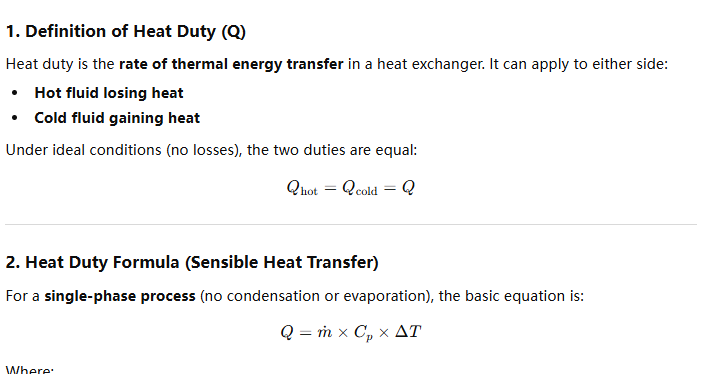
Where:
| Symbol | Description | Units |
|---|---|---|
| ( Q ) | Heat duty | kW, BTU/hr, MJ/s |
| ( dot{m} ) | Mass flow rate | kg/s or lb/hr |
| ( C_p ) | Specific heat capacity of fluid | kJ/kg·K or BTU/lb·°F |
| ( Delta T ) | Temperature change (inlet – outlet) | °C or °F |
Example:
- Water at 1 kg/s
- Cp = 4.18 kJ/kg·K
- Temp change = 60°C – 30°C = 30°C

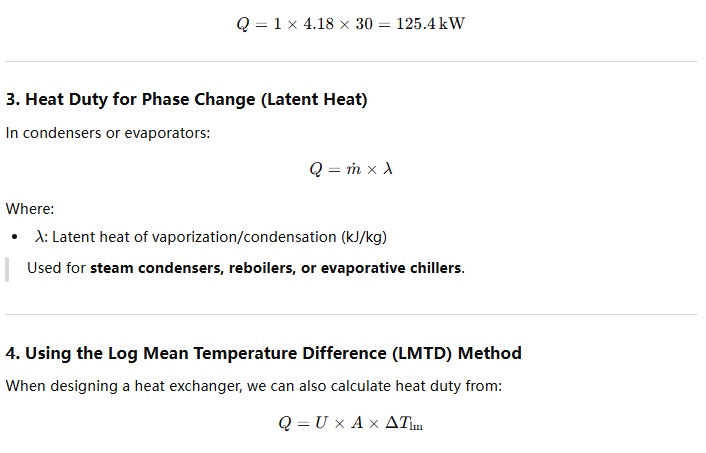
Where:
| Symbol | Description | Units |
|---|---|---|
| ( U ) | Overall heat transfer coefficient | W/m²·K or BTU/hr·ft²·°F |
| ( A ) | Heat transfer surface area | m² or ft² |
| ( Delta T_{text{lm}} ) | Log mean temperature difference | °C or °F |
LMTD Formula:

5. Heat Duty in Real Systems: Additional Factors
Real-world applications introduce variables that modify ideal calculations:
| Factor | Impact on Heat Duty |
|---|---|
| Fouling resistance | Reduces effective U-value, lowering Q |
| Thermal losses to ambient | Makes actual duty less than theoretical |
| Fluid phase changes | Requires latent heat calculation |
| Viscosity or flow regime | Affects convective heat transfer and overall U |
| Pressure drop | May restrict allowable flow rate, reducing Q |
6. How to Measure Heat Duty in Operation
In live systems, use sensors or flowmeters to determine:
- Inlet/Outlet temperatures
- Flow rate (mass or volumetric)
- Fluid properties from data sheets (Cp, ρ, λ)
These values are then plugged into the appropriate formula to calculate actual Q.
7. Unit Conversion Reference
| From | To | Multiply By |
|---|---|---|
| kW | BTU/hr | 3412.14 |
| BTU/hr | kW | 0.000293 |
| kg/s (water) | L/min | 60 |
| kcal/hr | kW | 0.001163 |
Summary Table: Heat Duty Calculation Methods
| Scenario | Formula to Use | Example Application |
|---|---|---|
| Sensible heat (no phase change) | Q = m × Cp × ΔT | Hot water or oil heating |
| Condensation or evaporation | Q = m × λ | Steam condensers, chillers |
| Design/sizing from surface area | Q = U × A × ΔTlm | New exchanger engineering |
| Field performance assessment | Same formulas using measured T and flow data | Onsite diagnostics, monitoring |
Conclusion: Accurate Heat Duty = Efficient System Design
Defining and calculating heat duty correctly is the cornerstone of heat exchanger design and performance monitoring. Whether sizing a new unit or troubleshooting inefficiency, using the right formula based on fluid behavior (sensible vs latent heat) ensures your system delivers optimal energy transfer. Always consider actual operating conditions, fluid properties, and system losses to refine your calculations.
Need Help Calculating Heat Duty for Your System?
We provide engineering consultation, thermal design services, and custom heat exchanger sizing based on your actual process data. Contact us today for a heat duty analysis, material recommendation, or tailored heat exchanger quote that meets your system’s exact thermal needs.
References
- Heat Duty Calculation Basics – Engineering Toolbox
- Heat Exchanger Energy Balance Explained – Chemical Engineering Resources
- Heat Transfer Principles and Formulas – Khan Academy
- Sensible vs. Latent Heat – ScienceDirect