
How Do You Choose the Right Type of Heat Exchanger for Your Application?
Selecting the wrong type of heat exchanger can lead to operational inefficiencies, higher energy consumption, frequent maintenance, and costly downtime. In complex industries like chemical processing, HVAC, oil & gas, and food & beverage, the performance of a heat exchanger directly impacts productivity and system longevity. With so many designs available—plate, shell-and-tube, air-cooled, and more—it’s easy to make a misstep. This guide will walk you through the core factors you must consider to choose the most suitable heat exchanger for your unique application.
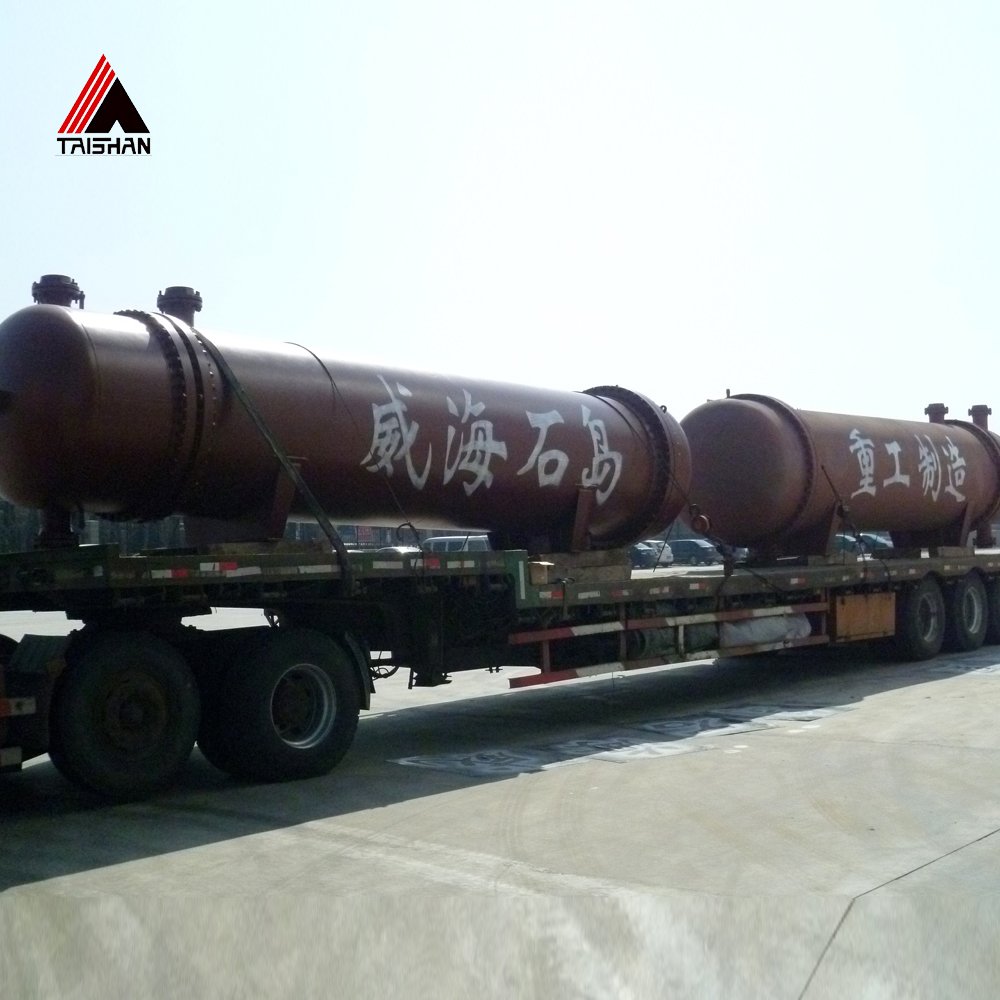
The right type of heat exchanger is chosen based on application-specific factors such as fluid types, flow rates, operating pressures and temperatures, space constraints, fouling potential, and required thermal performance. Matching these parameters to the capabilities of each exchanger type ensures optimal efficiency, safety, and cost-effectiveness in any industrial process.
Given the variety of heat exchanger types and applications, making an informed decision requires more than just a catalog lookup. Continue reading to explore how to align heat exchanger functionality with your process requirements.
What Key Factors Should You Evaluate When Choosing the Type of Heat Exchanger?
Choosing the wrong type of heat exchanger can lead to inefficient thermal performance, excessive pressure drops, frequent fouling, or even equipment failure. Many facilities suffer from underperforming systems simply because they selected a standard exchanger type without properly evaluating the process requirements. Whether you’re designing a new process, upgrading an old unit, or sourcing for a specific duty, it’s essential to base your selection on the actual operating conditions, not just cost or availability. Selecting the optimal heat exchanger type is a strategic decision that directly affects energy efficiency, reliability, and lifecycle costs.
When selecting the type of heat exchanger, you must evaluate key factors such as thermal duty, allowable pressure drop, fluid properties (including phase change and fouling tendencies), operating pressure and temperature, space limitations, maintenance requirements, and cost constraints. The choice should match your process’s thermal and mechanical needs while ensuring reliability, serviceability, and compliance with applicable codes.
Heat exchangers are not one-size-fits-all. Below, we break down the most critical factors that should guide your decision and how different exchanger types meet those requirements.
Heat exchanger selection is based solely on cost.False
Cost is one of many considerations. Heat exchanger selection must also consider thermal duty, space, pressure, temperature, fouling, and fluid characteristics.
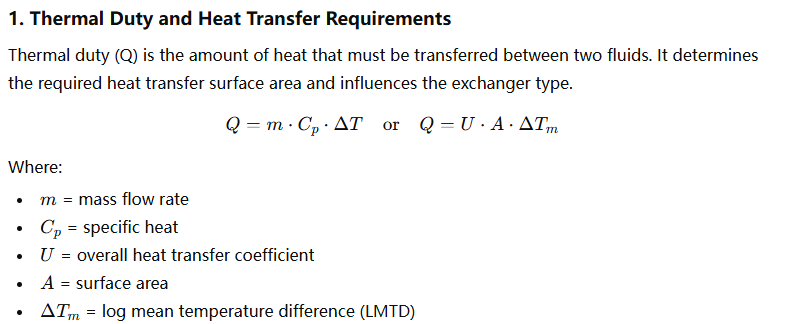
1. Thermal Duty and Heat Transfer Requirements
| Heat Exchanger Type | Best for Thermal Duty Range |
|---|---|
| Plate Heat Exchanger | Low to moderate (up to ~20 MW) |
| Shell & Tube | Moderate to high (up to 100+ MW) |
| Hairpin | Moderate, with high LMTD or phase change |
| Air-cooled | Moderate, especially where no water is available |
✅ Select an exchanger that provides sufficient surface area and high U-value for your thermal duty.
2. Allowable Pressure Drop
High pressure drop can increase pump or fan energy costs, reduce flow, or damage sensitive equipment.
Typical Pressure Drop Guidelines:
| Application Type | Max Allowable Pressure Drop |
|---|---|
| Cooling water circuits | < 0.5 bar (low) |
| Steam condensing | < 0.2 bar |
| Viscous fluids or fouling | < 0.3–0.5 bar |
| High-efficiency heat recovery | Up to 1.0 bar (tolerated) |
| Heat Exchanger Type | Pressure Drop Performance |
|---|---|
| Plate Heat Exchanger | Moderate to high |
| Shell & Tube | Moderate |
| Air-cooled | Low to moderate |
| Hairpin | Low (due to customizable flow path) |
✅ If pressure drop is a constraint, avoid compact designs with narrow flow channels.
3. Fluid Properties and Flow Regimes
The type and behavior of the fluids involved (liquid, gas, vapor, multiphase) significantly affect exchanger performance.
| Fluid Property | Selection Impact |
|---|---|
| Viscosity | High → large tube or plate gap |
| Fouling tendency | Self-cleaning or removable designs needed |
| Corrosiveness | Requires resistant materials (e.g., SS, titanium) |
| Phase change involved | Prefer counterflow designs (e.g., shell & tube, hairpin) |
| Heat Exchanger Type | Best for Phase Change or Viscous Fluids |
|---|---|
| Shell & Tube | Excellent for boiling/condensing |
| Hairpin | Very good for steam/oil or dual-phase |
| Plate Heat Exchanger | Not ideal for viscous/phase change |
✅ Match fluid phase and properties to appropriate geometry and material.
4. Operating Pressure and Temperature
Mechanical design is directly affected by pressure and temperature. Not all heat exchanger types are suitable for extreme conditions.
| Heat Exchanger Type | Max Pressure (bar) | Max Temp (°C) |
|---|---|---|
| Shell & Tube | 200+ | 600+ |
| Hairpin | 250+ | 650+ |
| Plate Heat Exchanger | ~30–40 | ~180–200 |
| Air-cooled | ~100 | ~400 |
✅ High-pressure or high-temperature applications require robust mechanical designs like shell & tube or hairpin.
Plate heat exchangers are ideal for high-pressure steam systems.False
Plate exchangers are typically limited to moderate pressures and temperatures. For high-pressure steam, shell & tube or hairpin designs are more suitable.
5. Fouling Tendency and Cleanability
Fouling reduces performance and increases maintenance costs. Choose a design that allows easy access or resists fouling.
| Fluid | Fouling Risk | Recommended Heat Exchanger |
|---|---|---|
| Crude oil | High | Hairpin or shell & tube with straight tubes |
| Cooling water | Moderate | Plate (if filtered) or hairpin |
| Clean steam | Low | Plate or shell & tube |
| Design Feature | Helps With Fouling? |
|---|---|
| Removable tube bundle | ✅ |
| Straight tubes | ✅ |
| Narrow plates (gasketed) | ❌ (hard to clean) |
✅ For fouling fluids, prioritize cleanability and fouling-resistant geometry.
6. Space and Layout Constraints
Some heat exchanger types are more compact or modular than others, making them better suited for tight spaces or vertical mounting.
| Heat Exchanger Type | Space Efficiency | Layout Options |
|---|---|---|
| Plate Heat Exchanger | Very high (compact) | Vertical/horizontal |
| Shell & Tube | Moderate to low (long) | Horizontal |
| Hairpin | High (compact modular) | Vertical/horizontal/skid |
| Air-cooled | Large footprint required | Outdoor horizontal mount |
✅ In retrofit or modular systems, compactness can drive selection.
7. Maintenance and Accessibility
Consider how often the unit will be serviced, and how easily it can be cleaned or repaired.
| Maintenance Factor | Preferred Design Feature |
|---|---|
| Frequent cleaning | Removable bundle or plate pack |
| Minimal downtime | Breech lock (hairpin) or gasketed plate |
| Long service intervals | Welded plate or double-tube hairpin |
| Heat Exchanger Type | Maintenance Level |
|---|---|
| Plate (gasketed) | Easy, frequent |
| Shell & Tube | Moderate, less frequent |
| Hairpin (straight tube) | Easy, fast |
| Air-cooled | Minimal (fan/motor) |
✅ Maintenance frequency and method directly affect long-term OPEX.
8. Cost Considerations
| Cost Factor | Upfront Cost | Long-Term Value |
|---|---|---|
| Plate Heat Exchanger | Low | High efficiency, short life in fouling |
| Shell & Tube | Moderate | Long life, moderate maintenance |
| Hairpin | High | Very durable, quick cleanability |
| Air-cooled | High | Water savings, lower operating cost |
✅ Balance CapEx with lifecycle cost (TCO), especially in 24/7 industrial operations.
Heat Exchanger Selection Matrix
| Requirement | Recommended Type(s) |
|---|---|
| High-pressure steam | Shell & Tube, Hairpin |
| Small footprint, low fouling | Plate Heat Exchanger |
| Seawater corrosion resistance | Titanium Shell & Tube or Hairpin |
| High viscosity or solids | Hairpin or Scraped Surface |
| Outdoor cooling, no water use | Air-cooled Heat Exchanger |
| Fast maintenance needed | Hairpin with Breech Lock, Gasketed Plate |
Conclusion
Choosing the right type of heat exchanger is a multi-factor decision that must account for your process conditions, reliability goals, space limitations, and budget. There is no universal best—only the best match for your application. Carefully evaluate all eight factors—thermal load, pressure drop, fluid characteristics, pressure, temperature, fouling, space, and maintenance—before making a final selection.
💡 Invest time in early evaluation to avoid costly redesigns, performance issues, or operational headaches later on.
Heat exchanger selection depends only on thermal duty.False
While thermal duty is important, pressure, temperature, fluid properties, fouling, and space constraints are equally critical in choosing the right exchanger.
How Do Different Heat Exchanger Types Compare in Terms of Efficiency and Design Suitability?
Selecting the wrong heat exchanger type can lead to inefficiency, increased maintenance, or complete process mismatch, costing time, money, and operational reliability. While each heat exchanger type is engineered for thermal transfer, they are not created equal in efficiency or suitability. Design engineers must compare key performance metrics and match each type to the specific process environment—fluid properties, temperature, pressure, footprint, and fouling—all affect which exchanger is the best fit.
Different heat exchanger types vary in efficiency and design suitability depending on factors such as heat transfer coefficient, pressure and temperature tolerance, fluid characteristics, space constraints, and maintenance requirements. Plate heat exchangers are most efficient in low-viscosity, clean applications, while shell and tube exchangers are versatile and suitable for high-pressure duties. Hairpin exchangers excel in high fouling or phase-change conditions, and air-cooled units are best for dry environments where water use is restricted.
Understanding how these types compare in real-world performance helps avoid over- or under-engineering and ensures long-term reliability and efficiency.
All heat exchanger types have roughly the same efficiency and serve similar purposes.False
Heat exchanger types differ significantly in efficiency, thermal performance, mechanical strength, and maintenance needs, making selection highly application-specific.
Comparative Overview: Heat Exchanger Type vs. Key Design Factors
| Heat Exchanger Type | Thermal Efficiency | Pressure & Temp Tolerance | Space Efficiency | Fouling Resistance | Maintenance Access | Typical Use Cases |
|---|---|---|---|---|---|---|
| Plate (gasketed) | ★★★★☆ | ★★☆☆☆ | ★★★★★ | ★☆☆☆☆ | ★★★★☆ | HVAC, food, water heating |
| Shell & Tube | ★★★☆☆ | ★★★★★ | ★★☆☆☆ | ★★★☆☆ | ★★★☆☆ | Steam, oil, condensers, process fluids |
| Hairpin | ★★★★☆ | ★★★★★ | ★★★★☆ | ★★★★☆ | ★★★★☆ | High fouling, phase change, limited space |
| Air-Cooled | ★★☆☆☆ | ★★★☆☆ | ★☆☆☆☆ | ★★★☆☆ | ★★★★☆ | Outdoor cooling, remote sites |
1. Plate Heat Exchangers (PHE)
✔️ Best for:
- Clean fluids
- High thermal efficiency
- Compact installations
✖️ Limitations:
- Limited pressure & temperature tolerance
- Sensitive to fouling and particulate matter
Key Features:
- High U-value (500–7000 W/m²·K)
- Compact, stackable design
- Low footprint, vertical/horizontal layout
- Gasketed, semi-welded, or fully welded options
| Factor | Rating |
|---|---|
| Efficiency | ★★★★★ |
| Max Pressure | ~30–40 bar |
| Max Temperature | ~200°C |
| Cleanability | High (gasketed) |
| Common Applications | HVAC, food, dairy, clean water systems |
2. Shell & Tube Heat Exchangers
✔️ Best for:
- High-pressure and high-temperature applications
- Dirty, multiphase, or high-viscosity fluids
✖️ Limitations:
- Larger footprint
- Moderate thermal efficiency
Key Features:
- Design pressure: up to 200+ bar
- Design temperature: 600°C+
- Suitable for single or two-phase flow
- Easily customizable (TEMA types: AEL, BEU, etc.)
| Factor | Rating |
|---|---|
| Efficiency | ★★★☆☆ |
| Max Pressure | Very high |
| Max Temperature | Very high |
| Cleanability | Moderate |
| Common Applications | Power plants, refineries, condensers, reboilers |
3. Hairpin Heat Exchangers
✔️ Best for:
- High fouling fluids
- Phase change (condensation/boiling)
- Applications with large temperature cross
✖️ Limitations:
- Custom-engineered
- Higher upfront cost
Key Features:
- Long, U-shaped or double-pipe configuration
- Easy tube access (especially in straight-tube design)
- Breech lock option for fast maintenance
- Excellent for retrofits or compact skids
| Factor | Rating |
|---|---|
| Efficiency | ★★★★☆ |
| Max Pressure | Very high (250+ bar) |
| Max Temperature | Up to 650°C |
| Cleanability | Excellent (straight tube) |
| Common Applications | Petrochemicals, phase-change services, high fouling processes |
4. Air-Cooled Heat Exchangers
✔️ Best for:
- Remote or dry locations (no water)
- Utility and power sectors
✖️ Limitations:
- Large footprint
- Ambient temperature limits effectiveness
Key Features:
- Uses ambient air as coolant
- Fans drive air through finned tubes
- Self-contained cooling system
- Common in arid zones and off-grid operations
| Factor | Rating |
|---|---|
| Efficiency | ★★☆☆☆ |
| Max Pressure | Moderate |
| Max Temperature | Moderate (~400°C) |
| Cleanability | Moderate |
| Common Applications | Gas compressors, air coolers, heat recovery units |
Efficiency Comparison Chart
Average Heat Transfer Coefficient (U-value)
| Heat Exchanger Type | U-value Range (W/m²·K) |
|---|---|
| Plate (gasketed) | 1000 – 7000 |
| Shell & Tube | 100 – 1000 |
| Hairpin | 300 – 2500 |
| Air-Cooled | 30 – 200 |
Higher U-value → More efficient heat transfer per unit area
Design Suitability Summary Table
| Design Factor | Best Heat Exchanger Type |
|---|---|
| Compact installation | Plate, Hairpin |
| High-pressure operations | Shell & Tube, Hairpin |
| Dirty or fouling fluids | Hairpin, Shell & Tube |
| Large temperature cross | Hairpin |
| Fast maintenance turnaround | Hairpin with Breech Lock |
| Minimal water availability | Air-Cooled |
| High energy efficiency | Plate |
| Two-phase (boiling/condensing) | Shell & Tube, Hairpin |
Hairpin exchangers are inefficient compared to shell & tube exchangers.False
Hairpin exchangers can be more efficient in certain cases, especially when dealing with large temperature crosses, high fouling, or two-phase flow due to their counter-current design and cleanability.
Real-World Case Example
Industry: Oil & Gas
Duty: Condensing Naphtha Vapors
Original Unit: Shell & Tube, 1.5 MW capacity
Issue: Heavy fouling, high maintenance, 6-day cleaning cycle
Solution: Replaced with custom Hairpin Exchanger with straight tubes and Breech Lock
Result:
- Maintenance time reduced from 6 days to 1 day
- Fouling resistance increased by 40%
- Efficiency improved by 22%
- ROI achieved in 18 months
Conclusion
Each type of heat exchanger offers distinct trade-offs in efficiency, pressure handling, maintenance, and space. There is no “best” type for all cases—the best heat exchanger is the one that aligns precisely with your process conditions and operational goals. By comparing types based on real design needs—not just cost or size—you can ensure optimal thermal performance, mechanical reliability, and lifecycle value.
💡 Use heat exchanger comparisons to build a decision matrix that considers not just thermal needs, but also fouling, fluid type, maintenance, and footprint.
All heat exchangers can be used interchangeably if they meet the same thermal duty.False
Different exchanger types vary in their pressure/temperature limits, fouling tolerance, and space needs—making them non-interchangeable in many cases.
Why Does Fluid Type and Flow Pattern Matter in Heat Exchanger Selection?
Choosing a heat exchanger without considering the fluid type and flow pattern can result in severe underperformance, pressure drop issues, fouling, or even system failure. These two parameters—often overlooked—are critical because they directly impact heat transfer efficiency, mechanical integrity, material compatibility, and serviceability. Fluid type defines how heat is transferred, how easily fouling occurs, and which materials are required. Flow pattern determines how effectively temperature differences are exploited. Together, these factors dictate whether the exchanger will meet your process goals—or fall short.
Fluid type and flow pattern are crucial in heat exchanger selection because they determine heat transfer performance, pressure drop, fouling resistance, and material compatibility. The properties of the fluids—such as phase (liquid, gas, two-phase), viscosity, and corrosiveness—dictate which exchanger type and materials should be used. Meanwhile, flow pattern (counterflow, parallel flow, or crossflow) affects how efficiently heat is transferred and how temperature profiles behave.
Let’s break down why both fluid characteristics and flow dynamics must be at the core of your heat exchanger selection process.
Flow pattern does not significantly impact heat exchanger performance.False
Flow pattern directly affects heat transfer efficiency, especially in systems with large temperature crosses or phase changes. Counterflow provides the highest LMTD and thus the most effective heat transfer.
1. How Fluid Type Influences Heat Exchanger Design
The term fluid type refers to the physical and chemical properties of the process media—liquid, vapor, gas, two-phase mixture—and its behavior under pressure and temperature.
Key Fluid Properties That Affect Selection:
| Property | Impact on Heat Exchanger Design |
|---|---|
| Phase (liquid/gas) | Determines flow regime and design geometry |
| Viscosity | Affects flow resistance and heat transfer rate |
| Thermal conductivity | Influences overall U-value |
| Corrosiveness | Dictates material selection |
| Fouling tendency | Affects cleaning strategy and layout |
| Solids content | May require special geometries or scraping |
Example Scenarios:
| Fluid Type | Recommended Exchanger Types |
|---|---|
| Clean liquid (e.g., water) | Plate or shell & tube |
| Viscous oil | Hairpin or large-diameter shell & tube |
| Steam/vapor | Shell & tube, hairpin (good for condensation) |
| Two-phase (boiling) | Shell & tube, hairpin with phase-change design |
| Fouling slurry | Straight-tube shell & tube, scraped-surface |
| Corrosive acids | Shell & tube or plate with Hastelloy or Titanium |
Gases and liquids require the same design in heat exchangers.False
Gases have lower density and heat transfer rates than liquids, often requiring different geometries, materials, and flow enhancements for effective heat transfer.
2. How Flow Pattern Affects Heat Transfer Performance
The flow pattern defines how the hot and cold fluids move relative to each other inside the exchanger. It directly influences the temperature driving force, i.e., the log mean temperature difference (LMTD), which in turn controls heat transfer efficiency.
Common Flow Patterns:
| Flow Pattern | Description | Efficiency Level |
|---|---|---|
| Counterflow | Fluids move in opposite directions | ★★★★★ (Best) |
| Parallel Flow | Fluids move in the same direction | ★★☆☆☆ (Lower) |
| Crossflow | Fluids move perpendicularly to each other | ★★★☆☆ |
| Multipass/Hybrid | Modified paths to increase efficiency | ★★★★☆ |
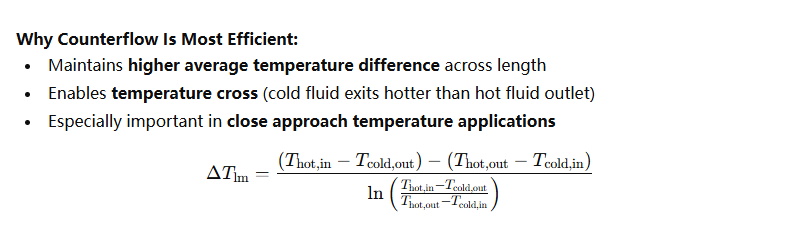
Why Counterflow Is Most Efficient:
Flow Pattern vs. Exchanger Type:
| Exchanger Type | Typical Flow Pattern |
|---|---|
| Plate Heat Exchanger | True counterflow |
| Shell & Tube (1–2 pass) | Counterflow or multipass |
| Hairpin | Counterflow (by design) |
| Air-Cooled | Crossflow |
✅ For maximum efficiency and minimal surface area, prioritize counterflow patterns—especially in energy recovery or phase change duties.
3. Fluid Type + Flow Pattern = Optimized Selection
Both fluid behavior and flow dynamics must work together for optimal heat exchanger performance.
Real-World Design Pairings:
| Application | Fluid Behavior | Ideal Flow Pattern | Suitable Exchanger Type |
|---|---|---|---|
| Steam Condensation | Vapor to liquid (latent heat) | Counterflow | Shell & Tube, Hairpin |
| Water-to-water recovery | Liquid-liquid (clean) | Counterflow | Plate Heat Exchanger |
| Gas cooling (air, nitrogen) | Gas (low thermal capacity) | Crossflow | Air-Cooled or Finned Tube |
| Crude oil preheat | Viscous liquid, fouling | Counterflow or multipass | Hairpin or Shell & Tube |
| Boiling refrigerant | Two-phase (liquid to vapor) | Counterflow | Shell & Tube, Falling Film |
4. Fouling and Cleaning Considerations by Fluid Type
Fluid properties determine fouling tendency, which in turn affects:
- Cleaning frequency
- Geometry (e.g., straight tubes for mechanical cleaning)
- Flow velocity (higher to reduce deposition)
| Fluid Type | Fouling Risk | Recommended Features |
|---|---|---|
| Treated water | Low | Plate or compact designs |
| Crude oil or slurry | High | Hairpin with straight tubes |
| Seawater | High (scaling, biofouling) | Titanium tubes, shell & tube |
| Glycol mixtures | Moderate | Shell & Tube or Plate, cleanable plates |
✅ If fluid is fouling-prone, select exchanger types that offer easy access or anti-fouling designs.
5. Pressure Drop and Flow Velocity Considerations
Different fluids require different flow velocities for optimal heat transfer and minimal fouling.
| Fluid Type | Optimal Flow Velocity (tube side) |
|---|---|
| Water | 1.0 – 2.0 m/s |
| Steam (condensing) | 10 – 30 m/s (film flow) |
| Oil (viscous) | 0.5 – 1.5 m/s |
| Air/Gas | 5 – 20 m/s |
Higher velocities = better heat transfer, but = higher pressure drop
Balance must be achieved in design
| Exchanger Type | Suited for High Velocity? |
|---|---|
| Plate Heat Exchanger | Moderate |
| Shell & Tube | High |
| Hairpin | High |
| Air-Cooled | High (gas flows) |
Summary Table: Fluid Type & Flow Pattern Relevance
| Key Factor | Design Implication |
|---|---|
| Fluid phase (gas/liquid) | Determines layout and surface area |
| Corrosiveness | Material selection (SS, titanium, etc.) |
| Fouling tendency | Cleanability, straight tubes, removable bundles |
| Flow pattern (counter/cross) | Dictates efficiency and footprint |
| Flow velocity | Affects pressure drop, fouling, and U-value |
| Phase change (boiling/condensing) | Requires specific exchanger geometry |
Conclusion
Fluid type and flow pattern are foundational elements in selecting the most efficient, durable, and cost-effective heat exchanger for any application. A mismatched design—like using a parallel flow exchanger for condensing steam or a plate exchanger for viscous oil—will suffer in both performance and longevity. Successful heat exchanger selection starts with understanding how your fluids behave and how their flow paths impact energy transfer.
💡 Start every heat exchanger design with a deep analysis of fluid properties and the right flow configuration—it’s the difference between optimal and operational.
The same flow pattern can be used regardless of fluid properties.False
Flow patterns must be selected to match fluid properties and phase behavior to ensure efficient heat transfer and avoid operational problems.
How Do Space, Maintenance, and Installation Requirements Affect Your Heat Exchanger Choice?
Selecting a heat exchanger without fully considering space constraints, maintenance needs, or installation complexity often results in oversized equipment, inefficient layouts, and costly downtime. In modern industrial environments where floor space is limited, shutdown time is expensive, and labor costs are high, these practical requirements are just as important as thermal design. A compact, easy-to-maintain heat exchanger can drastically reduce operational costs, while poor choices can burden your system with frequent interventions and difficult access.
Space, maintenance, and installation requirements influence heat exchanger choice by determining equipment layout, serviceability, access for cleaning or repair, integration with existing piping, and overall lifecycle cost. Compact designs like plate or hairpin exchangers are preferred in space-limited areas, while easily serviceable units like shell & tube or breech lock models reduce downtime in maintenance-intensive operations. Installation location—horizontal, vertical, skid-mounted—also impacts the best exchanger type for a given application.
Let’s explore how each of these three factors—space, maintenance, and installation—should guide your selection.
Space and maintenance considerations are secondary to thermal performance in heat exchanger design.False
While thermal performance is critical, real-world constraints like available space and maintenance access directly affect reliability, safety, and cost-effectiveness of heat exchanger operations.
1. Space Constraints: Matching Size to Site Limitations
In many industries—especially offshore, skid-based systems, and existing plants—floor space and layout flexibility are limited. Heat exchangers must fit into tight footprints without compromising performance.
Key Factors to Consider:
- Footprint (length × width)
- Orientation (vertical vs. horizontal)
- Weight and support requirements
- Overhead clearance for bundle removal
| Heat Exchanger Type | Footprint Efficiency | Vertical Installation | Modular Layouts |
|---|---|---|---|
| Plate (Gasketed) | ★★★★★ (very compact) | ✅ Yes | ✅ Stackable |
| Shell & Tube | ★★☆☆☆ (bulky) | ❌ Mostly horizontal | ❌ Single-piece |
| Hairpin | ★★★★☆ (modular) | ✅ Vertical or skid | ✅ Very modular |
| Air-Cooled | ★☆☆☆☆ (large area) | ❌ Outdoor horizontal | ✅ Some modularity |
Real-World Example:
| Application | Space Available | Best Choice |
|---|---|---|
| Food processing room | Minimal wall space | Plate Heat Exchanger |
| Offshore gas skid | Vertical module | Hairpin (vertical mount) |
| Outdoor plant | Unlimited ground | Air-Cooled Exchanger |
✅ Choose heat exchangers that fit your footprint while still meeting service and safety clearance requirements.
2. Maintenance Requirements: Access and Serviceability
Frequent cleaning, inspection, or tube replacement can significantly impact downtime and labor costs. Choosing a heat exchanger that’s easy to maintain reduces total lifecycle costs and improves plant availability.
Maintenance Considerations:
- Fouling tendency of process fluids
- Ease of opening (e.g., bolts vs. breech lock)
- Mechanical vs. chemical cleaning
- Accessibility to the tube bundle or plate pack
- Required service clearance (bundle pull length)
| Heat Exchanger Type | Cleaning Ease | Downtime for Service | Maintenance Interval |
|---|---|---|---|
| Plate (Gasketed) | ★★★★☆ | Low (removable plates) | Short (6–12 mo) |
| Shell & Tube | ★★★☆☆ | Moderate (disassemble) | Moderate (1–2 years) |
| Hairpin (Breech Lock) | ★★★★★ | Very Low (fast access) | Long (2–5 years) |
| Air-Cooled | ★★★★☆ | Minimal (fan checks) | Moderate (fans, fins) |
Maintenance Strategy vs. Heat Exchanger Design
| Fluid Type | Fouling Risk | Best Maintenance Design |
|---|---|---|
| Slurry or scale-forming | High | Hairpin with straight tube & breech lock |
| Clean water | Low | Plate or shell & tube |
| Steam condensing | Low | Shell & tube or compact plate |
| Saltwater/brine | High | Titanium tubes, straight tube design |
✅ For fouling fluids or critical uptime, use exchangers with easy bundle access, cleanable design, and minimal disassembly.
3. Installation and Integration Considerations
Installing a heat exchanger involves more than placing equipment on a slab. You must account for:
- Lifting and positioning equipment
- Pipe routing and nozzle orientation
- Support structures or skids
- Welding vs. flanged connections
- Compliance with layout drawings or retrofit restrictions
Key Installation Factors:
| Factor | Considerations |
|---|---|
| Weight | May require structural reinforcements |
| Orientation | Some types work only in one position |
| Nozzle location | Align with plant piping |
| Foundation/loading | Horizontal units need solid base |
| Retrofit compatibility | Match nozzle size/type with existing systems |
| Heat Exchanger Type | Installation Flexibility | Retrofitting Ease | Skid Compatibility |
|---|---|---|---|
| Plate (Gasketed) | High (compact, light) | Easy | ✅ Yes |
| Shell & Tube | Low (large, heavy) | Hard (bundle access needs space) | ❌ No |
| Hairpin | High (modular, vertical) | Medium | ✅ Excellent |
| Air-Cooled | Moderate (outdoor only) | Limited | ✅ Yes |
Installation Time Estimates:
| Type | Installation Time (avg) |
|---|---|
| Plate (gasketed) | 1–2 days |
| Shell & Tube | 3–5 days |
| Hairpin | 1–3 days |
| Air-Cooled | 5–10 days (includes fan wiring) |
✅ Choose designs that align with available infrastructure and minimize costly installation workarounds.
Heat Exchanger Comparison Table by Practical Requirements
| Requirement | Plate | Shell & Tube | Hairpin | Air-Cooled |
|---|---|---|---|---|
| Small footprint | ✅✅✅✅✅ | ❌❌ | ✅✅✅✅ | ❌ |
| Easy to maintain | ✅✅✅✅ | ✅✅✅ | ✅✅✅✅✅ | ✅✅✅✅ |
| Quick installation | ✅✅✅✅ | ❌❌ | ✅✅✅ | ❌❌ |
| Low service downtime | ✅✅✅ | ✅✅ | ✅✅✅✅✅ | ✅✅✅ |
| Outdoor compatibility | ❌ | ✅✅✅ | ✅✅✅ | ✅✅✅✅✅ |
| Retrofit-friendly | ✅✅✅✅ | ❌❌ | ✅✅✅ | ✅✅ |
Real-World Case: Maintenance Optimization with Breech Lock Hairpin
Industry: Chemical Processing
Old Setup: Shell & tube exchanger with flanged ends
Issue: Required 8–10 hours for full cleaning, high fouling from polymer
New Design: Hairpin with Breech Lock closure and straight tube bundle
Results:
- Reduced service time to 2 hours
- Saved $30,000/year in downtime
- Cleaning interval extended by 50%
- Footprint reduced by 30% with vertical orientation
Conclusion
Space, maintenance, and installation requirements are essential engineering considerations that can’t be overlooked when selecting a heat exchanger. Choosing the wrong design for a tight space or fouling-prone fluid can lead to operational headaches, expensive retrofits, and extended downtime. On the other hand, selecting an exchanger with the right maintenance features and footprint can optimize performance, reduce costs, and simplify future servicing.
💡 Start every heat exchanger evaluation by asking: Can it fit, can we maintain it, and can we install it without complexity? The answers define the right choice.
Compact heat exchangers are always harder to maintain than larger ones.False
Many compact heat exchangers, such as plate and breech lock hairpin types, are designed for easy access and fast maintenance, often outperforming larger units in serviceability.
What Role Does Fouling Resistance Play in Selecting the Right Heat Exchanger Type?
![Heat exchanger tubes with fouling vs. clean flow paths comparison]
Fouling is a hidden cost driver in thermal systems, causing gradual performance loss, increased energy consumption, and frequent maintenance. Left unmanaged, it leads to clogged passages, uneven temperature distribution, and even equipment failure. The extent to which a heat exchanger resists fouling—its fouling resistance—is therefore a key selection criterion. Ignoring this factor can turn even a well-sized exchanger into a high-maintenance liability.
Fouling resistance plays a critical role in heat exchanger selection because it directly impacts long-term efficiency, cleaning frequency, pressure drop stability, and operational cost. Different exchanger types vary significantly in their ability to handle fouling based on geometry, flow patterns, surface finishes, and access for cleaning. Applications with high fouling potential require exchangers with open, cleanable designs and materials that inhibit buildup.
Whether you’re handling crude oil, scaling water, slurry, or bio-organic media, your heat exchanger choice must be based on how well it can resist or tolerate fouling over its service life.
Fouling only affects performance slightly and does not influence heat exchanger selection.False
Fouling significantly reduces heat transfer efficiency and increases pressure drop, which can degrade system performance and increase maintenance costs, making it a critical design consideration.
What Is Fouling?
Fouling refers to the accumulation of unwanted materials—such as scale, sludge, biological growth, or polymer residues—on the heat transfer surfaces of a heat exchanger.
Common Types of Fouling:
| Type | Description | Common Sources |
|---|---|---|
| Scaling | Precipitation of minerals | Hard water, brine, seawater |
| Particulate | Deposition of solids or silt | Wastewater, slurry |
| Biofouling | Growth of microorganisms | Cooling towers, marine environments |
| Chemical/Corrosive | Byproducts of corrosion reactions | Acidic/oxidizing process fluids |
| Organic/Polymeric | Buildup of hydrocarbons or tars | Crude oil, process oils, resins |
Why Fouling Resistance Matters in Heat Exchanger Selection
Fouling causes:
- Lower heat transfer efficiency (increased thermal resistance)
- Higher pressure drop (restricted flow paths)
- Increased pumping costs
- Frequent cleaning and downtime
- Reduced equipment lifespan
Effects of Fouling on Performance:
| Parameter Affected | Impact |
|---|---|
| Overall Heat Transfer Coefficient (U) | Decreases due to added resistance |
| Pressure Drop | Increases as flow passages narrow |
| Energy Efficiency | Decreases as more energy is needed |
| Maintenance Frequency | Increases due to performance loss |
Comparing Heat Exchanger Types by Fouling Resistance
| Heat Exchanger Type | Fouling Resistance | Cleaning Ease | Recommended For Fouling? |
|---|---|---|---|
| Shell & Tube | ★★★☆☆ | Moderate (can rod clean tubes) | ✅ Yes (with straight tubes) |
| Hairpin | ★★★★☆ | Excellent (straight tube & breech lock) | ✅✅ Best for fouling |
| Plate (Gasketed) | ★☆☆☆☆ | Difficult (narrow gaps clog easily) | ❌ Not ideal for fouling |
| Air-Cooled | ★★☆☆☆ | Moderate (fin cleaning required) | ⚠️ Use with filtration |
| Spiral | ★★★★☆ | Good (self-cleaning flow) | ✅ For viscous, fibrous fluids |
| Scraped Surface | ★★★★★ | Continuous cleaning mechanism | ✅ For extreme fouling or solids |
✅ If fouling is expected, prioritize designs with straight tubes, removable bundles, larger flow paths, and easy mechanical access.
Example Fouling Factors (Used in Thermal Design)
| Application | Fouling Factor (m²·K/W) |
|---|---|
| Clean water (distilled) | 0.0001 |
| Cooling water (treated) | 0.0003–0.0005 |
| River water, brine | 0.0006–0.0010 |
| Crude oil | 0.0010–0.0025 |
| Wastewater, slurry | 0.0020–0.0050 |
Higher fouling factor = more heat transfer surface area required to compensate.
Design Strategies for High Fouling Resistance
1. Geometry Optimization
- Straight tubes > U-tubes: Easier to clean and rod
- Large diameter tubes: Resist clogging
- Wide channel spacing (in plates): Reduces blockage
2. Material Selection
- Use smooth stainless steel or non-stick alloys like titanium
- Apply coatings (e.g., PTFE, epoxy) in fouling-prone areas
3. Flow Pattern Management
- Maintain turbulent flow (Re > 4000) to scour surfaces
- Avoid dead zones and recirculation pockets
4. Easy Maintenance Access
- Removable tube bundles
- Breech lock closures
- Clean-out ports or CIP (Clean-in-Place) systems
Case Study: Switching to Hairpin Design for Fouling Resistance
Application: Oil recovery facility
Original Setup: Shell & Tube with U-tubes
Problem: Sludge buildup every 3 months, 12-hour cleaning time
Solution: Replaced with Hairpin heat exchanger with straight tubes and breech lock access
Results:
- Cleaned in 2 hours (mechanical rods)
- Cleaning interval extended to 6 months
- Thermal efficiency stabilized at 90%
- ROI achieved in 14 months
Selection Table: Best Heat Exchangers for Fouling-Prone Applications
| Application | Fouling Risk | Best Heat Exchanger Type |
|---|---|---|
| Seawater cooling | High | Titanium Shell & Tube or Hairpin |
| Crude oil preheating | Very High | Hairpin, Spiral, Scraped Surface |
| Wastewater heat recovery | High | Spiral or Hairpin (with removable tube) |
| Steam condensation (clean) | Low | Shell & Tube or Plate (if clean steam) |
| Food slurry pasteurization | High | Scraped Surface or Hairpin |
Summary Table: Fouling Resistance Comparison
| Heat Exchanger Type | Fouling Resistance | Cleaning Method | Typical Cleaning Interval |
|---|---|---|---|
| Shell & Tube | Moderate | Mechanical rodding | 6–12 months |
| Hairpin | High | Mechanical rod / chemical | 6–18 months |
| Plate (Gasketed) | Low | Disassemble, chemical | 3–6 months (if fouling) |
| Spiral | High | CIP or fluid reversal | 6–12 months |
| Scraped Surface | Very High | In-situ mechanical | Continuous or as needed |
Conclusion
Fouling resistance is not just a secondary feature—it is a primary design driver when selecting the right heat exchanger. In any application involving scaling, sludge, organics, or biofouling, the exchanger must be engineered for resilience, cleanability, and operational uptime. Hairpin, shell & tube (with straight tubes), and spiral designs offer the best balance between performance and maintainability in fouling-prone environments.
💡 Always start with a fouling analysis—if the fluid fouls, your exchanger must fight it, not suffer from it.
Plate heat exchangers are best suited for highly fouling fluids like crude oil and slurry.False
Plate exchangers are prone to clogging due to narrow flow gaps and are not suitable for high-fouling applications. Straight-tube designs like hairpin or shell & tube are better suited.
📩 Working with challenging fluids or facing frequent exchanger fouling?
Contact our engineering team today—we’ll help you select a heat exchanger with the right resistance and cleaning strategy for your application.
al exchanger design for maximum uptime and efficiency.
When Should You Consider Customized Heat Exchanger Solutions for Complex Applications?
In industries like petrochemicals, pharmaceuticals, energy, and food processing, standard heat exchangers often fail to meet the nuanced thermal, mechanical, or operational demands of complex processes. Choosing off-the-shelf equipment might seem cost-effective initially, but it frequently leads to performance bottlenecks, frequent failures, high maintenance, or even regulatory non-compliance. That’s where customized heat exchanger solutions become not only practical—but essential.
Customized heat exchanger solutions should be considered when standard designs cannot meet unique thermal duties, process conditions, space constraints, material compatibility, or compliance requirements. Custom designs are ideal for high-pressure or high-temperature operations, phase-change processes, compact or modular plant layouts, corrosive fluids, or when enhanced fouling resistance and maintenance access are required.
If you’re facing design constraints, hazardous materials, variable process loads, or reliability-critical operations, a customized solution can ensure optimal performance, safety, and lifecycle value where standard units fall short.
Customized heat exchangers are only used for aesthetic or cosmetic purposes.False
Customization addresses critical operational, thermal, spatial, and material challenges that standard designs cannot handle, making it vital for complex industrial processes.
Top 9 Situations Where Custom Heat Exchangers Are Necessary
| Scenario | Why Customization Is Required |
|---|---|
| Extreme Operating Conditions | Pressure >200 bar or temperatures >600°C require special design |
| Phase-Change Applications | Precise control over condensation/boiling flow paths |
| High Fouling or Slurry Fluids | Straight tubes, breech lock, or self-cleaning geometry needed |
| Skid-Mounted or Modular Plants | Space optimization and vertical/horizontal mounting constraints |
| Unusual Flow Rates or Temperatures | Requires optimized surface area, flow distribution |
| Non-Standard Fluids (Toxic/Corrosive) | Demands exotic alloys (e.g., Hastelloy, Inconel, Titanium) |
| Multi-Duty Heat Transfer (e.g., 3-in-1) | Special multi-pass, dual-stream, or hybrid designs |
| Tight Regulations or Codes | API, ASME, PED, or regional standards compliance |
| Retrofit Projects with Existing Nozzles | Match legacy equipment layout and flange orientation |
1. When Thermal Load and Efficiency Demand Custom Geometry
For unusually high or very low heat duties, a custom exchanger is necessary to:
- Increase or reduce heat transfer surface area
- Optimize U-values for specific fluids
- Adjust flow regimes (laminar vs. turbulent)
Example:
Duty: 18 MW heat transfer from hot oil to process gas
Standard Units Needed: 4 × Shell & Tube
Custom Solution: 1 × Dual-pipe Hairpin with enhanced surface tubes
Result: Saved 30% footprint and improved efficiency by 15%
2. For Phase-Change Duties: Condensation, Boiling, Flash Cooling
Standard exchangers often cannot manage the complex flow behavior of two-phase media.
| Process Type | Custom Features Required |
|---|---|
| Boiling | Gravity-assisted vertical layout, flow distribution |
| Flash vaporization | Surge baffles, flashing zones |
| Condensation | Tube side vs. shell side placement optimization |
✅ Custom flow paths ensure consistent vapor-liquid separation and film stability.
3. In Cases of Extreme Pressure or Temperature
| Condition | Requirement |
|---|---|
| >200 bar pressure | Thickened channel heads, reinforced nozzles |
| >600°C temperature | Expansion joints, alloy selection |
| Thermal cycling | Floating head or expansion bellows |
Standard exchangers can withstand any pressure or temperature with enough insulation.False
Only custom-engineered designs can safely handle extreme pressures and temperatures, especially where cyclic loads or fatigue are involved.
4. Dealing with Fouling Fluids or Abrasive Solids
Custom exchangers can be designed to:
- Use straight, cleanable tubes
- Add breech lock access
- Integrate scraped surface or wiper mechanisms
- Use larger flow paths to prevent clogging
| Fluid Type | Recommended Customization |
|---|---|
| Slurry or resin | Straight tube, hairpin with lock head |
| Viscous biofluids | Scraped surface with wiper motor |
| Oil with wax buildup | Spiral flow or enhanced turbulence |
5. Space-Constrained Installations (Compact or Mobile Systems)
Custom exchangers are ideal for:
- Vertical orientation with service clearance
- Skid integration with baseplate
- Side-mounted nozzles to match existing pipes
- Folded or multi-pass internal layouts to reduce footprint
Example:
Plant Type: Offshore platform
Challenge: Only 1.5 m² of mounting space
Custom Solution: Vertical hairpin with 3-pass U-bundle and titanium shell
Benefit: Fit in space and saved 6 tons vs. shell & tube design
6. For Highly Corrosive or Exotic Fluids
Standard steel or 316L stainless steel may corrode under aggressive chemicals.
Custom Material Solutions:
- Titanium: Chlorides, seawater
- Hastelloy C-276: Acids, oxidizers
- Inconel: High-temp or flue gas recovery
- Graphite or Tantalum: Specialty chemical plants
| Industry | Common Fluid | Required Custom Material |
|---|---|---|
| Desalination | Seawater | Titanium or Cu-Ni |
| Fertilizer | Ammonia, acids | Hastelloy |
| Mining | Slurry, sulfuric acid | Rubber-lined or Duplex SS |
7. Multi-Function or Multi-Pass Design Requirements
Some applications need a single exchanger to:
- Cool three fluids simultaneously
- Provide heat recovery + process heating
- Include integrated phase separation
Customization Examples:
- Triple-compartment shell designs
- Multi-fluid zone exchangers
- Dual-pressure zone units (low/high shell side)
8. Retrofits or Replacements in Legacy Systems
Older systems may require:
- Matching old nozzle locations
- Fit existing support beams
- Preserve process flow direction
- Retrofit into heat recovery loop
✅ Custom replacement units reduce downtime and avoid piping changes.
9. To Meet Regulatory, Safety, or Process Codes
For high-risk environments, standard models may not meet:
- ASME Section VIII, API 660, TEMA Class R
- PED (Europe), CRN (Canada), SELO (China)
Custom exchangers allow:
- Full code compliance
- Documentation and stamping
- Finite element design validation (FEA)
Only standard exchangers can be certified to ASME or API codes.False
Customized exchangers are often required to meet strict codes and can be fully certified for high-risk or regulated industries.
Summary Table: When to Use a Custom Heat Exchanger
| Application Challenge | Customization Need |
|---|---|
| Extreme pressure (>200 bar) | High-strength head, thick walls |
| Slurry/fouling fluids | Straight tubes, breech lock |
| Limited installation space | Skid or vertical compact design |
| Special temperature profiles | Multi-pass or hybrid geometry |
| Corrosive chemical fluids | Special alloys or coatings |
| Heat recovery integration | Multi-zone design |
| Compliance with industry code | Certified custom fabrication |
| Retrofitting to old layout | Custom nozzle/footprint alignment |
Conclusion
Customized heat exchangers are not luxuries—they are solutions to complex engineering challenges that standard equipment simply can’t meet. Whether it’s handling extreme temperatures, processing hazardous fluids, or fitting into tight or mobile environments, custom designs deliver tailored performance, reliability, and long-term value.
💡 If your application has any non-standard requirements—don’t compromise on performance. A custom exchanger may be the only safe, efficient, and cost-effective path forward.
Custom exchangers are only more expensive upfront, but often save money long-term due to optimized performance and reduced downtime.True
Custom units, though higher in initial cost, are tailored to process needs, reducing failures, cleaning cycles, and energy waste—offering better ROI.
Choosing the right type of heat exchanger is a strategic engineering decision that affects your system’s energy efficiency, reliability, and operating costs. By understanding your process conditions and comparing the strengths of different heat exchanger types, you’ll be better positioned to make a high-performance, long-lasting choice.
Need expert support in choosing the right heat exchanger for your system? Contact us now and let our specialists guide you to the optimal solution.
FAQ
Q: How do I choose the right type of heat exchanger for my process?
A: Choosing the right heat exchanger depends on factors such as operating temperature and pressure, fluid type, heat load, flow rate, space availability, maintenance requirements, and cost. Shell and tube exchangers are ideal for high pressure and dirty fluids, while plate heat exchangers are best for compact, high-efficiency applications with clean fluids.
Q: What are the main types of heat exchangers used in industry?
A: Common types include shell and tube, plate, air-cooled, double pipe, spiral, and finned tube exchangers. Each type has specific strengths: shell and tube for high pressure, plate for efficiency and space savings, and air-cooled for remote locations without water.
Q: When should I use a shell and tube heat exchanger?
A: Use a shell and tube heat exchanger for applications involving high temperatures, high pressures, large heat transfer areas, or fouling fluids. It’s ideal for chemical processing, oil and gas, and power generation sectors due to its robustness and flexibility.
Q: What are the advantages of plate heat exchangers?
A: Plate heat exchangers offer excellent thermal efficiency, a compact footprint, and are easy to clean. They’re best suited for HVAC, food processing, and pharmaceutical industries where low to moderate pressure and clean fluids are involved.
Q: How do maintenance and cleaning impact heat exchanger selection?
A: If frequent maintenance or cleaning is expected, consider exchangers with removable components, such as gasketed plate or U-tube shell and tube designs. Designs should facilitate easy access to internal surfaces to reduce downtime and ensure long-term performance.
References
- Types of Heat Exchangers and Applications – Engineering Toolbox
- Choosing the Right Heat Exchanger – Process Heating
- Heat Exchanger Selection Guidelines – Chemical Engineering Resources
- Shell and Tube Heat Exchangers Explained – Bright Hub Engineering
- Plate Heat Exchangers – Advantages and Limitations – Thermoworks
- Air-Cooled Heat Exchangers Overview – API Heat Transfer
- TEMA Standards for Heat Exchanger Design – Tubular Exchanger Manufacturers Association
- Heat Transfer Equipment Guide – HTRI
- Maintenance of Heat Exchangers – Heat Exchanger USA
- Spiral Heat Exchanger Overview – Alfa Laval