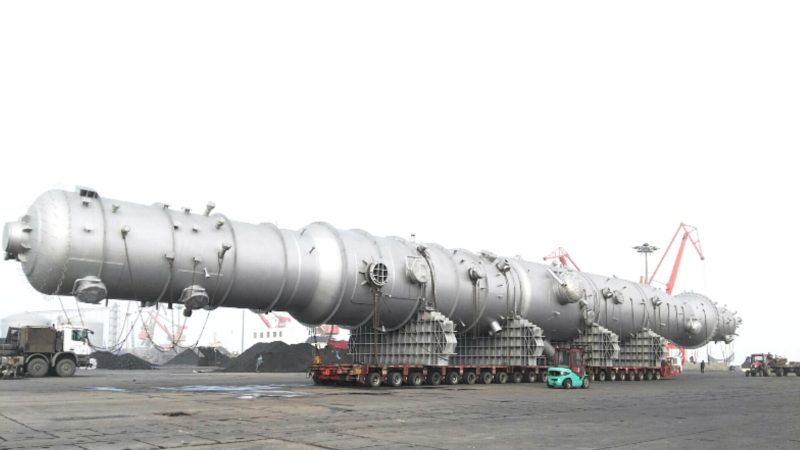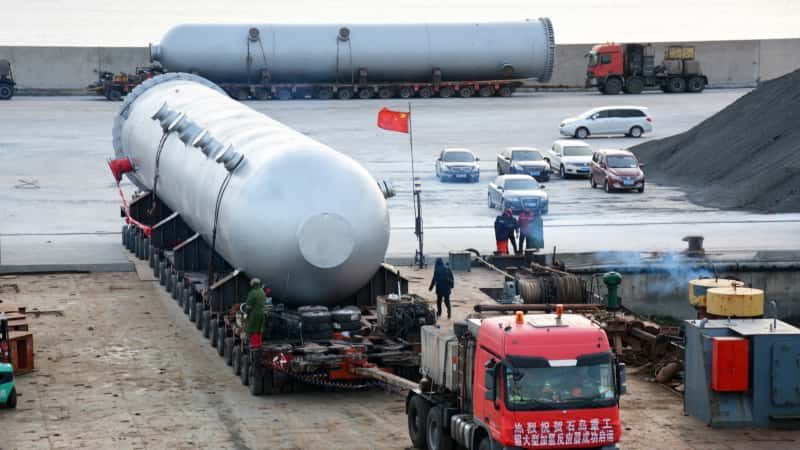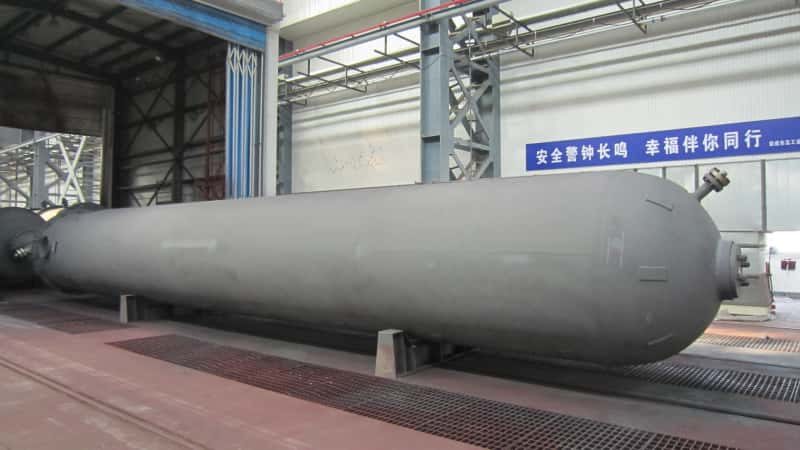

Hydrostatic and pneumatic tests are familiar milestones in the manufacture of industrial pressure vessels. Yet an equipment purchase order that merely states “pressure test per code” can leave critical questions unresolved: Is the proposed test method permitted for this vessel? Which construction-code edition governs the pressure calculation? Who must approve the procedure and witness the test? What evidence will the buyer receive before shipment?
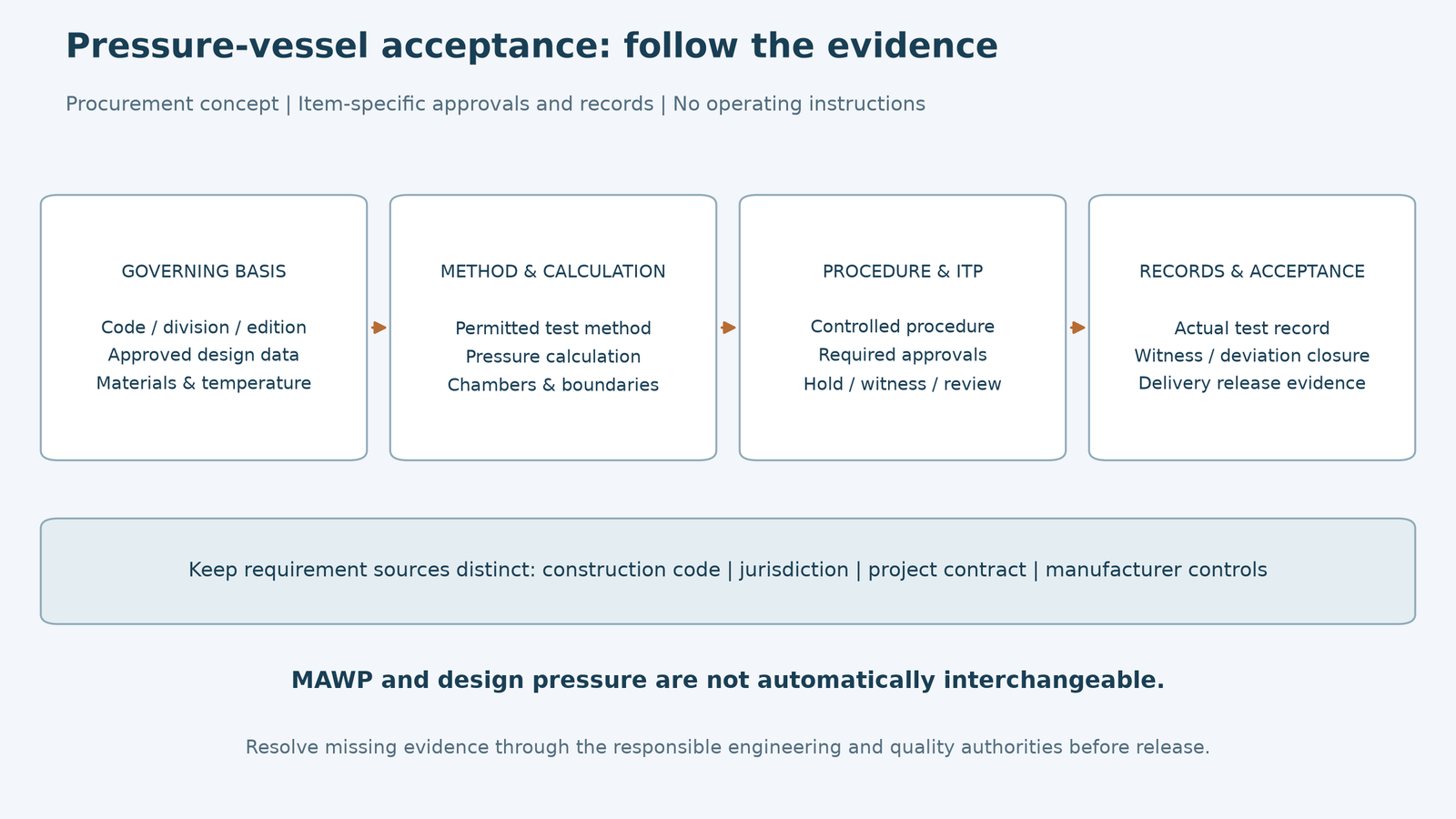
The procurement decision is not to choose a pressure multiplier or a holding time from a general article. It is to agree on a code-supported test basis, an approved execution and inspection plan, and traceable acceptance records for the specific vessel.
Hydrostatic testing normally uses water or another approved liquid, whereas pneumatic testing uses a compressible gas. Their stored-energy hazards differ substantially, but neither method can be selected solely by convenience or a supposed universal test-pressure factor. The governing construction code, vessel configuration, materials, test temperature, site constraints, contractual inspection requirements and applicable jurisdiction must be established first.
This guide is intended for international EPC purchasers, owner engineers, quality teams and industrial vessel suppliers. It covers pre-delivery acceptance decisions and documentation, not instructions for performing pressure tests. For the separate distinction between pressure tests and quantified leak-tightness tests, see our pressure vessel pressure-testing and leak-testing guide.
1. What Must Be Established Before Choosing a Pressure-Test Method?
The starting point is the equipment's actual construction and delivery basis—not the preferred medium of the fabrication shop.
A buyer should establish five conditions before accepting a proposed method:
- Equipment identity and scope. Define the complete pressure vessel, any separate pressure chambers, and which fabricated or assembled boundaries the test covers.
- Governing rules. Identify the construction code, division or part, edition and any legally applicable jurisdictional or conformity-assessment requirements.
- Approved design basis. Identify design conditions, the relevant maximum allowable working pressure (MAWP) where the code uses it, materials, test-temperature constraints and design revisions.
- Method suitability. Determine whether the normal liquid test can be performed without unacceptable structural, contamination, drainage or other problems, and whether an alternative gas test is permitted under the governing rules.
- Approval and verification. Agree on the party responsible for the engineering justification, procedure approval, inspection participation, acceptance and final document release.
A vessel that is designed and built to ASME BPVC Section VIII, Division 1 is not necessarily subject to the same testing provisions as a vessel built under Division 2, another pressure-equipment code, or an atmospheric storage-tank standard. ASME's official Section VIII, Division 1 scope explicitly includes design, fabrication, inspection, testing and certification; it is not a universal specification for every industrial tank.
Hydrostatic and pneumatic tests: a procurement comparison
| Issue | Hydrostatic test | Pneumatic test | What the EPC buyer must confirm |
|---|---|---|---|
| Test medium | Approved liquid, often water | Approved compressible gas | Medium compatibility and its specification |
| Stored-energy considerations | Generally lower compressive energy in the medium, but not hazard-free | Greater potential energy release from compressed gas | Project-specific risk evaluation and safeguards |
| Suitability | Liquid weight, contamination and drainage may constrain application | May be an allowable alternative under defined circumstances | Code-supported justification for the selected method |
| Design verification | Relevant construction-code liquid-test conditions | Relevant construction-code gas-test conditions | Approved pressure calculation and material/temperature basis |
| Inspection | Examination under applicable requirements | Examination plus any additional code or project requirements | Documented inspection scope, witness plan and acceptance basis |
| Delivery effect | Water supply, drainage, disposal and drying may matter | Gas supply, access restrictions and risk controls may matter | Real project schedule and supply boundaries, not generic day counts |
Editorial comparison only. The actual applicable rules and test procedure control.
Neither method guarantees that a vessel will perform safely under every future operating condition. Pressure tests are only one component of construction acceptance; material certification, welding, examination, dimensional checks, final assembly and design conformity remain separate responsibilities.
2. When Might a Pneumatic Test Be Considered Instead of Hydrostatic Testing?
Hydrostatic testing is commonly preferred because a liquid-filled system generally stores much less compression energy than a comparable gas-filled system. Nevertheless, a liquid test can introduce its own equipment or project constraints.
Establish the actual reason for a proposed exception
Examples requiring engineering consideration may include:
- Test-liquid weight: a large vessel, support system, installation arrangement or temporary structure may not be capable of carrying the complete liquid test load without additional engineering measures.
- Water-sensitive service: residual moisture may be incompatible with the future process or certain installed components, unless suitably managed through a controlled manufacturing and drying sequence.
- Drainage or cleaning limitations: vessel geometry or internal arrangements may make complete liquid removal difficult.
- Test-medium compatibility: material, lining, cleanliness and other constraints may require a specific medium or a change to the fabrication sequence.
- Field or access limitations: an installed vessel may pose water sourcing, foundation, disposal or site-access challenges that the project team must assess.
These circumstances are reasons to investigate, not automatic permission to substitute gas for water. The engineering team must consider whether the difficulty can instead be resolved by a suitable test sequence, support arrangement, approved test liquid, drying plan or other code-compliant measure.
For an illustration of jurisdiction-specific requirements, Singapore's Ministry of Manpower explains that pneumatic or hydro-pneumatic testing should generally be avoided where a hydrostatic test is feasible and that approval is required under the arrangements it describes. This is Singapore-specific guidance, not a universal approval rule for all export markets: Singapore MOM FAQ.
What must the proposal explain?
Before the purchaser accepts a pneumatic alternative, request a written technical basis identifying:
- Why the hydrostatic approach is unsuitable in this particular case.
- The applicable construction-code permission and the adopted edition.
- The identified risks of the selected gas medium and test configuration.
- The responsible design and quality approval authorities.
- Any additional examination, special inspection or procedural requirements.
- The jurisdictional or third-party approvals actually required for this contract.
- The consequences for production planning, documentation and final delivery.
A certificate, risk-assessment template or supplier's standard operating practice is not a substitute for confirming that the proposed method is permitted for the equipment at hand.
Test-medium hazards are not solved by changing gases
An inert gas may be chosen for certain compatibility reasons, but it remains compressible and capable of storing significant energy. Nitrogen also introduces oxygen-displacement hazards. Conversely, a hydrostatic test is not risk-free: a failure of temporary connections, trapped gas, unsuitable support conditions or inappropriate test arrangements can still cause harm.
The UK Health and Safety Executive's safety requirements for pressure testing address the need for a safe system of work. The guidance applies in its stated UK context and should not be mistaken for a construction-code formula or an export-market certification.
3. How Should the Required Test Pressure and Holding Time Be Verified?
Pressure-test values have to be traceable to the governing requirements and the approved vessel design. A buyer should not accept a rule of thumb that says every hydrostatic test uses one multiple of design pressure and every pneumatic test uses another.
Start with the correct pressure basis
Design pressure and MAWP are not automatically interchangeable. A construction code may determine the test requirement using MAWP and relevant material allowable-stress relationships, while a project datasheet may state a design pressure as a process input. Their relationship must be established from the finished design and the applicable code rules.
The test-pressure calculation should identify:
| Calculation input or question | Required evidence | Review responsibility |
|---|---|---|
| Governing code, division and edition | Approved code register or purchase specification | Owner/EPC and designer |
| Pressure basis used by the code | Final design report, approved drawings and applicable MAWP | Vessel design authority |
| Applicable material and test temperature | Material specification and temperature basis | Vessel designer and materials reviewer |
| Required stress or other correction factors | Code-based calculation with source references | Qualified designer |
| Separate pressure chambers, where relevant | Test-boundary diagram and chamber limitations | Design authority and manufacturer |
| Any upper or lower test-pressure constraints | Approved code calculation and engineering review | Design authority and quality team |
| Final required test pressure | Signed or approved calculation sheet | Manufacturer and required reviewer |
The manufacturer should show the calculation route, not merely report the final gauge reading. A later design revision, change in material or change in the pressure boundary can affect the test basis and must be reconciled before acceptance.
Why a universal pressure multiplier is inadequate
Different editions and divisions of ASME BPVC, as well as other national or regional codes, may prescribe different test relationships, examinations and limitations. ASME lists a 2025 edition of Section VIII, Division 1, but a purchaser cannot presume that every existing project automatically uses that edition.
A useful supplier clarification is:
Identify the governing code provision and edition, the pressure basis, the material and temperature assumptions, and the approved calculation supporting the proposed test pressure.
This article intentionally does not reproduce a numerical formula from paid code text or state that one multiplier is correct for every vessel.
Is there a universal hydrostatic test holding time?
No single number should be transferred across all codes, equipment types and contracts without checking the applicable provision. Hold or stabilization periods, inspection conditions, time needed for examination and recording requirements need to be read in the context of the adopted edition and approved test procedure.
The buyer should ask:
- Does the governing code specify a particular requirement for this test and vessel?
- Has the purchaser added a longer or different contractual requirement?
- What time and pressure conditions are needed for the required examination?
- How will any stabilization or temperature-related pressure changes be interpreted?
- Which records demonstrate that the approved conditions were met?
Likewise, a typical shop ramp rate is not a universally permissible rate. The written procedure must be prepared and approved by responsible specialists under the applicable rules; this procurement guide does not instruct personnel how to pressurize or depressurize a vessel.
Special attention: multiple pressure chambers
Jacketed vessels, shell-and-tube heat exchangers and other multichamber designs may require more than one clearly defined test boundary. The designer must consider the permitted differential pressure across shared components and other relevant design limits under the actual test configuration.
A purchaser should require a chamber-by-chamber test-boundary and acceptance plan where applicable rather than simply specifying the highest vessel pressure once.
4. Who Approves the Procedure, Witnesses the Test and Resolves Deviations?
An Inspection and Test Plan (ITP) should turn the purchase specification into defined review and verification responsibilities. However, the terms hold, witness, review and notification do not have one universally identical contractual meaning.
The project should define each status, the required notice period, permitted release conditions and the effect of a missed witness.
Separate mandatory requirements from additional project controls
A defensible ITP distinguishes:
- Construction-code requirements: examination, testing, certification and inspector involvement that apply to the adopted equipment code.
- Legal or jurisdictional requirements: any permits, competent authority involvement, conformity assessment or local oversight applicable to the installation or sale.
- Owner/EPC contract requirements: additional witnessing, approved procedures, records, acceptance criteria or hold points.
- Manufacturer quality arrangements: internal checkpoints, work instructions and proposed inspection practices that are consistent with the first three categories.
A manufacturer may use internal hold points that are not mandatory code requirements. Conversely, a buyer may specify additional hold points under the project contract. Neither should be falsely presented as a universal ASME requirement.
Define a clear responsibility and evidence register
| Decision or activity | Typical lead | Required agreement or evidence |
|---|---|---|
| Select governing test method | Responsible design engineer with project review | Permitted method and technical basis |
| Determine required test pressure | Qualified vessel designer | Approved test-pressure calculation |
| Prepare test procedure | Manufacturer's authorized quality/engineering personnel | Controlled procedure and applicable revisions |
| Evaluate significant test risks | Authorized safety and engineering team | Documented risk review and relevant safeguards |
| Establish ITP points | Manufacturer, EPC/owner and required inspection parties | Approved ITP, notification and attendance rules |
| Determine statutory inspection participation | Applicable certifying/inspection authority | Documented required scope and approvals |
| Record actual results | Manufacturer and required witnesses | Signed test and inspection records |
| Close deviations and release for shipment | Defined manufacturer/project authorities | NCR closure, required re-examination and document acceptance |
Responsibilities vary by governing code, jurisdiction and contract. This matrix is a procurement checklist, not a legal assignment of every party's duties.
What if a test result or witness record is disputed?
A discrepancy should be traceable through an agreed nonconformance and technical review process. Examples include differences between the test-pressure calculation and measured record; a changed test method; a pressure-boundary alteration after testing; or missing evidence of a required witness.
The responsible engineering and quality authorities must decide what further examination, documentation, retesting or approval is required. Procurement should not close a missing mandatory witness solely by asking for a retrospective signature.
5. What Must Be Included in the Final Pressure-Test and Delivery Records?
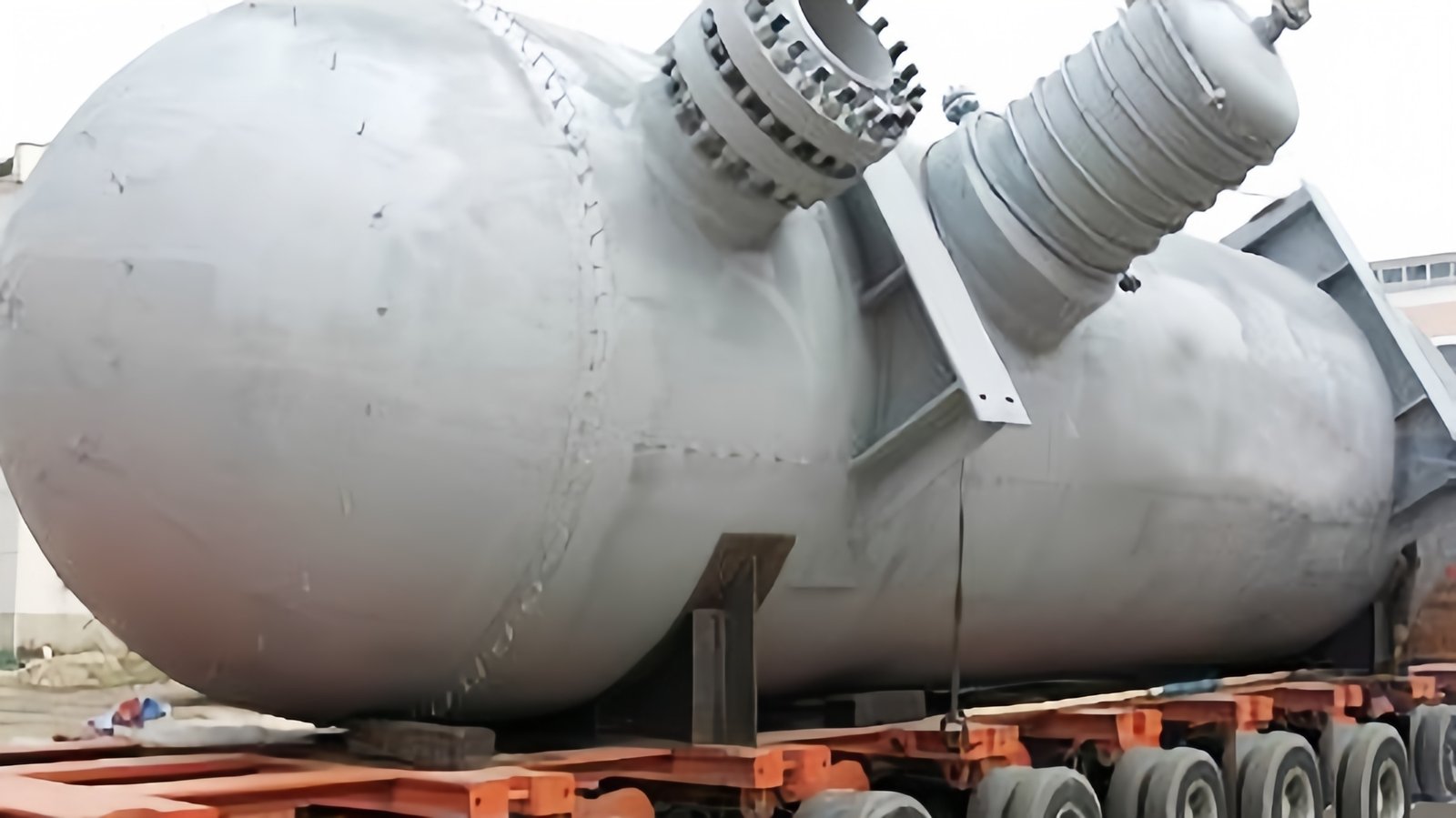
A statement that a vessel “passed hydrotest” is not enough to verify what was actually tested or whether all agreed handover conditions were met.
Pre-test records to identify in the purchase order
Depending on the project, the pre-test package should include:
- The approved test method and technical justification where the method is an alternative.
- The governing code, division, edition and approved test-pressure calculation.
- A controlled test procedure identifying the equipment, boundaries and acceptance requirements.
- Relevant material, fabrication, examination and test-temperature information.
- Calibration status and equipment identification for instruments used to establish the acceptance record.
- The applicable risk assessment and protective arrangements, where required.
- Required inspection notifications, hold/witness status and approvals.
- Water or gas quality requirements, drainage/drying criteria and disposal responsibilities where relevant.
This list does not establish that every item is mandatory under every code. The final required dossier must be mapped to the actual contractual and regulatory obligations.
What should the completed test report establish?
| Record item | Buyer review question |
|---|---|
| Vessel tag and manufacturer identification | Is the report unambiguously linked to the purchased equipment? |
| Drawing and test-procedure revisions | Was the tested configuration the approved final boundary? |
| Test type and medium | Does the recorded method match the approved plan? |
| Calculated required pressure and actual result | Can both be traced to the final approved design basis? |
| Date, temperature and relevant conditions | Are the conditions needed for acceptance recorded? |
| Hold/stabilization and examination evidence | Is there sufficient evidence of compliance with the actual required provisions? |
| Measuring device identification and calibration | Are the readings supported by suitable traceability? |
| Inspection and witness status | Are the signatures, notifications or waivers required by the ITP present? |
| Result and any deviations | Were issues documented and closed by authorized personnel? |
| Subsequent pressure-boundary work | Was any further test or examination assessed and documented? |
Where an ASME-certified vessel requires a Manufacturer's Data Report, the report and equipment marking should also be included and checked against the applicable certification arrangement. The ASME Boiler and Pressure Vessel Certification Program explains the manufacturer certification framework; a supplier's company certificate alone does not replace a particular vessel's required construction documents.
The shipment release is a separate decision
The project may require other manufacturing records, inspection reports, material certificates, drawings, packing records and agreed document approvals before release. For equipment tested with liquid, approved drainage, drying and cleanliness documentation may also affect readiness for delivery.
These are project-specific milestones. There is no reliable universal statement that pressure testing or the final document review always takes a fixed number of hours or days.
Pressure test versus separate leak-tightness acceptance
A construction pressure test may include examination for leakage. That does not necessarily establish compliance with a separate quantitative leak-rate specification or later assembly condition.
The detailed distinction, methods and leakage acceptance criteria are covered in our pressure testing versus leak-tightness guide. For this article, the key procurement action is to list any separately required leak-tightness verification as its own scope and deliverable rather than assuming the pressure-test report covers it automatically.
6. EPC RFQ Checklist: Which Clarifications Should Be Closed Before Vessel Delivery?
The best time to resolve the test method and approval path is during the quotation and technical-clarification stage—not when the completed vessel is awaiting shipment.
Issue a specific technical clarification matrix
| RFQ question | Evidence or answer requested | Suggested responsible party | Status to record |
|---|---|---|---|
| What is the applicable construction code and edition? | Approved code register and design basis | Owner/EPC and designer | Confirmed / open |
| Is hydrostatic testing feasible for the complete vessel? | Review of liquid load, medium compatibility and drainage constraints | Designer and manufacturer | Confirmed / open |
| If pneumatic testing is proposed, why? | Applicable code basis and technical justification | Designer/manufacturer, owner approval as required | Confirmed / open |
| What pressure basis is used? | MAWP/design-pressure reconciliation, material and temperature basis | Designer | Confirmed / open |
| What is the required test pressure? | Calculated and approved result tied to a code edition | Qualified designer | Confirmed / open |
| What test boundaries and chambers are included? | Drawing and test-boundary schedule | Manufacturer and designer | Confirmed / open |
| What examination, risk controls and procedure approvals apply? | Controlled procedure, risk review and ITP references | Manufacturer and required reviewers | Confirmed / open |
| Who must witness or approve the test? | Defined hold/witness/review points and jurisdictional obligations | EPC/owner, inspector, manufacturer | Confirmed / open |
| What are the acceptance and deviation rules? | Approved criteria, nonconformance and retest arrangements | Engineering and quality authorities | Confirmed / open |
| What records are required before shipment? | Final manufacturing-dossier index and release criteria | Manufacturer and EPC/owner | Confirmed / open |
A quotation that lists only “hydrotest included” or “pneumatic test on request” should be clarified before it is treated as technically equivalent to another supplier's offer.
Keep equipment scope and test responsibility aligned
Pressure equipment can include several interconnected or separately tested chambers. The purchase order must specify which completed pressure boundary the manufacturer is contracted to deliver and test, and which field assemblies or later work are outside that supply boundary.
This is especially important for industrial shell-and-tube heat exchangers and other fabricated vessels with multiple pressure-containing spaces.
Neither a product-category page nor general manufacturer credentials should be taken as proof that a specific project has a certain test approval, code stamp or capability. Those claims require project- and item-level verification.
The information buyers should submit
To obtain a meaningful technical response for a complete industrial vessel, provide the process service, design pressure and temperature, operating range, fluid compatibility information, material specification, applicable construction code and edition, destination jurisdiction, drawings or datasheets, proposed supply boundary and project inspection requirements.
When a nonstandard test method is being considered, make the constraints and unresolved questions explicit. Ask the supplier to identify whether the proposed test is permissible and what evidence, approvals, lead-time assumptions and final records will be included in its offer.
For a complete industrial vessel inquiry, contact the project team with the design basis, destination jurisdiction, supply boundary and inspection requirements.
Frequently Asked Questions
What does a pneumatic pressure test mean?
It is a pressure test performed with an approved compressible gas rather than a liquid. Because compressed gas can release substantial stored energy, its use requires careful consideration of the applicable code permission, project-specific hazards and approved inspection arrangements. It is not an ordinary substitute chosen simply to avoid handling water.
What is a hydrostatic pressure test in simple terms?
It is an examination of a pressure boundary under a specified liquid pressure, typically using water or another acceptable liquid. The actual required pressure, examination conditions and acceptance criteria depend on the governing rules and approved vessel design. Hydrostatic tests are not free of risk.
What is the correct test pressure for a vessel hydrotest?
There is no single pressure that applies to every industrial pressure vessel. The required pressure must be calculated under the adopted construction code, division and edition using the relevant vessel design information. A buyer should request the approved calculation instead of accepting a generic multiplier of design pressure.
How long must a hydrostatic test be held?
The governing code and edition, required examination and approved project procedure determine the applicable conditions. A commonly quoted shop hold time should not be presented as a universal code minimum. The supplier should identify the source of the requirement and demonstrate compliance in the test record.
Can an EPC buyer select a pneumatic test because it will be faster?
Not solely for schedule convenience. The alternative must be permitted for the actual vessel, supported by the required engineering justification and reviewed through the applicable approval and safety arrangements. The total schedule may include additional engineering, inspection and release activities.
Must every pressure test be witnessed by an independent third party?
The required participation depends on the adopted code, certification arrangement, jurisdiction and purchase contract. The ITP must state which checks are mandatory and what constitutes valid evidence of attendance or an approved waiver. A universal rule that every test requires the same third-party signature is not justified.
Does passing a pressure test guarantee no leakage in service?
No. Passing the applicable construction pressure test establishes only the acceptance represented by that test and its actual scope. A separately specified leak-tightness criterion, a subsequent assembly change, or future operating conditions may require additional consideration.
Conclusion
Hydrostatic and pneumatic testing should be managed as project-specific construction and delivery requirements, not as a comparison of universal pressure multipliers, holding times or shop procedures.
For EPC buyers, a complete acceptance basis identifies the governing code and edition, the approved design and test-pressure calculation, the technical justification for the selected method, the inspection and witness responsibilities, the acceptance criteria and the final documentation that proves the agreed checks occurred.
The most effective procurement control is a traceable chain from design basis to approved method, inspection evidence and shipment release. Close that chain before fabrication and test scheduling make changes difficult.
References
- American Society of Mechanical Engineers (ASME). BPVC Section VIII, Division 1: Rules for Construction of Pressure Vessels (publisher scope and available 2025 edition). https://www.asme.org/codes-standards/find-codes-standards/bpvc-viii-1-bpvc-section-viii-rules-construction-pressure-vessels-division-1
- ASME. 2025 Boiler and Pressure Vessel Code (official BPVC edition overview). https://www.asme.org/codes-standards/bpvc-standards/bpvc-2025
- ASME. Boiler and Pressure Vessel Certification (manufacturer certification scope and documentation context). https://www.asme.org/certification-accreditation/boiler-and-pressure-vessel-certification
- Health and Safety Executive (HSE), United Kingdom. Safety requirements for pressure testing (GS4, Fourth Edition; publication listed as 2012). https://www.hse.gov.uk/pubns/gs4.htm
- Ministry of Manpower, Singapore. Can I conduct pneumatic test or hydro-pneumatic test in lieu of hydrostatic test for a pressure vessel? (jurisdiction-specific guidance). https://www.iac.gov.sg/sitecore/content/momhomer2/faq/pressure-vessels/can-i-conduct-pneumatic-test-or-hydro-pneumatic-test-in-lieu-of-hydrostatic-test-for-a-pv