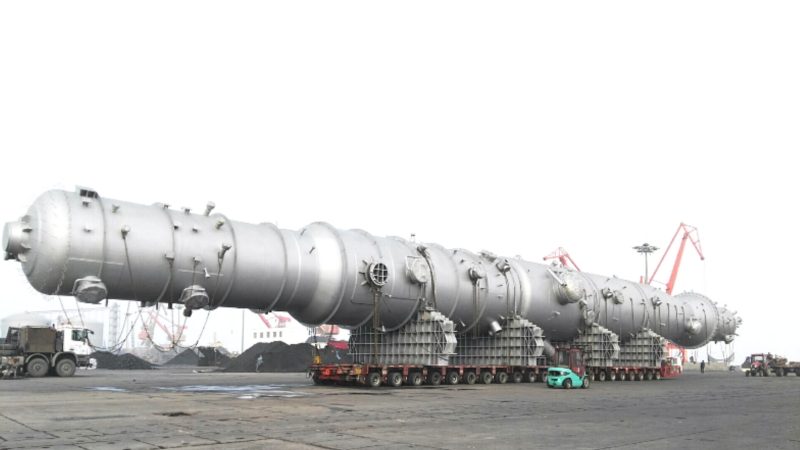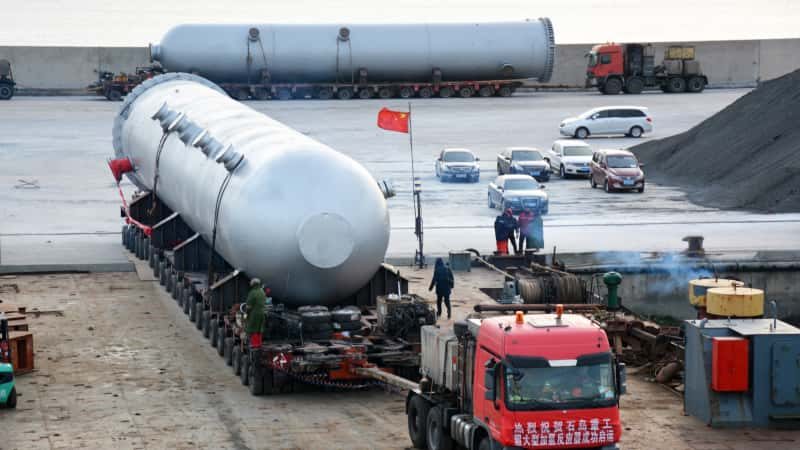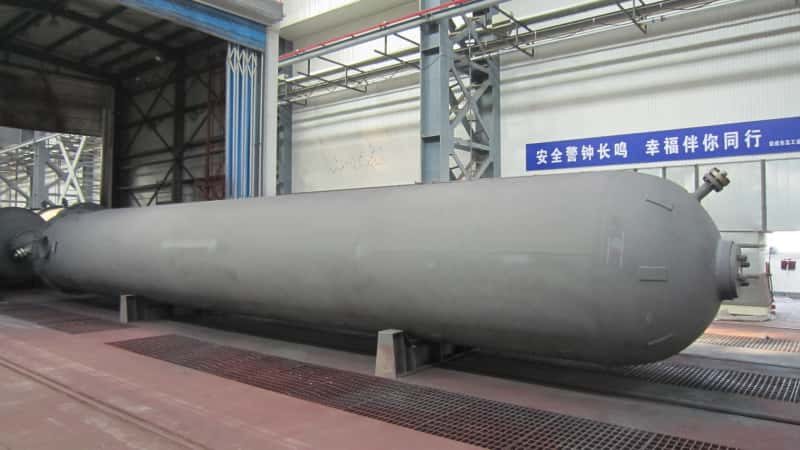

Specifying an internal lining on a large carbon steel storage tank and then discovering mid-project that the surface preparation grade is ambiguous, the curing schedule wasn’t accounted for in the delivery window, or the coating system is incompatible with the actual process fluid — that sequence destroys project schedules and procurement budgets fast. A failed lining in a tank storing concentrated acid or solvent doesn’t just mean a repair call; it means unplanned downtime, potential contamination of product or groundwater, and in the worst cases, structural corrosion that condemns a vessel that cost six figures to fabricate. Getting the lining specification right before purchase order signature is the only leverage point that actually matters.
Internal coatings and linings affect large industrial storage tank procurement through four interlocked variables: surface preparation grade (typically SA 2.5 minimum per ISO 8501-1, rising to SA 3 for immersion service in aggressive media), dry film thickness matched to chemical aggressiveness, curing schedule compatibility with ambient conditions, and holiday-test acceptance criteria — all of which must be locked into the datasheet and purchase order before fabrication begins, not negotiated during inspection.
What most procurement teams underestimate is how these four variables compound each other. A lining system specified at the right DFT but applied over inadequate surface preparation will fail at the interface regardless of coating quality. A correctly applied glass-flake epoxy system cured below 10 °C may never achieve full chemical resistance, yet it will pass a visual inspection and leave the factory looking acceptable. The decisions made in the specification and supplier qualification stage — weeks or months before steel is cut — determine whether that tank performs for fifteen years or fails in eighteen months.
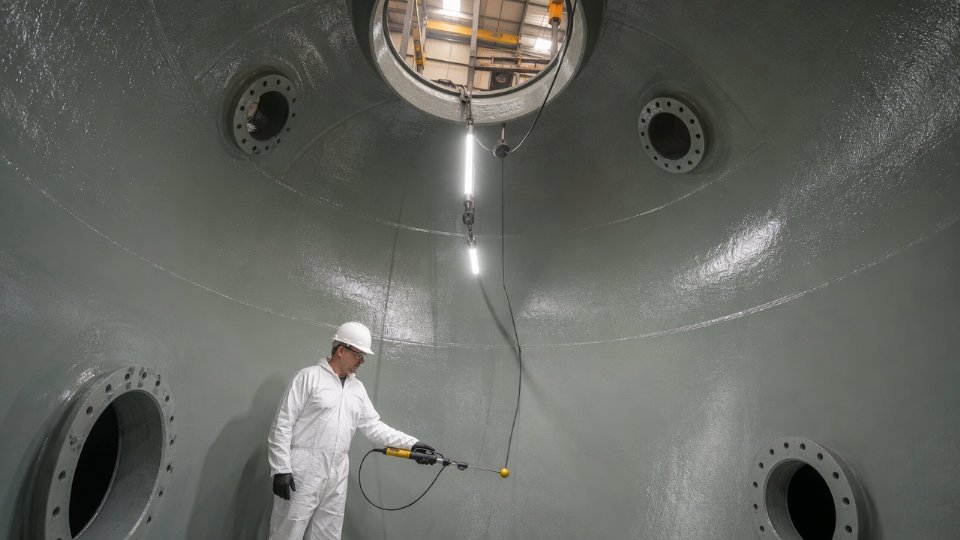
Mapping Lining System Types to Stored Media and Operating Conditions Above 1000 L
Selecting the wrong lining chemistry is not a quality-control problem you catch at final inspection — by then, you have a vessel that either needs sandblasting and re-lining at full cost, or ships and fails in service within its first year. The decision starts with media compatibility and works outward from there.
The Main Lining Families and What They Actually Handle
Solvent-free epoxy remains the workhorse for water, mild process streams, and petroleum products up to roughly 60–70 °C continuous service. It is inexpensive, widely available from qualified applicators, and well-understood. Its weakness is chemical aggression above about pH 10 or below pH 4, and it has essentially no resistance to aromatic solvents.
Glass-flake reinforced epoxy extends the barrier performance of standard epoxy by creating a tortuous diffusion path through overlapping glass platelets. DFT typically runs 500–1500 µm depending on media aggressiveness. This system handles dilute acids, saline solutions, and hydrocarbon service well, but it is rigid — elongation at break is low, often 2–5%. In tanks larger than roughly 5 m diameter, thermal cycling above 80 °C generates differential expansion between shell and lining that exceeds this limit. If the purchase order does not explicitly require minimum elongation-at-break and adhesion pull-off values (commonly 7–14 MPa for immersion service per relevant supplier TDS), you will see inter-coat delamination or cracking within a few thermal cycles.
Vinyl ester linings step up for stronger acids — sulfuric acid at moderate concentrations, hydrochloric acid up to around 37%, and many solvents that epoxy cannot handle. Temperature ceiling is typically 90–110 °C depending on formulation. They cost more and demand tighter application control; moisture contamination during cure causes porosity that holiday testing will find but that you cannot always repair without full strip-down.
Rubber linings — soft natural rubber, hard rubber (ebonite), neoprene, and EPDM — are the default answer for concentrated acid immersion, particularly sulfuric acid above 70% and hydrofluoric acid service, and for slurry tanks where abrasion resistance matters as much as chemical resistance. Hard rubber handles concentrated H₂SO₄ up to roughly 90 °C; soft rubber offers better impact and abrasion resistance but lower temperature tolerance. Application requires specialized bonding and curing procedures; in the field, unbonded edges at nozzle cutouts are the most common failure point and must be specified in the inspection plan.
Polyurea is increasingly specified for water and mild chemical service where rapid return-to-service matters, since plural-component spray application allows cure in hours rather than days. It tolerates thermal cycling better than glass-flake epoxy due to high elongation (often 200–400%). It is not suitable for strong oxidizing acids or aromatic solvents.
Fluoropolymer coatings (PVDF, ECTFE) occupy the high end of the chemical resistance spectrum — strong oxidizers, halogens, and high-purity applications where contamination of the stored product by lining extractables is unacceptable. They are expensive and require specialized application and inspection; ECTFE in particular is often applied as a thermally sprayed or sheet-lined system rather than a brush- or spray-applied coating.
Borosilicate glass tile lining is the specification for concentrated sulfuric acid, oleum, and similar highly aggressive inorganic services at elevated temperatures where no organic coating survives. The grout joints are the vulnerability; specifying the correct furan or sodium silicate grout for the specific acid concentration is non-negotiable.
Structured Compatibility Reference
| Lining System | Typical pH Service Range | Concentration Limit (example media) | Max Continuous Temp | Immersion / Splash Zone |
|---|---|---|---|---|
| Solvent-free epoxy | 4–10 | Hydrocarbons, water, brine | 60–70 °C | Splash zone preferred; immersion with caution |
| Glass-flake epoxy | 3–11 | Dilute acids, saline, crude | 80–90 °C | Immersion-rated grades exist; specify elongation |
| Vinyl ester | 1–13 | HCl ≤37%, H₂SO₄ ≤50%, solvents | 90–110 °C | Full immersion rated |
| Soft rubber (NR/EPDM) | 0–14 | HF, slurries, dilute acids | 60–80 °C | Full immersion; abrasion service |
| Hard rubber (ebonite) | 0–2 | Concentrated H₂SO₄ ≤90% | 80–90 °C | Full immersion |
| Polyurea | 4–10 | Water, mild process, wastewater | 80–120 °C (grade dependent) | Both; verify formulation |
| PVDF / ECTFE | 0–14 | Oxidizers, halogens, high-purity | 120–150 °C | Full immersion |
| Borosilicate glass tile | 0–1 | Oleum, concentrated H₂SO₄, HF | 180–200 °C | Full immersion only |
All figures are indicative ranges; actual limits depend on specific formulation, applicator qualification, and concentration — always verify against the lining manufacturer’s current TDS for the exact service.
Campaign Tanks: When One Lining Chemistry Is Never Enough
Campaign tanks — vessels that store product A for a period, are cleaned, then filled with product B — are genuinely difficult to specify because lining compatibility is not simply the union of both media’s individual requirements. The cleaning agent itself (caustic wash, steam, solvent flush) may be more aggressive than either stored product. A vinyl ester lining compatible with both the acid product and the hydrocarbon product may still blister under repeated caustic cleaning cycles at 80 °C. The procurement specification must define each campaign sequence, cleaning protocol, and maximum cleaning temperature, and require the lining supplier to confirm compatibility for the full cycle in writing. Without this, liability for failure becomes a contractual dispute rather than a solved engineering problem.
New-Energy Applications: Where Existing Databases Run Out
Compatibility data from traditional petrochemical lining databases is sufficient for lithium brine and battery electrolyte storage tank lining selection.False
Lithium brine contains complex ion mixtures and elevated boron, potassium, and lithium concentrations that are not covered by standard petrochemical compatibility tables. Battery electrolyte solvents such as ethylene carbonate and dimethyl carbonate, and hydrogen peroxide at concentrations above 30–35%, represent service environments where published compatibility data for common lining systems is sparse or absent. Independent coupon immersion testing at actual service concentration and temperature, run for a minimum period agreed in the purchase contract, is the only reliable qualification method before vendor approval.
For hydrogen peroxide intermediate storage — common in new energy and specialty chemical projects — even PVDF and ECTFE linings require vendor-specific confirmation above 35% concentration, because peroxide decomposition catalysis by trace impurities in the coating substrate can become a safety-critical issue, not just a service-life issue. Specify coupon testing as a contractual hold point, not a recommendation.
Surface Preparation Standards and Why Blasting Grade Disputes Delay Tank Deliveries
Surface preparation is where the majority of lining failures originate — not in the coating material itself, not in application thickness, but in the steel condition underneath. For tanks above 1000 L entering immersion or chemical service, inadequate surface prep is also one of the most common causes of shop-hold disputes, re-inspection costs, and delivery slippage that procurement teams never see coming until the tank is sitting on the shop floor waiting for a third-party inspector to sign off.
Understanding the ISO 8501-1 Cleanliness Grades in Plain Language
ISO 8501-1 defines four blasting grades — Sa 1, Sa 2, Sa 2.5, and Sa 3 — based on the percentage of mill scale, rust, and contamination remaining on the steel surface after abrasive blasting. Sa 1 is a light sweep that removes loose material; it has essentially no place in lined tank fabrication. Sa 2 removes most mill scale but leaves visible residue in pits and surface irregularities. Sa 2.5, the contractual baseline for virtually all epoxy and glass-flake lining systems in immersion service, produces a surface that is free of mill scale, rust, and foreign matter to the naked eye, with only faint staining permitted in pits. Sa 3 goes further — a visually clean, uniform metallic surface with no staining — and is required for concentrated acid, solvent, or oxidizing chemical service where any contamination under the lining becomes an initiation site for disbondment.
The dispute point between buyers and fabricators almost always falls between Sa 2.5 and Sa 3. These two grades look similar to an untrained eye, and fabricators working under schedule pressure will sometimes present Sa 2 surfaces as Sa 2.5 during inspection. Your purchase specification should require side-by-side comparison against ISO 8501-1 photographic reference panels — not verbal agreement — and the inspection clause should name who provides those reference panels and at whose cost.
SSPC-SP 10 (Near-White Blast) is roughly equivalent to Sa 2.5, and SSPC-SP 5 (White Metal Blast) maps to Sa 3. If your fabricator works primarily to SSPC standards, make sure your specification explicitly cross-references both systems so there is no ambiguity when the inspector arrives.
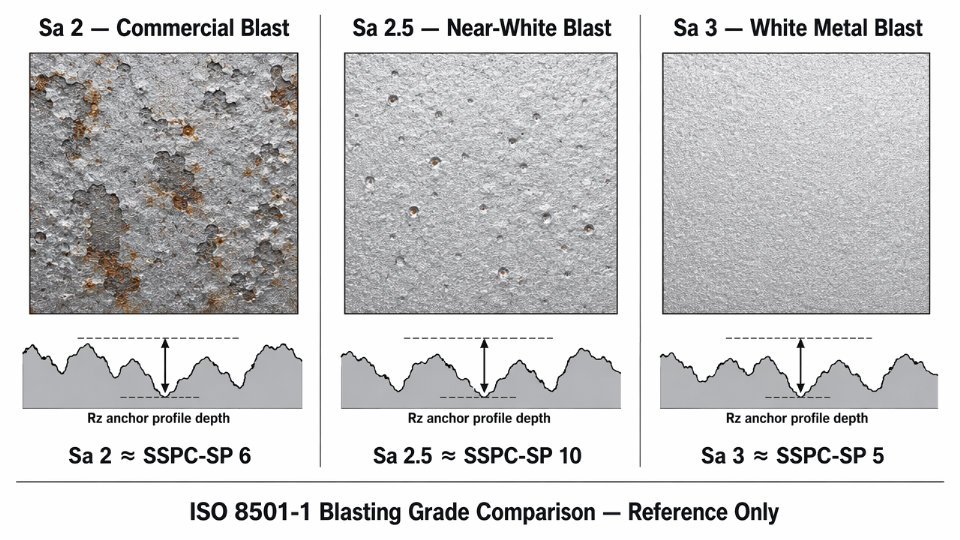
Anchor Profile Depth: Too Shallow Fails, Too Deep Also Fails
Surface cleanliness is only half the equation. The steel must also carry the right anchor profile — the microscopic peak-and-valley roughness that gives the coating mechanical adhesion. For epoxy and glass-flake systems, ISO 8503 typically targets 40–75 micrometers Rz, though the appropriate range depends on coating viscosity, DFT target, and lining chemistry. Verify against the lining manufacturer’s technical data sheet, not against a generic specification clause.
Shallow profiles below 40 micrometers Rz produce adhesion values too low for long-term immersion service; the lining may pass initial holiday testing and still disbond within one or two thermal cycles. Excessive profiles above 75–100 micrometers Rz create a different problem: peak tips consume dry film thickness, effectively reducing the functional DFT over the highest points on the surface. At those peaks, coating thickness can drop by 20–40% relative to the nominal target, and holiday detectors operating at the specified voltage will find breaks the eye never sees. Profile depth should be measured with a replica tape (Testex or equivalent per ISO 8503-5) at a minimum frequency specified in your QC plan — typically at least three readings per square meter on critical surfaces, more frequently near welds.
Fabrication Sequence: Blasting Must Come Last
Large tanks present a sequencing trap that smaller vessels do not. Nozzle attachment, internal stiffener welding, heat treatment, and post-weld inspection must all be complete before internal blasting begins. That sequence is logical but creates commercial friction: fabricators building tanks over several months want to blast and prime sub-assemblies early to prevent surface rust during extended production. If your contract permits this, you need explicit language defining which sub-assembly priming is acceptable, what primer is used, whether that primer is compatible with the final lining system, and how inter-coat contamination from welding fume and spatter will be managed before the finish coat is applied.
A workable clause structure distinguishes between “shop primer for rust prevention during fabrication” and “lining-compatible primer applied to final blasted surfaces.” Require the fabricator to submit a written fabrication and coating sequence plan before production begins, not after problems arise.
Flash Rust: The Humidity Window Problem
In coastal fabrication yards, tropical locations, or monsoon-season production schedules, the window between blasting completion and primer application can collapse to under two hours. Flash rust forms rapidly on freshly blasted carbon steel when relative humidity exceeds 85% or when the steel surface temperature approaches the dew point. Once flash rust appears, the surface must be re-blasted — which costs time, money, and often forces a dispute over who bears the rework cost.
A freshly blasted carbon steel surface can develop visible flash rust in under 30 minutes at 90% relative humidity and 25 °C steel surface temperature.True
Flash rust formation rate on abrasive-blasted carbon steel is strongly humidity- and temperature-dependent; at high humidity near the dew point, oxidation of the reactive fresh surface occurs within minutes. This is well-documented in NACE and ISO coating application guidance and is a recognized field risk in tropical and coastal fabrication environments.
Your contract should specify the maximum permissible flash rust grade per ISO 8501-4 before primer application (typically Ri 1 or better), mandate continuous humidity and dew-point logging during blasting and application operations, and require that the fabricator halt application work when ambient conditions fall outside the lining manufacturer’s stated parameters. Without this clause, you have no contractual basis to reject a surface that looks borderline acceptable but has already compromised adhesion.
Internal Corners, Weld Seams, and the Stripe Coat Requirement
Weld toes, internal corners, and rough weld seams are where lining systems fail first in service — not at mid-plate where DFT is easy to achieve. Coating pulls away from sharp geometry under surface tension during application, leaving thin spots at exactly the locations where crevice chemistry concentrates corrosive species. Weld spatter creates sharp steel protrusions that punch through the lining system under thermal movement.
A complete surface preparation specification for any large tank lining must include: grinding of weld spatter and sharp weld cap profiles before blasting; application of crevice-filling compound or fillet weld beads at tight internal corners with radius less than 3–5 mm (confirm with lining supplier); and mandatory stripe coat application — typically a brush-applied first coat at weld seams and corners before the main spray coat — as a separately inspected and documented line item. These are not optional refinements. On tanks in chemical or water immersion service, failure to specify stripe coats in the contract is a near-certain path to localized corrosion within two to four years of commissioning, regardless of how good the main lining application looks on final inspection.
Dry Film Thickness Specification, Holiday Testing Protocols, and Acceptance Criteria in Purchase Orders
Getting the lining applied is only half the battle. The other half is proving it was applied correctly — and that proof lives entirely in the acceptance criteria written into the purchase order before fabrication starts. Without enforceable, measurable thresholds, final inspection becomes a negotiation, and fabricators with legitimate cost pressures will default to whatever interpretation favors their schedule.
Nominal, Minimum, and Maximum DFT — All Three Must Appear in the Specification
Most procurement documents specify only nominal dry film thickness. That is insufficient. A complete DFT clause defines three values: nominal (the target), minimum (the floor below which chemical permeation risk becomes real), and maximum (the ceiling above which over-thickness defects appear).
For glass-flake epoxy systems in chemical immersion service, the minimum acceptable DFT typically runs 80–85% of nominal, while the maximum is commonly capped at 120–130% of nominal — the exact window depends on the coating manufacturer’s product data sheet, which should be contractually referenced by revision number. Under-thickness is the more obvious failure mode: thin spots allow corrosive media to permeate the film and attack the substrate, often invisibly until a blister or disbondment appears during service. Over-thickness is less intuitive but equally damaging on rubber lining systems and certain high-build epoxies. Excessive film build traps solvent during cure, producing internal voids that later collapse as blisters. On a 100,000 L carbon steel tank storing dilute sulfuric acid, a single delamination blister at the bottom plate can require complete draining, confined-space entry, and lining strip-out — a repair event that costs multiples of the original lining application.
Statistical Sampling Plans for Large Tank Interiors
Random spot-checking is not a sampling plan. Reference ISO 19840 and SSPC-PA 2 for measurement frequency rules scaled to coated surface area. For tank interiors, divide the total internal surface into inspection areas of roughly 10–30 m² each, take a defined minimum number of gauge readings per area (typically five), and apply the pass/fail logic for the batch of readings — not just individual outliers.
Nozzle internals, manway flange faces, and bottom plate weld toes are high-risk zones that also happen to be the hardest places to get a gauge onto cleanly. These locations require explicit callout in the QA clause: minimum one confirmed reading per nozzle bore, with magnetic gauge probes specified for ferrous substrates and eddy-current probes for any non-ferrous overlay. If access physically prevents gauge placement, the inspection record must document that fact — not leave a blank.
Holiday Testing: Voltage Selection and Pass/Fail Criteria
The test method depends on DFT. Films below 500 micrometers — thin-film epoxy primers and many phenolic systems — use low-voltage wet sponge testing per NACE SP0188. Films at 500 micrometers and above require high-voltage spark testing. The operating voltage is calculated as 5 to 10 V per micrometer of specified DFT (the exact multiplier depends on film type and is confirmed in the manufacturer’s application guide). For a 1,000-micrometer glass-flake system, that puts spark test voltage in the 5,000–10,000 V range.
For immersion service linings, the only acceptable holiday count at final inspection is zero.True
Any discontinuity in an immersion-grade lining creates a direct electrolytic path to the substrate. NACE SP0188 and most major owner specifications for chemical storage tanks specify zero detectable holidays as the pass criterion — not a low count or statistical tolerance.
Repair Clauses and How Many Cycles Before Rejection Rights Apply
The purchase order must define what constitutes an acceptable repair and how many times a zone can be repaired before the buyer gains the right to reject the entire lining application. A workable structure: one cycle of spot touch-up with re-inspection is permissible for isolated holidays in non-critical zones; a second repair trigger in the same zone requires full stripe recoat of that area; a third failure in the same zone, or any failure in a bottom plate or sump area, triggers mandatory full zone reblast to the original specified surface preparation grade and full recoat. Unlimited repair attempts with no contractual escalation clause allow a lining quality problem to drag on for weeks without buyer recourse.
All repaired areas must be re-holiday tested and re-DFT-measured before the repair is accepted, with the readings logged under the original inspection record rather than a new document — this prevents repair activity from being obscured in the final package.
Documentation as a Contractual Deliverable
The Coating Inspection Report is not a courtesy document. Specify in the purchase order that it is a mandatory mechanical completion deliverable, without which the fabricator cannot issue a request for final payment. The report must include all individual DFT readings with location references, holiday test records with voltage settings and test dates, ambient condition logs showing temperature, relative humidity, and dew point at application and cure, coating batch and lot numbers, and current applicator certification documents. Dew point margin is particularly critical: most epoxy systems require the substrate temperature to be at least 3°C above dew point, and any application outside that window during the documented curing period can void the manufacturer’s warranty regardless of how the final film looks.
How Lining Specification Affects Vendor Shortlisting and Technical Bid Evaluation for EPC Projects
For EPC project managers, the temptation is to shortlist tank fabricators on steel fabrication capability and price, then treat lining as something resolved later. That sequencing is backwards. By the time you discover a shortlisted vendor subcontracts all lining work to a coating contractor operating three provinces away in an unheated warehouse, you have already committed weeks of schedule and negotiating leverage.
The Subcontracting Chain and Where Warranty Responsibility Disappears
Most carbon steel tank fabricators — even competent, well-equipped ones — do not employ in-house certified coating applicators for immersion-grade lining systems. They subcontract. The subcontractor applies the lining, the fabricator signs the documentation, and the buyer assumes a single warranty chain exists. In practice, when a holiday failure appears six months into service, the fabricator points to the coating contractor and the coating contractor points to surface prep conditions on the day of application. Neither party owns the outcome clearly.
The RFQ must require the prime vendor to carry end-to-end lining warranty in writing — covering surface preparation, application, curing, and holiday acceptance — regardless of whether application is performed in-house or subcontracted. This is not boilerplate; it needs to be a named contractual obligation with a defined warranty period (typically two to five years for immersion service, depending on media aggressiveness and lining system type). Without it, the buyer is insuring a risk that the contract appears to have transferred.
Vendor Qualification Checklist Items That Actually Differentiate Capability
When evaluating lining capability at the qualification stage, the following items separate vendors who can genuinely execute from those who will scramble:
| Qualification Item | What to Look For | Red Flag |
|---|---|---|
| Applicator certification | NACE CIP Level 2 or FROSIO Inspector on staff or named subcontractor | No named inspector, vague “in-house QC” claim |
| Blast facility dimensions | Internal chamber or blast bay that fits the tank without disassembly | Vendor plans to blast in sections and join after — introduces contamination windows |
| Temperature-controlled curing area | Enclosed, heated/cooled area maintaining 10–35 °C through cure cycle | Open yard curing in variable climate |
| Reference tanks in similar service | Documented lining performance history for comparable media and capacity | References only for water tanks when buyer needs solvent or acid service |
Writing a Scope-of-Supply Matrix That Forces Honest Bid Comparison
Without a lining scope matrix in the RFQ, bid comparison is fiction. One vendor bids Sa 2.5 two-coat glass-flake epoxy at 750 µm DFT with NACE SP0188 holiday testing. Another bids Sa 2 single-coat coal tar epoxy at 300 µm with visual inspection only. The second bid is 18–30% cheaper on paper. The cost comparison misleads every stakeholder who sees it.
A usable scope matrix forces line-item commitments on: surface preparation grade (ISO 8501-1 reference), lining system manufacturer and product code, number of coats, DFT per coat and total minimum DFT, holiday test voltage and acceptance standard, curing time and temperature log submission, and third-party inspection hold points. Vendors must complete every cell. A blank cell is a scope exclusion, not an equivalence.
Requiring vendors to complete a lining scope-of-supply matrix in the RFQ eliminates the most common source of artificial price differences in carbon steel tank bids.True
Bid price variation for identically-sized tanks in similar service routinely traces to unequal lining scope assumptions rather than fabrication cost differences — a documented problem in EPC procurement audits across chemical and oil storage projects.
Evaluating Brand Substitution Requests Without Losing Chemical Resistance Assurance
EPC owners frequently pre-approve specific coating products — Jotun Jotacote Universal, Carboline Plasite 7122, Sherwin-Williams Dura-Plate 235 are common examples in chemical storage applications. Fabricators propose substitutes to reduce material cost or because their preferred coating contractor carries a different brand. The request is not inherently illegitimate, but accepting it casually is a real risk.
Evaluate substitution requests against three sources: the manufacturer’s published chemical resistance data for the exact stored medium and concentration, independent third-party immersion test reports at service temperature, and the owner’s formal brand-approval procedure if one exists. If the EPC owner specification cites a brand by name, any substitution requires owner written approval — not just engineer-of-record sign-off. The consequence of skipping this step shows up in coating delamination after 12–24 months, at which point the warranty dispute is complicated by the unapproved substitution.
Tying Payment Milestones to Lining Acceptance
Lining completion should be a standalone payment milestone, not buried inside “mechanical completion.” When it is bundled, the buyer loses the clearest point of commercial leverage: the ability to withhold a payment tranche until holiday testing passes and curing logs are submitted. A defined lining milestone — typically 5–10% of contract value — gives both parties a clear acceptance event and removes the ambiguity of what “ready for shipment” actually means for a lined vessel. Structure the milestone as: lining applied and cured per specification, holiday test witnessed by buyer’s inspector or approved third party, DFT records submitted and accepted, with payment released within a defined number of days of written acceptance.
Lining System Impact on Tank Weight, Nozzle Design, Heating Coil Compatibility, and Structural Details
Internal lining specifications rarely appear in the structural or mechanical engineering packages until late in the procurement cycle — and that timing gap is where expensive surprises originate. The lining is not a surface cosmetic applied after the vessel is complete. It interacts with foundation design, nozzle geometry, ancillary equipment, and corrosion protection strategy in ways that must be resolved before a purchase order is issued.
Weight Addition and Foundation Load Recalculation
A 1200-micrometer glass-flake epoxy lining applied to the full interior shell and floor of a 100,000 L carbon steel tank adds roughly 800 to 1200 kg to the structure’s operating weight, depending on glass-flake content, resin density, and application build. That range sounds manageable until you account for the fact that foundation load calculations are often finalized from the steel fabrication drawing alone, before a lining system is specified. When the lining specification arrives later — because procurement treated it as a separate line item — the structural engineer may need to recheck anchor bolt sizing, grout bearing area, and lifting lug capacity. On tanks above 200,000 L with applied rubber lining systems at 6–10 mm thickness, the added mass can reach 3,000 to 5,000 kg. Flag the target DFT and lining density to your structural team before the foundation package is issued for construction, not after.
Nozzle Bore Lining Continuity
One of the most consistent failure initiation points on lined tanks is the transition between the lined shell and an unlined nozzle bore. The stored medium — particularly anything acidic, alkaline, or chloride-bearing — pools in that uncoated crevice at every nozzle penetration. The fix is straightforward to specify but frequently omitted from drawings: the lining must extend into each nozzle bore to a minimum depth of one times the nozzle inside diameter or 150 mm, whichever is greater, and the flange face itself requires a compatible coating or lining to the raised-face seal line. Procurement specifications should list every nozzle by tag, nominal diameter, and required lining continuation length. Leaving it to a general note on the drawing is not sufficient — fabricators interpret general notes inconsistently, and you will find uncoated nozzle bores at final inspection.
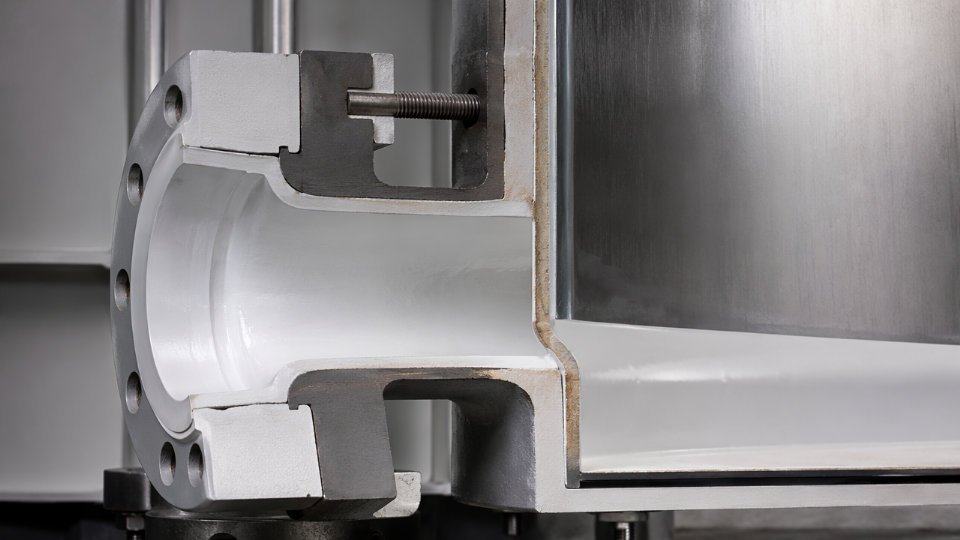
Heating Coil Attachment and Local Thermal Degradation
Steam coils or hot-oil coils welded directly to the tank floor present a localized temperature problem that most lining datasheets do not address adequately. Standard glass-flake epoxy systems carry service temperature limits in the 60–90 °C range; immersion-grade phenolic or vinyl ester systems extend that to roughly 120 °C, depending on formulation. A coil surface running at 150 °C steam condensate temperature, attached flush to the floor plate, creates a contact zone that routinely exceeds those limits. Delamination at the coil attachment points follows, typically within the first heating cycle.
The engineering resolution requires three coordinated decisions at the design stage: coil attachment using standoff supports rather than continuous floor contact (a 25–50 mm clearance is common practice), specifying a locally upgraded lining system — sometimes a ceramic-filled epoxy or fluoropolymer patch — in the coil zone, and documenting the maximum floor plate temperature in the lining system datasheets submitted for approval. None of this can be retrofitted cheaply after fabrication.
Manway Diameter and Applicator Access
Rubber linings and thick glass-tile systems require a minimum 600 mm manway to allow an applicator to enter, position spray or trowel equipment, and allow a QA inspector to reach all internal surfaces with a holiday detector wand. A standard 500 mm manway paired with a thick lining specification is a direct conflict that will surface during fabrication review — at which point the options are cutting a new manway opening, accepting a different lining system, or accepting restricted access and an unverifiable application. Specifying manway diameter in the same document section as the lining system type is a simple discipline that eliminates this conflict entirely.
Floor Lining and Cathodic Protection System Coordination
Above-ground storage tanks with annular bottom plates sometimes carry both an internal floor lining and a cathodic protection system on the external underside. These two systems must be engineered together. A holiday defect — a pinhole in the floor lining — concentrates impressed current from a CP system at that single point. Instead of protecting a broad steel surface, the CP current densifies at the defect and accelerates localized pitting at exactly the location the lining was meant to protect.
Specifying internal floor lining and underside cathodic protection independently, without coordinating holiday acceptance criteria and CP design current density, can accelerate pitting at floor lining defects rather than prevent it.True
CP current concentrates at coating holidays; a single pinhole in an otherwise continuous floor lining becomes a high-current-density anode site when CP is active, producing accelerated localized corrosion rather than general protection.
The practical requirement is that the CP designer receives the lining specification — including maximum allowable holiday frequency per unit area — before sizing anode output or rectifier current. Treat them as one corrosion control system with two components, not two separate line items in the bill of materials.
Pre-Delivery Inspection, Curing Validation, and Shipment Protection Requirements for Large Lined Tanks
A lining that passes shop holiday testing can still fail within the first operating cycle. The window between final coat application and first product fill is where procurement contracts most often fail to protect the buyer — not through bad workmanship, but through missing procedural requirements that nobody wrote down.
Curing Validation: The Tests That Must Be Contractually Mandated
Shore D hardness and MEK double-rub testing per ASTM D4752 are the two fastest shop-floor indicators of cure state. For a typical glass-flake epoxy system, a MEK double-rub count below 100 passes indicates inadequate solvent resistance and almost always means the coating was either applied too thick in a single pass, force-cured outside the specified temperature window, or simply not given enough time. Shore D readings below the manufacturer’s minimum — often in the 70–80 range for immersion-grade epoxies, depending on formulation — tell the same story.
Neither test replaces adhesion pull-off per ISO 4624. For epoxy systems in full immersion service on tanks above 1,000 L, the contractual minimum should be written as a specific value in the purchase order — typically 5 to 8 MPa, though the correct floor depends on the substrate condition, primer system, and lining manufacturer’s qualification data. Accepting a fabricator’s verbal assurance that “the lining is cured” without documented pull-off results from a third-party coating inspector is procurement negligence, not procurement practice.
Require third-party witness inspection for all three tests. A NACE/AMPP Coating Inspector Level 2 or equivalent is the appropriate qualification. This person should issue a signed curing certification report before any hydrostatic test is scheduled.
The Hydrotest Sequencing Problem
This is one of the most reliably expensive mistakes in tank procurement. A buyer’s project schedule shows hydrostatic testing as a fixed milestone, and the test gets run before the lining has reached full cure because nobody cross-referenced the lining manufacturer’s data sheet with the fabrication schedule. Water penetrates the partially cured film under hydrostatic pressure. The lining passes visual inspection at that moment. Blisters and adhesion loss appear four to eight weeks after commissioning, typically after the tank is already in service with product inside.
The contractual fix is simple: insert a clause mandating a minimum cure period — taken directly from the lining system manufacturer’s published data sheet for the actual shop temperature conditions — between final coat application and water introduction. This period commonly ranges from 7 to 21 days for epoxy systems, and it compresses or extends depending on ambient temperature and relative humidity during curing. Specify it as a calendar-day hold with temperature and humidity log documentation, not as a fabricator’s judgment call.
After the hydrotest, require a mandatory post-drain holiday re-inspection before final acceptance sign-off. Weld seam areas are particularly vulnerable to mechanically induced pinholes during fill and drain cycles. This second holiday test closes the gap between shop inspection and actual delivery condition.
Scheduling hydrostatic testing before lining cure is complete can cause adhesion loss that is invisible at shop inspection but manifests as blistering weeks after commissioning.True
Water absorption into an incompletely cross-linked epoxy film under hydrostatic pressure disrupts adhesion at the substrate interface. The film may appear intact immediately after drain but fails progressively under thermal cycling and chemical exposure once in service.
Shipment Protection Specification for Road, Rail, and Sea Transport
Large lined tanks are routinely shipped with open nozzles, no desiccant, and loose lifting hardware still inside. Any one of those conditions can destroy a lining that cost more than the base steel fabrication.
Purchase orders for tanks above 10,000 L should specify: all nozzles and manways blinded with bolted covers carrying desiccant packs rated for the expected transit duration and container humidity conditions; nitrogen purge and positive-pressure blanket for tanks lined with hygroscopic systems such as certain polyurea and amine-cured epoxy formulations; foam-rubber or closed-cell polyethylene internal blocking to immobilize any items that could impact the lining surface during road or rail vibration; and photographic documentation of the full interior condition taken after curing certification and again after loading, with both image sets time-stamped and tied to the shipping documents.
Thermal shock is a less-discussed but real transport risk for large tanks shipped by sea through temperature extremes — a tank cured at 25 °C in a fabrication shop, then loaded into a steel cargo hold where temperatures drop below 0 °C overnight and rise above 50 °C during the day, can develop micro-cracking in brittle lining systems. Specify transit temperature limits in the shipping clause if the lining system has a published thermal shock sensitivity range.
Site-Receipt Acceptance Protocol
Who performs the site inspection, and by what deadline, should be written into the purchase order before the tank is fabricated. The default — owner inspects at some point after delivery, defects are disputed verbally — produces expensive arguments about whether damage occurred in transit or was a pre-existing fabrication defect.
A workable structure: the owner’s appointed third-party coating inspector witnesses an interior holiday re-test and DFT spot checks at all accessible zones within 10 to 15 working days of site arrival. Nozzle lining condition, particularly at internal edges and welds, gets a dedicated visual assessment using a borescope for nozzles below 150 mm bore. The purchase order should define a hard contractual deadline — typically 15 to 30 days after confirmed site delivery — for raising lining defect claims, after which responsibility for damage transfers to the owner. Without that clause, a fabricator facing a warranty claim six months after delivery has no contractual basis for disputing liability, and neither does the buyer have a defined remedy. Neither position serves a project.
Total Cost of Ownership Model: Lining Upfront Cost Versus Relining, Downtime, and Remediation Expenses
Procurement committees reviewing capital budgets for large storage tanks routinely challenge lining specifications on the basis of first cost. The fabricator’s line-item quote for an internal lining system is visible and immediate; the cost of relining a tank in the field five years later is an operations problem that belongs to someone else’s budget cycle. That structural disconnect between capital expenditure ownership and maintenance cost ownership is where under-specified linings survive the approval process and later generate disproportionate losses.
Breaking Down the Real TCO Components
The initial lining cost for a shop-applied system on a carbon steel tank above 50,000 L typically includes surface preparation labor and consumables, coating materials, application labor, DFT gauging, holiday testing, and third-party inspection sign-off. Depending on lining tier and shop location, this package runs roughly 8–18% of the bare tank fabrication cost, with the spread driven by coating system complexity, DFT requirements, and whether the scope includes a stripe coat on welds and nozzle bores.
Recoat cycle cost is structurally different. Relining a large tank already installed in the field typically costs 2.5 to 4 times the original shop application cost. Confined-space entry requirements add safety overhead — atmospheric monitoring, rescue standby, ventilation equipment, permit administration — before a single abrasive blast nozzle enters the manway. Achieving SA 2.5 quality with portable blasting equipment inside a 50,000 L or larger vessel is genuinely difficult; surface profile consistency in corners, under nozzle flanges, and along roof-to-shell junctions is harder to control than in an open fabrication bay with purpose-built rotation equipment. Partial relining, where only the bottom course or floor plate is addressed, rarely stays partial once the blasting crew is inside.
Operational downtime cost is the component that most changes the TCO calculation when it is properly quantified. Taking a process tank offline for field relining means product transfer to temporary storage or a sister vessel, a cleaning cycle to remove residue, and then the relining schedule itself — typically 3 to 6 weeks for application and curing on a large vessel, longer in cold or humid ambient conditions. For a tank in continuous chemical process service, the throughput loss at realistic production margins frequently exceeds the entire original lining cost within the first relining event.
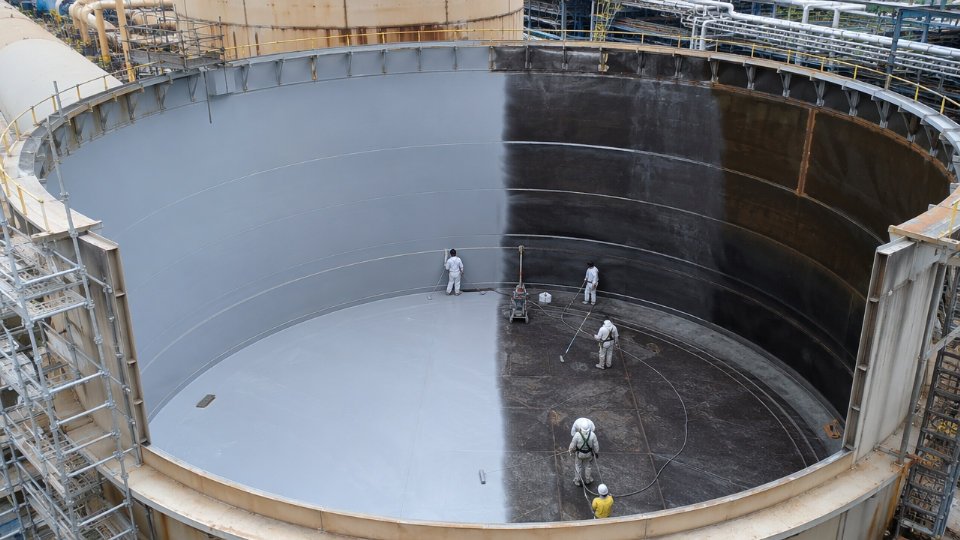
Service Life Arithmetic Over a 15-Year Plant Life
The service life gap between specification tiers is wide enough to dominate the cost comparison. A single-coat solvent-based epoxy applied at 250 micrometers DFT in dilute acid service — pH in the 3 to 4 range, ambient temperature — commonly shows pinholing and substrate corrosion within 3 to 5 years. A properly applied glass-flake vinyl ester system at 1000 micrometers DFT in the same service can deliver 12 to 18 years before the first recoat is warranted, provided surface prep met SA 2.5 and curing conditions were controlled. Over a 15-year plant life, the cheaper system requires two to four full recoat cycles; the premium system may require none or one. When the field relining cost multiplier and the downtime cost are layered on top of the recoat material cost, the annual cost per square meter of internal surface favors the premium system by a margin that typically justifies the higher upfront specification — often by a factor of 2 to 3 over the plant life.
Field relining of a large installed tank costs 2.5 to 4 times the original shop application cost when confined-space safety requirements and surface preparation difficulty are fully accounted for.True
This range is consistent with field maintenance cost structures in industrial tank service — confined-space entry permitting, atmospheric monitoring, rescue standby, portable blasting inefficiency, and remobilization overhead all add to the cost base relative to a controlled fabrication shop environment.
Insurance, Financing, and Environmental Liability
This dimension is underdiscussed in procurement engineering conversations but increasingly consequential. Lenders financing large chemical or energy storage installations and insurers writing property and environmental liability coverage are now more likely to request lining system documentation as part of project close-out packages. Material data sheets, application records, inspector sign-off, holiday test logs, and curing validation records are the documents they want. A tank that entered service with an undocumented or substandard lining may face coverage exclusions or policy conditions at the first renewal cycle after commissioning.
Environmental remediation cost is the tail risk. A lining failure in a tank storing acids, hydrocarbons, or regulated chemicals that results in a containment breach generates regulatory notification obligations, cleanup costs, and potential fines — costs that are structurally uncapped in most jurisdictions and that dwarf any lining specification savings from the original procurement.
A Practical Decision Rule for Procurement Teams
For tanks meeting any one of the following conditions — design life above 15 years, stored medium with pH below 4 or above 10, operating temperature sustained above 60 °C, or stored product value above a defined threshold per cubic meter of tank capacity — the procurement specification should default to the premium lining tier. Any scope reduction from that baseline should require a documented, owner-approved risk acceptance that acknowledges the TCO implications explicitly. Treating a lining downgrade as a routine value-engineering decision without that documentation creates an accountability gap that tends to surface at the worst possible moment: the first inspection after the warranty period expires.
Regulatory Compliance, Environmental Standards, and Lining-Related Certification Requirements in Cross-Border EPC Projects
Cross-border EPC procurement adds a compliance layer that catches many procurement teams off guard. A lining system that is technically correct for the service chemistry and structurally compatible with the tank design can still fail regulatory acceptance at the installation site — forcing last-minute reformulation, re-approval delays, or outright rejection by the local authority having jurisdiction. These failures are almost always traceable to a specification written only around chemistry, not around the regulatory context of where the tank will operate.
Food-Grade and Potable-Water Lining Approvals Narrow the Vendor Pool Sharply
When the stored product is potable water, a food ingredient, a beverage precursor, or a pharmaceutical intermediate, the lining itself becomes a regulated contact material. In North America, NSF/ANSI 61 certification is the governing standard; tanks storing potable water for public systems must use linings that appear on the NSF-certified products list, and the certification is specific to the formulation batch — a manufacturer cannot substitute a “similar” resin and claim equivalence. European projects face a patchwork: the EU drinking water framework references national transpositions of the 98/83/EC directive, with Germany’s KTW-BWGL guidelines and the UK’s WRAS approval being the most commonly encountered. Most standard industrial coal tar epoxy, solvent-borne phenolic epoxy, and high-build glass-flake systems used in chemical service are not listed under any of these schemes. For procurement teams, this is a shortlisting filter applied before price comparison — not after. Issuing an RFQ for a potable-water tank to five fabricators and discovering that only one or two have an NSF 61-listed lining system wastes bid cycle time and compresses delivery schedules.
VOC Limits Force Formulation Trade-Offs That Should Be Resolved at Specification Stage
EU Directive 2004/42/EC sets VOC content limits for coating products by category, and US EPA Method 24 provides the test method against which domestic coating suppliers must demonstrate compliance. Equivalent limits exist in GCC countries through SASO regulations and in several Southeast Asian markets — Singapore, Malaysia, and Thailand each have adopted or are converging toward comparable limits. The operational consequence is real: some of the best-performing chemical-resistant epoxy formulations for concentrated acid or solvent service are high-VOC solvent-borne systems. Where the regulatory ceiling prohibits them, procurement must specify waterborne or solvent-free alternatives, which in some service environments will carry a shorter recoat window, higher sensitivity to substrate moisture, and potentially reduced chemical resistance at elevated temperatures. None of this is disqualifying — solvent-free glass-flake epoxy systems perform very well across a wide range of services — but the trade-off must be evaluated and documented at the specification stage. Discovering during shop inspection that the fabricator applied a non-compliant formulation because the PO was silent on VOC content creates a dispute with no clean resolution.
Import Controls on Lining Raw Materials Create Hidden Supply Chain Risk
Bisphenol-A epoxy resins, isocyanate-based topcoats, and certain aromatic solvents used in high-performance lining systems are classified as controlled substances or require specific SDS declarations under import regulations in several project-country markets. The Gulf Cooperation Council countries, India, and some Southeast Asian jurisdictions impose pre-import notification or quantity restrictions. A fabricator in one country sourcing a specified lining resin for a tank being shipped to another country may find the material cannot clear customs at the destination, or that a local substitute must be approved — a process that can run four to eight weeks depending on the authority. Procurement teams should include a raw material importability check as a standard step during vendor qualification, not a task left to the fabricator after contract award.
NSF/ANSI 61 certification is specific to the exact coating formulation and cannot be transferred to a chemically similar alternative product.True
NSF/ANSI 61 evaluates and lists specific commercial products by formulation. Reformulation, resin substitution, or pigment changes require re-evaluation. This is confirmed in NSF International's certification program documentation.
Hazardous Waste from Surface Preparation Must Be Allocated in the Purchase Order
Lining application on a large carbon steel tank generates two waste streams that carry environmental liability: spent blast abrasive (which may be classified as hazardous if it contains lead, chromium, or other regulated metals from existing surface contamination) and solvent-contaminated rags, solvents, and coating residues from the application process itself. In jurisdictions with strict waste management frameworks — EU member states, California, and increasingly China’s coastal provinces — these streams require manifested disposal through licensed hazardous waste contractors. The cost is not trivial for tanks above 50,000 L where abrasive blast quantities can run several tonnes. Purchase orders that are silent on waste management responsibility default to ambiguity, and fabricators will either absorb the cost into margin or find the cheapest disposal route available. A clear waste management clause — specifying manifested disposal, requiring disposal certificates to be submitted with the final inspection dossier, and allocating cost explicitly to the fabricator — removes this ambiguity before contract award.
China-Manufactured Tanks: Aligning GB Standards With International Lining Specifications
For procurement teams sourcing lined tanks from Chinese fabricators — whether for Chinese domestic projects or export — the interaction between Chinese national standards and international lining specifications requires explicit treatment in the technical requirements document. GB/T 1766 covers the assessment and rating of paint and varnish coating systems and serves as a condition evaluation reference. HG/T 20679 governs lining design for chemical equipment and is directly relevant to internal lining specification for process tanks. Where the lined tank also qualifies as a pressure vessel under Chinese regulations, TSG 21 applies, and the inspection and documentation requirements for the vessel itself interact with, but do not replace, the lining QA requirements. The practical issue that arises on cross-border projects is a PO that specifies NACE SP0188 for holiday testing and ISO 8501-1 SA 2.5 for surface preparation but makes no reference to HG/T 20679 for lining design adequacy. The fabricator follows whichever standard they are most familiar with, which creates compliance gaps in both directions — the tank may satisfy one framework but not the other. Writing both the international standard and the applicable GB standard into the technical requirements document is a straightforward precaution that eliminates this ambiguity.
Frequently Asked Questions About Internal Coatings and Linings in Large Tank Procurement
Can I specify an internal lining after the tank has already been fabricated and welded?
Yes, but with significant caveats. Post-fabrication lining is technically feasible provided the tank has adequate manway access — typically a minimum 500 mm diameter opening, though 600 mm is the practical working standard for a technician carrying equipment. The harder problem is weld condition. Welds completed without a lining in mind often retain spatter, sharp weld toes, and undercut profiles that no field blasting can adequately address. Glass-flake and immersion-grade epoxy systems require weld profiles ground to a smooth radius; a sharp internal weld toe creates a stress concentration point where the lining bridges rather than bonds, and that bridged area fails first. If the fabricator did not specify grinding and profile finishing to ISO 8501-3 grade P3 during fabrication, you may be applying an expensive lining over a surface that will never hold it reliably. Post-fabrication lining is a legitimate procurement path, but it requires a surface audit before you commit, not after.
What is the minimum tank size where an internal lining is worth specifying versus upgrading to alloy material?
The cost crossover logic depends on media aggressiveness, alloy type, and regional fabrication rates — but a workable rule for procurement planning is this: for tanks above roughly 20,000 L handling aggressive but non-extreme media (dilute acids, produced water, mild solvents), a carbon steel shell with a high-build glass-flake epoxy or vinyl ester lining is almost always more economical than upgrading to duplex stainless or alloy-clad plate. The alloy cost premium scales with shell surface area, which grows fast as tank diameter increases. A lined carbon steel tank in the 50,000–200,000 L range will typically carry a lower installed cost than the alloy equivalent even after accounting for the lining application, cure schedule, and inspection costs. Below roughly 5,000 L, the equation can reverse — alloy fabrication costs become proportionally less punishing and lining application on a small tank with limited internal access becomes expensive per square meter. The real decision boundary sits somewhere in the 10,000–25,000 L range and shifts based on how extreme the service chemistry is.
How do I verify that the lining system delivered is the product that was specified and not a cheaper substitute?
Certificate of conformance alone is insufficient. Require batch number traceability: the batch numbers on delivered containers must be traceable to the lining manufacturer’s quality records, confirming that the product formulation, shelf life, and storage conditions are compliant. Beyond documentation, a third-party coating inspector witnessing material delivery — checking container labels, batch codes, and physical condition before mixing — is the most reliable control. For high-value or high-risk applications, infrared spectroscopy fingerprinting of a retained sample can confirm the resin chemistry matches the specified product. Density and viscosity checks at mixing, compared against manufacturer data sheets, catch diluted or substituted materials before they go on the tank wall.
Batch number traceability to the lining manufacturer's quality records is the minimum standard for verifying product identity on large lined tanks; certificate of conformance alone cannot confirm that the delivered material matches the specification.True
Certificates of conformance can be issued by the fabricator or applicator and do not independently verify product identity. Batch traceability linked to manufacturer quality records, combined with physical witnessing of material delivery, is the operationally sound standard used in refinery and chemical plant construction QA programs.
Does an internal lining eliminate the need for corrosion allowance in the tank shell design?
No. Under ASME Section VIII, API 650, and EN 13121, internal linings are not recognized as credited corrosion barriers for the purpose of reducing the required corrosion allowance in shell thickness calculations. The corrosion allowance remains a mandatory design parameter regardless of lining specification. The practical implication for procurement is that the lining extends service life and reduces internal corrosion rate in operation, but the structural safety margin built into the shell thickness is calculated as if the lining were not there. Buyers who attempt to reduce shell plate thickness on the basis of an internal lining are introducing a design non-conformance that will surface during third-party design review or statutory inspection.
What happens to the lining warranty if the fabricator subcontracts the lining application?
This is a common procurement gap. When lining application is subcontracted, buyers sometimes end up holding two partial warranties — one from the prime fabricator covering tank construction, one from the coating subcontractor covering application workmanship — with neither party accepting full responsibility when a lining failure occurs at the interface of fabrication quality and application quality. The correct mechanism is a back-to-back warranty clause in the purchase order: the prime fabricator issues a single integrated warranty covering both application workmanship and lining system performance, and the subcontractor’s warranty flows up contractually to the prime. Require this in the RFQ stage, not during contract negotiation.
How should we handle lining inspection for a tank too large to fully access internally during shop inspection?
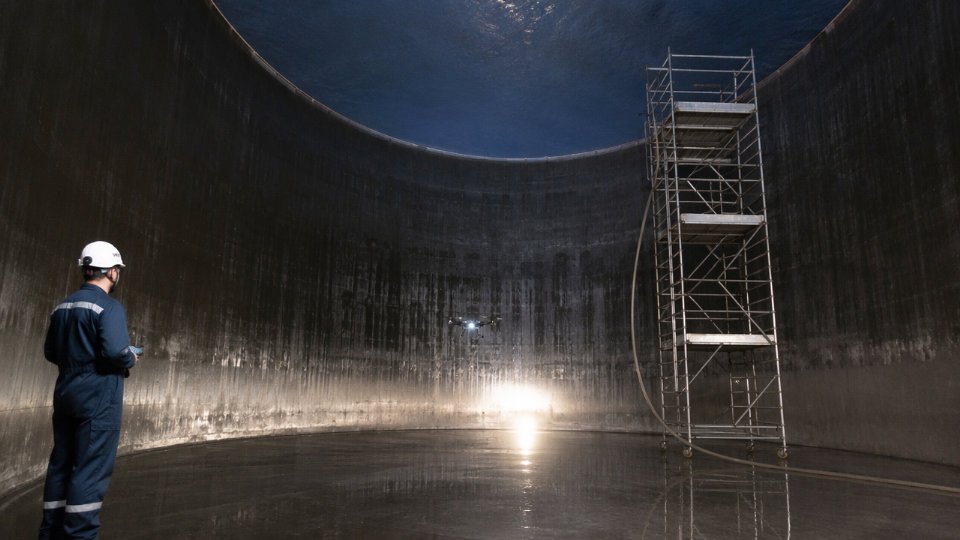
For tanks above roughly 10 m diameter, full internal access during shop inspection is impractical using conventional methods. Remote visual inspection cameras — including articulated borescope systems and compact drone platforms rated for confined space use — now provide adequate coverage for visual assessment of lining continuity and defect detection. Calibrated long-reach holiday detection probes handle pinhole testing at extended reach. Drone-based DFT mapping tools can survey large shell areas systematically, producing a spatial record of thickness distribution that conventional spot-check measurements on a large tank cannot replicate. The critical step is agreeing on the inspection methodology with the vendor and incorporating it into the quality control plan before fabrication starts. Negotiating inspection scope after the tank is built — when access is already constrained and the vendor’s schedule pressure is highest — consistently produces worse outcomes than writing the methodology into the contract upfront.