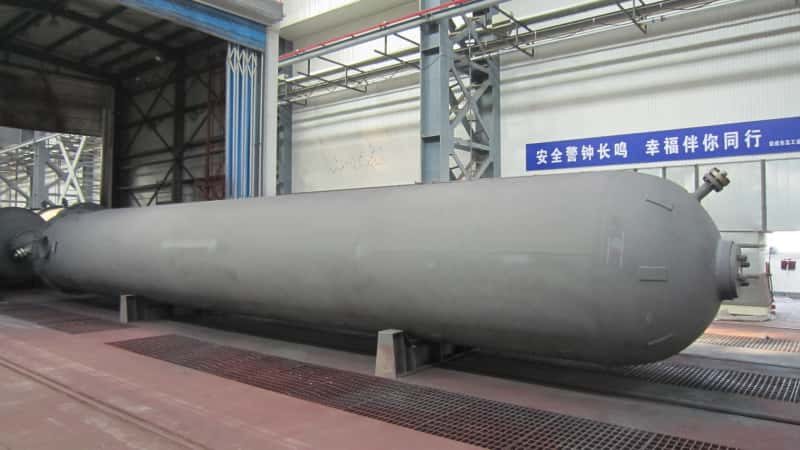

Procurement teams and inspection engineers misflag equipment classifications more often than the industry admits. A vessel purchased under the wrong code class arrives on-site under-rated for nozzle loads, missing the required impact-tested material certificates, or stamped to the wrong inspection category — and the project stalls at pre-commissioning while someone renegotiates scope with the fabricator. In EPC work, that reclassification rarely costs less than schedule delay alone; add expedited re-inspection, weld repairs to upgrade joint efficiency, and potential re-stamping fees, and the procurement error compounds fast.
A process vessel is any pressure-containing item that participates directly in a chemical or physical transformation — reaction, separation, heat transfer, absorption — and is designed to ASME Section VIII, EN 13445, or GB 150 for pressures typically ranging from 0.1 MPa to 35 MPa and temperatures from −196 °C to 650 °C. A storage tank holds product at or near atmospheric conditions, generally below 6.9 kPa gauge, and is governed by API 650, API 620, or equivalent standards. The design philosophy, material certification depth, nozzle rating, and inspection category are fundamentally different between the two.
What makes this boundary genuinely tricky is that the line between “storing” and “processing” is not always obvious from a drawing. A vessel sitting on a foundation, filled with liquid, and equipped with a single inlet and outlet can look identical to a storage tank — until you check the operating pressure, the fluid phase behavior, or whether residence time is doing any work. That grey zone is exactly where misclassification happens, and where the regulatory and commercial consequences are sharpest for projects above 1,000 L involving hazardous or flammable media.
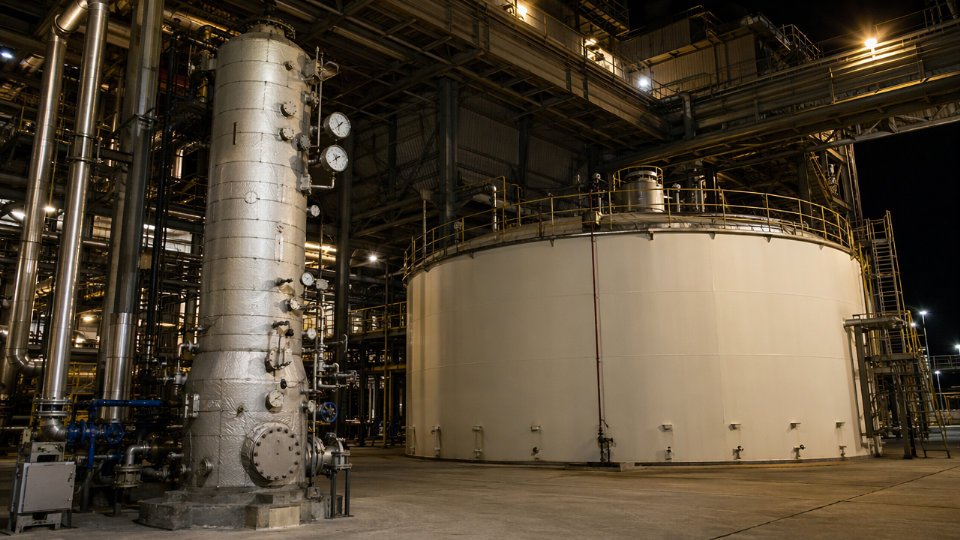
Functional Definition: What a Process Vessel Actually Does Inside a Plant
A process vessel is not defined by its shape, its wall thickness, or even its pressure rating alone. It is defined by what happens to the fluid while it is inside. The fluid entering a process vessel is chemically or physically different from the fluid leaving it. That single criterion — active participation in a unit operation — is what separates a process vessel from every other piece of pressure-containing equipment on a plot plan.
That distinction sounds simple. On a real project, it creates a cascade of engineering decisions that storage tank procurement logic simply cannot accommodate.
Active Duty: What “Participating in a Unit Operation” Means
When a process engineer assigns a vessel to a unit operation, they are defining an obligation. The vessel must create or maintain the exact conditions — temperature, pressure, residence time, fluid dynamics, or mass transfer driving force — under which a specific transformation occurs. A reactor must sustain reaction kinetics. A separator must resolve a two- or three-phase mixture into discrete streams. An absorber must maintain the vapor-liquid contact area and approach to equilibrium that the mass balance demands. None of that happens passively.
Compare that to a tank holding feedstock at ambient conditions. The tank participates in nothing. Inventory sits inside; inventory leaves. The fluid is identical on entry and exit.
Canonical Process Vessel Types in Petrochemical and Energy Projects
Each of the following vessel types has a specific, defined process duty. Knowing them by duty — not just by name — is what prevents misclassification on a requisition sheet.
| Vessel Type | Process Duty |
|---|---|
| Reactor | Provides containment, residence time, and often heat management for a chemical reaction |
| Two-phase / three-phase separator | Resolves a mixed feed into gas, liquid hydrocarbon, and water streams by gravity and retention time |
| Scrubber | Removes particulates or acid gases from a vapor stream by contact with a liquid wash |
| Absorber | Transfers a target component from a gas phase into a solvent under controlled pressure and temperature |
| Stripper / desorber | Reverses absorption duty — drives dissolved components back into the vapor phase using heat or pressure reduction |
| Flash drum | Reduces pressure across a liquid stream to generate partial vaporization, achieving a defined split |
| Knockout drum | Removes entrained liquid droplets from a high-velocity gas stream upstream of compressors or fired heaters |
| Coalescer | Agglomerates fine dispersed-phase droplets into larger ones using internals, enabling downstream separation |
| Pressure filter | Separates solids from a liquid slurry under differential pressure across a filter media |
A knockout drum protecting a compressor suction is not a storage vessel that happens to be pressurized. It is a protection device with a process function, and its sizing depends on droplet settling velocity, inlet momentum, and the mist eliminator performance specification.
Why Operating Conditions Are Process-Driven, Not Inventory-Driven
This is the point that procurement documents most frequently obscure. For a storage tank, the design pressure and temperature are set by the properties of the stored fluid — vapor pressure at maximum ambient temperature, hydrostatic head, and thermal breathing loads. They are, in essence, properties of the inventory.
For a process vessel, the operating envelope is set by the process itself. A high-pressure flash drum may operate at 6–12 MPa and 180–320°C because those are the conditions required to achieve the target vapor fraction. A reactive absorption column may cycle through exothermic temperature peaks that a static pressure calculation would never anticipate. Residence time — minutes to hours depending on reaction kinetics or settling requirements — imposes vessel volume constraints that have nothing to do with storage capacity planning.
Operating conditions for a process vessel are determined by process requirements, not by the physical properties of the stored fluid alone.True
Process engineers fix temperature, pressure, and residence time through heat and material balances, reaction kinetics, or phase equilibrium calculations. Changing those conditions changes the process outcome, which is why mechanical design must follow the process data sheet, not generic storage assumptions.
Those requirements translate directly into design obligations: cyclic loading analysis for vessels with batch reactions, nozzle reinforcement for high-momentum inlet streams, internal support structures for trays or packing, and material selection driven by process chemistry rather than ambient corrosion allowance alone. A vessel specified under API 650 logic — even if it ends up pressure-rated — will systematically miss those requirements. That is the gap where the real project risk lives.
Functional Definition: What Qualifies as a Storage Tank and Where the 1,000 L Threshold Becomes Regulatory
A storage tank has one job: hold fluid inventory. Fluid enters at storage conditions, fluid leaves at storage conditions, and nothing meaningful happens to the fluid in between. No heat transfer, no mass transfer, no chemical reaction, no phase change driven by the equipment itself. The tank is a buffer — a managed inventory point between upstream supply and downstream demand. That deceptively simple function is exactly what separates it from a process vessel, and it is also what makes correct classification so consequential when you are building a design specification or filling out a purchase requisition.
The Three Sub-Categories Engineers Encounter in Practice
Not all storage tanks are the same, and treating them as a single bucket during procurement is a recurring source of specification errors.
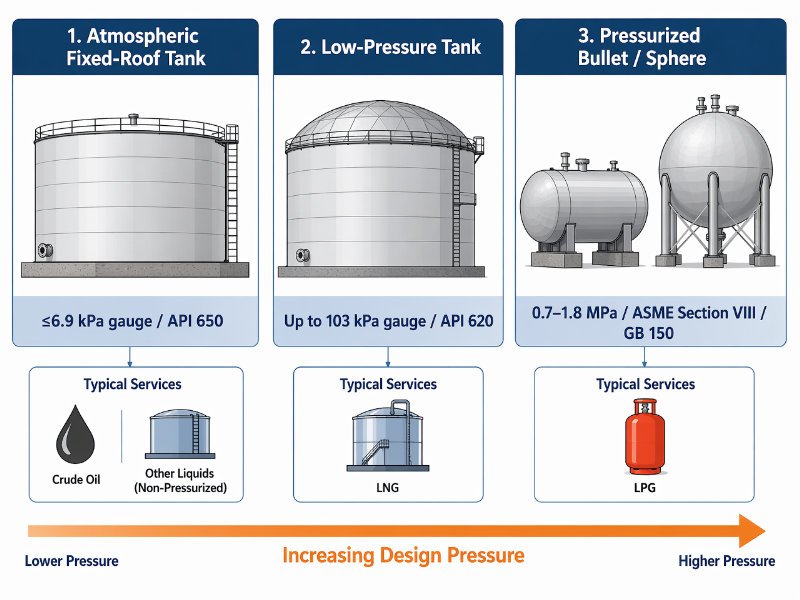
Atmospheric fixed-roof tanks sit at the most common end of the spectrum. Designed under API 650, they operate at internal pressures typically below 6.9 kPa gauge — essentially atmospheric with a small positive pressure margin to control vapor losses. Tank diameter, shell course thickness, and annular plate design are all driven by hydrostatic load from the stored liquid, not by internal pressure. The roof-to-shell joint is intentionally weak, designed to fail before the shell if overpressure occurs. Wall thickness for a large-diameter API 650 tank in water or crude service can range from 6 mm to 40 mm or more depending on diameter, fluid specific gravity, and the applicable corrosion allowance.
Low-pressure tanks — covered by API 620 — extend the design envelope up to roughly 103 kPa gauge (15 psi). You encounter these in LNG storage, ammonia service, and certain refrigerated hydrocarbon applications. The design methodology shifts meaningfully: pressure now contributes to shell loading alongside hydrostatic head, and the structural analysis becomes more involved. Misrouting an API 620 service into an API 650 tank is not a paperwork problem; it is a structural failure risk.
Pressurized bullets and spheres — horizontal or spherical vessels holding liquefied gases above their atmospheric boiling point — fall under ASME Section VIII Division 1 or Division 2, or GB 150 in Chinese-manufactured equipment. LPG bullets, for example, typically operate between 0.7 MPa and 1.8 MPa depending on product composition and ambient temperature. At this point the vessel is a pressure vessel that stores fluid, and the full pressure vessel code regime applies: radiographic examination, impact testing, authorized inspection, and stamping.
Why 1,000 L Is the Number That Changes Your Procurement Workflow
The 1,000 L capacity threshold appears in multiple national and regional regulatory frameworks as the practical cut-off where simplified equipment rules stop applying to hazardous or flammable service.
Below 1,000 L, many jurisdictions permit a manufacturer to supply a tank under general fabrication standards with internal quality documentation only. The design may not require third-party review, the drawings may not need to be registered with a statutory authority, and the inspection scope can be limited to manufacturer’s own checks. For low-hazard fluids this is entirely reasonable. For a small workshop storing hydraulic oil, nobody is routing that through full ASME Section VIII certification.
Above 1,000 L in hazardous, flammable, or toxic service, the picture changes sharply across most frameworks:
| Capacity and Service | Typical Regulatory Requirement | Design Code Likely Triggered |
|---|---|---|
| Below 1,000 L, non-hazardous | Manufacturer self-certification acceptable in many jurisdictions | General fabrication standard |
| Below 1,000 L, hazardous fluid | Jurisdiction-dependent; simplified PED category or GB 150 Class I may apply | Simplified pressure vessel code |
| Above 1,000 L, atmospheric hazardous | Third-party inspection, registered drawings, periodic inspection schedule | API 650 or equivalent national standard |
| Above 1,000 L, low/elevated pressure hazardous | Full pressure vessel code regime, authorized inspector, nameplate stamping | ASME VIII, EN 13445, GB 150 Class II/III |
A storage tank above 1,000 L holding flammable or toxic media can legally require third-party inspection and registered design documentation even if it operates below pressure vessel thresholds.True
Multiple regulatory frameworks — including PED 2014/68/EU, GB 150, and various national implementations of atmospheric storage tank regulations — impose formal documentation and inspection requirements on above-ground storage tanks above specific capacity cut-offs when the stored media presents a hazard, independent of whether internal pressure would trigger pressure vessel code.
The operational consequence in project procurement is direct. A tank specified at 950 L to avoid regulatory overhead, when the actual process buffer volume requires 1,100 L, creates two problems: the equipment is undersized and the procurement team has implicitly assumed a regulatory classification that does not hold once the correct volume is acknowledged. That kind of early-stage corner-cutting routinely surfaces during pre-commissioning inspection or, worse, during a statutory audit after start-up — at a point where retrofitting third-party documentation and inspection records is expensive and schedule-damaging.
Size alone does not define what a tank is. Function defines it. The 1,000 L threshold defines when regulators begin treating your tank with the same seriousness they give to pressure vessels.
Design Code Mapping: ASME, API, EN, and GB Standards and Which Applies to Which Equipment
Selecting the wrong design code at the requisition stage is not a paperwork problem — it propagates through every downstream document: the data sheet, the inspection test plan, the material requisition, and ultimately the fabricator’s shop drawing package. Getting this right early is cheaper by an order of magnitude than a re-classification during third-party inspection or, worse, after hydrostatic testing.
The Core Standard-to-Equipment Matrix
The table below is the working reference. Pressure ranges and temperatures reflect typical service envelopes; actual applicability depends on fluid hazard class, jurisdiction, and whether cyclic or fatigue loading is present.
| Equipment Type | Applicable Standard | Design Pressure Range | Design Temperature Range | Primary Use Case |
|---|---|---|---|---|
| Process pressure vessel (general) | ASME VIII Div.1 | 0.1 MPa to ~20 MPa | -196°C to 650°C | Reactors, separators, drums, heat exchangers |
| High-pressure or fatigue-critical vessel | ASME VIII Div.2 | 0.1 MPa to 35 MPa | -196°C to 650°C | Hydrocracker reactors, high-cycle buffer drums |
| Atmospheric & low-pressure storage tank | API 650 | ≤ 2.5 kPa gauge (with annex) | -40°C to 90°C typical | Crude oil, water, chemical product storage |
| Large low-pressure storage tank | API 620 | Up to 103 kPa (15 psig) | Down to -165°C (LNG) | Ammonia, LNG, low-pressure gas storage |
| Process pressure vessel (European) | EN 13445 | 0.05 MPa to 100+ MPa | -270°C to 900°C | PED-regulated vessels, EU project requirements |
| Atmospheric storage tank (European) | EN 14015 | Atmospheric to ~10 kPa gauge | -40°C to 200°C | Above-ground site-built storage, ATEX zones |
| Process pressure vessel (China domestic) | GB 150 | 0.1 MPa to 35 MPa | -196°C to 900°C | All pressure vessel categories in Chinese regulations |
| Atmospheric & low-pressure tank (China) | GB 12337 | Atmospheric to 0.1 MPa | -20°C to 300°C | Spherical and atmospheric tanks, domestic projects |
Pressure Boundary Is Not Negotiable
A vessel containing hydrogen sulfide at 0.15 MPa and 200°C with a volume of 800 L is a pressure vessel under every major code regime — ASME VIII, EN 13445, and GB 150 all capture it based on the combination of pressure, temperature, and fluid hazard class, not volume alone. The 1,000 L threshold discussed elsewhere in this article affects regulatory categorization and inspection frequency, but it does not move a pressurized hazardous-service vessel into tank territory. Procurement teams writing equipment requisitions sometimes anchor on physical size and route a small separator to a tank fabricator operating under API 650 shop practices. That fabricator may have no UT examination procedures for weld joints under pressure vessel code, no ASME U-stamp program, and no fatigue analysis capability. The resulting vessel may look identical but carries a fundamentally different documentation pedigree.
Why API 650 Is the Wrong Code for a Cycling Buffer Drum
This is the most consequential misapplication encountered in EPC procurement. API 650 is a static-stress design code. It assumes the tank fills, sits, and empties under roughly constant pressure — essentially gravity-driven hydrostatic load. It contains no fatigue design methodology, no cyclic pressure rules, and no requirements for stress concentration analysis at nozzle junctions under alternating loads.
A compressor suction buffer drum, a flash drum upstream of a letdown valve, or any vessel that sees repeated pressure swings — even within a moderate range like 0.3 MPa to 1.2 MPa — accumulates fatigue damage at weld toes and nozzle-to-shell junctions. ASME VIII Div.2 Part 5 and Annex 5.C provide the fatigue screening and detailed analysis procedures that protect against this failure mode. EN 13445 Part 3 Clause 18 covers the same ground.
API 650 includes fatigue design rules suitable for cyclic pressure service.False
API 650 is a static-stress code for atmospheric and low-pressure storage tanks. It contains no fatigue analysis methodology. Vessels subjected to cyclic pressure loading must be designed to ASME VIII Div.2, EN 13445, or equivalent codes that explicitly address pressure fatigue.
Specifying API 650 for a buffer drum because it is cheaper or faster to fabricate is a short-term procurement decision with long-term consequence: cracking at nozzle welds, potential brittle fracture in low-temperature service, and a vessel that cannot be certified under pressure vessel inspection programs when the plant later seeks regulatory audit. Catching this at the inquiry stage costs a conversation. Catching it after fabrication costs a vessel.
Mechanical Design Differences: Wall Thickness, Nozzle Ratings, Internals, and Support Structures
When a vendor submits a proposal that lumps a scrubber and a product receiver into the same fabrication category, the first place to audit is the mechanical design package — not the P&ID. The differences show up immediately in wall thickness calculations, nozzle schedules, and internal scope. Getting these wrong at the requisition stage doesn’t just cause a drawing revision; it causes rework after hydrostatic testing or, worse, a non-conformance report during third-party inspection.
Wall Thickness Calculation: Two Completely Different Methodologies
A process vessel designed to ASME Section VIII Division 1 calculates minimum required shell thickness using the internal pressure formula — typically the hoop stress equation — and then stacks on top of that a corrosion allowance (commonly 1.5 mm to 6 mm depending on fluid corrosivity and service life target), a mill undertolerance factor, and a joint efficiency factor that drops as low as 0.70 for radiographed single-butt welds on lower-inspection-category joints. Post-weld heat treatment requirements then apply above certain thickness thresholds or for specific material grades, adding lead time and cost that must be priced into the fabrication contract.
An atmospheric storage tank designed to API 650 works from an entirely different starting point. Shell course thickness is governed by hydrostatic head — the weight of the liquid column acting on each ring — not internal pressure in the vessel-code sense. The bottom courses of a large tank are thicker than the top courses precisely because liquid head increases with depth. No joint efficiency multiplier in the pressure vessel sense applies here. Applying a pressure vessel wall thickness formula to an API 650 tank specification produces an over-designed, over-priced shell that still fails the API 650 design check because the methodology is simply wrong.
Nozzle and Flange Ratings: Where Misspecification Creates Expensive Rework
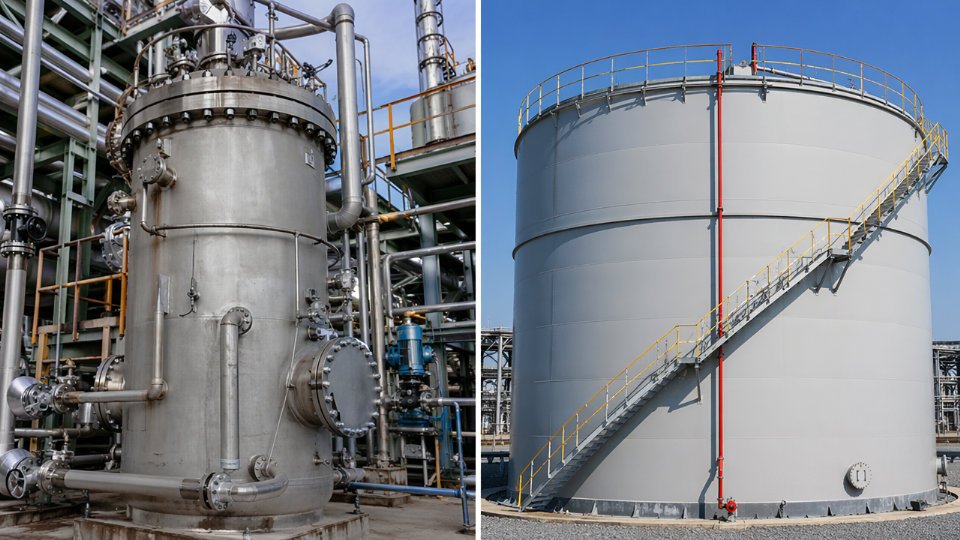
Process vessel nozzles are rated to ASME B16.5 flange classes — 150# through 2500# for nominal pipe sizes up to NPS 24 — or B16.47 for larger bore connections. Flange class selection follows from design pressure, design temperature, and material group. A 300# raised-face weld-neck flange on a high-pressure separator inlet is not interchangeable with a 150# flat-face slip-on nozzle on a product storage tank, even if the pipe bore is identical.
Atmospheric tank nozzles are predominantly flat-face flanges at low pressure ratings — often 150# rated by class but specified flat-face to protect the tank shell from bending moments — and reinforcing pad calculations follow API 650 Annex A rather than ASME UG-37. When a datasheet for a field-erected tank mistakenly calls for raised-face 300# flanges throughout because someone copied a process vessel specification, the fabricator either charges a change order to revise the nozzle schedule or builds what the drawing says and creates a gasket compatibility problem at commissioning.
Applying ASME B16.5 Class 300 raised-face flanges to an atmospheric storage tank nozzle schedule does not improve safety and creates bolt-load and gasket seating mismatches with the tank's connecting pipework.True
Atmospheric tank nozzles are designed for near-zero internal pressure; specifying high-class raised-face flanges changes the bolt pattern, required gasket type, and seating stress in ways that downstream piping designed to API 650 nozzle loads does not anticipate.
Internal Components: Fundamentally Different Vendor Scopes
This is where the vendor scope diverges most sharply, and where a poorly written purchase requisition creates the most ambiguity.
A process vessel — a distillation column, an absorber, a two-phase separator — contains internals that are integral to the process duty. Structured packing sections require height and specific surface area to be specified. Demisters need wire mesh grade, pad thickness, and drainage clearance. Vortex breakers on liquid outlet nozzles prevent gas entrainment in the product stream. Distributor plates must be designed for the actual vapor and liquid loadings at operating conditions. These are engineered components; the vendor scope includes design, material certification, and often witness inspection.
A storage tank above 1,000 L requires level instrumentation bridles, a fixed or floating roof depending on vapor pressure of the stored product, possibly a heating coil for viscous fluids, and a sump or drawoff nozzle arrangement. That is functionally the entire internal scope. Floating roof tanks add seal systems and rolling ladder guides, but these are still fundamentally different in engineering complexity from a packed column’s internal hydraulics.
When a procurement team issues a single line item covering both a reflux drum and a reflux accumulator tank without distinguishing internal scope, the vendor with the lower bid has almost certainly priced no internals at all. The consequence is a vessel that arrives on site missing its demister pad or vortex breaker — discovered during pre-commissioning inspection, at a point where the delivery schedule has no slack.
Support structure selection follows the same logic. Process vessels on saddles or skirts are designed to ASME or EN code rules for nozzle load combinations, wind and seismic loading on elevated vessels, and thermal expansion at the support points. Large flat-bottom tanks sit directly on compacted granular foundations or ring-wall foundations designed to API 650 Annex B — a completely different civil and structural interface that affects both foundation design and tank bottom settlement monitoring requirements over the service life.
Inspection, Testing, and Certification Requirements Compared Across Equipment Classes
The inspection burden on a project team scales sharply with how a piece of equipment is classified. Get that classification wrong at the requisition stage and you will discover the error during third-party inspection — at the worst possible point in a project schedule.
How Inspection Categories Are Assigned Under PED and GB 150
Under the European Pressure Equipment Directive (PED 2014/68/EU), vessels are sorted into Categories I through IV based on a matrix of fluid group (Group 1 for hazardous, Group 2 for non-hazardous), maximum allowable pressure, and volume. A process vessel handling a Group 1 fluid above roughly 0.5 MPa at volumes above 1 L will almost always land in Category III or IV. That triggers mandatory involvement from a Notified Body — an independent inspection authority — for design examination, production surveillance, and final certification. A fixed-roof atmospheric storage tank for a non-hazardous liquid, by contrast, frequently falls below the PED threshold entirely, or lands in Category I where self-certification by a competent manufacturer is permitted.
GB 150 and the Chinese special equipment regulations (TSG 21) use a parallel three-tier system: Class I, II, and III pressure vessels. Class III is the most stringent and captures high-pressure or high-hazard process equipment. It requires involvement from a licensed inspection agency (特种设备检验机构 — and for international readers: this is a state-authorized third-party body) at defined hold points during fabrication. Atmospheric storage tanks above 1,000 L in China are governed separately under GB 50341 or GB 50128 depending on type, with their own inspection protocols that do not mirror the pressure vessel classification ladder.
The practical consequence: if a procurement team writes a purchase order for a flash separator using atmospheric tank inspection requirements, the vendor’s ITP will have no NDE hold points at pressure-bearing seams, no Notified Body sign-off, and no code stamp. That vessel will fail acceptance at commissioning.
NDE Requirements: Where the Gap Between Classes Is Widest
For a process vessel under ASME Section VIII Division 1, longitudinal and circumferential seam welds on shells and heads are subject to radiographic testing (RT) or ultrasonic testing (UT) according to the joint efficiency specified in the design calculation — full RT yields a joint efficiency of 1.0 and directly reduces required wall thickness. Post-weld heat treatment (PWHT), where required by material grade or wall thickness thresholds, must be followed by hardness testing to verify the heat-affected zone has been properly tempered. Pressure testing — hydrostatic at 1.3× MAWP (1.5× under older editions and certain GB requirements) or pneumatic at 1.1× MAWP with additional precautions — is a mandatory final hold point before the Data Report is signed.
Atmospheric storage tanks under API 650 follow a different inspection logic entirely. Floor weld integrity is checked by vacuum box testing or spark testing. Shell welds are visually inspected and may receive spot RT, but the extent is far lower than for pressure vessels. Roof welds on fixed-roof tanks are inspected for tightness rather than structural pressure containment. Hydrostatic testing of an API 650 tank means filling to design liquid level — it is a settlement and leak check, not a pressure proof test.
Documentation Deliverables and Why Mixing Them Creates NCRs
A code-stamped ASME pressure vessel ships with a Form U-1 Manufacturer’s Data Report, signed by the Authorized Inspector, plus material mill certificates with full traceability to each pressure-retaining component, PWHT charts, NDE reports, and the stamped nameplate. Under GB 150 Class III, the equivalent package includes a 竣工图 (as-built drawing) — in English project documentation: the certified as-built drawing — inspection certificates from the licensed agency, and a product quality certificate registered with the local special equipment authority.
An API 650 storage tank completion package looks nothing like this. It includes a settlement record, the manufacturer’s certificate of conformance, weld inspection records, and where Annex M applies, a checklist-format completion certificate. There is no equivalent of the U-1 form and no code stamp on the shell.
When a project delivery team receives a mixed batch of equipment and files all certificates together without distinguishing the document types, the commissioning inspector’s document review will raise non-conformance reports against whichever item is missing its correct deliverable. Resolving an NCR for a missing U-1 form after a vessel is installed can hold up mechanical completion by weeks, because the original Authorized Inspector must review records, sign off retroactively if permitted, or in the worst case require a re-inspection at site.
A process vessel that passes API 650 inspection is compliant with ASME Section VIII requirements.False
API 650 is a tank fabrication standard governing atmospheric or near-atmospheric storage vessels. ASME Section VIII governs pressure vessels with defined MAWP. The NDE scope, joint efficiency requirements, pressure testing protocol, and documentation package are fundamentally different. A tank built and inspected to API 650 does not satisfy ASME VIII requirements and cannot receive a U stamp.
Specify the inspection category, the applicable code, and the required documentation package in the purchase order — not just the equipment type. That single discipline in procurement prevents the majority of certification-related NCRs on multi-equipment EPC projects.
Procurement Decision Framework: How to Classify Borderline Equipment in Your MTO Before Issuing RFQs
Getting classification right before the RFQ goes out matters far more than most project schedules allow time to acknowledge. Once a vendor prices a vessel against the wrong code, the cost delta to correct the specification — revised drawings, re-stamping, additional NDE — typically runs well beyond any early-stage time saved by guessing.
The three questions below form a sequential gate. Work through them in order for every borderline item on your MTO. A single “yes” anywhere in the chain is sufficient to route the item toward process vessel classification and all the design, inspection, and documentation obligations that follow.
Step 1: Does the Fluid Undergo Any Phase Change, Reaction, or Composition Change Inside the Vessel?
If the answer is yes — vapor breaks out of solution, condensate forms, a reagent neutralizes, or dissolved gas separates — the vessel is performing process duty. Geometry and pressure rating are irrelevant at this gate. A produced water degasser sitting at near-atmospheric pressure still satisfies this criterion because dissolved methane is actively migrating out of the liquid phase. Route it to process vessel classification and specify accordingly.
Step 2: Does the Vessel Operate Above 0.1 MPa Gauge During Normal or Upset Conditions?
Normal operating pressure is not the only number that matters here. Check the relief valve set pressure, check the blocked-outlet scenario in the process hazard study, and check any steam-out or nitrogen-blanketing pressure specified in the operating philosophy. A diesel day tank may sit at atmospheric pressure during normal filling and dispensing, but if the site’s nitrogen blanket system can deliver 0.15 MPa to that vessel during an upset, you are above the threshold. The vessel datasheet must capture the maximum allowable working pressure (MAWP) for the worst credible condition, not the typical operating point.
Step 3: Is the Volume Above 1,000 L and Does It Contain a Hazardous, Flammable, or Toxic Medium?
This gate catches vessels that cleared Steps 1 and 2 but still carry regulatory weight due to inventory size and media hazard. An ammonia buffer vessel holding 2,500 L at 0.08 MPa gauge does not trigger Step 2, but it absolutely triggers Step 3. Under PED 2014/68/EU and equivalent GB 150 annex classifications, the combination of toxic medium and volume above 1,000 L places the vessel in a higher hazard category regardless of operating pressure.
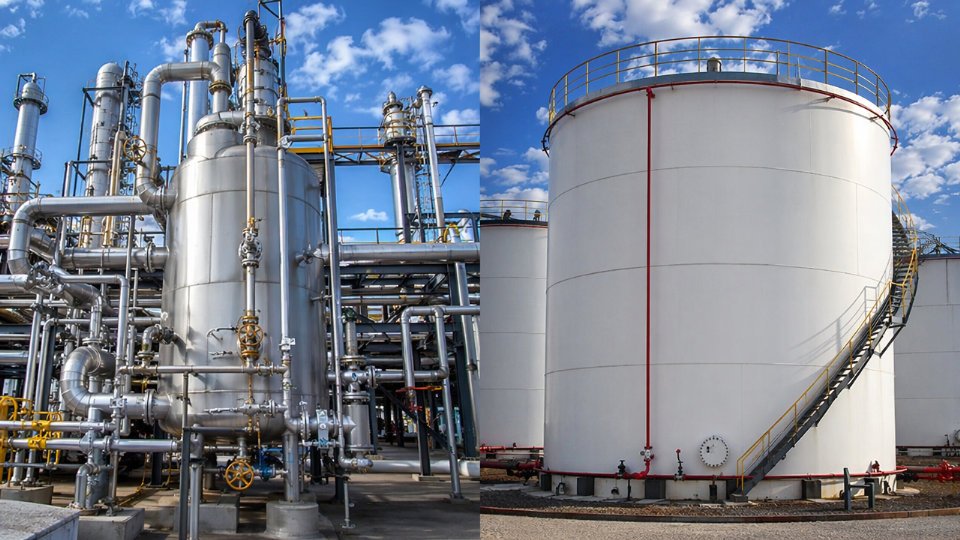
Worked Classification Table for Five Common Borderline Items
| Equipment | Phase Change? | Above 0.1 MPa Gauge? | Hazardous + >1,000 L? | Classification | Rationale |
|---|---|---|---|---|---|
| Condensate surge drum | Yes — vapor-liquid separation | Often yes at 0.3–1.2 MPa | Yes | Process vessel | Active separation duty; design to ASME VIII Div.1 or equivalent |
| Diesel day tank | No | No under normal operation | Check volume and site regs | Storage tank (typically) | Verify nitrogen blanket pressure before confirming |
| Produced water degasser | Yes — dissolved gas release | Near-atmospheric possible | Yes — produced water classification | Process vessel | Gas evolution makes it process duty regardless of pressure |
| Ammonia buffer vessel | No | Depends — liquid NH₃ saturation pressure can reach 0.8–1.6 MPa at 20–50°C | Yes — toxic inventory | Process vessel | Saturation pressure alone clears Step 2; toxic classification reinforces |
| Caustic storage tank (NaOH ≤50%) | No | No | Yes if >1,000 L in many jurisdictions | Regulated storage — verify locally | Not a process vessel, but not a standard tank either; requires corrosion allowance review and secondary containment |
A vessel that clears all three gates as 'no' can be specified as a storage tank for code selection purposes, but local regulatory thresholds for hazardous media must still be verified independently of this framework.True
The three-gate logic addresses functional and pressure classification; country-specific dangerous goods regulations (OSHA PSM, ATEX zoning, REACH) impose additional requirements that operate independently of equipment classification under ASME or EN codes.
Handling Dual-Service Vessels
The hardest items on any MTO are vessels that store and occasionally process — a slop tank that receives hot two-phase blowdown intermittently, or a buffer drum that also acts as a knockout pot during startup. The correct approach is unambiguous: specify the most demanding duty for code selection, not the most common duty. Document this explicitly in the vessel datasheet under “design basis” so that any vendor reading the RFQ understands why the wall thickness, nozzle rating, and inspection category exceed what a plain storage tank would require.
Note on the inspection category: align it to the process vessel requirement even when the vessel spends 95% of its life in storage service. Under-designing the inspection category to match the storage duty is the precise error that surfaces during pre-commissioning audits and, in the worst scenario, during an insurer’s post-incident review.
Cost and Lead Time Implications: Why Correct Classification at FEED Saves Budget and Schedule
Getting the classification wrong at FEED does not just create a paperwork problem. It creates a budget line that moves, a schedule that slips, and sometimes a fabrication slot that disappears entirely. For a project with 20 or more vessels in scope, the compounding effect of even three or four misclassified items can shift overall equipment cost by hundreds of thousands of dollars and push mechanical completion out by two to three months.
The Fabrication Cost Gap Between a Coded Pressure Vessel and an Atmospheric Tank
Start with raw material. A process vessel designed to ASME Section VIII Division 1 or GB 150 — with full pressure-temperature design conditions, nozzle reinforcement calculations, and corrosion allowance driven by actual process chemistry — will almost always require SA-516 Gr. 70 or an equivalent pressure-vessel-quality plate. An atmospheric tank under API 650 can be built from structural-grade carbon steel with far less restrictive mill certification requirements. That material difference alone typically runs 15–25% higher on plate cost, depending on thickness and quantity.
Then add the inspection stack. A coded pressure vessel requires an Authorized Inspector (AI) at multiple hold points: material traceability verification, fit-up, weld procedure qualification, NDE (radiography or UT on longitudinal and circumferential seams), post-weld heat treatment if wall thickness or material grade requires it, and hydrostatic test witnessed by the AI. The ASME code stamp fee, AI visit costs, and NDE subcontract together commonly add $8,000–$35,000 per vessel depending on size and complexity — figures that depend heavily on vessel diameter, number of nozzles, and whether PWHT is triggered. An API 650 tank of comparable volume carries a fraction of that inspection burden.
When you budget a 2,000-liter item as an atmospheric storage tank and it is reclassified as a pressure vessel after FEED is complete, the fabrication cost increase typically runs 30–80% above the original estimate. The wide range reflects whether PWHT is required, whether the design pressure pushes into thicker shell courses, and how many nozzle ratings must be upgraded from Class 150 to Class 300 or higher. A project that budgeted $40,000 for what looked like a simple day tank can face a revised quote of $60,000–$72,000 once the correct code, NDE category, and AI involvement are priced in.
Misclassifying a pressure vessel as an atmospheric storage tank during FEED and correcting it post-RFQ award typically adds 30–80% to that item's fabrication cost.True
The cost increase is driven by mandatory NDE upgrades, PWHT where applicable, higher-grade plate requirements, authorized inspector hold points, and code stamp fees — none of which apply to API 650 atmospheric tanks of equivalent volume.
Schedule Erosion From a Late Reclassification
Re-issuing a datasheet sounds fast. In practice it is not. A revised datasheet triggers a new technical review cycle, a revised RFQ, and re-quotation from vendors who may have already allocated their fabrication slots elsewhere. That sequence typically consumes 4–12 weeks depending on how many vendors are on the bidder list and how backlogged the relevant shops are. If the error surfaces during a fabrication review — say, during the first AI hold point when the inspector flags that the design documentation does not meet Section VIII requirements — the consequences are more severe: potential design restart, loss of the fabrication slot, and re-entry into a shop queue that may now be 6–10 weeks longer than when the original order was placed.
An operational warning worth stating plainly: a fabrication shop that loses its slot to a reclassification-driven restart has no contractual obligation to hold your position in the queue. You go back to the end.
The ROI Case for Early Vendor Engagement During FEED
Engaging a pressure vessel manufacturer informally during FEED — before the MTO is locked — costs almost nothing in the context of a capital project. A technical review of all vessels above 1,000 L, specifically to flag any item where service conditions, nozzle count, or fluid hazard classification could push it into pressure vessel territory, typically takes one or two working days of engineering time from an experienced fabricator. On a project with 25 vessels in scope, even catching two misclassified items before RFQ issue justifies the effort several times over.
The practical ask is simple: share the preliminary process datasheets and P&IDs at the FEED stage, ask the fabricator to flag any item where classification is ambiguous, and document their input in the project basis-of-design. That record also provides a defensible audit trail if a third-party inspector or regulatory authority later questions the specification basis. The cost of that early review is negligible. The cost of skipping it, on a mid-size process plant, rarely is.
Frequently Asked Questions About Process Vessels and Storage Tanks in Industrial Projects
These questions come up repeatedly during FEED reviews, vendor qualification, and MTO audits. Each one has real procurement or compliance consequences.
Can a storage tank be re-rated as a process vessel if operating conditions change?
Yes — but it is not a simple paperwork exercise. If an existing atmospheric or low-pressure storage tank is being considered for a new duty that involves higher pressure, elevated temperature, or a more hazardous fluid class, you need a formal fitness-for-service assessment under API 579-1/ASME FFS-1 or an equivalent national standard before any change of service is permitted. That assessment must confirm that the existing shell thickness, weld quality, nozzle reinforcement, and material toughness all meet the requirements of the applicable pressure vessel code — ASME Section VIII Division 1, EN 13445, or GB 150, depending on jurisdiction.
If the fitness-for-service calculation identifies shortfalls, remediation — weld repairs, reinforcement ring additions, nozzle replacements — must be completed and inspected to the higher category’s NDE and hydrostatic test requirements. In practice, the cost of retrofit inspection and documentation for a tank originally built to API 650 can approach or exceed the cost of ordering a purpose-built pressure vessel, particularly where third-party authorized inspector sign-off is required. Do not assume a tank rated to 6.9 kPa gauge can be quietly upgraded to 0.35 MPa service with a revised P&ID label.
A storage tank originally certified to API 650 cannot be placed into pressure vessel service simply by updating the process datasheet without a formal fitness-for-service assessment and re-inspection.True
API 579-1/ASME FFS-1 and pressure vessel design codes explicitly require re-evaluation to the applicable code's design basis, NDE requirements, and authorized inspection before any change of service that increases design pressure or fluid hazard classification.
Is a pressurized day tank above 1,000 L always classified as a pressure vessel?
Not automatically. Classification depends on two independent variables: design pressure and fluid hazard class. A diesel day tank operating at 0.05 MPa gauge may qualify under a simplified vessel category or even fall below the threshold for full pressure vessel code application in certain jurisdictions — some national regulations set a combined pressure-volume threshold below which reduced requirements apply. The moment you substitute a hazardous or flammable fluid — methanol, LPG, hydrogen — that same 1,200 L vessel at the same operating pressure is pulled into full pressure vessel code requirements because the fluid hazard class overrides the low-pressure exemption. Specify the fluid correctly on the requisition from day one. A misidentified fluid on an early MTO has a predictable downstream consequence: a vendor builds to the wrong standard, the authorized inspector flags it at hydro, and you are looking at schedule impact and potential de-certification.
What is the difference between an ASME U-stamp and an API 650 certificate, and can one substitute for the other?
No. They are not interchangeable and they cover entirely different design bases. An ASME U-stamp, issued after an Authorized Inspector witnesses manufacture and certifies compliance with ASME Section VIII Division 1, confirms the vessel was designed and built to a pressure vessel code that accounts for cyclic loading, nozzle reinforcement calculations, and impact testing requirements appropriate to the service. An API 650 completion certificate confirms the tank was constructed to an atmospheric storage tank standard with its own — far less stringent — shell thickness rules, foundation loading assumptions, and inspection regime.
Substituting one for the other in a project specification is a compliance failure, not a commercial shortcut. Jurisdictional authorities, insurance underwriters, and EPC owner engineers will reject equipment presented with the wrong certification for its service classification.
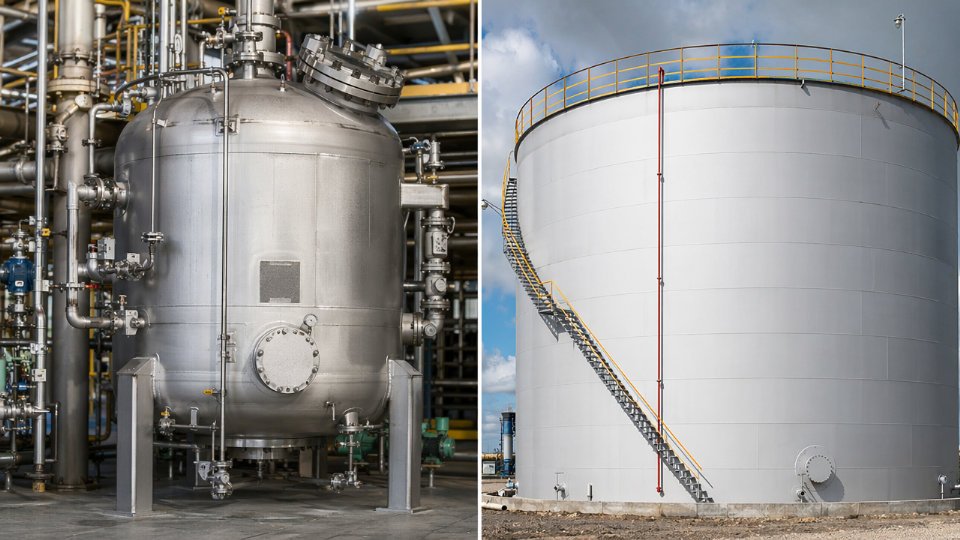
How do EPC contractors typically split procurement of process vessels and storage tanks between vendor pools?
The supply chains are largely separate and for good reason. Coded pressure vessels — especially non-standard, high-pressure, or cryogenic items — require fabricators holding a valid ASME Certificate of Authorization, PED-notified body approval, or an equivalent national license. Those fabricators maintain documented quality management systems, employ qualified welding procedures, and have standing relationships with authorized inspection agencies. Large atmospheric storage tanks, by contrast, are frequently awarded to specialized tank erection contractors who field-fabricate on-site using API 650 or equivalent procedures. Trying to purchase a large field-erected atmospheric tank from a shop-fabricated pressure vessel manufacturer — or vice versa — typically produces a mismatch in capabilities, pricing structure, and delivery format. On an EPC project, mixing these categories in a single RFQ package causes bid confusion and inflated pricing as vendors price in uncertainty.
What documentation should a buyer request to confirm correct classification and design?
Request the following as a minimum package before accepting any vessel or tank at FAT or at site receipt:
- Vessel or tank datasheet with the applicable design code explicitly identified
- Code calculation summary showing design pressure, temperature, corrosion allowance, and material selection rationale
- The applicable standard’s data report form: ASME Form U-1 for Section VIII pressure vessels, the API 650 completion record for atmospheric tanks, or the national equivalent
- Full NDE reports — radiographic, ultrasonic, or WFMT as specified in the ITP — with acceptance criteria referenced to the correct code
- Material test reports (MTRs) traceable to the shell and nozzle materials specified on the datasheet
- Authorized inspector’s release certificate confirming witnessed hydrostatic or pneumatic testing to code-required test pressure
Missing any of these — particularly the data report form and the AI release — means the equipment is not legally certified to the standard claimed, regardless of what the vendor’s commercial invoice states. For cross-border procurement, also confirm that the certifying body is recognized in the destination country’s regulatory regime before the vessel ships.