
There is no universal number of years that defines the service life of every pressure vessel.
A pressure vessel may remain fit for service for decades under stable operating conditions, while another vessel can require major repair or replacement much earlier because of corrosion, cracking, fatigue, high-temperature degradation, process changes, or unexpected damage.
This means statements such as:
“Pressure vessels normally last 20 years”
or
“A pressure vessel should automatically be replaced after 30 years”
are too simplistic for industrial equipment.
For plant owners, EPC contractors, engineers, and equipment buyers, the more useful question is:
Does the pressure vessel still have sufficient structural integrity to remain safely in its actual service conditions?
That question is answered through a combination of the original design basis, material selection, operating history, inspection data, corrosion rate, damage mechanisms, remaining life calculations, and—where necessary—Fitness-for-Service assessment.
API 510 provides a framework for the in-service inspection, rating, repair, alteration, and rerating of pressure vessels, while API 579-1/ASME FFS-1 provides engineering methodologies for determining whether equipment containing degradation or flaws can continue to operate safely.
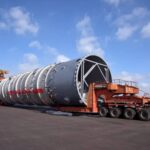
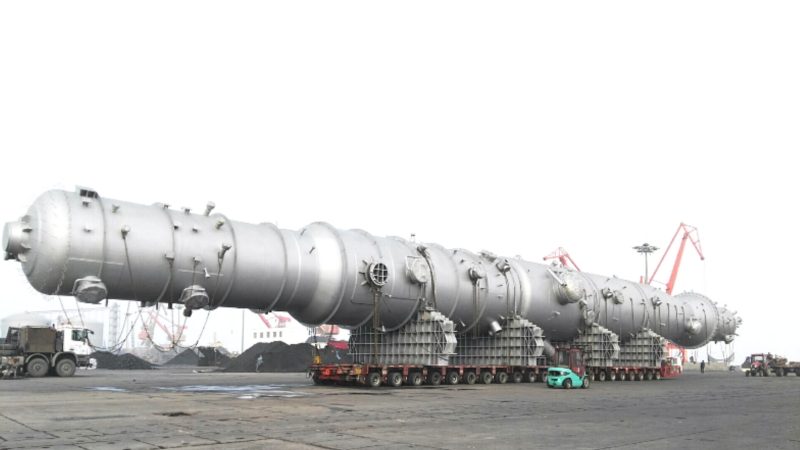
Large hydrocracking reactor manufactured by Weihai Shidao Heavy Industry (WSHI). Pressure vessel service life depends on actual metallurgy, operating conditions, degradation mechanisms, inspection history, and integrity management rather than calendar age alone.
Executive Summary
The service life of a pressure vessel is determined by much more than its age.
Key factors include:
| Factor | Effect on Pressure Vessel Life |
|---|---|
| Original design basis | Defines pressure, temperature, loads, materials and other design conditions |
| Material selection | Controls resistance to corrosion, temperature, hydrogen and other damage mechanisms |
| Corrosion allowance | Provides additional thickness for expected metal loss where appropriate |
| Actual corrosion rate | Determines how quickly available wall thickness is being consumed |
| Pressure and temperature cycling | Can progressively consume fatigue life |
| Operating temperature | May introduce creep or metallurgical degradation at elevated temperature |
| Process medium | Determines corrosion and environment-assisted cracking risks |
| Operating excursions | Can expose equipment to conditions outside the original design basis |
| Inspection history | Provides evidence of actual deterioration |
| Repairs and alterations | Can restore serviceability if properly engineered and executed |
| Fitness-for-Service assessment | Helps determine whether damaged equipment can continue operating safely |
The main takeaway is:
Calendar age is not the same as remaining service life.
A vessel should not automatically be replaced because it reaches a certain age, nor should it remain in service simply because it has not yet reached a nominal design-life number.
Quick Answer: How Long Does a Pressure Vessel Last?
Industrial pressure vessels can often remain in service for many years or even several decades, but there is no technically valid universal lifespan.
The useful service life depends on whether the vessel continues to meet the required integrity criteria under its actual operating conditions.
A relatively old vessel may remain suitable if it has:
- appropriate original materials;
- adequate remaining wall thickness;
- low and stable corrosion;
- no unacceptable cracking;
- manageable fatigue usage;
- appropriate inspection history;
- properly controlled operating conditions.
A newer vessel may have a much shorter remaining life if it experiences:
- unexpectedly aggressive corrosion;
- erosion;
- process chemistry changes;
- excessive pressure or temperature cycling;
- hydrogen-related damage;
- stress corrosion cracking;
- high-temperature degradation;
- significant fabrication or repair problems.
Therefore, the question should not simply be:
“How old is the vessel?”
It should be:
“What deterioration has occurred, how quickly is it progressing, and is the equipment still fit for the intended service?”
Design Life vs. Service Life vs. Remaining Life
These three terms are often confused, but they are not interchangeable.
Design Life
Design life is an engineering basis established during the project or equipment design stage.
It represents the period of operation, number of cycles, or other lifecycle assumption that the equipment is expected to accommodate under specified conditions.
Depending on the project, design-life considerations may influence:
- corrosion allowance;
- fatigue assessment;
- material selection;
- creep design;
- component thickness;
- maintainability;
- inspection philosophy.
Design life does not necessarily mean that the vessel must be scrapped on the exact day that period expires.
It is part of the original engineering basis.
Actual Service Life
Actual service life is how long the vessel has physically been operating.
For example, a vessel commissioned 22 years ago has approximately 22 years of calendar service.
But calendar age alone tells engineers very little about its actual integrity.
Remaining Life
Remaining life is an engineering estimate of how much usable life remains before a specific limit is reached.
For pressure vessels subject to measurable wall thinning, API 510 uses inspection data and corrosion rate as important inputs for estimating remaining service life.
This is why an old vessel with very low metal-loss rates may still have substantial remaining life, while a younger vessel with aggressive corrosion may have comparatively little.
Why Pressure Vessel Age Alone Is a Poor Replacement Criterion
Consider the following simplified comparison.
| Vessel | Calendar Age | Condition |
|---|---|---|
| Vessel A | 25 years | Stable service, low corrosion, good inspection history |
| Vessel B | 8 years | Rapid pitting and unexpected process chemistry |
| Vessel C | 15 years | Frequent thermal cycles and suspected fatigue cracking |
| Vessel D | 30 years | Stable thickness but undergoing a major change of service |
It would be unreasonable to conclude automatically that Vessel A or Vessel D must be replaced simply because they are older.
Likewise, Vessel B cannot be assumed to have another 12 or 20 years of useful life merely because it is relatively new.
The integrity assessment must focus on actual deterioration and actual future service.
This principle connects directly with two related pressure-vessel lifecycle questions:
The first identifies how vessels deteriorate.
The second addresses how frequently their condition should be reassessed.
This article addresses the third question:
How do those factors determine how long the vessel can continue operating?
1. Corrosion Rate Is One of the Most Important Life-Limiting Factors
For vessels affected by general or localized metal loss, corrosion rate can be one of the strongest indicators of future life.
Suppose inspection measurements show that the vessel wall is gradually becoming thinner.
The key engineering questions become:
- What is the current actual thickness?
- What is the minimum required thickness?
- How rapidly is metal being lost?
- Is the corrosion rate stable?
- Is the damage uniform or localized?
- How long can the vessel operate before reaching an unacceptable condition?
API 510 explicitly addresses corrosion-rate determination and remaining-life calculations as part of pressure-vessel integrity evaluation.
A simplified conceptual relationship is:
Remaining Life ≈ Remaining Usable Thickness ÷ Corrosion Rate
This is useful for understanding the principle, but real-life assessment must use the applicable code requirements, inspection data, engineering calculations, and qualified personnel.
Why Corrosion Rate Matters More Than Age
Imagine two carbon-steel vessels with identical original thickness.
One loses metal extremely slowly.
The other loses metal several times faster because of process chemistry.
After ten years, their remaining lives could be completely different.
This is why corrosion monitoring is so important for process equipment.
Corrosion Allowance Helps, but It Is Not a Universal Solution
Corrosion allowance is additional material thickness provided to accommodate an expected amount of metal loss.
For a vessel expected to experience reasonably predictable general corrosion, it can form part of the lifecycle design strategy.
However:
Corrosion allowance does not make an unsuitable material suitable for every corrosive service.
Certain damage mechanisms are not solved simply by adding more thickness.
Examples can include:
- stress corrosion cracking;
- hydrogen-induced cracking;
- sulfide stress cracking;
- some forms of localized corrosion;
- high-temperature hydrogen attack.
In these cases, material chemistry, hardness, metallurgy, heat treatment, stress, temperature, and process environment may be more important than nominal corrosion allowance.
For new equipment, the buyer should therefore provide accurate process information before material selection.
WSHI manufactures custom industrial pressure vessels using project-specific materials and configurations for chemical, petrochemical, oil and gas, energy, and other severe industrial applications.
2. Material Selection Can Add or Remove Years from Vessel Life
Material selection is one of the earliest lifecycle decisions.
The correct material must withstand not only mechanical pressure but also the real process environment.
Depending on service conditions, pressure vessel materials may include:
- carbon steel;
- low-alloy steels;
- Cr-Mo steels;
- stainless steels;
- duplex stainless steels;
- nickel alloys;
- titanium;
- zirconium;
- clad steel;
- corrosion-resistant weld overlay.
The correct choice depends on factors such as:
- design pressure;
- design temperature;
- process chemistry;
- hydrogen partial pressure;
- sulfur compounds;
- chloride concentration;
- corrosion potential;
- low-temperature toughness;
- cyclic loading;
- welding requirements;
- fabrication route.
A vessel built from mechanically strong but chemically unsuitable material can deteriorate rapidly.
A correctly engineered material system can significantly improve long-term reliability.
Severe-Service Example: Hydrocracking Reactor
Refinery hydroprocessing equipment shows why pressure-vessel life cannot be discussed independently from materials.
WSHI manufactured a hydrocracking reactor for Wudi Xinyue Fuel Chemical Co., Ltd. with published specifications including:
| Parameter | Project Data |
|---|---|
| Equipment | Hydrocracking Reactor |
| Diameter | φ4000 mm |
| Wall configuration | 212 + 6.5 mm |
| Length | 22,049 mm |
| Weight | 626.6 tons |
| Base material | 12Cr2Mo1V forged |
| Overlay | E309L + E347 |
This type of equipment operates in a much more severe environment than an ordinary utility receiver or mild-service storage vessel.
High pressure, elevated temperature, hydrogen exposure, thick-wall construction, and specialized metallurgy all affect lifecycle management.
The correct question is therefore not:
“How many years should a hydrocracking reactor last?”
It is:
“How is this specific metallurgy behaving under this specific hydrogen, temperature, stress, and operating history?”
3. Pressure and Temperature Cycling Can Consume Fatigue Life
Not all pressure vessel life is consumed by corrosion.
A vessel may retain almost all of its original wall thickness and still accumulate fatigue damage.
Every cycle involving:
- pressurization;
- depressurization;
- heating;
- cooling;
- startup;
- shutdown;
can create fluctuating stresses.
The effect becomes particularly important around local stress concentrations such as:
- nozzles;
- attachment welds;
- geometric transitions;
- repaired areas;
- weld profiles;
- thermal-gradient regions.
Continuous vs. Cyclic Service
Consider two reactors.
Reactor A operates continuously for months at relatively stable pressure and temperature.
Reactor B performs multiple batch cycles every day.
Even if their calendar ages are identical, their fatigue histories may be very different.
For cyclic equipment, service-life evaluation may therefore require consideration of:
number of cycles + stress range + local geometry + thermal gradients + material fatigue behavior
rather than years alone.
This is especially relevant to industrial reactors and other batch or frequently cycled process equipment.
4. High Temperature Can Introduce Creep Life
At elevated temperatures, metals can undergo time-dependent deformation known as creep.
This creates a fundamentally different lifecycle problem.
Corrosion-related life may depend largely on material loss.
Fatigue life may depend heavily on number and severity of cycles.
Creep life depends on a combination of:
temperature + stress + exposure time + material properties
For equipment operating in a creep-sensitive range, even relatively stable operation gradually consumes material life.
Possible areas requiring attention include:
- base metal;
- weld metal;
- heat-affected zones;
- high-stress regions;
- geometric discontinuities.
API 579-1/ASME FFS-1 includes Fitness-for-Service assessment methodologies relevant to creep damage and remaining life, illustrating why high-temperature vessel life cannot be evaluated using a simple age limit.
5. Process Chemistry Can Change the Expected Vessel Life
The process fluid is often one of the strongest drivers of pressure-vessel deterioration.
Important variables can include:
- water content;
- H₂S;
- hydrogen;
- chlorides;
- acids;
- alkalis;
- sulfur compounds;
- ammonia;
- oxygen;
- process contaminants;
- solids.
A vessel designed for one chemistry may experience very different degradation if the feedstock changes.
For example, a process may gradually introduce:
- more water;
- higher chloride content;
- different sulfur concentration;
- different acid concentration;
- new cleaning chemicals.
Even when pressure and temperature remain unchanged, material compatibility may have changed significantly.
This is why change of service should trigger an appropriate engineering review rather than assuming that the vessel’s original lifecycle expectations remain valid.
6. Erosion Can Shorten Life Even Without Traditional Corrosion
Some pressure vessels handle fluids containing:
- catalyst particles;
- slurry;
- solids;
- droplets;
- high-velocity flow.
In such systems, erosion or erosion-corrosion can cause localized wall loss.
Typical high-risk areas can include:
- inlet nozzles;
- outlet nozzles;
- impingement zones;
- reducers;
- flow-direction changes;
- areas of turbulence.
Localized erosion can be particularly important because an average vessel thickness measurement may not accurately represent the most severely affected area.
The remaining-life evaluation should therefore consider where deterioration is occurring, not simply the average wall thickness.
7. Heat Exchanger Life May Be Limited by Tubes Before the Shell
A shell-and-tube heat exchanger presents an interesting lifecycle problem because it contains multiple pressure-retaining and heat-transfer components.
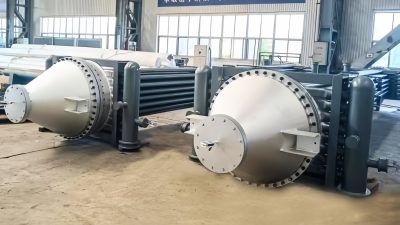
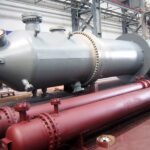
High-pressure industrial shell-and-tube heat exchanger manufactured by WSHI. Exchanger lifecycle assessment should distinguish between shell integrity, tubesheet condition, tube degradation, channel condition, and other pressure-retaining components.
In an industrial shell-and-tube heat exchanger, deterioration may affect:
- shell;
- channel;
- heads;
- tubesheets;
- nozzles;
- welds;
- heat-transfer tubes.
The shell may have substantial remaining life while the tubes experience:
- erosion;
- corrosion;
- pitting;
- vibration wear;
- fretting;
- cracking.
Therefore:
The useful life of a heat exchanger cannot always be represented by one single remaining-life number.
Tube plugging, retubing, bundle replacement, channel repair, or other maintenance may extend equipment service without requiring complete replacement of the entire exchanger.
This is an important lifecycle and procurement consideration for refinery, petrochemical, chemical, power, and process-industry projects.
8. Storage Vessel Life Depends Strongly on the Stored Medium
The same lifecycle principles apply to industrial storage vessels.
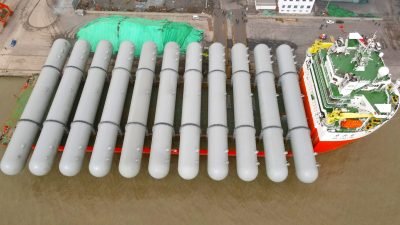
Large industrial pressure storage vessels manufactured for project-based applications. Storage-vessel life depends on medium, pressure, temperature, corrosion environment, material, inspection history, and operating conditions.
WSHI manufactures industrial storage tanks and pressure storage vessels for industrial projects starting from 1,000 liters.
Depending on service, storage vessels may contain:
- LPG;
- industrial gases;
- hydrocarbons;
- chemical liquids;
- process intermediates;
- industrial water;
- utility media.
A dry, non-corrosive service may create a very different deterioration profile from a vessel storing a corrosive chemical.
When evaluating storage vessel life, important questions include:
- Is internal corrosion occurring?
- Is external corrosion occurring?
- Is corrosion under insulation possible?
- Is the stored medium changing?
- Is there water accumulation?
- Are pressure cycles increasing?
- Is the coating or lining still effective?
- Are nozzles or supports deteriorating?
Again, equipment age is only one part of the answer.
9. Fabrication Quality Influences the Starting Point of Vessel Life
Pressure-vessel life begins at fabrication, not after commissioning.
The original manufacturing process establishes the condition from which decades of service may follow.
Important manufacturing controls include:
| Control | Lifecycle Importance |
|---|---|
| Material traceability | Confirms that specified materials were actually used |
| WPS/PQR | Establishes qualified welding procedures |
| Welder qualification | Supports weld quality |
| NDE | Identifies relevant fabrication discontinuities |
| PWHT | Controls residual stress and metallurgical condition where required |
| Dimensional control | Reduces unintended geometric stresses |
| Material verification | Reduces alloy mix-up risk |
| Pressure testing | Verifies pressure-boundary integrity at fabrication stage |
| Manufacturing records | Provide baseline information for future integrity assessment |
A poorly documented vessel becomes more difficult to evaluate years later because engineers may not know exactly:
- which material was installed;
- what NDE was performed;
- where repairs occurred;
- whether PWHT was completed;
- what the original thickness was.
For large EPC projects, the manufacturing data book should therefore be regarded as part of the vessel’s future lifecycle information, not merely final shipping paperwork.
10. Inspection Quality Directly Affects Life Decisions
A pressure vessel does not gain life simply because it has been inspected.
Inspection creates useful lifecycle information only when the technique is capable of detecting the relevant damage.
For example:
- UT thickness measurements can monitor general wall loss;
- corrosion mapping can characterize localized thinning;
- PT or MT may identify suitable surface-breaking indications;
- advanced ultrasonic techniques may be used for appropriate crack-like flaws;
- heat-exchanger tube inspection may require specialized tube techniques.
The inspection strategy should therefore begin with:
What damage mechanism are we trying to detect?
The answer determines:
Where should we inspect, how should we inspect, and how often should we inspect?
For a more detailed discussion of inspection intervals, see:
How Often Should Pressure Vessels Be Inspected?
11. A Process Change Can Change the Remaining Life
A vessel may operate safely for twenty years and then encounter a major change in process conditions.
Examples include:
- higher operating pressure;
- higher operating temperature;
- increased throughput;
- different feedstock;
- new contaminants;
- increased hydrogen concentration;
- more frequent startup and shutdown;
- altered cleaning chemicals;
- changed relief conditions.
The vessel may have been perfectly suitable for its original service but not automatically suitable for the new one.
This is why management of change is important.
Before changing service, engineers may need to reassess:
- materials;
- corrosion mechanisms;
- fatigue;
- pressure rating;
- temperature suitability;
- relief requirements;
- inspection requirements.
Remaining-life expectations should then be updated accordingly.
12. Repairs Can Extend Service Life—But Only When the Damage Mechanism Is Understood
Pressure vessel repair does not automatically mean that the vessel has reached the end of its life.
Appropriately engineered repairs can restore equipment to acceptable service.
Possible actions may include:
- localized weld repair;
- nozzle replacement;
- component replacement;
- heat-exchanger retubing;
- reinforcement;
- clad or overlay restoration;
- pressure rerating.
However, a repair is only valuable if the original damage mechanism is understood.
For example:
Repairing a corrosion defect without correcting the corrosive process condition may simply allow the damage to recur.
Similarly:
Repairing a fatigue crack without addressing the local stress or cycling mechanism may allow a new crack to develop.
API 510 provides a recognized framework for in-service inspection, repair, alteration, and rerating of applicable pressure vessels.
What Is Fitness-for-Service?
When inspection finds deterioration, the decision is not always simply:
Pass or fail.
This is where Fitness-for-Service (FFS) becomes important.
API 579-1/ASME FFS-1 provides engineering assessment methods for equipment containing damage or flaws.
Examples of conditions that may be evaluated include:
- general metal loss;
- localized metal loss;
- pitting;
- crack-like flaws;
- hydrogen-related damage;
- brittle-fracture concerns;
- creep damage;
- fire damage;
- deformation;
- other applicable degradation.
The objective is to answer a practical question:
Can this equipment continue to operate safely under defined conditions, and if so, for how long?
This supports run–repair–replace decisions rather than automatically replacing every vessel containing deterioration.
Run, Repair or Replace?
When a vessel is aging or damaged, owners generally face three broad options.
Option 1: Continue Operating
Continued operation may be appropriate when:
- remaining thickness is adequate;
- relevant flaws remain acceptable;
- damage rate is understood;
- inspection provides sufficient confidence;
- future operating conditions remain controlled.
The next inspection interval may still need adjustment.
Option 2: Repair or Rerate
Repair may be appropriate when damage is localized and technically repairable.
Rerating may sometimes be considered if the equipment can no longer support its previous operating conditions but may remain suitable at reduced pressure or temperature.
These decisions require engineering evaluation under the applicable code and owner requirements.
Option 3: Replace
Replacement becomes more attractive when:
- degradation is widespread;
- corrosion rate is difficult to control;
- repeated repairs are required;
- cracking is extensive;
- remaining life is short;
- operating requirements have changed substantially;
- replacement metallurgy would significantly improve reliability;
- maintenance downtime and repair cost are becoming excessive;
- the vessel no longer meets future production needs.
The technically best decision and the economically best decision often need to be considered together.
When Is It Better to Replace an Aging Pressure Vessel?
There is no single numerical rule, but several indicators can justify serious replacement planning.
1. Remaining Life Is Becoming Short
If inspection shows that remaining usable thickness is being consumed rapidly, increasingly frequent inspection and repair may become uneconomic.
2. Damage Is Becoming More Difficult to Manage
Localized corrosion, repeated cracking, or multiple repair areas can progressively reduce confidence and increase maintenance complexity.
3. The Process Has Changed
An older vessel may remain structurally sound but no longer be suitable for the plant’s new:
- capacity;
- pressure;
- temperature;
- chemistry;
- production cycle.
In such cases, replacement can solve both integrity and process-capacity limitations.
4. Better Materials Are Now Available
A replacement vessel may use improved:
- corrosion-resistant alloys;
- clad materials;
- weld overlay;
- low-temperature materials;
- special metallurgy.
Higher initial cost may be justified by lower long-term maintenance and inspection burden.
5. Maintenance Cost Is Increasing
An aging vessel may require:
- more frequent shutdowns;
- repeated repairs;
- extensive NDE;
- temporary operating restrictions;
- reduced production.
At some point, lifecycle cost may favor replacement.
Should a Pressure Vessel Be Replaced When Its Design Life Expires?
Not automatically.
Design life should be treated as an important engineering basis, but expiry of a nominal design-life period does not by itself establish the actual physical condition of the vessel.
Depending on the equipment and applicable rules, continued operation may require:
- inspection;
- engineering review;
- remaining-life assessment;
- fatigue review;
- Fitness-for-Service assessment;
- other lifecycle evaluation.
Likewise, equipment should not automatically remain in service simply because its nominal design life has not expired.
If serious deterioration is discovered earlier, action may be required immediately.
The appropriate decision is condition-based and engineering-based.
Can a 30-Year-Old Pressure Vessel Still Be Safe?
Potentially, yes.
Age alone does not prove that a pressure vessel is unsafe.
A vessel that has operated for 30 years may remain suitable if:
- the original design remains appropriate;
- materials remain suitable;
- thickness remains adequate;
- damage mechanisms are understood;
- no unacceptable flaws are present;
- inspections are reliable;
- repairs have been correctly managed;
- current service remains within acceptable conditions.
At the same time, a much younger vessel may require replacement if severe deterioration has occurred.
The phrase “old pressure vessel” should therefore trigger an integrity review, not an automatic pass or fail decision.
Can Pressure Vessel Life Be Extended?
In some applications, yes.
Potential lifecycle-extension measures can include:
Better Corrosion Control
- process chemistry control;
- corrosion inhibitors;
- water management;
- coatings;
- linings;
- cathodic protection where applicable.
Improved Operating Control
- reducing abnormal pressure excursions;
- controlling temperature;
- reducing unnecessary cycling;
- maintaining Integrity Operating Windows.
Targeted Inspection
- identifying high-risk areas;
- monitoring corrosion rate;
- using suitable NDE;
- updating inspection locations as damage patterns develop.
Repairs
- engineered weld repair;
- component replacement;
- retubing;
- cladding or overlay repair.
Rerating
Reducing allowable pressure or temperature may sometimes permit continued service, subject to appropriate engineering and code requirements.
Fitness-for-Service Assessment
FFS can help determine whether equipment containing known degradation can remain in service under defined conditions.
Life extension should therefore mean:
engineering evidence that continued operation is acceptable
not simply:
keeping the old vessel in operation for longer.
How Can Buyers Design for a Longer Pressure Vessel Service Life?
Long vessel life begins before the purchase order is issued.
For EPC contractors and industrial buyers, several decisions during procurement can materially affect future reliability.
Provide Accurate Process Data
The RFQ should define:
- design pressure;
- design temperature;
- operating pressure;
- operating temperature;
- process medium;
- chemical composition;
- corrosion data;
- cyclic conditions;
- vacuum conditions;
- upset scenarios;
- expected design life.
Specify Appropriate Materials
Material selection should reflect:
- actual chemistry;
- temperature;
- pressure;
- hydrogen exposure;
- chlorides;
- sulfur compounds;
- toughness requirements.
Define Corrosion Allowance Properly
Where applicable, corrosion allowance should reflect the expected corrosion mechanism and lifecycle philosophy.
It should not simply be copied from a previous project without engineering review.
Consider Inspection Access
Future maintenance becomes easier when the vessel includes appropriate:
- manways;
- inspection openings;
- removable internals;
- accessible nozzles;
- inspection access.
Require Traceable Manufacturing Documentation
The manufacturer should provide the documentation required by the code and project, potentially including:
- material certificates;
- welding records;
- NDE reports;
- PWHT records;
- dimensional inspection reports;
- pressure-test documentation;
- as-built drawings;
- manufacturing data reports.
These records may become critical 10, 20, or 30 years later when engineers need to evaluate remaining life.
What Should Buyers Check When Selecting a Pressure Vessel Manufacturer?
For long-life industrial pressure equipment, supplier selection should be considered part of lifecycle risk management.
A practical assessment should examine:
| Capability | Lifecycle Relevance |
|---|---|
| Engineering capability | Helps establish an appropriate design basis |
| Code qualifications | Supports applicable construction requirements |
| Material experience | Important for severe and corrosive service |
| Welding capability | Directly affects pressure-boundary quality |
| Special-material capability | Important for alloy, clad and CRA equipment |
| PWHT capability | Critical for applicable thick-wall and alloy vessels |
| NDE capability | Supports manufacturing-quality verification |
| Heavy fabrication capability | Determines ability to manufacture large equipment correctly |
| Material traceability | Provides future integrity information |
| Project documentation | Supports future inspection and FFS assessment |
| Comparable experience | Reduces execution risk |
WSHI Heavy Pressure Vessel Manufacturing Capability
Weihai Shidao Heavy Industry (WSHI) specializes in large, tailor-made industrial pressure vessels and heavy process equipment.
Key product categories include:
For its reactor manufacturing scope, WSHI publishes capabilities of up to approximately:
| Parameter | Published Capability |
|---|---|
| Diameter | Ø10,000 mm |
| Length | 60,000 mm |
| Wall thickness | 300 mm |
| Pressure | ≤35 MPa |
| Equipment weight | 960 tons |
| Temperature | ≤575°C |
WSHI also lists ASME U/U2 certification and pressure-vessel manufacturing qualifications for heavy industrial applications.
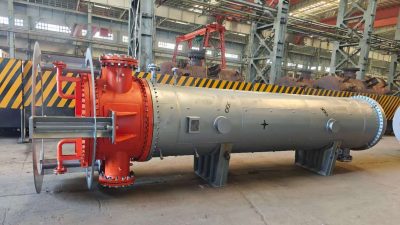
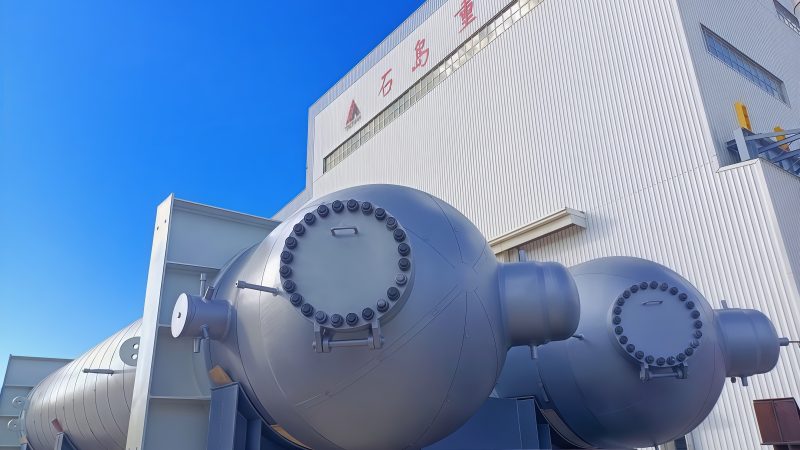
Industrial pressure equipment manufactured at WSHI. Long service life begins with accurate process data, suitable materials, qualified fabrication, documented inspection, and lifecycle-oriented engineering.
Planning a New or Replacement Pressure Vessel?
For a technical and commercial evaluation, prepare:
equipment type + process medium + design pressure + design temperature + expected design life + material requirement + corrosion allowance + cyclic conditions + dimensions + applicable code + inspection requirements + drawings/datasheet
Contact the WSHI engineering team to discuss your pressure vessel requirements.
Pressure Vessel Life Assessment Checklist
Before deciding whether an aging vessel should continue operating, be repaired, rerated, or replaced, consider:
- Original design code and design basis
- Original design life
- Actual operating age
- Material of construction
- Original and current wall thickness
- Minimum required thickness
- Corrosion rate
- Localized metal loss
- Relevant cracking mechanisms
- Pressure and temperature cycles
- High-temperature exposure
- Hydrogen or corrosive service
- Previous inspection findings
- Previous repairs and alterations
- Changes in process chemistry
- Changes in operating pressure
- Changes in operating temperature
- Remaining-life estimate
- Fitness-for-Service assessment where required
- Future production requirements
- Repair cost versus replacement cost
- Consequence of failure
Frequently Asked Questions
How long does a pressure vessel usually last?
There is no universal service-life number.
Industrial pressure vessels can remain in operation for many years or decades, but actual life depends on material, process conditions, corrosion, fatigue, temperature, damage mechanisms, inspection history, repairs, and changes in service.
The vessel’s condition and calculated remaining life are more meaningful than calendar age alone.
Do pressure vessels have a 20-year life?
Not as a universal rule.
Some projects may use 20 years as a design-life requirement, while others may use different lifecycle criteria.
That does not mean every pressure vessel must be replaced at exactly 20 years or that every vessel will safely reach 20 years.
Actual integrity must be evaluated from inspection and engineering data.
Can a pressure vessel last 30 years?
Yes, some pressure vessels can remain fit for service for 30 years or longer when their condition, materials, damage mechanisms, inspection history, and operating environment support continued operation.
However, age alone cannot confirm safety.
A 30-year-old vessel should be evaluated according to its actual condition and applicable integrity requirements.
What determines pressure vessel remaining life?
For equipment affected by metal loss, important inputs may include:
- actual measured thickness;
- minimum required thickness;
- corrosion rate.
For other equipment, remaining life may also depend on:
- fatigue;
- creep;
- cracking;
- hydrogen damage;
- process conditions;
- other degradation mechanisms.
Different mechanisms require different engineering methods.
What is the difference between design life and remaining life?
Design life is an engineering assumption or requirement established during equipment design.
Remaining life is an assessment of how much acceptable service may remain based on the vessel’s actual condition and deterioration.
They should not be treated as the same number.
Does corrosion allowance determine pressure vessel life?
Corrosion allowance can help accommodate predictable material loss, but it does not determine the entire vessel lifespan.
Some damage mechanisms—such as certain forms of cracking or hydrogen-related damage—cannot be managed simply by adding extra wall thickness.
Material selection and damage-mechanism analysis remain essential.
Does an ASME pressure vessel have an expiration date?
ASME Section VIII primarily establishes requirements for pressure-vessel design and construction rather than a single universal calendar expiration date for all pressure vessels.
In-service suitability should be managed under applicable local regulations, inspection codes, owner requirements, and integrity-management procedures.
When should an old pressure vessel be replaced?
Replacement should be seriously considered when deterioration becomes difficult or uneconomic to manage, remaining life becomes short, repeated repairs are required, operating conditions have changed substantially, or the vessel can no longer meet future service requirements.
The decision should be based on engineering condition and lifecycle economics rather than age alone.
Can a damaged pressure vessel continue operating?
Sometimes.
Depending on the type, size, and location of damage, qualified engineers may use inspection data and Fitness-for-Service methodologies such as API 579-1/ASME FFS-1 to determine whether continued operation is acceptable.
Possible outcomes include continued operation, monitoring, repair, rerating, or replacement.
Can repairing a pressure vessel extend its life?
Yes, properly engineered repairs can extend usable service life.
However, the underlying damage mechanism must also be addressed.
Repairing the visible damage without correcting the reason it occurred may lead to recurring deterioration.
How do you know when a pressure vessel has reached the end of its life?
A vessel may be considered no longer suitable for continued service when its structural condition, degradation, remaining thickness, cracking, fatigue, creep condition, or other integrity factors cannot support the intended operating conditions within acceptable engineering criteria.
End of life should therefore be determined through engineering assessment rather than simply counting years.
Conclusion
So, how long do pressure vessels last?
There is no responsible engineering answer such as:
20 years
or
30 years
that applies to every industrial pressure vessel.
Actual service life is controlled by the interaction of:
original design + material selection + corrosion allowance + corrosion rate + fatigue + temperature + process chemistry + operating history + inspection findings + repairs + process changes + remaining-life assessment
The most important distinction is:
Calendar age is not remaining life.
An older vessel may still have substantial usable life.
A younger vessel may require early replacement if its service environment causes rapid deterioration.
For plant owners and EPC contractors, good lifecycle management should therefore follow a logical sequence:
identify damage mechanisms → inspect the relevant areas → quantify deterioration → calculate or assess remaining life → evaluate Fitness-for-Service where necessary → decide whether to run, repair, rerate, or replace
For new projects, pressure vessel longevity begins even earlier.
Accurate process data, appropriate materials, realistic design-life assumptions, corrosion control, inspection access, qualified fabrication, welding quality, NDE, heat treatment, and complete manufacturing documentation all contribute to the vessel’s future integrity.
A pressure vessel should therefore not be purchased simply to survive its factory pressure test.
It should be engineered and manufactured to provide a reliable foundation for its entire intended operating lifecycle.