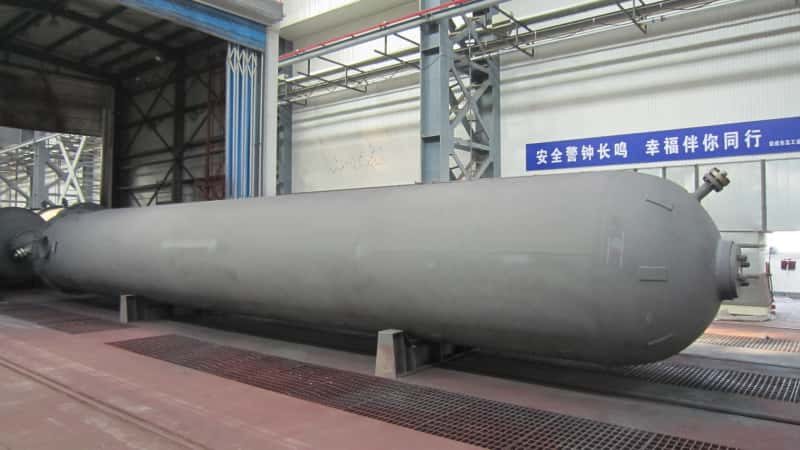

When a production line needs to separate one valuable component from another, the process can quickly become inefficient, expensive, or even impossible if the mixture does not respond well to filtration or distillation. Many plants face losses from poor purity, solvent waste, unstable throughput, fouling, and off-spec products when operators do not fully understand how an extraction tower really works step by step. The good news is that an extraction tower or extraction column is built specifically to solve this problem by creating controlled contact between phases so that target compounds move where engineers want them to go, with repeatable industrial performance.
An extraction tower or extraction column works by bringing two immiscible phases, usually two liquids or sometimes a gas and a liquid, into close contact inside a vertical vessel so that a target component transfers from one phase into the other based on solubility, concentration gradient, and mass-transfer driving force. Step by step, the feed enters the column, the extracting solvent enters from the opposite end, the phases are dispersed and contacted through trays, packing, or agitation, the desired solute moves into the solvent-rich phase, the phases gradually separate as they travel countercurrently, and two outlet streams leave the system: the raffinate, which has had the target reduced or removed, and the extract, which contains the transferred component for later recovery or purification.

Once you see the sequence clearly, extraction towers stop looking like mysterious vertical vessels and start making practical engineering sense. The real value is not only knowing the basic principle, but understanding what happens at each internal stage, why countercurrent flow matters, how droplets behave, where efficiency is won or lost, and what operators must control to keep the column stable in real industrial service.
An extraction tower separates mixtures mainly by selective mass transfer between two phases rather than by simple filtration.True
Extraction columns rely on solubility differences and phase contact so that selected components move from one phase into another, which is different from filtration that separates mainly by particle size.
Step 1: The Process Objective Is Defined Before the Column Even Runs
Before an extraction tower starts operating, the first practical step is not mechanical flow but process definition. Engineers must decide exactly what component needs to be transferred, what purity is required, what feed composition is expected, what solvent can selectively absorb or dissolve the target material, and whether the operation is intended for recovery, purification, contaminant removal, or product concentration. This first step matters because extraction is not a universal separation method; it is a selective one. The column will only work well when the solvent has a much stronger affinity for the target compound than the original carrier phase does. In liquid-liquid extraction, for example, one liquid may contain a dissolved solute that is more soluble in the added solvent. The entire tower is therefore designed around equilibrium behavior, distribution coefficient, phase density difference, viscosity, interfacial tension, corrosion conditions, operating temperature, and downstream solvent recovery strategy. If the chemistry is wrong, the column cannot save the process. In actual industrial design, engineers often begin with lab-scale batch extraction tests, equilibrium curves, distribution data, and pilot-column trials. These studies tell them whether one stage is enough or whether many theoretical stages are required. They also help determine solvent-to-feed ratio, expected loading, and whether internal equipment such as trays, packing, sieve plates, pulsation devices, or rotating disc contactors will be most effective. This is why operators often say that extraction performance is won first in solvent selection and only then in hardware selection. An extraction tower is therefore the physical platform where a selective chemical relationship is transformed into continuous industrial separation. Without a clear process objective and correct phase chemistry, the tower may still circulate fluids, but it will not separate them economically or reliably. From a customer and plant perspective, this first step is where project risk is reduced: choose the right solvent, define the separation target, and size the column around real operating data rather than theory alone. That approach leads to better product quality, lower solvent consumption, reduced energy use in downstream recovery, and fewer startup problems once the system enters production.
Step 2: The Feed Stream Enters the Column at a Controlled Location
After the process basis is set, the next step is introducing the feed stream into the extraction tower at the correct point and under controlled hydraulic conditions. In most continuous extraction columns, the feed does not simply pour into the vessel at random. It enters through a designated feed distributor designed to achieve even phase introduction and to avoid channeling, flooding, or poor contact. The exact feed location depends on the column type and the phase behavior. If the feed is the heavier phase, it is often introduced higher than the lighter phase so gravity can assist phase movement. If it is the lighter phase, the placement changes accordingly. In countercurrent extraction, the feed is typically introduced somewhere between the two ends, while the extracting solvent enters from the opposite side so that the richest solvent meets the leanest feed near one end and the freshest solvent meets the richest feed near the other. This arrangement maximizes the average driving force for mass transfer across the full height of the column. During feed introduction, flow control is critical. Too high a flow rate can create excessive entrainment, unstable droplet size, pressure surges, or flooding. Too low a flow rate may reduce throughput and impair the designed droplet dispersion pattern. Good distributors spread the feed across the cross-section of the column so that no one zone becomes overloaded while another remains underutilized. In packed columns, this is especially important because maldistribution can cause severe efficiency loss; some packing becomes over-wetted while other regions hardly participate in extraction. In tray columns, the feed point must align with stage requirements so that the feed composition enters where equilibrium contact is most beneficial. At this step, temperature also matters. Viscosity, density difference, and solute partition behavior all depend on temperature, so feed preconditioning may be necessary before entry. In industrial service, the feed may also be filtered or degassed upstream to reduce fouling and prevent gas pockets that can disturb liquid-liquid contact. This step may sound simple, but it is where a large share of operating problems begins. Poor feed entry can lead to unstable interfaces, phase inversion, emulsification, and off-spec outlet streams. A well-designed extraction column treats feed entry not as a pipe connection but as a hydraulic and mass-transfer event that must be controlled with precision.
Step 3: The Solvent Enters from the Opposite End to Create Countercurrent Contact
The next step is solvent introduction, and this is where the tower begins to function as a true extraction device rather than just a vessel. The selected solvent is fed into the opposite end of the column from the feed so that the two phases travel in opposite directions, usually countercurrently. This countercurrent arrangement is one of the main reasons extraction towers are so widely used in industry. It keeps the concentration gradient favorable across much of the column height, allowing the target solute to keep transferring from the feed phase into the solvent phase as both streams move past each other. In practical terms, the fresh solvent, which has the highest capacity to absorb the target solute, contacts the partially depleted feed at one end, polishing the separation. At the other end, the increasingly loaded solvent contacts the richest incoming feed, where even a smaller driving force may still be sufficient because the feed concentration is high. This gives better efficiency than simple single-stage or cocurrent operation. Solvent entry must be carefully distributed just like feed entry. The distributor must produce stable droplets or uniform wetting behavior depending on the column internals. In liquid-liquid systems, one phase becomes continuous and the other becomes dispersed; which phase is dispersed depends on flow regime, equipment type, and physical properties. Solvent purity matters too. If the solvent arrives contaminated, saturated, or too warm or too cold, extraction performance can drop immediately. In industrial plants, solvent storage and solvent regeneration units are therefore tightly linked to column performance. The solvent rate is also one of the most important operator-controlled variables. Increasing solvent flow often improves extraction efficiency but also increases pumping load, solvent recovery cost, and downstream separation requirements. Too much solvent may even worsen hydraulics by increasing entrainment or reducing effective residence balance. Too little solvent can starve the process and leave too much target compound in the raffinate. The tower therefore depends on a practical compromise between mass-transfer efficiency and total plant economics. This step also introduces an important reality: extraction does not end at the column outlet. The solvent phase exiting the tower, often called the extract, usually goes to another unit for stripping, distillation, evaporation, or back-extraction so the valuable solute can be recovered and the solvent reused. That is why solvent entry conditions must be managed not only for column performance but for the performance of the whole integrated process.
Step 4: One Phase Becomes Dispersed and the Other Becomes Continuous
Once both feed and solvent are introduced, the actual contacting zone develops inside the extraction tower. At this stage, one liquid phase usually forms droplets dispersed within the other continuous liquid phase. This dispersed-versus-continuous relationship is fundamental to how the column works. The dispersed phase creates countless moving droplets, and each droplet provides interfacial area through which the target solute can diffuse. The more stable and appropriately sized those droplets are, the better the mass transfer tends to be. If droplets are too large, the interfacial area per unit volume is low and extraction becomes less efficient. If droplets are too small, separation later becomes difficult because settling slows, entrainment rises, and emulsions may form. The role of the column internals is therefore to manage this contact pattern. In a packed extraction column, the fluids spread and break around packing elements, renewing interface repeatedly. In a tray column, dispersion occurs as one phase passes through perforations or valves into the other phase at each stage. In a rotating disc contactor, mechanical agitation generates and renews droplets continuously, increasing contact area and mass-transfer rates. The hydraulic behavior in this step determines much of the column’s actual efficiency. Residence time, droplet size distribution, coalescence frequency, backmixing, and hold-up all become relevant. Hold-up refers to the amount of dispersed phase retained in the column at any moment. Too much hold-up can push the system toward flooding, while too little may reduce contact area. This is where practical extraction differs from textbook equilibrium diagrams. Real columns are dynamic hydraulic systems. Internal pressure fluctuations, solvent contamination, trace surfactants, solids, or temperature variation can change the droplet pattern and therefore the entire extraction performance. In industry, operators monitor interface stability, differential pressure, phase clarity, and outlet composition to infer whether this internal contacting regime is healthy. Customers buying extraction towers should pay close attention to how a supplier designs the internals for the intended phase system, because not all liquid pairs behave the same. A tower that works beautifully for one solvent-feed combination may struggle badly with another if density difference is smaller, viscosity is higher, or interfacial tension is lower. This step is where the vessel becomes an active mass-transfer machine, turning fluid motion into usable separation.
Step 5: Mass Transfer Happens Across the Droplet Interface
This is the heart of the process: the target solute moves from one phase into the other. Once droplets and continuous liquid are in contact, a concentration gradient exists between them. The compound being extracted is more soluble, or chemically more favorable, in one phase than in the other, so it begins to diffuse across the interface. In many industrial cases, the feed contains the solute and the solvent selectively absorbs it. The rate of this transfer depends on interfacial area, solute diffusivity, phase turbulence, temperature, viscosity, and how far the system is from equilibrium. Mass transfer is often described as occurring through several resistances: movement through the bulk of the feed phase toward the interface, passage across the interface itself, and movement away from the interface into the solvent phase. In practice, the slower of these steps dominates the overall transfer rate. For example, if the solute diffuses very slowly in a viscous feed, increasing interfacial area may help but will not fully overcome the diffusion limitation. This is why extraction columns are designed not just for contact, but for repeated contact and renewal of interface. Every time droplets break, merge, deform, or slide across internals, the concentration boundary layers are partially renewed, helping transfer continue. The concept of equilibrium is crucial here. At any local contact point, the solute tends toward a distribution between phases defined by its partition coefficient. However, because both phases keep moving, the system may not reach full equilibrium at each point. The job of the tower is to approximate enough stagewise or continuous contact so that the final outlet streams approach the desired separation target. Engineers often express performance in terms of theoretical stages, height equivalent to a theoretical plate, or overall mass-transfer coefficient. Those terms help connect real equipment to design targets. For end users, the practical takeaway is simple: extraction works because the desired compound “prefers” the solvent, and the tower gives that preference repeated opportunities to act. This step is why extraction is especially valuable when distillation is too energy-intensive, when boiling points are too close, when compounds are heat-sensitive, or when selective chemical affinity offers a cleaner route to separation. At the plant level, this step determines recovery rate, raffinate purity, solvent loading, and operating margin.
Step 6: Repeated Contact Along the Height of the Column Improves Separation
A single contact event is rarely enough for demanding industrial separation, so the extraction tower is designed to create repeated contacting throughout its height. This is the step that turns simple liquid-liquid mixing into efficient continuous separation. Each section of the column acts like a partial extraction stage. As the two phases move countercurrently, the composition of each gradually changes. The feed phase becomes leaner in the target solute, while the solvent phase becomes richer. In an idealized stagewise view, each tray or contact zone brings the phases closer to local equilibrium. In a packed or differential contact column, the composition changes continuously from top to bottom. Either way, the principle is the same: more effective contact height generally means deeper extraction, provided hydraulics remain stable. This is why column height is such an important design parameter. If the tower is too short, the raffinate may leave with too much target component still remaining. If it is taller than necessary, capital cost rises and pressure losses or hold-up may increase without sufficient economic benefit. Good design therefore matches height to required separation, solvent ratio, and phase-transfer characteristics. Repeated contact also improves selectivity. In many systems, the solvent extracts not only the desired solute but also some unwanted components. Multi-stage contact can help manage this by progressively enriching the solvent in the target compound while reducing residual levels in the raffinate. Some advanced systems even use scrubbing or washing sections to improve product quality further. From an operator’s point of view, this step means that local upsets inside the column can have a cumulative effect. A maldistributed zone near the inlet can reduce performance across many downstream contact sections. Fouled packing or damaged trays can cut effective stage count. Interface instability can reduce not only one section’s performance but the entire concentration profile through the column. This is why extraction towers are often instrumented with pressure taps, temperature points, interface detectors, sampling points, and analyzers. Customers seeking reliable industrial equipment should understand that internal mechanical quality, distributor design, and service access are not minor details. They directly affect how many useful contact stages the column can sustain over long-term operation.
Step 7: The Two Phases Continuously Separate as They Travel
As extraction progresses, the two liquid phases repeatedly contact and then partially disengage. This separation while traveling is essential because the tower must maintain directional movement of the phases rather than becoming a single mixed tank. Typically, the lighter phase rises and the heavier phase falls under gravity, though the exact flow pattern depends on the process. As droplets move through the continuous phase, they eventually coalesce into larger bodies of liquid when local conditions allow. Internals are designed to balance contact with disengagement. Too much mixing without enough coalescence can cause emulsification and poor outlet clarity. Too much disengagement without sufficient contact reduces mass transfer. A successful extraction tower therefore manages a dynamic compromise between mixing and settling. At each level of the column, droplets form, travel, exchange solute, deform, and then coalesce. New droplets are created again at the next contact zone. This repeated sequence is what makes the process both continuous and efficient. Phase separation quality is strongly influenced by density difference and interfacial tension. Systems with large density differences usually settle more readily, while systems with very low interfacial tension may suffer from persistent emulsions. Solids, surfactants, corrosion products, or organic impurities can make this worse. Operators often discover extraction problems not because mass transfer has disappeared, but because phase disengagement has degraded. The column then shows cloudy outlets, cross-contamination, unstable interfaces, or erratic level control. In some designs, calming zones or enlarged disengagement spaces are provided near the top and bottom to allow cleaner phase separation before withdrawal. Coalescers or demisters may also be used. This step matters greatly for downstream units. If the extract stream contains too much entrained raffinate, solvent recovery units may be overloaded or contaminated. If the raffinate carries solvent droplets, product quality may suffer and solvent loss increases. Therefore, an extraction tower is not just a contacting device; it is also a controlled separator that must deliver two reasonably clean outlet streams continuously. In many plants, successful operation is judged not only by extraction percentage but by how cleanly and stably these two phases disengage over time.
Step 8: The Raffinate Leaves with Less of the Target Component
At this stage, the depleted original phase exits the tower. This outlet stream is called the raffinate. It is the phase that originally contained the target solute but has now had part or most of that solute removed through extraction. The composition of the raffinate is one of the most important process results because it directly indicates how well the column is performing. In environmental service, the raffinate may be the wastewater stream after contaminant removal. In chemical manufacture, it may be the purified carrier liquid after undesirable compounds have been extracted. In hydrometallurgy, it may be the aqueous phase after valuable metal ions have been transferred to the organic solvent. The raffinate outlet is usually taken from the end of the column where that phase accumulates after traveling through the full contacting height. Good hydraulic control is essential here. The outlet must be drawn without dragging excessive amounts of the other phase with it. Interface level control near the outlet region is therefore critical. If the internal interface shifts due to flow imbalance, the raffinate nozzle may begin withdrawing the wrong phase or a badly contaminated mixed stream. In industrial systems, outlet clarity, residual solute concentration, solvent carryover, temperature, and density are often monitored. These measurements help operators decide whether the solvent rate, feed rate, or interface position needs adjustment. For customers evaluating extraction equipment, one practical question is how easily outlet conditions can be sampled and controlled. A tower may look impressive externally, but if outlet hydraulics are poorly designed, operational reliability suffers. It is also important to understand that the raffinate is not always the waste stream. Depending on the process, it may be the main saleable product. In some aromatic extraction services, for example, the raffinate contains the non-aromatic fraction desired for blending or further processing. In other cases, the raffinate is simply the cleaned mother liquor sent onward. This step shows why extraction columns are useful in industry: they allow plants to alter the composition of a stream continuously and predictably without needing to vaporize the whole system. That can save energy, protect heat-sensitive compounds, and enable separations that are not practical by simple thermal methods.
Step 9: The Extract Leaves Rich in the Desired Solute
At the opposite end of the column, the solvent-rich stream exits. This is called the extract. It contains the solvent plus the transferred target component and sometimes smaller amounts of co-extracted impurities. The extract represents the success of the solvent’s selective action. In many industrial flowsheets, this stream is the key intermediate because it concentrates the valuable or undesirable compound into a phase that can be handled more efficiently downstream. For example, in copper solvent extraction, the organic extract carries the copper complex to a stripping stage. In pharmaceutical purification, the extract may contain the desired active ingredient in a solvent chosen for later recovery. In petrochemical extraction, the extract may carry aromatic compounds or specific contaminants that need additional processing. The quality of the extract depends on both equilibrium selectivity and hydraulic cleanliness. If the solvent is overloaded, extraction performance may drop near the feed end. If entrained raffinate contaminates the extract, downstream recovery may become difficult. For this reason, extract withdrawal zones are usually designed with settling space and careful nozzle placement. Sometimes settlers or decanters are installed after the column to polish phase separation further. The extract flow rate and composition are closely tied to economics because this stream often moves to solvent recovery equipment such as distillation columns, evaporators, stripping units, or back-extraction stages. A highly diluted extract may require more energy later, even if it achieves strong extraction. That is why operators must balance extraction completeness against solvent usage. More solvent can improve raffinate purity but can make the extract more dilute. Good process design finds the optimum operating window. This step also highlights the integrated nature of industrial extraction. The extraction tower is rarely a stand-alone machine. It is one separation step within a larger process that includes solvent storage, solvent regeneration, heat exchange, pumps, controls, analyzers, and downstream purification. When customers ask how an extraction tower works, the most complete answer is that it works as a selective transfer device whose success is measured not only by what happens inside the column, but by how useful and recoverable the extract stream becomes afterward.
Step 10: Downstream Recovery Regenerates the Solvent and Isolates the Product
The final practical step is often outside the extraction tower itself, but it is essential to understanding the full workflow. Once the extract leaves the tower, the transferred solute usually must be separated from the solvent. This is done in downstream recovery equipment. Depending on the chemistry, the process may use distillation, evaporation, steam stripping, pH shift, back-extraction, precipitation, crystallization, or chemical reaction. The purpose is twofold: recover the target component in useful form and regenerate the solvent for reuse. This is one of the main reasons extraction is economically attractive in industry. A well-designed solvent system can circulate continuously, reducing net consumption and keeping operating cost under control. The quality of the regenerated solvent directly affects the next pass through the extraction tower. If solvent recovery is poor, impurities build up, selectivity drops, viscosity may rise, and column hydraulics can deteriorate. Therefore, when engineers explain extraction tower operation step by step, they often include solvent regeneration as the final loop-closing step. Without it, the column would be only a transfer device, not a sustainable industrial separation system. In many plants, the solvent circuit is where much of the total energy use occurs, especially if thermal recovery is required. This is why solvent selection must consider not only extraction performance but also ease of regeneration, stability, toxicity, compatibility with materials of construction, and environmental compliance. The most successful extraction systems are those where the column and the solvent recovery section are optimized together. A column that creates a perfectly clean but extremely dilute extract may not be the best economic choice if recovery cost becomes excessive. Likewise, a very concentrated extract is not useful if the raffinate remains off-spec. This last step turns the extraction tower from a piece of equipment into a complete process solution. For users in industry, that is the real answer to why extraction towers matter: they enable continuous selective transfer, and when integrated properly with solvent recovery, they create a repeatable, scalable, commercially viable route to purification, recovery, and separation.
Step-by-Step Operating Sequence at a Glance
| Step | What Happens in the Extraction Tower | Why It Matters |
|---|---|---|
| 1 | Process objective and solvent are selected | Determines whether extraction is chemically feasible |
| 2 | Feed enters through a controlled distributor | Prevents maldistribution and hydraulic instability |
| 3 | Solvent enters from the opposite end | Creates countercurrent contact for higher efficiency |
| 4 | One phase disperses into the other | Generates interfacial area for mass transfer |
| 5 | Solute transfers across the phase boundary | Produces the actual separation effect |
| 6 | Repeated contact continues along column height | Improves removal efficiency and product purity |
| 7 | Phases partially disengage as they travel | Maintains continuous flow and outlet cleanliness |
| 8 | Raffinate exits depleted in target solute | Confirms extraction performance on the original stream |
| 9 | Extract exits enriched in target solute | Sends concentrated material to downstream recovery |
| 10 | Solvent is regenerated and reused | Closes the loop for economic industrial operation |
What Happens to Each Stream Inside the Column
| Stream or Zone | Typical Direction | Composition Trend | Main Operational Concern |
|---|---|---|---|
| Feed phase | Up or down, depending on density | Loses target solute over distance | Channeling, entrainment, insufficient residence time |
| Fresh solvent | Opposite to feed | Gains target solute over distance | Incorrect flow ratio, poor distribution |
| Dispersed droplets | Through continuous phase | Exchange solute rapidly at interface | Wrong droplet size, emulsification |
| Continuous phase | Stable bulk phase path | Receives or donates solute depending on design | Backmixing, poor wetting, unstable holdup |
| Raffinate outlet | End of depleted original phase | Lowest target concentration in original phase | Solvent carryover, interface control |
| Extract outlet | End of loaded solvent phase | Highest target concentration in solvent phase | Raffinate entrainment, downstream recovery load |
Simplified Text Chart: How Mass Transfer Progresses Through the Column
| Column Section | Feed Phase Solute Level | Solvent Phase Solute Level | Net Transfer Direction |
|---|---|---|---|
| Feed entry region | Very high | Moderate to high | From feed to solvent |
| Middle section | Medium | Medium | From feed to solvent |
| Solvent polishing region | Low | Very low to low | From feed to fresh solvent |
| Raffinate exit region | Lowest | Slightly loaded nearby | Minimal remaining transfer |
| Extract exit region | Feed no longer present nearby | Highest | Loaded solvent leaves system |
What Determines Whether the Step-by-Step Process Works Well?
Solvent Selectivity
The solvent must strongly prefer the target compound. A solvent with poor selectivity may still extract material, but it will also co-extract too many unwanted components, increasing recovery costs and reducing purity. In professional system design, selectivity is often more important than raw extraction strength because industrial plants need stable, economical separations, not merely movement of material from one stream to another.
Density Difference
A good density difference helps the two phases move in opposite directions and disengage cleanly. When densities are too similar, the column may suffer from poor settling, more entrainment, and harder interface control. This is why extraction tower design often begins with a review of fluid physical properties under true operating conditions rather than room-temperature laboratory assumptions.
Interfacial Tension
Interfacial tension influences droplet formation and coalescence. Very high interfacial tension can reduce contact efficiency because droplets may be too coarse. Very low interfacial tension can create persistent emulsions and make phase separation difficult. Practical extraction design seeks a workable balance.
Viscosity
Highly viscous systems slow droplet movement, reduce diffusion, and increase hydraulic losses. Viscous feeds often need specialized internals or larger columns to maintain efficient contact. In some cases, temperature adjustment is used to reduce viscosity, but only when this does not damage solvent stability or product quality.
Internal Design
Trays, packing, pulsation systems, sieve plates, and rotating disc arrangements all produce different contact patterns. The “best” design depends on flow rate, chemistry, fouling tendency, required efficiency, and maintenance preference. Industrial users should match the internal design to the specific separation duty rather than assuming one style is universally better.
Common Extraction Column Types and How Their Step-by-Step Action Differs
Packed Extraction Columns
In a packed column, the phases move through a bed of structured or random packing. The packing breaks up flow paths, increases contact area, and renews the interface. Step by step, droplets form and reform as they pass through packing surfaces. Packed columns are often valued for lower shear and relatively simple construction, though liquid distribution quality becomes extremely important.
Tray Extraction Columns
In tray columns, one phase passes through openings in a series of trays while contacting the other phase on each stage. This creates a more stagewise contact pattern. They are robust and familiar in many process industries, but tray performance can be sensitive to flow regime, weeping, flooding, and mechanical condition.
Rotating Disc Contactors
These columns use rotating discs and stationary rings to generate controlled agitation. The step-by-step process includes forced droplet breakup and enhanced mass transfer, making them useful for difficult systems, especially where natural contact would be too weak. They can deliver excellent efficiency but involve more mechanical complexity.
Pulsed Columns
Pulsed extraction columns superimpose oscillation or pulsation on the fluid flow, improving dispersion and contact while maintaining overall countercurrent movement. They are common in specialized high-efficiency applications and can be effective for systems needing more controlled droplet behavior.
Typical Industrial Uses Where Step-by-Step Extraction Matters
Extraction towers are used because many industrial separations cannot be done economically by simpler methods. In petrochemical service, they help separate aromatics, lube oil fractions, and contaminants where boiling-point differences alone are not enough. In hydrometallurgy, they transfer metal ions between aqueous and organic phases to recover copper, uranium, nickel, cobalt, and rare metals. In pharmaceuticals and fine chemicals, they purify sensitive compounds without exposing them to damaging temperatures. In food and biotechnology, they help isolate flavors, specialty compounds, or biologically derived products under gentler conditions than aggressive thermal treatment. In wastewater and environmental cleanup, extraction columns remove organics or recover useful components from industrial effluents. In every case, the step-by-step sequence remains similar: define the chemistry, introduce feed and solvent countercurrently, create controlled dispersion, transfer the solute, disengage the phases, withdraw raffinate and extract, and regenerate the solvent.
Frequent Operating Problems and What They Mean in the Step Sequence
| Problem | Where It Shows Up in the Sequence | Likely Cause | Practical Impact |
|---|---|---|---|
| Flooding | Contacting and travel stages | Excessive flow, bad internals, high hold-up | Loss of separation, pressure rise, unstable interface |
| Emulsification | Dispersion and disengagement stages | Low interfacial tension, surfactants, over-agitation | Poor settling, contaminated outlets |
| Channeling | Feed or solvent distribution stage | Poor distributor design, fouling, bad packing wetting | Reduced effective contact area |
| Solvent loss | Raffinate outlet stage | Entrainment, poor settling, interface shift | Higher operating cost, contamination |
| Off-spec raffinate | Mass transfer stages | Low solvent rate, poor selectivity, insufficient height | Inadequate removal of target component |
| Dirty extract | Extract outlet stage | Raffinate entrainment, unstable disengagement | Downstream recovery problems |
How Operators Know the Tower Is Working Properly
A well-performing extraction tower usually shows stable flow rates, consistent interface position, expected differential pressure, clean outlet phases, and outlet compositions that match process targets. Operators often watch solvent-to-feed ratio, raffinate purity, extract loading, temperature, density, and visual clarity. If the raffinate suddenly contains too much target compound, the issue may be insufficient solvent flow, poor internal contact, or solvent degradation. If the extract looks cloudy, phase disengagement may be failing. If pressure drop climbs, packing fouling or flooding may be beginning. Good operators do not treat the tower as a black box. They relate each measurement back to a step in the internal sequence.
Why Countercurrent Operation Is Better Than Simple Mixing
A common customer question is why industry uses tall extraction towers instead of just mixing the feed and solvent in a tank and letting them settle. The answer is efficiency. A single mixer-settler stage can work, but a countercurrent column uses concentration gradients much more effectively. Fresh solvent meets nearly depleted feed, allowing final polishing, while partially loaded solvent meets rich feed where it can still extract strongly. This produces better overall separation with less solvent and less footprint in many applications. In other words, the tower makes the solvent work harder and more intelligently over the full contact path.
A Practical Example
Imagine a feed stream containing a dissolved organic impurity that must be removed before the product can be sold. The process engineer selects a solvent in which the impurity is much more soluble than the main product. The feed enters the middle or upper section of the column, while fresh solvent enters from the bottom. As the solvent rises through the descending feed, droplets form and the impurity diffuses into the solvent. With each stage of contact, the feed loses more impurity. At the top, the cleaned raffinate exits. At the bottom, the impurity-loaded solvent exits as extract. That extract then goes to a recovery system where the impurity is stripped or the solvent is regenerated. The solvent returns to the column and the cycle repeats continuously. This is the industrial logic of extraction in its simplest form.
In summary, an extraction tower or extraction column works step by step by introducing a feed and a selective solvent into opposite ends of a vertical vessel, creating controlled phase contact, allowing mass transfer of a target component across droplet interfaces, repeating that transfer across the height of the column, separating the two phases as they move, and withdrawing a depleted raffinate plus an enriched extract for downstream recovery. What makes this equipment so powerful is not only the chemistry of selective solubility, but the engineering of contact, hydraulics, phase disengagement, and solvent regeneration that turns that chemistry into reliable large-scale industrial performance.