
There is no single “best” reactor type for every gas-liquid, liquid-liquid, or solid-catalyst reaction. The right choice depends on reaction kinetics, phase behavior, mass transfer, heat release, pressure, temperature, catalyst form, fouling risk, corrosion, maintenance strategy, and plant capacity. For EPC contractors, process engineers, and equipment procurement teams, reactor selection must connect process performance with mechanical design, fabrication quality, inspection, and delivery feasibility.
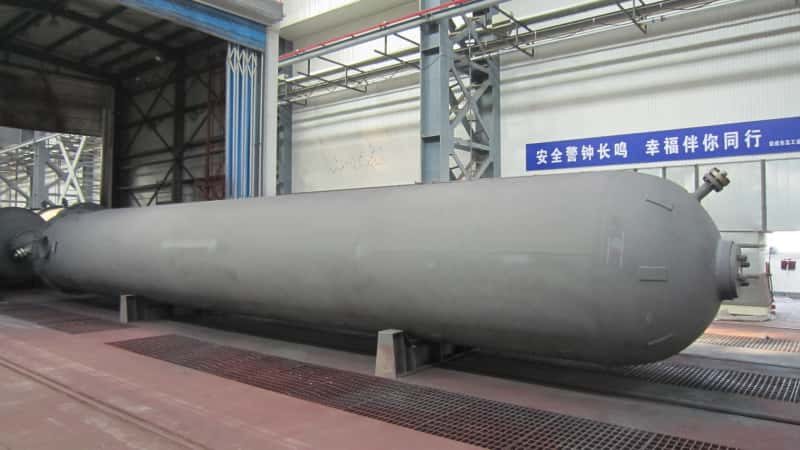
In industrial process plants, reactors are often designed as custom pressure vessels because they must contain reaction media under controlled pressure and temperature while supporting internals, catalysts, mixing, heat transfer, and safe operation.

Why Reactor Type Depends on the Reaction System
A reactor must do more than hold reactants. It must create the right contact between phases. In multiphase reactions, the main engineering challenge is usually one or more of the following:
- Gas must dissolve or contact a liquid phase.
- Two immiscible liquids must be mixed and separated.
- A fluid stream must contact a solid catalyst.
- Heat must be removed or supplied.
- Reaction time must be controlled.
- Catalyst activity and pressure drop must be managed.
- Corrosion and fouling must be controlled.
This is why a reactor type that works well for one process may be unsuitable for another. A hydrogenation process may require a fixed-bed reactor or slurry reactor, while an extraction reaction may need a stirred vessel or column-type contactor.
Reactor Types for Gas-Liquid Reactions
Gas-liquid reactions involve a gas phase reacting with a liquid phase. Common examples include hydrogenation, oxidation, chlorination, carbonation, absorption-reaction systems, and some wastewater or gas treatment processes.
Stirred Tank Reactor
A stirred tank reactor is often used when strong mixing is required. Gas may be introduced through a sparger, and an agitator helps disperse bubbles into the liquid.
It may be suitable when:
- Reaction rate depends on gas-liquid mass transfer.
- Liquid mixing must be uniform.
- Heat removal is important.
- Batch or semi-batch operation is acceptable.
- Catalyst or solids may be suspended.
However, agitator design, shaft sealing, gas dispersion, foam control, heat transfer surface, and maintenance access must be reviewed carefully.
Bubble Column Reactor
A bubble column reactor allows gas to rise through a liquid column without mechanical agitation. It can be attractive where simpler mechanical construction is preferred.
It may be suitable when:
- Gas-liquid contact is needed.
- Mechanical simplicity is valuable.
- Moderate mixing is acceptable.
- The process can tolerate gas holdup and backmixing.
Bubble column reactors may be less suitable when precise mixing, narrow residence time distribution, or high-viscosity liquid handling is required.
Trickle Bed Reactor
A trickle bed reactor is commonly used when gas and liquid flow through a packed bed of solid catalyst. It is widely associated with refining and hydrogenation-related processes.
It may be suitable when:
- A solid catalyst is fixed in the reactor.
- Gas and liquid must contact catalyst surfaces.
- Continuous operation is required.
- Catalyst bed management is central to the process.
For these services, buyers often evaluate pressure vessels for oil and gas and related refinery reactor vessels.
Reactor Types for Liquid-Liquid Reactions
Liquid-liquid reactions involve two liquid phases, often immiscible or partially miscible. Examples may include extraction reactions, neutralization, esterification, nitration, alkylation, and specialty chemical processes.
Agitated Reactor Vessel
An agitated reactor vessel is commonly considered when two liquid phases need controlled dispersion. The agitator creates droplets and increases interfacial area between the phases.
It may be suitable when:
- Liquid-liquid contact area controls reaction rate.
- Batch or continuous stirred operation is needed.
- Temperature control is important.
- Phase separation occurs after reaction.
Important design factors include impeller type, droplet size, residence time, emulsion risk, viscosity, heat removal, and corrosion resistance.
Mixer-Settler System
A mixer-settler combines mixing for reaction or extraction with a settling zone for phase separation. It is often used where liquid-liquid separation after contact is essential.
It may be suitable when:
- Controlled mixing and clear phase separation are required.
- Multiple stages are needed.
- Residence time and interface control matter.
The equipment may include mixing vessels, settlers, phase separators, pumps, and storage tanks.
Extraction Column
An extraction column may be used when continuous counter-current liquid-liquid contact is required. It is more column-like than tank-like and may include internals for phase contact.
For these projects, buyers may review process towers and columns or a dedicated extraction tower design depending on the process requirements.
Reactor Types for Solid-Catalyst Reactions
Solid-catalyst reactions use catalyst particles, pellets, rings, extrudates, or structured catalyst to promote reaction without being consumed. These are common in refining, petrochemical, methanol, ammonia, hydrogenation, and renewable fuel projects.
Fixed-Bed Reactor
A fixed-bed reactor contains a stationary catalyst bed. Reactants flow through the bed and contact the catalyst surface.
It may be suitable when:
- Catalyst can remain fixed for long operating periods.
- Continuous operation is required.
- Pressure drop is manageable.
- Catalyst replacement can be planned during shutdown.
- The reaction is suitable for plug-flow behavior.
Fixed-bed reactors are common in hydroprocessing, methanol synthesis, shift conversion, and many petrochemical processes. They may require catalyst support grids, distributors, thermowells, quench nozzles, outlet collectors, and carefully designed internals.
Fluidized-Bed Reactor
A fluidized-bed reactor suspends catalyst particles in an upward flow of gas or liquid. It can improve mixing and heat transfer, but the mechanical and process design is more complex.
It may be suitable when:
- Strong heat transfer is required.
- Catalyst circulation or regeneration is part of the process.
- Good mixing is needed.
- Solids handling can be managed.
Buyers should carefully review erosion, catalyst attrition, internals, cyclones, separation systems, and maintenance requirements.
Slurry Reactor
A slurry reactor suspends catalyst particles in a liquid phase while gas or liquid reactants contact the catalyst. It may be used when heat transfer and catalyst contact are important.
It may be suitable when:
- Fine catalyst particles are used.
- Gas-liquid-solid contact is required.
- Heat removal is important.
- Catalyst separation can be managed downstream.
Slurry reactors require careful review of agitation, catalyst separation, erosion, filtration, and maintenance.
Key Selection Factors for EPC Buyers
Reaction Kinetics and Mass Transfer
If the reaction is slow, residence time may dominate. If the reaction is fast, gas-liquid or liquid-liquid mass transfer may control the process. The reactor must be selected around the controlling step, not only around capacity.
Heat Release and Temperature Control
Many reactions are exothermic or require heat input. Heat control may involve jackets, internal coils, external loops, condensers, coolers, or industrial heat exchangers. For demanding duties, a shell and tube heat exchanger may be part of the reactor system.
Catalyst Type and Replacement Strategy
Solid catalyst systems require planning for catalyst loading, unloading, support, pressure drop, dust handling, regeneration, and replacement intervals. Catalyst handling access must be considered in the mechanical design.
Materials and Corrosion
Material selection depends on reactants, products, solvents, catalysts, temperature, pressure, water content, acid gases, chlorides, hydrogen exposure, and corrosion allowance. Carbon steel, stainless steel, alloy steel, clad materials, lined equipment, or weld overlay may be considered depending on service conditions.
Pressure Vessel Design
If the reactor operates under pressure, it must be designed according to the applicable pressure vessel code and project specification. ASME BPVC Section VIII Division 1 is commonly referenced for pressure vessel construction, but applicability must be confirmed by project engineers and local regulatory requirements. OSHA also provides a general pressure vessel standards reference page for U.S. safety context.
For broader reactor and fluid-flow fundamentals, DOE technical references available through OSTI can provide useful engineering background.
Internals and Interface Control
Reactor internals can include distributors, trays, catalyst supports, quench systems, spargers, baffles, coils, demisters, thermowells, and internal piping. Responsibilities between the process licensor, EPC contractor, internals supplier, and vessel fabricator should be clearly defined.
Manufacturing and Quality Control Considerations
A reactor manufacturer should review process datasheets, drawings, material specifications, welding requirements, internals interfaces, inspection plans, heat treatment requirements, coating or lining needs, and delivery conditions before fabrication.
Important manufacturing controls may include:
- Material certificate review
- Plate cutting and forming
- Shell rolling and head fitting
- Nozzle installation
- Internal support welding
- Welding procedure control
- Heat treatment where required
- Dimensional inspection
- NDT such as RT, UT, MT, or PT where specified
- Pressure or leak testing
- Final documentation review
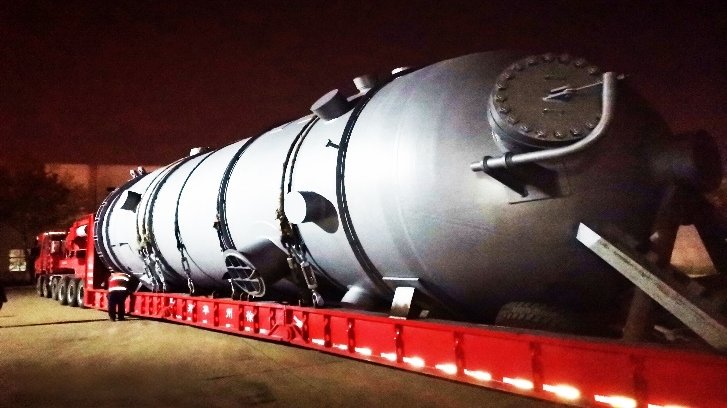
A large-scale pressure vessel manufacturer can support manufacturability review, material traceability, welding control, inspection coordination, and large equipment delivery planning.
What Buyers Should Prepare Before Requesting a Quotation
Before requesting a quotation for a reactor vessel, buyers should prepare:
- Reaction type and process description
- Gas-liquid, liquid-liquid, or solid-catalyst phase system
- Process datasheet
- Design pressure and design temperature
- Operating pressure and operating temperature
- Reactant and product composition
- Catalyst information, if applicable
- Required residence time or volume
- Heat transfer requirements
- Material specification
- Corrosion allowance
- Internals scope and interface requirements
- Nozzle schedule
- Support and lifting requirements
- Applicable design code and project standard
- NDT and inspection requirements
- Pressure or leak testing requirements
- Delivery destination and transport limits
- Documentation requirements
FAQ
What reactor is best for gas-liquid reactions?
Stirred tank reactors, bubble columns, and trickle bed reactors are common options. The best choice depends on gas solubility, mass transfer, catalyst use, pressure, heat removal, and operating mode.
What reactor is best for liquid-liquid reactions?
Agitated vessels, mixer-settlers, and extraction columns are common options. Selection depends on phase mixing, separation requirements, residence time, emulsion risk, and continuous or batch operation.
What reactor is best for solid-catalyst reactions?
Fixed-bed reactors are widely used for many continuous catalytic processes. Fluidized-bed and slurry reactors may be selected when heat transfer, catalyst circulation, or gas-liquid-solid contact is important.
Are reactor vessels always pressure vessels?
Not always. Some reactors operate at atmospheric or low pressure. A reactor becomes a pressure vessel when its design conditions fall within the applicable pressure equipment code or regulatory scope.
What should buyers evaluate in a reactor manufacturer?
Buyers should evaluate engineering review capability, material traceability, heavy fabrication capacity, welding quality, heat treatment, NDT, pressure testing, documentation, and delivery support.
Conclusion
The best reactor type for gas-liquid, liquid-liquid, and solid-catalyst reactions depends on phase contact, reaction kinetics, heat transfer, catalyst behavior, corrosion, pressure, temperature, maintenance, and project execution requirements. For EPC buyers, reactor selection should connect process design with pressure vessel manufacturing capability.
If you are sourcing reactor pressure vessels, stirred reactors, fixed-bed reactors, heat exchangers, separators, towers, storage tanks, or other custom process equipment for petrochemical, refining, coal chemical, fertilizer, new energy, or EPC projects, you can discuss your project requirements with an engineering and manufacturing team. Sharing process datasheets, phase behavior, materials, internals requirements, inspection needs, and delivery terms will support technical communication and fabrication evaluation.