
An industrial evaporator may be able to remove the required amount of water while still being unsuitable for the specified final concentration. As dissolved constituents become more concentrated, a process stream can approach saturation, develop precipitates, or form deposits under conditions that differ from the bulk liquid.
Before selecting an industrial evaporator, buyers should establish the intended concentrate composition, identify the relevant solubility and precipitation boundaries over the complete temperature–composition path, and verify whether the required operating range can remain acceptably liquid or must accommodate solids. Feed total dissolved solids (TDS) alone cannot establish a reliable concentration limit for a mixed industrial solution.
For chemical manufacturing and industrial wastewater projects, this requires cooperation between the process engineer, laboratory or testing organization, and equipment supplier. The purpose is not simply to select a higher numerical concentration target. It is to establish a defensible operating envelope and translate that envelope into requirements for the complete evaporation equipment.
What Does a Validated Evaporator Concentration Limit Mean?
A concentration target is the product condition the process is intended to achieve. A validated operating limit is the concentration range supported by appropriate property data, process analysis, and, where necessary, experimental evidence under defined conditions.
The two should not be treated as interchangeable.
Define the Concentration Basis First
An RFQ that states “concentrate the wastewater to 25%” is incomplete unless it identifies what the percentage represents.
Common reporting bases include:
- Total dissolved solids expressed as a mass fraction or percentage by mass.
- Individual dissolved components expressed in mg/L, g/L, molality, or another stated basis.
- Total solids including both dissolved and suspended material.
- A specific target constituent, such as a recoverable compound or dissolved salt.
- A concentration ratio defined from feed and product conditions.
Mass concentration and volume concentration are not necessarily interchangeable. Converting between them may require the solution density at a defined temperature.
Likewise, a conductivity-derived estimate of TDS should not automatically be treated as equivalent to a complete compositional analysis.
For the concentration target to be meaningful, buyers should identify the relevant components, reporting units, reference conditions, and analytical method.
Distinguish the Target From the Acceptable Operating Envelope
A process may have several boundaries:
| Boundary | What it means | Procurement question |
|---|---|---|
| Commercial concentration target | Desired concentrate composition or volume reduction | What final condition must the project deliver? |
| Predicted saturation boundary | Calculated conditions at which one or more solid phases may become thermodynamically stable | Which components and property model support this prediction? |
| Experimentally observed precipitation behavior | Solids formation or other behavior observed under specific test conditions | Which samples, temperatures, durations, and methods were used? |
| Acceptable operating envelope | Agreed composition, temperature, and operating conditions with an assessed level of precipitation and deposition risk | What range can the process and proposed equipment accommodate? |
| Equipment design boundary | Conditions used to develop the complete equipment configuration and its mechanical and process interfaces | What must be confirmed before final design and procurement? |
Editorial terminology for EPC procurement. Actual project acceptance must be defined by the responsible engineering authority.
An experimentally observed limit is only as broad as the conditions investigated. A clear sample during a short test does not prove that no solids will ever develop during extended operation, shutdown, or storage.
Solubility Is Not a Universal Percentage
Solubility depends on the substance and its surrounding chemical and physical conditions.
A liquid can be undersaturated with respect to one potential solid phase and simultaneously approach saturation with respect to another.
At equilibrium, saturation describes the thermodynamic relationship between the solution and a particular solid phase. Supersaturation can provide a driving force for precipitation, but the actual onset of visible crystals also depends on nucleation, growth, time, and process conditions.
For purchasing decisions, this means that the upper concentration limit must be associated with a defined feed composition, temperature range, operating conditions, and acceptable solids behavior.
A single universal TDS or salt percentage cannot replace that assessment.
Why Are TDS and Single-Salt Solubility Data Insufficient?
TDS is useful for describing the overall dissolved material load. It is not a complete description of the chemical species that determine whether a concentrated solution will precipitate.
Two industrial wastewater streams may have the same reported TDS but contain substantially different proportions of sodium, calcium, chloride, sulfate, carbonate, silica, or organic compounds.
Their crystallization and deposition behavior can consequently be very different.
Identify the Relevant Dissolved Components
An adequate feed analysis may need to identify:
- Major dissolved cations and anions.
- Constituents that may form sparingly soluble compounds.
- pH, alkalinity, and other relevant chemical-equilibrium information.
- Dissolved or suspended silica, as relevant to the process.
- Organic constituents, additives, and potential complexing agents.
- Suspended solids and other material not represented by TDS.
- Feed-to-feed variation arising from different production campaigns or wastewater sources.
The required analytical scope depends on the actual process. Not every project needs an identical list of constituents.
The USGS work on salinity and dissolved-solids calculations shows why major-ion composition matters when interpreting TDS and related measurements.
Understand Mixed-Salt Interactions
In a mixed electrolyte solution, the solubility of an individual constituent cannot always be predicted by directly applying a pure-salt solubility table.
Ion interactions, activity coefficients, changes in chemical speciation, and competition among possible solid phases can influence the result.
For some systems, changing temperature or pH may shift which solid phase is favored. The presence of common ions, complexing agents, and other dissolved constituents may also alter the relevant equilibria.
A single-compound solubility curve therefore may not represent a real mixed industrial brine.
The U.S. Geological Survey’s research on geochemical calculations for concentrated brines describes calculations involving ion activities, mineral saturation indices, and mixed-electrolyte solutions.
Such methods can support engineering assessment when the chemical system, parameter database, and model range are appropriate. Their existence does not establish that a particular industrial wastewater has already been modeled or validated.
Use the Right Property Model
| Available information | Potential value | Important limitation |
|---|---|---|
| Feed TDS measurement | Describes overall dissolved-solids concentration on the stated basis | Does not identify individual saturation limits |
| Individual-ion analysis | Provides a more detailed chemical composition | May still omit species or equilibrium effects |
| Pure-component solubility data | Provides useful reference behavior for a defined substance | May not represent a mixed solution |
| Mixed-electrolyte thermodynamic model | Can estimate speciation and potential saturation conditions | Requires suitable parameters, assumptions, and validation |
| Targeted concentration or solubility tests | Provides observations using actual or representative material | Valid only within the tested conditions and uncertainty |
| Representative pilot operation | Can reveal process behavior under a more relevant operating arrangement | Still requires appropriate scale-up and equipment assessment |
Different data sources answer different questions; none should be accepted outside its demonstrated scope.
Model predictions should be checked for the actual concentrations and temperatures of interest. A model calibrated near dilute-feed conditions may not remain reliable when extrapolated into highly concentrated mixed-salt conditions.
Account for Organic Matter and Impurities
Not all concentration limits result from conventional salt crystallization.
Organic components may change solution behavior, form deposits, create separate phases, or affect the stability of other dissolved substances. Some streams may contain reactions or degradation products that change during heating.
The process team should identify which mechanisms are relevant rather than label every observed deposit as a salt-solubility problem.
An unexpected deposit or solid phase should be investigated based on actual analysis and operating evidence.
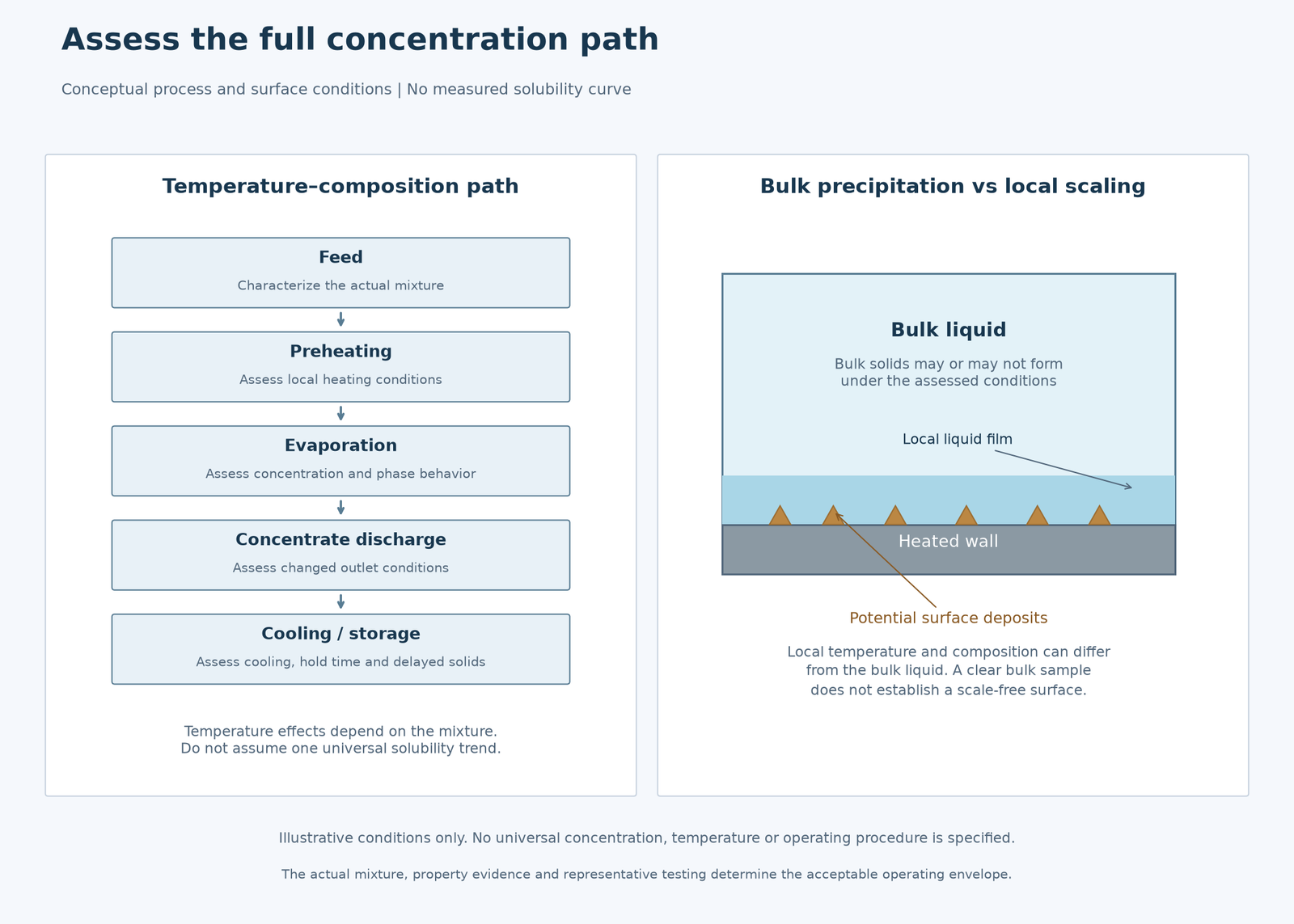
Where Can Precipitation or Scaling Begin Along the Process Path?
A concentrate that appears acceptable at one temperature may not remain acceptable throughout the full industrial process.
The engineering review should follow the solution from the feed tank through evaporation, transfer, shutdown, and downstream storage or handling.
It must also distinguish the condition of the bulk liquid from conditions near heat-transfer surfaces.
Follow the Temperature–Composition Path
The relevant process stages may include:
| Process stage | Conditions to assess | Potential issue |
|---|---|---|
| Feed receipt and storage | Incoming composition, temperature, aging, and possible feed variability | Pre-existing solids or changes before evaporation |
| Preheating | Local temperature change and chemical equilibrium | Precipitation or deposition in heated regions |
| Evaporation and concentration | Increasing dissolved-solids concentration under the operating temperature and pressure | Approach to saturation or bulk precipitation |
| Heat-transfer surface | Local thermal and concentration conditions near the heated wall | Surface deposition despite apparently clear bulk liquid |
| Concentrate discharge | Concentration, temperature, pressure change, and flow conditions | New solids formation or handling limitations |
| Cooling and shutdown | Changing temperature, stagnant periods, and possible concentration changes | Precipitation during cooling or extended holding |
| Downstream storage and transfer | Minimum storage temperature, residence time, and transfer conditions | Delayed precipitation, settled solids, or difficult pumping |
Editorial process-path review. The limiting stage must be determined from the actual liquid and equipment conditions.
The direction of the temperature effect cannot be assumed universally.
For some compounds, cooling can reduce solubility and promote crystallization. Other constituents may exhibit flat, inverse, or more complex temperature-dependent behavior.
The selected temperature path must reflect the actual solution.
Distinguish Bulk Crystallization From Local Surface Scaling
Bulk crystallization refers to the formation of solids within the main liquid phase as the solution enters a condition favorable to precipitation.
Local surface scaling refers to deposits developing at equipment surfaces. This can occur when local temperature, composition, phase behavior, or other surface conditions differ from the bulk.
A bulk liquid sample may remain clear even while deposits are developing near a heated wall.
The U.S. EPA’s historical Feasibility of Treating Wastewater by Distillation distinguishes these mechanisms, including cases in which concentration or temperature changes near a heating surface create local scaling conditions before the bulk stream reaches the same condition.
The report supports this physical distinction. It is not a current universal equipment-design standard.
Consider Startup, Shutdown, and Storage
Concentration design should not stop at the normal evaporation outlet.
A product that can be discharged as a clear hot concentrate may form solids during cooling or storage. Conversely, a constituent that becomes less soluble at higher temperatures may create a particular risk in heated equipment.
Holding time can also affect the interpretation of experimental observations.
An agreed operating limit should state whether the product is required to remain clear during normal evaporation only, during transfer, or throughout a specified storage condition.
These are different acceptance objectives.
Understand What a Saturation Prediction Cannot Prove
A predicted saturation boundary helps identify a potential thermodynamic limit. It does not fully determine crystal nucleation rate, deposit adhesion, long-term fouling, or solids-handling performance.
Likewise, the absence of visible solids in a short-duration sample does not establish permanent stability.
Buyers should require the process engineer to explain which conclusions are supported by equilibrium calculations and which require additional testing or operating evidence.
What Testing Is Needed to Establish an Acceptable Limit?
Testing should address the unresolved engineering question, not follow a universal program prescribed for every evaporator.
For a well-characterized solution, reliable property data and an appropriate validated model may be sufficient for a preliminary design decision.
For a variable or complex industrial wastewater, representative samples and targeted testing may be necessary before the equipment design is fixed.
Start With Representative Feed Characterization
The test basis should identify:
- The origin and production conditions of the feed.
- Normal, high-solids, and other relevant composition cases.
- Representative major-ion and organic composition.
- Existing suspended or precipitated material.
- Analytical methods and concentration units.
- Sampling conditions, preservation, and sample age where relevant.
- Variability between batches or operating periods.
- Unknown components and limitations in the analysis.
Testing a cleaner-than-normal sample may lead to an overly optimistic concentration limit.
Where the feed includes multiple wastewater sources, the mixing conditions and resulting chemistry should also be considered.
Match the Testing Scope to the Uncertainty
| Validation level | Main objective | Example deliverable |
|---|---|---|
| Data and model review | Determine whether existing solubility and chemical information is sufficient | Documented property basis and unresolved risks |
| Detailed feed characterization | Identify relevant dissolved and suspended constituents | Representative chemical analysis with methods and uncertainty |
| Targeted solubility or precipitation study | Investigate solid formation across selected composition and temperature conditions | Observed behavior, analytical results, and defined test limits |
| Concentration-path assessment | Review behavior as the solution approaches the intended final condition | Evidence relating concentration changes to solids formation |
| Pilot or representative equipment testing | Investigate circulation, deposition, operability, and relevant process behavior | Test report with conditions, observations, and engineering limitations |
The required test scope is project-specific. Pilot testing is not mandatory for every industrial evaporation application.
GEA’s Evaporation Technology publication describes its use of physical-property measurements, laboratory studies, and pilot facilities to assess solubility, maximum achievable concentration, viscosity, and other design inputs.
Those facilities and testing capabilities belong to GEA. They should not be presented as capabilities of a different equipment manufacturer.
Define What the Test Must Report
A technically useful report should identify:
- The feed sample and its representativeness.
- Its analyzed composition and measurement basis.
- The relevant concentration and temperature conditions.
- The examination or testing method.
- Observed solid formation, where applicable.
- Whether deposits occurred in the bulk liquid, on exposed surfaces, or both, if examined.
- The time and conditions associated with the reported observations.
- The composition of recovered solids, where identified.
- Measurement uncertainty and analytical limitations.
- The conditions not covered by the test.
The results should distinguish a measured observation from a model prediction.
If a test shows that solids appear within the evaluated range, that observation can inform a design decision. If no solids are observed, the conclusion should be limited to the conditions and sensitivity of the test.
Establish a Defensible Concentration Envelope
The responsible process team should use the available results to define:
- The targeted final concentrate composition.
- The concentration range supported by the approved evidence.
- The relevant temperature and operating-pressure range.
- Permitted or prohibited solids formation.
- Relevant transient and downstream conditions.
- Residual uncertainty and required engineering safeguards.
- Any open validation requirement before final equipment selection.
The operating envelope may need to be revised if the feed composition changes materially.
No universal safety margin below a calculated saturation concentration should be invented without a project-specific basis.
How Should Validation Results Affect Equipment Selection?
The purpose of validating the concentration boundary is to determine the actual service that the equipment must perform.
A liquid-concentration duty in which precipitation must be avoided is not the same as a duty that permits or intentionally develops suspended solids.
This difference can affect the complete equipment arrangement, process responsibilities, and quotation assumptions.
Translate the Findings Into Equipment Requirements
| Validation finding | Required engineering review |
|---|---|
| Target range supported for liquid operation under defined conditions | Evaluate the proposed evaporation duty and applicable normal operating cases |
| Bulk precipitation predicted or observed near the target | Clarify whether solids are acceptable and whether process or configuration changes are needed |
| Local heating-surface deposition identified as a material risk | Review thermal arrangement, local operating conditions, circulation, and maintenance implications |
| Cooling or storage precipitation expected | Evaluate discharge, downstream transfer, holding, and storage conditions |
| Mixed-salt data remain uncertain | Identify further characterization or model validation before committing to critical process requirements |
| Solids-containing operation is permitted | Define expected solids condition and review compatible complete-equipment and downstream interfaces |
| Product target or feed variability changes | Reassess the operating envelope, not only the nominal equipment capacity |
Editorial engineering decision matrix. It does not prescribe one equipment configuration for every case.
The separate evaporator versus crystallizer guide discusses the broader differences between those equipment categories.
This article addresses the evidence needed before that type of equipment decision can be justified.
Clarify Whether Solids Are Acceptable
One of the most important contractual decisions is whether the proposed duty requires:
- A liquid concentrate without unacceptable precipitation under the agreed conditions.
- A concentrate in which a defined amount or condition of solids is permitted.
- An intentionally crystallizing process requiring appropriate slurry and solids-handling provisions.
These conditions should not be treated as minor variations in the same unqualified evaporation rating.
If precipitation is expected, the responsible process engineer must establish the relevant solids basis and determine what configuration is suitable.
GEA’s forced-circulation crystallizer overview describes equipment designed for specific crystallizing duties, including high-solids circulation and scaling considerations.
That reference demonstrates why solids behavior can change the equipment problem. It does not establish that this site’s manufacturer supplies the same proprietary crystallization technology.
Avoid Treating Thermal Capacity as the Only Design Constraint
The verified concentration envelope must be coordinated with the heat and material balance and the proposed equipment operating conditions.
As the solution becomes more concentrated, boiling-point elevation, viscosity, and thermal performance may also require evaluation.
For an explanation of how those factors affect processing capacity, see the site’s separate evaporator capacity at higher concentrations guide.
Here, the critical requirement is that the equipment rating must not assume a completely liquid process stream if the approved chemistry indicates a material risk of solids formation.
Keep Process Validation and Manufacturing Responsibility Separate
The project process engineer or appointed technology provider should establish the acceptable concentration envelope and process duty.
The testing organization should document the evidence within its agreed scope.
The equipment designer and manufacturer should evaluate the approved service conditions against the offered mechanical equipment configuration, applicable design code, materials, and inspection requirements.
Where a manufacturer is also contracted to provide process design or performance guarantees, that responsibility must be explicit.
The existence of evaporator-related fabrication capability does not automatically establish proprietary crystallization technology, a complete wastewater ZLD process license, or a guarantee of particular salt recovery purity.
What Should Buyers Include in an Industrial Evaporator RFQ?
An industrial evaporator RFQ should link the required concentration result to the actual feed chemistry and approved operating envelope.
A statement such as “process 5 m³/h of wastewater to a specified TDS” may be insufficient for a reliable quotation if the final concentrate composition, solubility behavior, and solids acceptance conditions remain unknown.
Recommended RFQ Data Handover
| Data category | Information to provide |
|---|---|
| Application and process objective | Chemical concentration, wastewater volume reduction, or another defined duty |
| Representative feed analysis | Relevant ionic composition, organics, TDS, TSS, pH, and analytical basis as applicable |
| Feed variability | Normal, limiting, and relevant abnormal or batch composition cases |
| Flow and mass basis | Feed rate, density, and concentration units |
| Target concentrate | Required constituent concentrations and total-solids basis |
| Operating range | Expected temperatures, pressures, and batch or continuous conditions |
| Solubility evidence | Available component data, mixed-salt model, test reports, and validation status |
| Solids acceptance | Whether suspended or deposited solids are permitted and under which conditions |
| Concentration path | Relevant conditions at evaporation, discharge, cooling, and storage |
| Heat-transfer considerations | Approved thermal duty and any identified local deposition restrictions |
| Materials and corrosion | Chemical compatibility and concentration-dependent material requirements |
| Complete equipment scope | Vessel and heating equipment, relevant vapor/liquid interfaces, and agreed supporting equipment |
| Downstream interface | Concentrate transfer, storage, solids management, and condensate handling responsibilities |
| Quality requirements | Applicable design, manufacture, inspection, documentation, and testing requirements |
| Open technical risks | Missing data, provisional assumptions, responsible parties, and closure conditions |
Editorial EPC procurement checklist, not a universal mandatory datasheet.
Ask Suppliers to State Their Assumptions
A comparable technical quotation should identify:
- The feed and target composition used for the proposed design.
- The supporting solubility and process-property basis.
- Whether the proposed configuration assumes liquid-only or solids-containing operation.
- The specified temperature and operating range.
- Material or process limitations affecting the design.
- Exclusions concerning testing, process integration, and downstream handling.
- Unresolved data that could materially change the equipment requirements.
A supplier should not silently assume that a required final TDS is achievable as a stable liquid without adequate evidence.
Establish an Approval Gate Before Fabrication
A budgetary quotation may be developed using clearly labeled preliminary conditions.
However, when unresolved precipitation risk could require a fundamentally different equipment arrangement, the parties should establish a technical hold point before approving the affected equipment design for fabrication.
The owner or EPC process team should approve the concentration envelope and process requirements. The complete-equipment supplier should then verify the contractual design inputs and disclose any limitations.
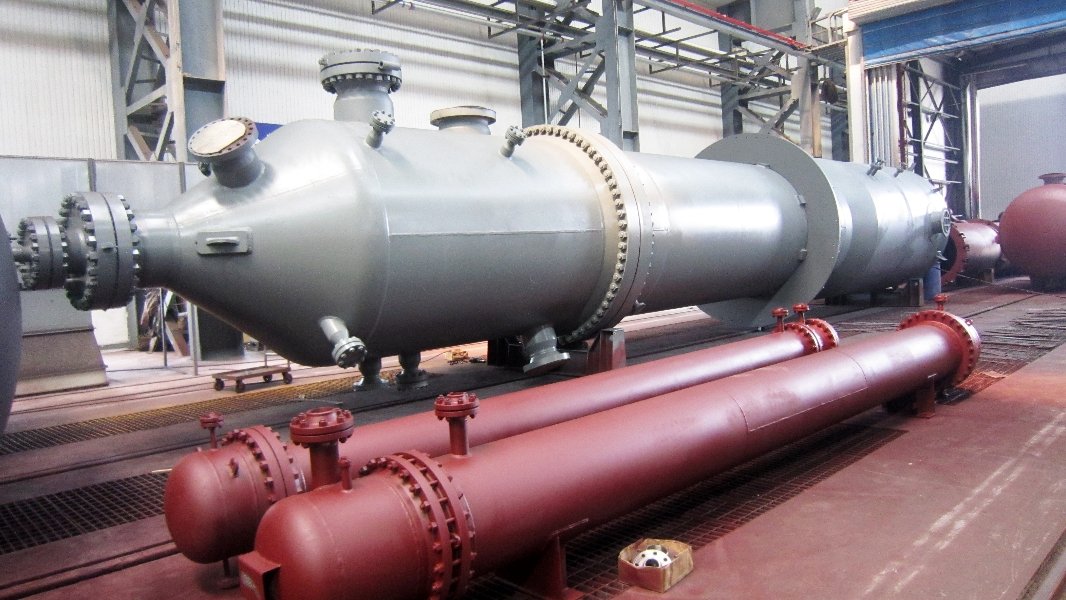
For appropriate applications, the company’s industrial shell-and-tube heat exchanger range provides a reference for discussing heat-transfer equipment used in evaporation duties.
The exact evaporator, vessel, system-integration, and process-guarantee scope must be confirmed for each project.
Frequently Asked Questions
Can feed TDS alone establish the maximum evaporator concentration?
No. TDS indicates an overall dissolved-solids quantity but does not establish the concentrations, activities, or saturation limits of individual components and potential solid phases. Representative composition and appropriate property evidence are needed.
What is the difference between a target concentration and a validated operating limit?
The target is the composition the project intends to produce. The validated operating limit is the range supported by the approved data, assumptions, and test conditions. A target may lie outside the demonstrated range and therefore require further engineering review.
What is evaporative crystallization?
Evaporative crystallization removes solvent so that one or more dissolved components become supersaturated and crystals can form. The equipment and operating strategy must be appropriate for that solids-forming duty. See the evaporator versus crystallizer comparison for the wider equipment distinction.
Does a clear concentrate sample prove that scaling will not occur?
No. A clear bulk sample does not necessarily represent conditions at the heat-transfer surface, during prolonged operation, or after cooling and storage. The conclusion must be limited to the sampled conditions and test method.
Conclusion
The concentration limit of an industrial evaporator should be established from the behavior of the actual mixture across its intended process conditions, not from a generic TDS percentage or the solubility of one isolated salt.
EPC buyers should define the target composition, review the temperature–composition path, distinguish bulk precipitation from surface deposition, and obtain suitable evidence where the existing property basis is inadequate.
Those findings should then determine the acceptable operating envelope, whether solids are permitted, and the process and mechanical assumptions supplied to equipment manufacturers.
For an industrial evaporation equipment enquiry, submit representative feed analyses, flowrate and concentration bases, the required final composition, temperature range, available solubility or precipitation data, and the agreed downstream handling conditions.
This information gives the process team and equipment supplier a defensible basis for discussing complete evaporator, heat-transfer, and associated vessel requirements without converting unverified chemistry assumptions into equipment guarantees.
References
- GEA. Evaporation Technology. Corporate technical publication, particularly page 3, describing physical-property testing for solubility, viscosity, boiling-point elevation, and achievable concentration. Publication date is not independently established here. https://www.gea.com/assets/170546/
- GEA. Forced Circulation Crystallizers. Technical description of solids-containing evaporative crystallization and associated equipment. https://www.gea.com/en/products/evaporators-crystallizers/solution-crystallization-plants/forced-crystallization-crystallizer/
- U.S. Geological Survey (USGS). Data for Salinity Regressions and Total Dissolved Solids Calculations in Groundwater in the United States. Data release first published in 2025 and revised in January 2026, describing major-ion composition and TDS determination. https://www.usgs.gov/data/data-salinity-regressions-and-total-dissolved-solids-calculations-groundwater-united-states
- USGS. Plummer, L. N., Parkhurst, D. L., Fleming, G. W., and Dunkle, S. A. (1988). A Computer Program Incorporating Pitzer’s Equations for Calculation of Geochemical Reactions in Brines. Historical technical research concerning ionic interactions and saturation calculations in concentrated solutions. https://www.usgs.gov/publications/a-computer-program-incorporating-pitzers-equations-calculation-geochemical-reactions
- U.S. Environmental Protection Agency (EPA). (1971). Feasibility of Treating Wastewater by Distillation. Historical research describing bulk-liquid saturation and localized evaporator heating-surface scaling. Used for physical explanation, not as a current design or operating standard. https://nepis.epa.gov/Exe/ZyPURL.cgi?Dockey=9100WF2N.TXT