
Executive summary. A pilot evaporator that reaches the specified concentration or evaporation rate during a short run has demonstrated a result under the conditions tested—not necessarily a sustainable industrial operating interval. For chemical and industrial wastewater projects, buyers should review three separate questions: whether the process can reach the target, whether its performance remains acceptable as operating time and feed conditions change, and whether an agreed cleaning process restores comparable performance. A useful pilot report therefore contains time-stamped operating trends, feed and concentrate analyses, a justified test duration, a complete interruption log, matched pre- and post-cleaning comparisons, and a clear statement of what can—and cannot—be extrapolated to a full-scale plant. No single pilot-run duration or cleaning-recovery percentage is valid for all feeds and evaporator configurations.
A pilot trial can be decisive when purchasing industrial evaporation equipment, but only if it addresses the right uncertainty. One apparently successful shift may establish a short-term material balance or concentration result. It may not reveal progressive deposits, changing circulation, loss of heat-transfer performance, or the consequences of repeated start-ups and cleaning cycles.
This distinction matters to plant owners, EPC process engineers, and technical procurement teams preparing to specify complete evaporation equipment. The point of a pilot trial is not simply to produce an attractive capacity figure. It is to develop an evidence-based operating envelope and transfer its limitations to the process licensor, engineering team, and equipment manufacturer.
GEA’s published Evaporation Test Center description, for example, identifies a mobile falling-film pilot specifically used to investigate long-time behavior, including fouling and cleaning-in-place (CIP). That is evidence of the value of extended testing in industry; it is not evidence that every manufacturer supplies the same test facilities or proprietary process technology.
1. What Does a Successful Short Evaporator Trial Actually Prove?
Separate concentration achievement from durable operation
A short trial may show that a representative feed can be concentrated to a target composition while the pilot unit operates within a stated temperature, pressure, and circulation range. If sufficiently measured, it may also show the instantaneous water-removal rate and the corresponding utilities demand.
It cannot, by itself, establish how those indicators behave after substantial operating time, exposure to a different feed batch, or repeated cleaning. A test can finish before meaningful deposits have formed or before a cumulative operational constraint becomes visible.
Buyers should distinguish three levels of evidence:
| Evidence level | What the trial may demonstrate | What remains unresolved without additional evidence |
|---|---|---|
| Initial process feasibility | Target concentration or evaporated-water quantity achieved at an identified operating point | Performance trend, long-term deposit behavior, repeatability |
| Sustained operating behavior | Measured performance over a justified representative interval, including drift and interruptions | Conditions outside the tested feed and operating envelope; extended lifetime |
| Cleaning and restart recovery | Post-cleaning performance compared against a documented pre-cleaning and initial reference under comparable conditions | Future cleanability, industrial cleaning interval, or long-term guarantee unless independently supported |
These categories are a buyer’s evidence framework, not universal test classifications or mandatory acceptance criteria.
Define what “capacity” means before examining a result
An evaporator trial report may use feed throughput, evaporated water rate, concentrate production rate, or product concentration as its leading performance indicator. These are not interchangeable.
For a nonreacting system with a valid mass balance, evaporated solvent is related to feed and concentrate streams, but a concentrate rate alone cannot prove the amount of solvent removed without composition and inventory information. Recycle loops and changing liquid holdup add further complexity.
The purchaser should require a consistent mass and composition basis, including whether measurements describe instantaneous values, time-window averages, or cumulative totals. A statement such as “pilot capacity achieved” should always identify the metric and measurement period.
State the acceptance question before starting the trial
An effective test plan may ask:
- Can the process achieve the target concentrate quality using the representative feed?
- Does the required water-removal rate remain achievable within agreed utility and operating limits?
- Does performance change with run time under otherwise comparable conditions?
- What triggers an interruption or cleaning decision?
- After cleaning and restart, which performance indicators recover, and how reliably?
- Which unresolved process risks could materially change the equipment arrangement?
These questions should be approved by the process authority before the supplier interprets the trial as a basis for mechanical equipment selection.
2. How Should Buyers Specify Pilot Run Length Without Guessing a Universal Number of Days?
Justify duration against the mechanisms being investigated
There is no defensible universal minimum run length for all industrial evaporator pilot tests. The required duration depends on the actual process, feed variability, deposit mechanism, equipment arrangement, planned operating pattern, and the decision the test must support.
For an initial material-balance feasibility check, a relatively short controlled period may answer a narrowly defined question. For a service in which deposits build gradually, or where the project needs to establish a credible cleaning frequency, the relevant evidence may require much longer observation and repeat operation.
A statement that a pilot ran for a given number of hours is not meaningful without showing whether that period was sufficient to reveal the process behavior of concern. Conversely, a longer test is not automatically superior if the trial ran on unrepresentative feed or changed operating conditions without proper records.
| Potential uncertainty | What a suitable run must capture | Why elapsed hours alone are insufficient |
|---|---|---|
| Gradual heat-transfer deterioration | Trend in corrected thermal indicators under documented conditions | Changes in utility supply or concentration can imitate a fouling trend |
| Circulation and hydraulic deterioration | Flow, pressure difference, pump or circulation behavior, and restrictions | Pilot hydraulics may not represent industrial flow distribution |
| Feed variability | Planned representative feed cases and transition records | A long run using one unusually clean batch may not test the limiting duty |
| Deposit accumulation | Time-related evidence, inspections or samples where practicable | Deposits may be intermittent or local rather than evident in bulk product |
| Cleaning effectiveness | Pre-cleaning condition, agreed cleaning event, matched restart comparison | One successful cleaning may not establish repeatability |
| Start-up/shutdown sensitivity | Relevant transients and documented intervention history | A continuous steady run may miss the intended industrial operating pattern |
Specify a duration rationale, not an unsupported duration promise
A pilot test plan should document the proposed time period and why it is expected to provide relevant evidence. The justification should consider prior operating history, available laboratory data, expected time-dependent behavior, practical limitations, and the consequences of missing a slowly developing failure mode.
If the mechanism is poorly understood, the trial may need a decision gate: continue testing until a meaningful trend is established, a defined stopping criterion is reached, or the test’s limitations require a further program. A flat trend over a brief interval is not proof of permanent stability.
The buyer should ask the responsible process specialist to state whether the run length is intended to establish feasibility, trend characterization, cleaning-cycle evidence, or a specified contractual performance basis. The same trial is not automatically sufficient for all four purposes.
Account for interruptions and data exclusions
The report should distinguish elapsed test time from on-stream time and time spent inside the agreed test envelope. Warm-up, feed changes, instrument faults, maintenance stops, emergency interruptions, and cleaning periods must be identified rather than hidden inside a single “total run hours” figure.
An interruption may be valuable evidence of an operating weakness. Removing it from an average without explanation can make the trial appear more successful than the operating history supports. Both the complete event record and the justified steady-state analysis windows should be retained.
3. Which Time-Series Measurements Reveal Sustainable Evaporation Performance?
Keep a synchronized record of the operating basis
A useful pilot dataset connects each reported performance value to the feed properties, heating conditions, circulation conditions, and test phase at the same time. A single beginning-of-test datasheet and an end-of-test certificate are rarely sufficient to investigate drift.
The following fields form a practical data handover. The exact instrument set depends on evaporator configuration and the project’s process model.
| Data group | Information to record | Engineering question supported |
|---|---|---|
| Feed and composition | Source/batch, feed flow, relevant dissolved and suspended constituents, density and concentration basis | Was the tested feed representative, and did it change? |
| Product and vapor | Concentrate flow and composition, condensate or vapor quantity/quality where relevant, inventory changes | Did the water and material balances close credibly? |
| Thermal conditions | Heating-side supply and return conditions, temperatures, pressure, utility flow/consumption, boiling conditions | Did available driving force or supplied duty change? |
| Process hydraulics | Operating pressure/vacuum, circulation rate, differential pressure where meaningful, pump/valve status | Did the flow regime or hydraulic resistance change? |
| Operating state | Start-up, steady operation, feed transition, upset, cleaning and restart timestamps | Which periods are legitimately comparable? |
| Surface/deposit evidence | Inspectable deposit location, appearance, samples, and maintenance observations where feasible | Is observed performance loss plausibly linked to deposition? |
| Instrument quality | Calibration status, sensor location, units, data gaps, uncertainty and any corrections | Can small apparent changes be trusted? |
The frequency of recording and sampling must suit the expected dynamics. Fast disturbances may require more frequent instrument logging than slowly varying feed chemistry. Buyers should not prescribe a universal interval without considering the process.
Track capacity and thermal performance separately
At minimum, a review should seek trends for evaporated-solvent rate, achieved concentrate quality, thermal driving conditions, and utility use. Where the engineering basis allows, the process team may also calculate a consistent apparent overall heat-transfer coefficient or a normalized thermal-performance indicator.
For a suitable heat-transfer model, the familiar relationship is:
Here, Q is the appropriate heat-transfer duty, U an overall heat-transfer coefficient on the stated area basis, A the reference heat-transfer area, and ΔTeffective a driving-temperature difference appropriate to the actual arrangement. For an evaporator, boiling-point elevation, phase changes, multiple effects, losses, and variable conditions may make a simple terminal-temperature calculation inadequate.
An apparent reduction in U is not automatically a measured fouling resistance. It may reflect changes in composition, viscosity, circulation, vapor-side conditions, instrument readings, or the assumptions used to infer heat duty. The process engineer must decide whether comparisons at different times are physically equivalent or require a validated correction.
Similarly, achieving the same concentration at a lower feed rate could conceal reduced evaporation capacity. Reaching the same evaporation rate at higher heating demand could conceal performance deterioration. Buyers need more than one headline result.
Use trend evidence, not selected snapshots
A technically useful report should display the progression of performance from the clean or early-run reference through later operating periods and, if applicable, several clean/restart cycles. Relevant plots may include:
- Solvent removal rate versus cumulative qualified operating time.
- Concentrate composition and feed composition over the same period.
- Heating conditions, calculated thermal duty, and corrected or clearly qualified thermal-performance indicator.
- Circulation and pressure-related observations, if meaningful for the design.
- Cleaning, feed changes, sampling, and interruptions marked on each trend.
A trend requires contextual interpretation. For example, a decrease in throughput following an increase in feed viscosity is not necessarily evidence of new surface scale. Conversely, stable throughput maintained by increasing steam consumption or another operating input may mask deteriorating thermal efficiency.
NIST’s Measurement Process Characterization describes the importance of repeatability, stability, calibration and uncertainty when interpreting measurement processes. Those are general metrology principles—not an evaporator-specific acceptance standard.
Record events that simple averages hide
The trial log should include valve changes, operating setpoint changes, feed interruptions, pump trips, loss of vacuum, abnormal foaming, carryover, localized fouling observations, changes in solids behavior, and operator interventions where relevant.
A short incident can materially affect later performance. A time average that excludes it without explanation loses information required for full-scale risk assessment. Every exclusion from a reported performance period should have a reason and retain its original underlying record.
4. How Can Buyers Compare Performance Before and After Cleaning Fairly?
Establish three clearly identified reference states
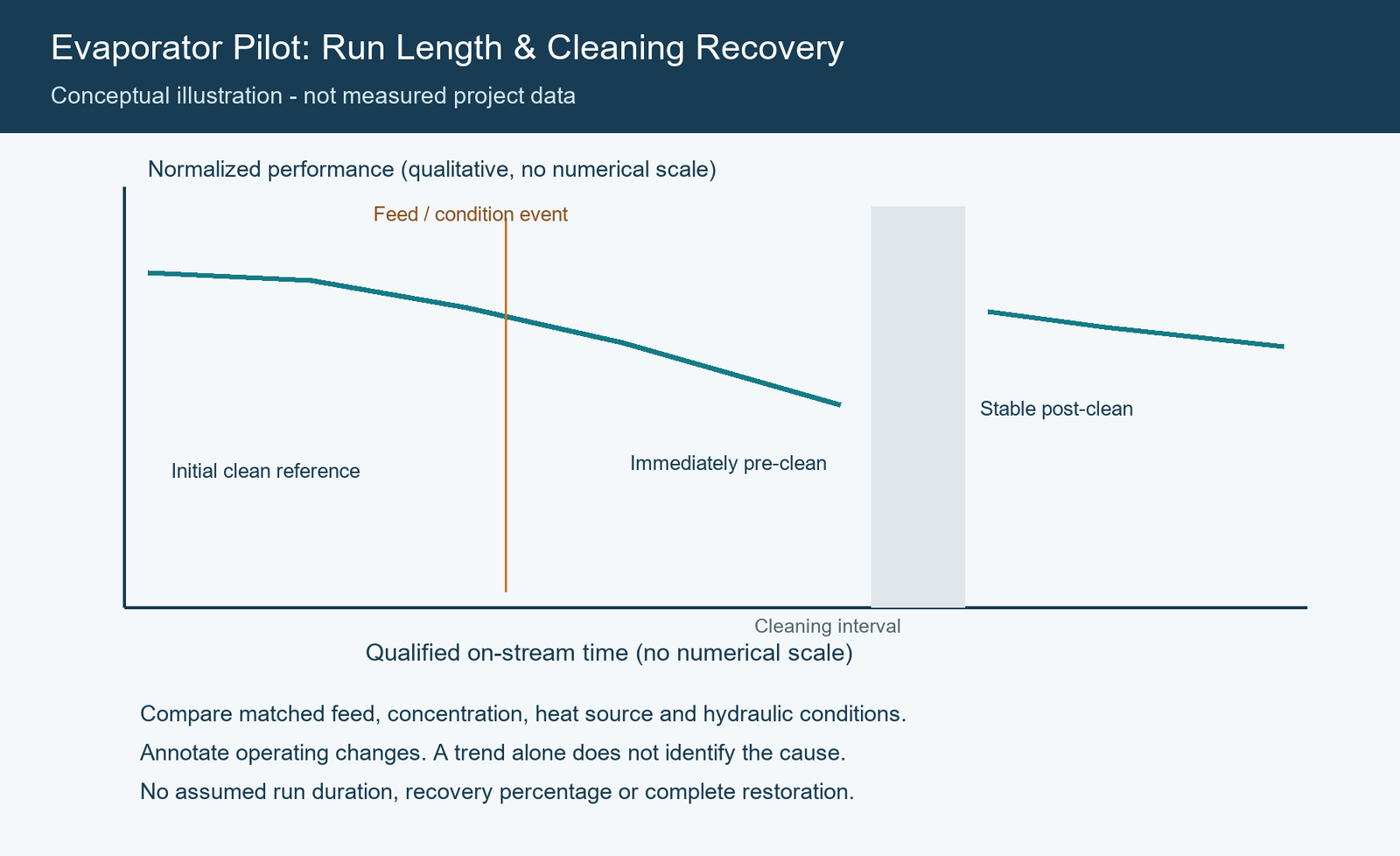
Cleaning recovery should not be based only on whether the final concentrate once again meets specification. A more defensible comparison identifies:
- Initial or validated clean reference: the performance of the tested unit at a stated feed, thermal and hydraulic condition before meaningful deterioration, where actually established.
- Pre-cleaning condition: measured performance immediately before the agreed cleaning decision, together with the prevailing composition, thermal conditions and symptoms.
- Post-cleaning condition: measured performance after cleaning, rinsing/verification and return to a defined, stable operating state, using a comparable feed and operating basis.
The test report should say when any reference is inferred rather than directly measured. The accepted criterion might concern evaporation rate, thermal behavior, pressure difference, concentrate quality or several indicators together, depending on what the project actually needs.
Match conditions—or make the adjustment visible
| Comparison variable | What must be matched or reconciled | Risk if ignored |
|---|---|---|
| Feed composition and solids load | Same representative feed or quantified difference with an approved comparison basis | Post-clean result looks better because feed was easier |
| Feed and operating temperatures | Comparable thermal inlet state and boiling conditions | Thermal driving force is mistaken for recovered surface performance |
| Heating utility and available duty | Same relevant utility parameters or documented model-based correction | Higher supplied energy is labeled “cleaning recovery” |
| Circulation and hydraulic state | Comparable operating and flow regime | Changes in circulation are mistaken for deposit removal |
| Concentrate endpoint | Same concentration target and compositional basis | Different duty is compared as though identical |
| Measurement method | Compatible sensors, sampling, calculations and accepted uncertainty | Instrument bias is interpreted as recovery |
| Time since restart | Defined stabilization period and comparable steady-state window | Temporary transients distort the comparison |
If genuinely equivalent conditions cannot be recreated, the process engineer may use a documented, validated normalization method within its stated domain. An unvalidated mathematical correction is not a substitute for a controlled test. Results should be labeled not directly comparable when the remaining differences are material.
Avoid the “100% recovery” trap
A recovery ratio can help summarize a specific metric if its reference is clear. For example, a project might compare a corrected post-clean thermal-performance indicator with a separately measured initial clean value. But such a ratio does not prove all deposits were removed, all passages are clear, or future cleanings will restore the same level.
Likewise, recovering outlet concentration does not necessarily mean the original heat-transfer coefficient, solvent removal rate, circulation characteristics or energy performance has returned. One metric may improve while another remains constrained.
A useful cleaning evidence packet should identify the approved cleaning method at a high level, pre- and post-event trends, the amount of downtime, inspection findings where available, unresolved deposits, and any changes to the plant or operating conditions. This article does not provide chemical concentrations, exposure times or hazardous cleaning procedures; these depend on actual deposits, material compatibility, the cleaning supplier’s instructions and project safety approval.
Test whether recovery is repeatable
If repeat cleaning performance is central to the design decision, a single cleaning event may provide insufficient evidence. Repeated operating/cleaning cycles can help reveal whether fouling becomes harder to remove, whether a clean baseline shifts, or whether the maintenance burden changes.
The number of cycles must be justified by the project objective. The report should not imply a proven industrial cleaning interval merely because one pilot restart was successful. For a detailed discussion of how cleaning access and maintenance provisions affect equipment selection, see our industrial evaporator cleaning requirements guide.
5. What Does Pilot Testing Still Leave Unproven About Full-Scale Equipment?
Similar chemistry does not ensure similar thermal and hydraulic behavior
A pilot unit can provide valuable observations without reproducing every feature of a full-size evaporator. Heat-transfer area, tube geometry, liquid distribution, circulation residence time, vapor disengagement, wall conditions, control response, and cleaning accessibility may change at industrial scale.
Those differences can alter local concentration, surface wetting, supersaturation, deposition and cleaning coverage. Directly multiplying the pilot’s hourly production by an area ratio is therefore not sufficient to validate full-scale production capacity.
The supplier and process engineer should state which pilot observations support scale-up, which models or established design methods bridge the scales, and which assumptions remain unverified. The appropriate evidence may be different for falling-film, forced-circulation and other evaporation configurations.
Do not confuse feed representativeness with a complete operating envelope
A pilot performed with genuine process liquid is more relevant than one using an arbitrary substitute, but it may still fail to cover seasonal changes, production campaigns, contamination events, high-solids batches, changes in organics, or the full planned concentration endpoint.
A feed envelope should identify the normal and design-limiting compositions considered, what has actually been tested, and which cases remain engineering assumptions. A test may be representative of one batch, without being representative of the future full-scale plant’s long-term feed supply.
Where solubility and precipitation boundaries determine whether a solution can reach the target concentration, that is a separate question treated in our industrial evaporator concentration-limit guide. This article instead asks whether the validated duty remains operable over time and can be restored after cleaning.
Distinguish pilot observation from plant guarantee
| Pilot evidence | Potential relevance to industrial design | What it cannot establish by itself |
|---|---|---|
| Target concentration attained | Indicates feasibility under the tested feed and operating conditions | Performance for every future feed composition |
| Stable trend for a specified pilot interval | Supports an interpretation of sustained behavior for that interval | Unlimited run life or a fixed full-scale cleaning interval |
| Measured pre/post-clean recovery | Supports assessment of a particular cleaning response | Repeated recovery under different industrial conditions |
| Representative deposit analysis | Helps identify a likely deposition mechanism | A universally valid deposit rate or industrial cleaning recipe |
| Calculated pilot thermal performance | Provides input for a suitable engineering scale-up model | Full-scale thermal guarantee without design review |
| Restart after cleaning | Demonstrates a specific successful operating event | Plant availability, complete lifecycle performance or automatic scale-up approval |
GEA and Alfa Laval’s evaporation systems information both describe pilot testing as an engineering tool for developing or confirming evaporation solutions. The existence of those services is specific to those companies and should not be attributed to a different equipment manufacturer.
Keep process responsibility separate from mechanical supply
The project should specify who is responsible for each decision:
| Decision or deliverable | Typical accountable party to identify in the contract | Required handover |
|---|---|---|
| Representative feed and required product specification | Owner/EPC process team | Approved feed envelope, target and analytical basis |
| Pilot design, operation and data integrity | Appointed test organization/process technology provider | Test plan, logs, analyzed dataset and limitations |
| Run-length and cleaning-recovery interpretation | Appointed process authority | Signed or approved technical assessment and open risks |
| Full-scale thermal/process scale-up basis | Appointed process designer or technology provider | Design conditions, model assumptions and required interfaces |
| Complete equipment mechanical design and fabrication | Contracted equipment manufacturer within agreed scope | Mechanical design basis, drawings, manufacturing QA and agreed equipment documentation |
| Overall plant integration and performance guarantee | Parties specifically named in the project contract | Guarantee boundaries, test conditions and exclusions |
This is a suggested interface matrix, not an assertion that every supplier accepts all these responsibilities. If a manufacturer also offers process guarantees, pilot trials or full-system engineering, the contract must expressly define that scope.
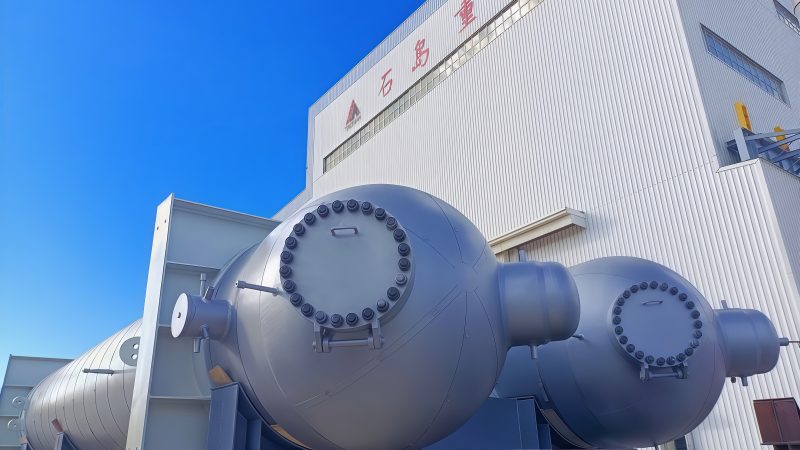
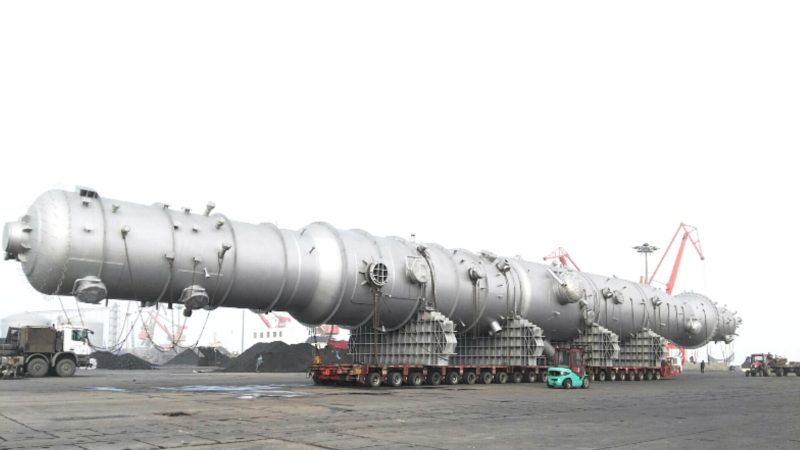
Our MED desalination system and structural frames project describes large-scale mechanical fabrication, electrical assembly and structural integration for a multi-effect distillation system. It illustrates relevant large-equipment manufacturing experience, not independent proof that our company conducts proprietary chemical-evaporator pilot programs or guarantees a particular fouling and cleaning cycle for every process fluid.
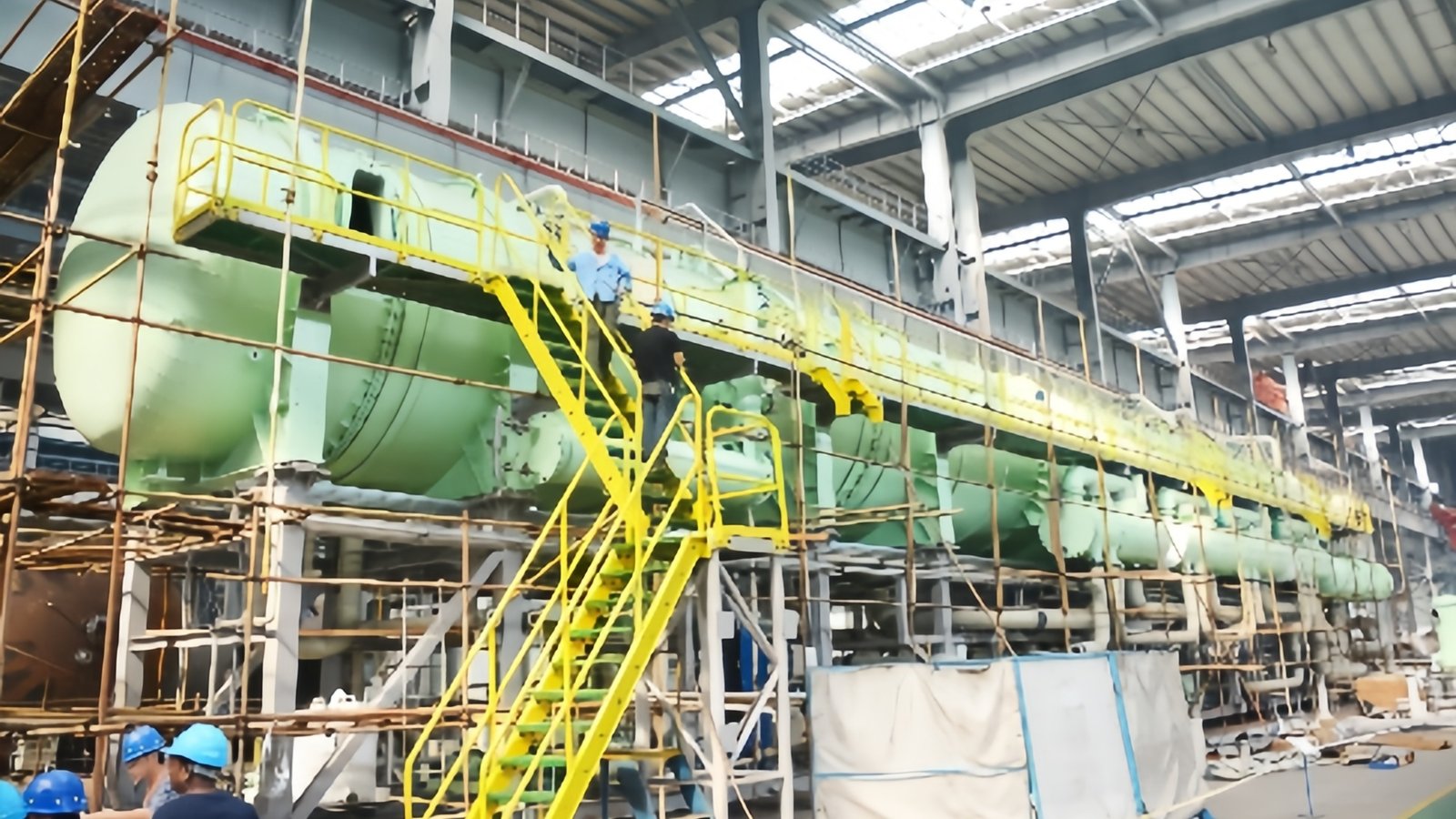
6. What Should an Industrial Evaporator Pilot Report Contain Before an RFQ Is Finalized?
A buyer should be able to hand the process team’s findings to competing complete-equipment manufacturers without forcing each bidder to invent different feed, fouling or cleaning assumptions.
Minimum report and data-package checklist
| Package section | Evidence to include | If missing, ask… |
|---|---|---|
| Test purpose and acceptance basis | Written objectives, target metrics, approved stopping/continuation logic | What decision was the test designed to support? |
| Pilot equipment description | Configuration, relevant dimensions, flow paths, heating system and controls | What features differ materially from the industrial design? |
| Feed characterization | Sample sources, analysis methods, normal and limiting cases, changes over time | Was the trial run with representative and challenging material? |
| Test-duration rationale | Planned run length, qualified on-stream time and explanation | Why was this enough to observe the mechanism of concern? |
| Time-stamped operating records | Flow, temperatures, pressures, compositions, utilities and significant operating actions | Can the reported trends be independently reconciled? |
| Performance calculations | Clearly defined solvent removal, mass balance, heat duty and any thermal indicator | Were calculations made on a consistent and valid basis? |
| Deposit/fouling observations | Symptoms, inspection evidence, deposit analysis where available | What evidence supports the alleged mechanism? |
| Interruption and deviation log | Faults, feed changes, off-spec periods, exclusions, manual interventions | Which hours were not representative—and why? |
| Cleaning event record | Conditions before cleaning, agreed procedure reference, downtime, observations | Can effectiveness and practical maintainability be reviewed? |
| Restart and recovery evidence | Comparable before/after windows, calculations, limitations and repeat cycles if relevant | Is “recovery” based on comparable conditions and the right metrics? |
| Scale-up assessment | Which results are transferable, model validation, major differences and residual risk | Which guarantees need more testing or contractual qualification? |
| Review and approvals | Responsible parties, signed conclusions, unresolved action list | Who owns the remaining process and equipment assumptions? |
A report containing only final capacity, final concentration and a short photograph gallery is not equivalent to this evidence package.
Distinguish findings, provisional assumptions and commitments
For each design-critical topic, the evaluation should label its status:
- Observed: measured in the pilot at identified conditions with a traceable record.
- Calculated: derived using a disclosed physical or analytical model with stated inputs and limitations.
- Assumed: adopted for preliminary sizing without direct validation; requires risk assessment.
- Agreed: reviewed and approved for the relevant phase of project design.
- Guaranteed: expressly included in the responsible party’s contractual undertaking, subject to defined conditions.
A measured pilot fact should not silently become a full-scale contractual guarantee. Equally, an engineering assumption should not be represented as a measured test result.
Define technical hold points in the procurement process
Where results remain uncertain, a project may allow a budgetary quote against provisional inputs. Before approving final manufacturing data, however, the buyer should close any uncertainty that could materially change the selected evaporator configuration, material specification, heating surface, vessel arrangement, cleaning access or operating philosophy.
A practical sequence is: approve the test report → approve the process design envelope → confirm the equipment duty and interfaces → obtain technical quotations → resolve bidder deviations → release the relevant mechanical design for fabrication. The precise order and approval authority depend on the contract and project execution model.
7. Which Questions Should EPC Buyers Ask Before Selecting a Full-Scale Evaporator Supplier?
The following questions can be copied directly into a technical clarification schedule:
- Feed relevance: Which analyses and production batches support the representative and design-limiting feed cases?
- Scope of evidence: Does the trial prove only target concentration, or also a specified sustainable operating interval and cleaning response?
- Run length: What mechanism and prior evidence justify the selected trial duration? What qualified operating time was actually achieved?
- Performance trend: Are solvent-removal rate, product quality, heating conditions, utility consumption and circulation documented as time-series data?
- Material balance: How are feed, concentrate, recovered solvent and changing inventory reconciled?
- Deterioration mechanism: Is a reported performance decline supported by deposit evidence, or could changes in feed and operating conditions explain it?
- Cleaning definition: Which parameters establish the pre-clean, initial clean and post-clean reference states?
- Comparability: Were restart conditions matched, or were changes corrected using an approved method with disclosed limitations?
- Repeatability: How many relevant run/clean cycles were observed, and what remains unproven about subsequent cycles?
- Scale-up: Which hydraulic, thermal, material and control differences prevent direct extrapolation to industrial scale?
- Bid assumptions: What design conditions are verified, provisional or excluded in each complete-equipment offer?
- Responsibility: Who approves the process envelope, who supplies the pilot data, who owns process guarantees, and who supplies the mechanically complete equipment?
Bid comparison rule: Do not reward an offer solely because it claims a longer run between cleanings or a higher sustained capacity unless the feed, test duration, measurement basis, plant configuration and guarantee conditions are truly comparable.
From test report to a complete-equipment enquiry
Once the process authority has established an acceptable design basis, purchasers can request evaluation of the corresponding evaporation vessels, heating equipment and associated industrial fabrication scope. Provide the approved feed and concentrate envelopes, required throughput, operating pressures and temperatures, materials and corrosion assumptions, cleanability and inspection needs, mechanical interfaces, utility conditions, and required documentation.
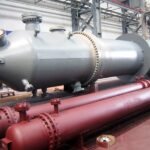
For available industrial heat-transfer equipment categories, see our shell-and-tube heat exchanger product range. The final evaporator and process-system scope must be confirmed against the actual project; a product catalog alone does not establish full-process testing or performance-guarantee capability.
Frequently Asked Questions
Does a short successful evaporator pilot run establish sustainable operation?
No. It demonstrates performance for the reported feed, operating conditions and duration. If progressive fouling, feed variations or cleaning recovery are critical to the purchasing decision, the test must include evidence relevant to those issues.
How long should an industrial evaporator pilot test run?
There is no universal number of hours or days. The duration should be justified by the slowest important behavior being investigated, feed variability, available operating history, the need for cleaning-cycle evidence and the level of uncertainty the project can accept.
Does restored outlet concentration prove complete cleaning recovery?
No. The same outlet concentration may be reached at different feed rates, energy consumption, circulation and thermal conditions. Buyers should compare defined performance metrics at matched or appropriately reconciled operating conditions.
Should pilot fouling always be measured as a decline in heat-transfer coefficient?
Not exclusively. Apparent thermal coefficients can help if calculated consistently, but changes in utility conditions, feed properties, hydraulics and calculation assumptions can also affect them. Deposit inspections, trends in capacity, energy use and pressure-related measurements may provide complementary evidence.
Can a pilot trial guarantee the full-scale cleaning interval?
Not by itself. The extrapolation requires assessment of pilot-to-plant differences, representative feed exposure, operating scenarios, repeatability and the contract’s guarantee boundary. A pilot result cannot be treated as an unconditional industrial interval.
Is repeated cleaning testing necessary for every evaporation project?
No. It is useful when repeatability of cleaning recovery is a material process risk and the existing evidence is inadequate. The responsible process team should determine the need and extent of repeated trials; a fixed number of cycles is not universally required.
Does a stable trend mean the evaporator will never foul?
No. Stability over one observed interval supports a conclusion limited to the tested duration and conditions. It cannot exclude slower mechanisms, different feed batches, changing chemistry or scale-dependent effects.
What should buyers provide when requesting a complete industrial evaporator quotation?
Provide the approved process duty and feed envelope, concentration target, pilot trends and cleaning-recovery evidence, process design and scale-up assumptions, applicable mechanical conditions and a clear responsibility split between process designer, testing organization and equipment manufacturer.
Conclusion
Industrial evaporator pilot testing should answer more than whether a target concentration or evaporation rate was achieved once. For procurement, the critical evidence is whether the process remains usable over a justified period, how performance changes with operating time, and whether cleaning restores comparable thermal and hydraulic behavior.
Buyers should insist on a traceable run-length rationale, synchronized operating trends, transparent interruption records, matched pre/post-clean comparisons and a qualified scale-up assessment. Where evidence is incomplete, the project should disclose the uncertainty instead of converting short pilot results into unsupported full-scale capacity or cleaning-interval guarantees.
To discuss a complete equipment quotation, submit representative feed analyses, the process duty, your pilot-test report, time-based operating and cleaning records, and the approved division of process and mechanical engineering responsibilities. This gives both EPC teams and manufacturers a meaningful basis for reviewing industrial evaporator-related equipment requirements.
References
- GEA. Evaporation Test Center. Official description of pilot facilities, including a mobile single-effect falling-film unit used to study long-term behavior, fouling and CIP. Scope: GEA-specific facilities and industry testing approach, not proof of our company’s pilot-test service.
- Alfa Laval. Evaporation Systems. Official overview of laboratory/pilot services and process-water characterization for evaporation-system evaluation. Scope: third-party methods and capabilities, not a universal scale-up standard.
- NIST/SEMATECH. Engineering Statistics Handbook, Chapter 2: Measurement Process Characterization. General reference for measurement repeatability, calibration, stability and uncertainty. Scope: metrology principles, not evaporator fouling limits.
- Zahran et al. Thirty-day evaluation of crystallization fouling and heat transfer performance degradation in a submerged-tube evaporator for thermal desalination. Public abstract of a specific experimental desalination study. Scope: an example of time-dependent behavior under one study’s conditions; its duration and results must not become universal industry benchmarks. Full article was not independently reviewed here.