
For a custom pressure vessel, attach a low-temperature case register to the RFQ. Give each credible event a case ID and pair the estimated local metal temperature with the pressure and loads expected at the same time and location. Record the source, revision and approval status so suppliers can quote against the same basis. For background on cold-climate procurement, see the cold-climate pressure vessel guide.
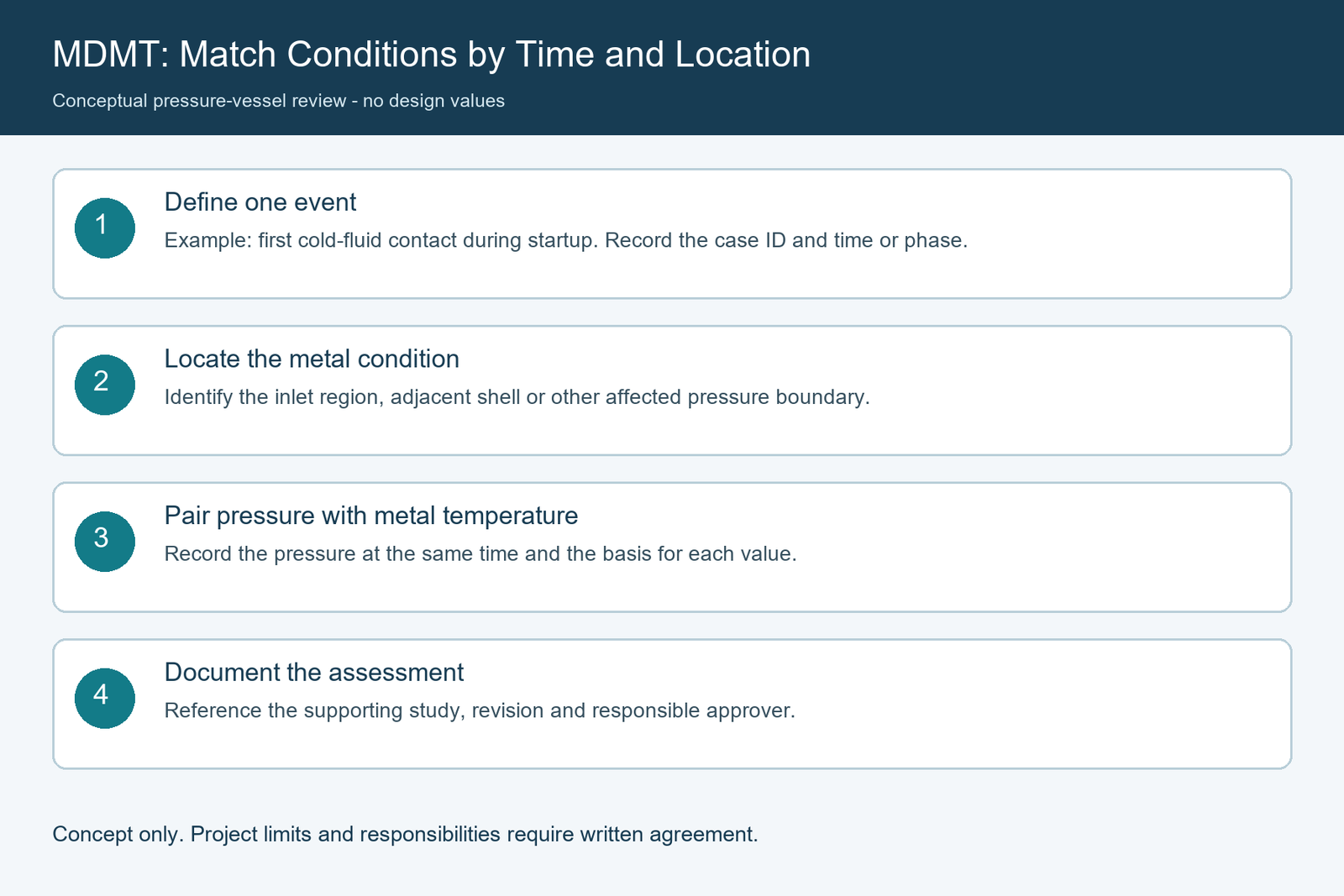
Start with one row per event and affected location
| Case ID and time or phase | Local metal temperature and basis | Coincident pressure and reference | Affected location | Evidence and disposition |
|---|---|---|---|---|
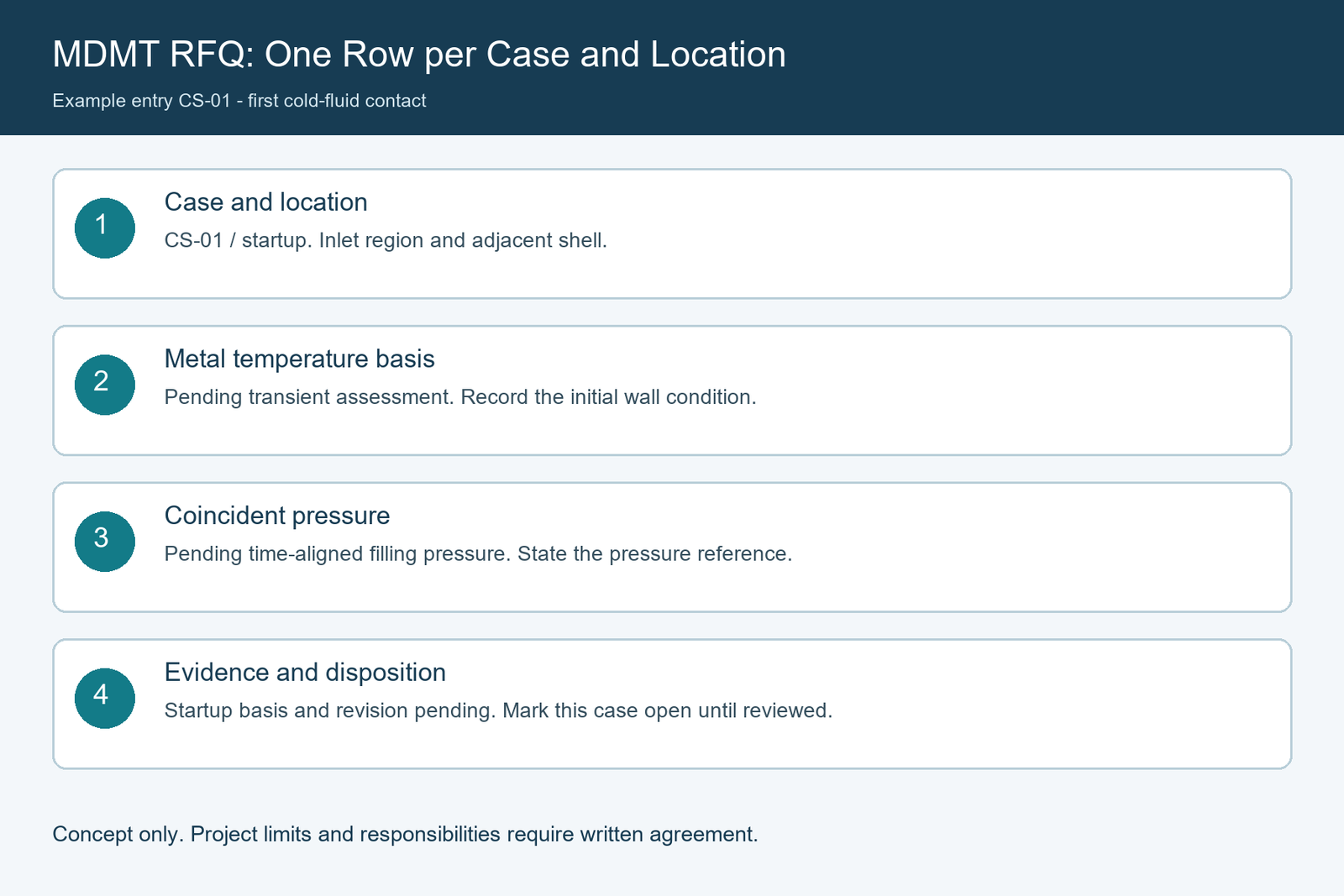
| CS-01 / first cold-fluid contact | Pending transient assessment. Record initial wall condition. | Pending time-aligned filling pressure. State gauge or absolute basis. | Inlet region and adjacent shell | EPC startup basis, revision pending. Open. |
| SD-01 / extended standby | Pending cooldown assessment. Record exposure duration and thermal protection assumptions. | Confirm retained pressure or vacuum at the same time. | Affected shell and heads | Shutdown case sheet, revision pending. Open. |
| TS-01 / pressure test | Confirm metal-temperature basis for the test condition. | Use the pressure for the same test stage. | Pressure boundary under test | Approved procedure and engineering review pending. Open. |
These rows illustrate the format. Screen other credible events, including turndown, depressurization, abnormal routing and utility failure, for the actual project. Split a row when different locations or times could govern. Keep transport and handling conditions distinct from pressurized service and testing.
Complete the register with traceable inputs
A datasheet line marked “MDMT = [value]” does not show why that value is credible or where it applies. For each potentially limiting case, the buyer should provide a traceable set of inputs to the mechanical designer.
The low-temperature case register
Use a table such as the following. The entries are field names, not fabricated design cases or performance figures.
| Required field | What to record | Responsible source / verification |
|---|---|---|
| Case ID and scenario | Normal minimum, cold start, standby, upset, test, etc. | Owner/EPC process basis |
| Event credibility and status | Included, excluded with documented basis, or open | Process safety and project engineering |
| Time or operating phase | Steady condition, initial state, peak transient, recovery | Operations/process engineering |
| Fluid identity and composition | Relevant phase and properties; assumptions for mixed fluids | Process datasheet / licensed process data if applicable |
| Fluid temperature | Temperature at named stream boundary, with time history if necessary | Process engineering |
| Metal-temperature basis | Measured, calculated, assumed or pending; method and confidence | Responsible thermal/mechanical analysis |
| Pressure at the same time | Internal pressure, external pressure/vacuum and applicable differential pressure | Process/mechanical engineers |
| Pressure reference | Gauge/absolute basis, location/elevation and static head where relevant | Equipment/process datasheets |
| Equipment location | Shell course, head, nozzle region, jacket or other identified pressure-boundary zone | General arrangement and mechanical review |
| Concurrent loads | Relevant local, thermal, mechanical and installation loads | Mechanical engineering |
| Case disposition | Governing, covered by another case, conditional, or still open | Approved design review |
| Evidence/version | Study, drawing, datasheet revision and approver | Project document control |
Do not combine noncoincident entries as though they were measured at the same moment. For example, minimum fluid temperature from a brief upset and maximum normal operating pressure may belong to different time steps. They may still define a conservative design envelope, but whether that combination governs should be a documented engineering decision, not a spreadsheet accident.
Also distinguish internal pressure at an identified reference point from any local pressure due to liquid inventory. In tall or liquid-filled vessels, hydraulic head may affect particular regions; the input should say whether pressure values already include those contributions. This principle is particularly relevant to vertical process columns and large pressurized storage equipment, but the present guide is about low-temperature pairing, not recalculating static head or MAWP.
A qualitative example of why a single number is inadequate
Suppose a project has a Case A involving extended cold standby and a Case B involving a shorter process cooling event. Case A may have the lowest external-air temperature, while Case B may have colder process contact or a different pressure history. A technical bid that evaluates only Case A is incomplete until Case B’s metal temperatures and coincident loads are considered. A bid that states the minimum of both temperatures without explaining the simultaneous load can also be ambiguous.
A defensible supplier response identifies the cases evaluated, the resulting designated design condition(s), outstanding process assumptions, and the qualified engineer’s basis for accepting or rejecting individual cases. It does not replace those steps with a guessed fixed low-temperature margin.
Multiple chambers and different pressure boundaries
A vessel with separate process volumes, jackets or distinct pressure zones may require separate evaluation of low-temperature cases and corresponding pressures. Local geometry and thermal coupling matter. Where applicable, document which side or region creates the colder pressure-retaining metal and whether differential pressure or another load governs. Do not borrow a temperature rating from one chamber to establish the suitability of another.
Compare supplier responses against the same case IDs
A comparable quote starts with a common design-basis revision. If one fabricator prices a vessel using ambient temperature only, a second assumes low-temperature depressurization, and a third excludes all transients pending confirmation, the prices do not yet describe the same scope.
Use a bid clarification table rather than comparing a single temperature value:
| Bid-comparison item | What an adequate supplier response should contain | Red flag needing clarification |
|---|---|---|
| MDMT/design basis | Defined value or case-dependent design condition with its contractual basis | A bare number without scenario or reference |
| Coincident pressure | Documented pairing or approved design envelope | Unrelated temperature and pressure values mixed silently |
| Governing scenarios | Listed case IDs, excluded cases and reasons | “Normal operation only” without an upset review |
| Local metal temperature | Referenced location, derivation/analysis or conservative justification | Using fluid temperature as wall temperature without evaluation |
| Code and edition | Exact applicable documents and qualifications | “ASME compliant” without division, edition or scope |
| Materials and controlling sections | Identified material forms, sections, thickness and condition | Generic alloy suggestion without fabrication/toughness basis |
| Impact-test basis | Proposed test or documented exemption/alternative, pending final design if necessary | “No impact testing required” without assessment |
| Weld and heat-treatment scope | Relevant qualification, traceability and records to be supplied | Base-metal certificate presented as entire vessel proof |
| Test considerations | Test conditions, review/approval route and evidence | Assuming service assessment automatically covers testing |
| Exclusions and changes | Written deviations, pending data and commercial effects | Hidden assumptions that transfer uncertainty to the buyer |
When input information is genuinely unavailable
Not all RFQs arrive with a completed dynamic process model. At an early inquiry stage, explain the missing evidence and specify a conditional quotation basis. For example, state that abnormal depressurization metal temperature remains under EPC study, identify an interim provisional envelope approved for budgetary comparison (if one exists), and require suppliers to price or qualify changes before contract release.
Do not invent a cold-case temperature to make the table look complete. If the operating case cannot yet be justified, the proper output is a documented open item and an agreed owner of the follow-up study—not a fake minimum-temperature guarantee.
This distinction matters commercially. MDMT and material-toughness requirements may affect proposed materials, welding qualifications, heat treatment, testing, documentation and manufacturing lead times. The magnitude is project-specific; no general cost premium or delivery extension should be inferred from the mere mention of impact testing.
Close open cases before releasing manufacture
The owner or EPC team confirms credible scenarios and supplies the approved process data. The mechanical designer checks the affected pressure boundary, the applicable code and edition, and whether the proposed materials, controlling thicknesses, weld qualifications and heat treatment support the specified condition. Where testing or an exemption is proposed, request a documented basis tied to the relevant case and component. Record the disposition, evidence revision and responsible approver for each open row.
Send the completed register and equipment datasheet when requesting a quotation for custom industrial pressure vessels.
References
- ASME — BPVC Section VIII, Division 1: Scope and 2025 Edition Information. Public scope/edition information only; not a substitute for the purchased code or the project’s adopted edition.
- UK Health and Safety Executive — The Assessment of Pressure Vessels Operating at Low Temperature (HSG93). Background on low-temperature material behavior and assessment; intended primarily for pressure-system users/competent persons.
- TWI — Background to Requirements for the Prevention of Brittle Fracture in European Standards. Historical paper (2001) on the development of draft European rules; not a current code clause.
- TWI — What Is a Charpy Impact Test?. Public technical explanation of notch-toughness testing and its limits.
- UK Legislation — Pressure Equipment (Safety) Regulations 2016, Schedule 2, Paragraph 31. Jurisdiction-specific example of material suitability for operating and test conditions; not a universal international requirement.