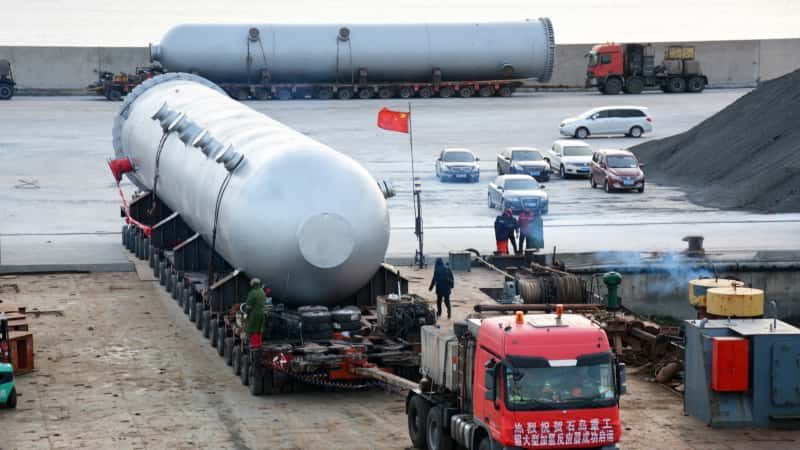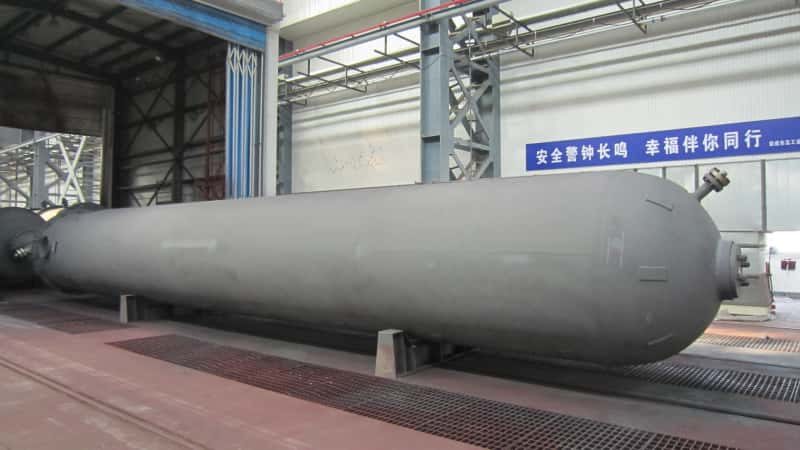

Executive summary. A gas cooler quotation is only comparable when the EPC team defines the actual gas stream, the required outlet condition, the available pressure-drop allowance, and the cooling utility. If the gas contains water vapor, hydrocarbons, solvents, or other condensable components, the buyer must also establish whether cooling produces liquid and where that liquid is expected to go. An outlet-temperature target alone may not define a mixed gas–liquid duty.
For a large, custom shell-and-tube exchanger, the most useful RFQ is not the longest list of mechanical dimensions. It is a short, traceable set of process conditions and equipment boundaries that allows each supplier to rate the same service. This guide explains the gas-specific inputs, identifies the decisions that remain with the process designer, and provides an RFQ checklist for evaluating complete industrial equipment.
What Does the Gas-Cooling Duty Actually Require?
A shell-and-tube heat exchanger transfers heat between a process gas and a separate cooling fluid across a metal heat-transfer surface. In a gas cooler, the primary process objective is typically to reduce gas temperature while keeping its pressure loss within a defined limit. That outcome may protect downstream equipment, establish a desired process temperature, or prepare a gas for a later treatment step.
However, the words gas cooler do not establish the design case. The same nominal inlet and outlet temperatures can represent materially different services when gas composition, mass flow, pressure, moisture content, or utility conditions change.
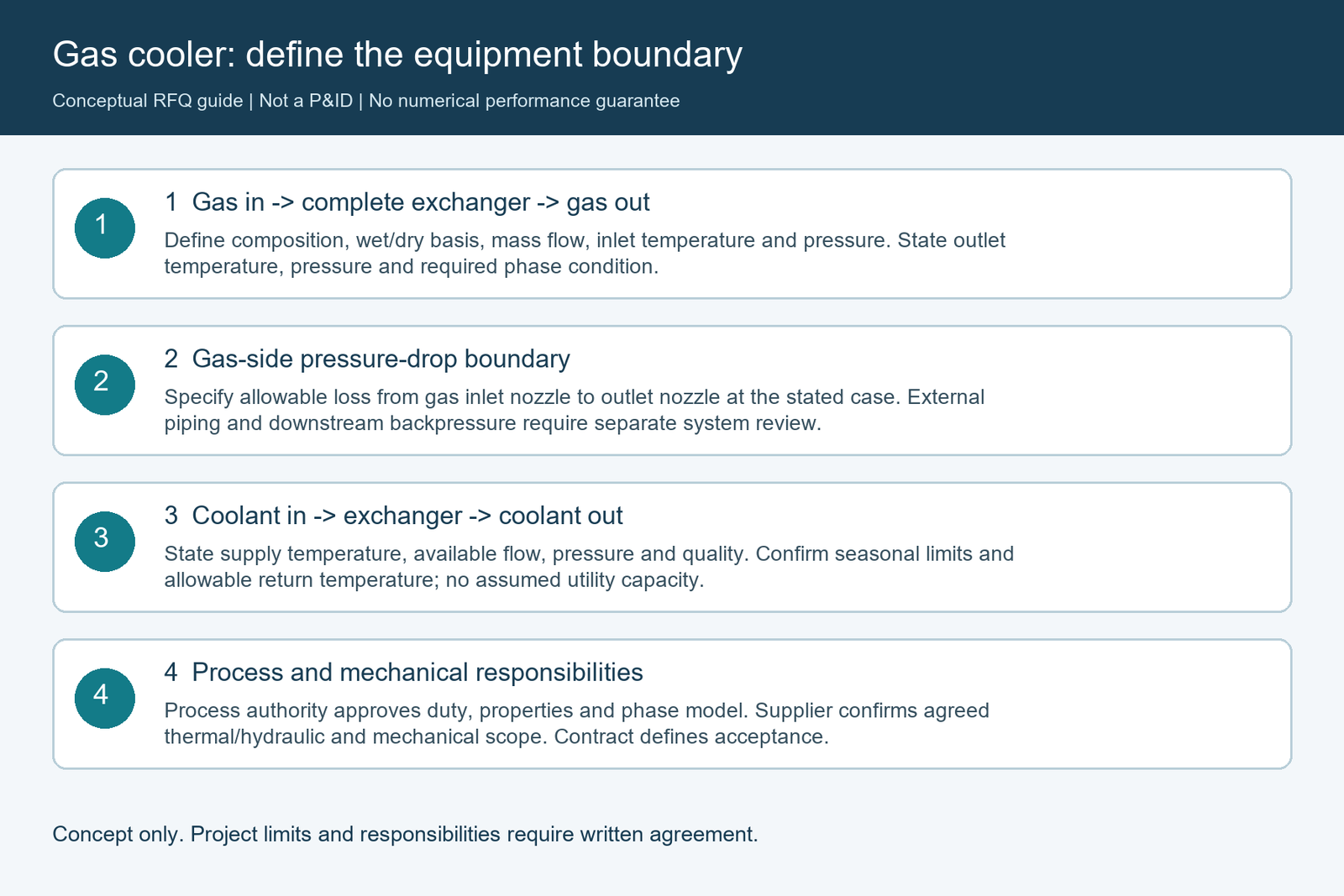
Start by recording four questions:
- What exactly enters the gas-side nozzle? State the component composition, flow basis, inlet temperature, inlet pressure, and any entrained material.
- What must leave? Define the target gas outlet temperature and pressure, and whether the stream must remain single-phase or may contain newly formed liquid.
- How much pressure can be lost? Give a maximum allowable gas-side pressure drop and identify the measurement boundary.
- What cooling resource is available? Specify coolant temperatures, flow or allowable consumption, pressure, quality, and credible operating limits.
These are performance inputs for the complete exchanger, not a specification for a stand-alone compressor aftercooler accessory, drain valve, or gas-processing package. The responsible process engineer should approve the duty before a manufacturer finalizes the mechanical proposal.
Specify Real Gas Composition and a Clear Flow Basis
Give composition rather than a generic gas name
“Process gas,” “air,” or “wet gas” may conceal properties that control the exchanger rating. The buyer should identify relevant components and their mole or mass fractions, including condensable species. If the reported analysis is on a dry basis, provide the moisture content separately; otherwise the quoted composition may not describe the actual wet stream entering the cooler.
Depending on the application, relevant information may include water vapor, condensable hydrocarbons or solvents, acid-forming impurities, particulate carryover, and the variation of these constituents between operating cases. The specification should flag known corrosive or fouling exposure and whether any components may solidify at the coldest credible metal or fluid temperature. Materials selection and corrosion assessment remain project-specific.
Distinguish mass flow, actual volume, and reference volume
A volumetric flow such as “m³/h” is incomplete unless the pressure and temperature basis is stated. A value in standard cubic meters per hour also requires the reference temperature, reference pressure, and wet/dry basis: the word standard does not establish the same definition in every document or jurisdiction.
Prefer a consistent gas mass flow in kg/h (or another declared unit) together with composition and thermodynamic conditions. If a volumetric value is also used, record whether it refers to actual inlet conditions, normal conditions, or a contract-defined reference state. KAESER’s reference-volume explanation illustrates why reference conditions must be identified; it does not provide this project’s process data.
Avoid converting between flow bases with an assumed constant gas density when pressure, temperature, composition, or phase fraction changes across the equipment. The responsible process team must supply the appropriate properties or a validated process model where needed.
| Gas-stream RFQ field | Buyer should state | Why the supplier needs it |
|---|---|---|
| Gas identification | Component list and wet/dry composition basis | Thermal properties, potential condensation, material exposure |
| Flow | Mass flow and units; any accompanying volumetric reference basis | Comparable duty and hydraulic rating |
| Inlet condition | Temperature and absolute or clearly labeled gauge pressure | Initial gas state, density and driving force |
| Variability | Design case plus any limiting or composition-changing cases | Avoids rating only an unrepresentative average |
| Contaminants | Moisture, condensables, solids and known corrosive constituents | Fouling, corrosion and liquid-handling assessment |
| Property source | Approved property package, analysis, or data revision where relevant | Traceable thermal and phase-equilibrium assumptions |
Editorial buyer checklist, not a mandatory form from a design standard.
Define the Outlet Gas State, Not Just a Temperature Number
For a demonstrably single-phase gas, the RFQ can identify the required outlet temperature at a stated inlet condition and cooling-utility condition. Even then, the pressure at the outlet must be considered because it affects density and the downstream pressure balance.
For a potentially condensing gas, buyers should instead specify an outlet-state requirement:
- The required gas outlet temperature and the associated operating pressure or allowable pressure-drop envelope.
- Whether a single gas phase is required, or whether a gas–liquid outlet is permissible.
- Any required downstream gas composition, moisture level, recovery objective, or liquid load—but only if the process engineer has established a defensible basis.
- The guaranteed operating case, applicable tolerances, calculation method and measurement locations, where the contract requires a performance guarantee.
“Cool the gas to the dew point” is not an adequate universal requirement. For a mixture, the relevant dew-point behavior depends on composition and pressure; the formation of a liquid phase can alter both the residual gas composition and the heat removed. A plant that only needs a specified outlet temperature should not accidentally promise complete vapor recovery, while a project that does require liquid recovery must make that obligation explicit.
This article addresses gas cooling first, with partial condensation as a possible consequence. If the primary duty is controlled vapor recovery in a stream containing non-condensables, the site’s separate guide to shell-and-tube condensers handling non-condensable gases covers that narrower service. It should not be confused with a general gas-cooling RFQ.
Set a Gas-Side Pressure-Drop Limit That the Supplier Can Verify
Gas-side pressure drop is a process constraint, not a freely interchangeable exchanger design parameter. Excessive loss may reduce pressure available to downstream users or increase the burden on upstream compression or flow-control equipment. A thermal design offering more surface or a different gas-flow path does not automatically satisfy the available hydraulic margin.
Specify the maximum allowable pressure drop at a named gas flow and inlet state, together with whether it applies to the exchanger from inlet nozzle to outlet nozzle, the exchanger core alone, or a larger skid boundary. State which nozzles, internal passages and other supplied items are included in the quoted figure. Site piping, strainers, valves and downstream separation equipment should be excluded or included explicitly, rather than silently mixed into two suppliers’ results.
The supplier should report calculated gas-side pressure drop for each required case, with assumptions on fluid properties, fouling, phase and flow allocation. A separate utility-side allowable pressure drop is also needed. For multi-case projects, a design that meets the pressure limit at normal load may still need review at a different flow, pressure, or phase composition.
Shell configuration, tube arrangement, baffles, nozzles and gas-side allocation affect heat transfer, velocity, pressure loss and vibration risk. Enerquip’s discussion of shell configurations describes these design trade-offs. It does not mean one TEMA shell type is automatically correct for every gas cooler. The purchaser should state the constraint; the qualified designer should justify the arrangement.
Comparison check: if two bids report substantially different gas pressure drops, do not compare only surface area and price. Check whether they used identical gas composition, temperature-dependent properties, wet/dry flow basis, phase assumption and nozzle-to-nozzle boundary.
What If Cooling Produces Condensate?
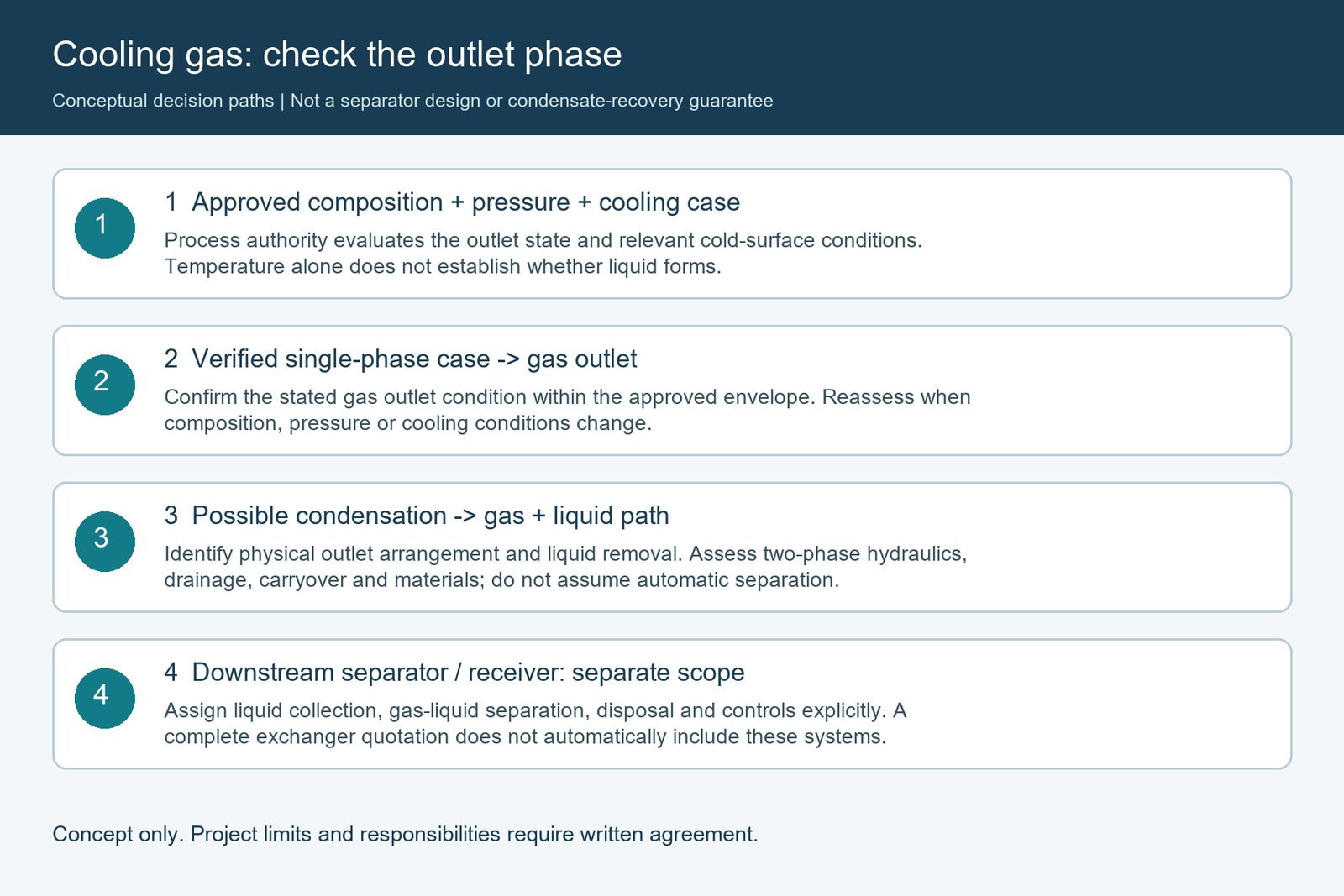
Ask for a documented phase assessment
A gas may enter entirely in the vapor phase and cross a dew-point boundary as it cools. Water, process solvents and certain hydrocarbons can form liquid depending on the mixture and pressure. The U.S. EPA’s condenser technical overview explains how stream composition, moisture content, pressure-related vapor behavior and coolant conditions influence condensation. This is supporting physical background, not a claim that an EPA emissions-control design method governs every industrial gas cooler.
The EPC process team should determine whether condensation is expected or credibly possible for the specified operating cases. Where it is, the process basis should include the appropriate vapor–liquid-equilibrium method or property package, expected outlet vapor and liquid amounts, and the corresponding enthalpy or heat-release calculation. Do not apply a single gas heat-capacity calculation across a phase-change region as if all heat removal were sensible cooling.
The supplier can then evaluate the exchanger against that approved two-phase thermal and hydraulic basis. A change in predicted condensate fraction can affect heat duty, gas velocity, liquid hold-up and the validity of a dry-gas pressure-drop result. Where entrained droplets, non-equilibrium behavior or multiphase hydraulics are material, the responsible engineering parties must agree the assessment method.
Identify the physical liquid outlet and downstream boundary
A statement that “some condensate may form” is not a complete interface specification. The design review needs to determine whether the process gas and liquid leave through one mixed outlet, whether the selected exchanger arrangement permits drainage, whether a separate liquid connection is proposed, and who provides the downstream liquid separation or collection system.
Before quotation comparison, record:
- Whether free liquid is already present at the inlet or is generated only during cooling.
- Expected or limiting condensate amount, composition, and any solids or emulsion concerns if established by approved process data.
- The proposed outlet arrangement, orientation, drainage points and provisions against unintended liquid accumulation.
- The destination of liquid, together with any downstream separator, receiver, treatment or pumping boundary.
- Any process-safety, corrosion, freezing or fouling concern caused by the liquid or by cold surfaces.
A gas cooler does not become a guaranteed gas–liquid separator merely because condensate may appear. If downstream separation is required, its scope and performance criteria should be defined under a separate approved process specification. This prevents accidental expansion of an exchanger manufacturer’s responsibility into an unconfirmed complete gas-treatment package.
| Process assessment | Single-phase cooling basis | Possible partial-condensation basis |
|---|---|---|
| Thermal calculation | Appropriate gas properties and inlet/outlet states | Gas/liquid phase equilibrium, enthalpy change and phase fractions |
| Outlet requirement | Specified gas temperature and pressure | Gas outlet state plus permissible/required liquid behavior |
| Hydraulic review | Gas-side pressure drop at stated conditions | Pressure drop and flow regime assessed for the relevant two-phase conditions |
| Mechanical interface | Gas connections and agreed drainage/maintenance provisions | Defined condensate drainage or mixed outlet; downstream separation scope identified |
| Owner/EPC input | Verified single-phase envelope | Approved composition, property method and downstream liquid route |
Editorial comparison, not a claim that every gas cooler will condense.
Include Real Cooling-Utility Conditions
The supplier needs the cooling-fluid specification rather than merely “cooling water” or “chilled water.” Give inlet temperature and its seasonal or operating range, available pressure, normal and allowable flow, and outlet-temperature or consumption restrictions as applicable. If the coolant itself can change phase, provide the approved utility-side duty and pressure/phase conditions.
Report relevant water quality, fouling assumptions, corrosion constraints and utility-side design requirements. The warmest credible coolant inlet condition may govern whether the gas outlet target can be achieved; the coldest condition may matter for unwanted condensation, excessive cooling or freezing of susceptible mixtures. Which case is controlling must be demonstrated rather than assumed.
The EPC team should distinguish conditions supplied by the utility network from performance offered within the exchanger’s nozzles. A supplier cannot verify a process temperature against an unspecified utility supply. For general multi-case documentation beyond this gas-specific RFQ, use the site’s heat-balance and measurement-boundary guide when the engineering problem is reconciliation of existing operating data, rather than a new gas-cooler specification.
Align Mechanical Design, Materials, and Guarantees With the Duty
After the process duty is defined, establish the applicable mechanical design and procurement requirements: design pressures and temperatures for both sides, relevant upset conditions, material and corrosion basis, required inspection and testing, orientation, installation loads, maintainability, and agreed deliverables. These must be based on the project and jurisdiction, not invented from a generic product name.
For relevant oil, gas and petrochemical applications, ISO 16812:2019 addresses mechanical design, materials, fabrication, inspection, testing and shipment of shell-and-tube exchangers and identifies its relationship to API 660. The ISO listing confirms the edition’s current status, but the contractual code and edition still require project confirmation. A mechanical-code compliance statement is not, by itself, a gas-outlet-temperature or condensate-recovery guarantee.
In the technical bid, ask the vendor to distinguish three matters:
- Thermal/hydraulic rating: predicted gas outlet state, duty, gas-side and utility-side pressure drops for defined cases.
- Mechanical equipment scope: exchanger, connections, support arrangements, agreed instruments and documentation—not unconfirmed compressor, utility-plant or separator supply.
- Acceptance basis: which requirements are demonstrated by drawings and calculations, which by shop tests or inspection records, and which (if contracted) require performance verification under agreed field conditions.
A hydrostatic test or factory document review cannot automatically prove thermal performance at the operating gas composition and utility conditions. The contract should define the method for any such guarantee and the owner/EPC’s responsibility to provide valid conditions and measurements.
Gas Cooler Heat Exchanger RFQ: A Practical Buyer Checklist
The following table can be copied into a project inquiry and completed with real engineering data. Mark fields as Approved, Provisional, or Not yet available; an empty cell should not be treated as a supplier-approved assumption.
| RFQ item | Required information or decision | Responsible input / evidence |
|---|---|---|
| Application and equipment | Complete shell-and-tube gas cooler; tag, project location and service | Owner/EPC datasheet |
| Gas components | Wet and dry composition as relevant; impurity ranges | Approved process analysis |
| Gas throughput | Mass flow and units; actual/reference volume if quoted, with T/P and wet/dry basis | Process balance and reference definitions |
| Gas inlet | Inlet temperature, pressure type (absolute/gauge), physical state | Process design basis |
| Gas outlet | Required temperature, corresponding pressure and acceptable phase condition | EPC process requirement |
| Gas pressure loss | Maximum gas-side allowable ΔP, named case and boundary | EPC pressure balance |
| Cooler-side fluid | Identity, composition/quality, T/P/flow ranges, allowed ΔP | Utility specifications |
| Phase-change review | Whether condensation is excluded, expected or unresolved | Process engineer and property model |
| Condensate handling | Expected liquid amount (if determined), connection/route and separation boundary | P&ID and interface responsibility |
| Limiting conditions | Cases governing maximum gas flow, hottest utility, minimum load and relevant composition change | Agreed operating-case register |
| Materials and fouling | Corrosion, deposition, water quality, solids and cleaning constraints | Material/service specifications |
| Mechanical requirements | Codes/editions, design T/P, testing, inspection, orientation and access | Approved equipment specification |
| Guarantees | Identified rating cases, contractual acceptance criteria and verification method | Bid clarification and contract |
| Vendor deliverables | Thermal/hydraulic rating, GA drawings, nozzle schedule, deviations and open-item list | Supplier technical proposal |
A useful RFQ instruction: “Please quote the complete exchanger against the stated gas composition, flow basis, gas outlet condition, allowable gas-side pressure drop and available utility conditions. Identify any assumed phase state, condensate-handling boundary and unverified input. List technical deviations rather than silently revising the design basis.”
How Should EPC Buyers Compare Two Gas-Cooler Proposals?
First, confirm that both bids address the same approved process basis. A lower quotation is not directly comparable if it assumes drier gas, warmer gas outlet, higher permitted pressure loss, more cooling-water consumption, no condensation, or excluded liquid-handling connections.
Next, request a side-by-side comparison of the achieved outlet gas state, allowable versus predicted pressure drops, the coolant case used for rating, the phase-change assessment and the offered mechanical scope. Where an item is unresolved, assign an owner and a decision date. Vendors should identify clarifications and deviations explicitly; buyers should not treat unapproved assumptions as performance commitments.
Finally, separate the design calculation from the contractual guarantee. A supplier may propose an exchanger rating under stated fluid properties and utility conditions, while downstream gas quality, condensate handling and process-wide efficiency remain with the plant’s responsible process design party unless expressly included in the supplier’s scope.
For complete industrial equipment inquiries, review the manufacturer’s shell-and-tube heat exchanger product category and submit the actual project datasheet. Public product descriptions do not replace a project-specific technical and commercial review.
Frequently Asked Questions
Can a heat exchanger be used for cooling?
Yes. A shell-and-tube exchanger can remove heat from a process gas using a cooler stream on the other side of the heat-transfer surface. Its suitability depends on the actual flow, composition, temperature, pressure, permitted pressure drop, utility availability and any phase change. This question was observed in a Google People also ask module on November 13, 2026; the answer here is independently authored.
Is standard volumetric gas flow enough for a gas-cooler quote?
No. A standard volumetric flow still needs stated reference pressure and temperature, and often a wet/dry definition. Gas composition and actual inlet pressure and temperature are also required to establish the physical stream entering the equipment. Mass flow is generally a clearer comparison basis when supplied with consistent composition and state data.
Does reaching the specified gas outlet temperature mean condensation will not occur?
No. Whether liquid forms depends on the gas mixture and pressure as well as temperature. The process engineer should assess the relevant dew-point and phase-equilibrium behavior before declaring the service single-phase.
Does the gas-cooler manufacturer automatically supply a condensate separator?
No. The exchanger’s gas/liquid outlet arrangement and any downstream separator or receiver are separate scope decisions. They must be stated in the RFQ and confirmed in the supplier’s technical offer.
Conclusion
A useful gas-cooler RFQ defines the gas entering the exchanger, the gas expected to leave it, the pressure loss available, and the cooling utility that makes the duty possible. If the service may produce liquid, the process team must also establish the phase-equilibrium basis and the condensate destination.
Buyers should request vendor ratings against the same approved inputs, require deviations and assumptions to be visible, and keep process-wide gas handling and recovery guarantees separate from the scope of the complete shell-and-tube exchanger. Those steps make quotations easier to compare and reduce the risk of discovering unresolved process interfaces after equipment selection.
References
- International Organization for Standardization (ISO). ISO 16812:2019 — Petroleum, petrochemical and natural gas industries: Shell-and-tube heat exchangers. Scope and status of mechanical-equipment requirements; the applicable project edition must be confirmed.
- U.S. Environmental Protection Agency. Monitoring by Control Technique — Condensers. Technical background on gas composition, dew point, cooling and condensation; not a universal gas-cooler design standard.
- Enerquip. 7 Shell Configurations to Consider When Designing a Shell and Tube Heat Exchanger. Manufacturer discussion of shell configuration and hydraulic/thermal trade-offs; not proof of this site’s product capabilities.
- KAESER. Standard Cubic Metre Conversion. Background on reference volumetric conditions; project gas data remain controlling.