
A heat exchanger tube plugging allowance should define the performance that a complete exchanger must deliver when an agreed number and arrangement of tubes are unavailable for normal flow. A percentage in a purchase specification is not sufficient on its own. Buyers also need to know which tubes the allowance refers to, how unavailable flow paths are represented in the thermal rating, what operating conditions apply, and whether the associated pressure drops remain acceptable.
For a new shell-and-tube heat exchanger, an allowance can be evaluated as a prospective design case before the equipment is ordered. For an existing exchanger, the actual condition of the bundle and the surrounding process system must be assessed. Neither a new-equipment allowance nor a satisfactory thermal calculation gives automatic permission to plug tubes in service.
This guide explains how EPC engineers and industrial equipment buyers can specify the case, compare supplier ratings and establish the scope of a contractual performance commitment. It is not a tube repair procedure or a universal limit on the number of tubes that may be removed from service.
What Does a Tube-Plugging Allowance Mean in a New Exchanger RFQ?
Tube plugging takes a tube out of normal through-flow service. In a procurement specification, a plugging allowance generally describes a hypothetical future configuration in which some tubes are unavailable while the exchanger is still expected to perform an agreed process function.
The distinction between the installed bundle and the configuration used to establish performance is important. A new exchanger can be delivered with its complete intended bundle while its design is evaluated for a separate case involving unavailable tubes. Unless the contract expressly states otherwise, the hypothetical case is not an instruction to deliver the exchanger with tubes already plugged.
For a complete industrial shell-and-tube heat exchanger, the requirement may affect not only the surface area but also the shell and channel configuration, tube arrangement and hydraulic suitability of the offered equipment. The appropriate provision should be assessed during the technical bid review, rather than assumed from the manufacturer’s general design margin.
New equipment and existing equipment require different evidence
| Review context | Information that defines the case | Decision being supported |
|---|---|---|
| New exchanger quotation | Proposed installed geometry, assumed unavailable tubes, process cases, performance requirements | Whether the offered complete exchanger can meet the specified conditions |
| New exchanger manufacturing deviation | Approved design, actual as-built tube status, affected rating and disposition requirements | Whether the delivered equipment still meets the contract and applicable construction requirements |
| Existing exchanger assessment | As-built geometry, actual tube status and location, inspection findings, present operating conditions and equipment history | Whether responsible engineering and integrity personnel can accept the actual condition under the applicable rules |
An approved hypothetical allowance may be useful input to an existing-equipment review, but it does not establish that the actual damage mechanism, tube arrangement or current operating conditions match that original design assumption. The manufacturing-deviation case also requires its own disposition; buyers should not silently consume a future allowance to accept an as-built deviation.
How Should Buyers Define the Number and Distribution of Unavailable Tubes?
Identify the denominator before comparing percentages
The same stated percentage can describe different physical configurations. It might refer to original installed tubes, the tubes in a particular pass, or a specified section of the bundle. If the exchanger has already undergone changes, a percentage may be reported relative to a different reference count again.
Ask the supplier to identify the reference population and the definition of an unavailable tube. For a U-tube bundle, the counting convention should make clear whether the number refers to physical U-tubes or tube legs at the tubesheet. Counting openings as if they were independent tubes can misrepresent the actual flow paths.
A percentage calculated from tube count is also not necessarily the percentage of installed heat-transfer area represented by those tubes, particularly where tube lengths or geometries differ. The rating should use the actual relevant surface and passage geometry, not just the percentage in the datasheet.
Define the distribution by pass and affected region
Two plugging scenarios with the same total count need not have equivalent thermal or hydraulic effects. In a straight-tube multipass arrangement, unavailable tubes concentrated in one pass may leave that pass with considerably less open flow area than another pass. In a different arrangement, the loss of a continuous tube path can affect more than one section of the circuit.
For condensers or exchangers with distinct thermal zones, the location of unavailable surface may matter in addition to the amount. The engineer should identify whether location-dependent effects need to be represented explicitly. A uniformly distributed assumption is not evidence that every possible distribution is acceptable.
The EPRI Comprehensive Tube Plugging Guidelines, published in 2016 for nuclear plant heat exchangers other than steam generators, specifically identifies multipass distribution as an engineering consideration. Its sector-specific guidance is not a general industrial construction standard, but it illustrates why the same total count may require different assessments.
Use a traceable plugging-case definition
The following register is a template for an RFQ or clarification sheet. The empty fields are intentional; they require project and supplier information.
| Required field | Project or vendor entry | Source or approval needed |
|---|---|---|
| Equipment tag and geometry revision | To be supplied | Process datasheet and vendor drawing |
| Original installed physical tube count | ___ tubes | Approved or offered tube layout |
| Counting basis and denominator | To be defined | Vendor and responsible reviewer |
| Total unavailable tubes for each case | ___ tubes | Owner requirement or approved design assumption |
| Tube count and unavailable paths by pass | To be supplied | Pass arrangement and case-specific tube map |
| Affected locations or thermal zones | To be defined | Approved distribution assumptions |
| Alternative distributions to be assessed | To be defined, if applicable | Responsible thermal/mechanical engineering |
| Basis of remaining active surface and flow area | To be calculated | Rating method and geometry revision |
| Restrictions on the accepted case | To be documented | Engineering approval and contract schedule |
If the project cannot specify an exact distribution at enquiry stage, the RFQ can request proposed assumptions and a justified representative or bounding assessment. The supplier should state what was evaluated, what was not evaluated and whether the model can distinguish the relevant patterns. A claim that a case is bounding requires an explanation; an arbitrary pattern cannot simply be called the worst case.
Why Is Lost Heat-Transfer Area Not the Same as Lost Heat Duty?
In basic steady-state heat-transfer analysis, duty depends on the temperatures, available surface, fluid properties and overall heat-transfer behavior. For an applicable exchanger represented using a log-mean temperature difference approach, the relationship can be written as:
Q = U × A × F × ΔTlm
Here Q is heat duty, U is the overall heat-transfer coefficient on the specified area basis, A is the corresponding heat-transfer area, F is the applicable temperature-difference correction factor, and ΔTlm is the log-mean temperature difference. With Q in W, U in W/(m²·K), A in m² and ΔTlm in K, F is dimensionless.
This is a conceptual relationship, not a plugged-bundle rating model. It is applicable where the chosen temperature-difference method and assumptions are appropriate; phase-changing and strongly varying-property services may require segmented or other suitable analysis. The exchanger’s actual thermal rating must also satisfy the energy balance for the two streams.
Removing available flow paths may change the effective surface used by the rating. But U is not necessarily unchanged, since local fluid velocities, film coefficients and flow distribution may change. The temperature difference may also change because the achievable outlet conditions are different. Consequently, a stated reduction in available surface does not establish an identical reduction in achieved heat duty.
For an RFQ, the task is normally to rate the offered equipment against the specified process conditions rather than to calculate the area of a hypothetical alternative exchanger with all tubes unchanged. The rating should represent the actual arrangement retained in the offered design. Treating unavailable tubes as if their physical presence had disappeared from the shell may misrepresent shell-side geometry and flow. The thermal engineer must decide how inactive tubes and their surrounding regions are modeled, and document any simplifying assumptions.
What should the thermal rating demonstrate?
The buyer should require a comparison between the baseline configuration and the specified unavailable-tube case, reporting at least the achievable duty and outlet conditions under common approved inputs. Whether the duty or outlet state is the controlling acceptance target depends on the service. For a single-phase cooler it may be an outlet temperature; for a condenser it may include an agreed condensation requirement or outlet phase condition. A nominal duty reported without these associated conditions can hide an operating deficiency.
Distinguish a specified duty from the calculated achievable duty. A rating that simply enters the required duty as an input, without showing that the offered geometry can achieve it within the agreed constraints, is not adequate evidence of performance. Likewise, an outlet temperature imposed as an input is not necessarily a predicted result.
How Does Tube Plugging Change the Hydraulic Assessment?
At a fixed total volumetric flow in an applicable liquid-flow pass, a smaller open tube area generally results in a higher mean velocity through the remaining open paths. The local distribution may not be uniform, however, and the additional resistance depends on the geometry, fluid properties and flow regime.
For a gaseous or two-phase stream, volumetric flow and local velocities may vary substantially along the exchanger. A simple ratio of total tube counts is not sufficient to determine the hydraulic response. The rating should account for the service and relevant flow regions using an appropriate method.
The buyer needs both the predicted tube-side and shell-side pressure drops under the specified case, together with their measurement or calculation boundaries. The tube-side pressure loss is particularly relevant where fewer paths are available. Shell-side results should also be reviewed; the interaction of changes in temperature or phase conditions with fluid properties may alter its hydraulic behavior even when the physical shell arrangement is unchanged.
Distinguish specified flow from available system flow
A comparison at the same required flow is useful for assessing the change caused by the unavailable tubes. However, it may not represent the flow the installed system can actually deliver. For instance, a centrifugal pump operating in a liquid circuit may move to a different operating point when circuit resistance changes. The Hydraulic Institute’s pump and system curve guidance explains how that operating point depends on the interaction of the pump and system curves.
Where the available driving pressure is limited, the system engineer should confirm that the required flow remains achievable. Alternatively, the project may require an additional rating at a validated system-limited flow. This must not be used to quietly reduce a required process duty or acceptance criterion.
The guide to allowable pressure drop for shell-and-tube exchangers explains how the project can establish a defensible hydraulic allowance. In the plugging case, the additional question is whether that same allocation remains sufficient for the proposed unavailable-tube configuration.
A 2021 industry case reported by Curtiss-Wright EST Group described a gas-processing exchanger whose original flow conditions had changed. A project-specific flow analysis informed a change in available tube paths. The case is a useful example of why configuration and actual conditions must be considered together. It does not establish a general design allowance or a recommended field action. It is an external case, not a WSHI project.
How Should the Plugging Case Be Separated from Fouling and Area Margin?
Heat exchanger quotations sometimes combine several design provisions into a single statement of conservatism. The effect of each provision should instead be identified in the rating basis.
| Design provision | What it represents | What it does not prove |
|---|---|---|
| Specified fouling resistance | Thermal resistance associated with the assumed fouled surface condition, on the specified side and area basis | The number or distribution of unavailable flow passages that can be accepted |
| Installed area margin | Extra installed surface relative to a stated required-area calculation and reference case | That flow, pressure drop and duty will meet the contract after tubes become unavailable |
| Tube-plugging allowance | An agreed configuration with specified unavailable tube paths, evaluated at defined conditions | Permission to repair, continue operating or accept all possible tube-loss patterns |
| Process duty margin | An approved increment or case representing additional duty requirements or uncertainty | That other thermal, hydraulic and mechanical restrictions have already been satisfied |
A conventional fouling resistance models the thermal effect of deposits; it is not a complete representation of the hydraulic effects of fouling, nor of blocked passages. Where deposits or debris may affect hydraulic area, that condition must be defined separately as appropriate to the service. A tube-plugging assessment should state whether the remaining active surface is assumed clean or fouled and whether any additional flow-area reduction is included.
For example, a supplier might offer additional installed surface and show a rating at the design fouling resistance with all tubes available. The buyer cannot conclude that the exchanger can meet the same duty under the specified unavailable-tube condition until the offered geometry has also been evaluated for that condition. Conversely, if the unavailable-tube case is already included in the rating used to select the installed geometry, an additional allowance for exactly the same assumption should not be added without a separate justification.
For the broader process of reconciling these provisions, see the heat exchanger design margin guide. The plugging-case requirement is more specific: it needs an explicit configuration and an associated thermal-hydraulic result, not merely another entry in the area reserve calculation.
Which Operating Cases Should Be Included in the Supplier’s Rating Package?
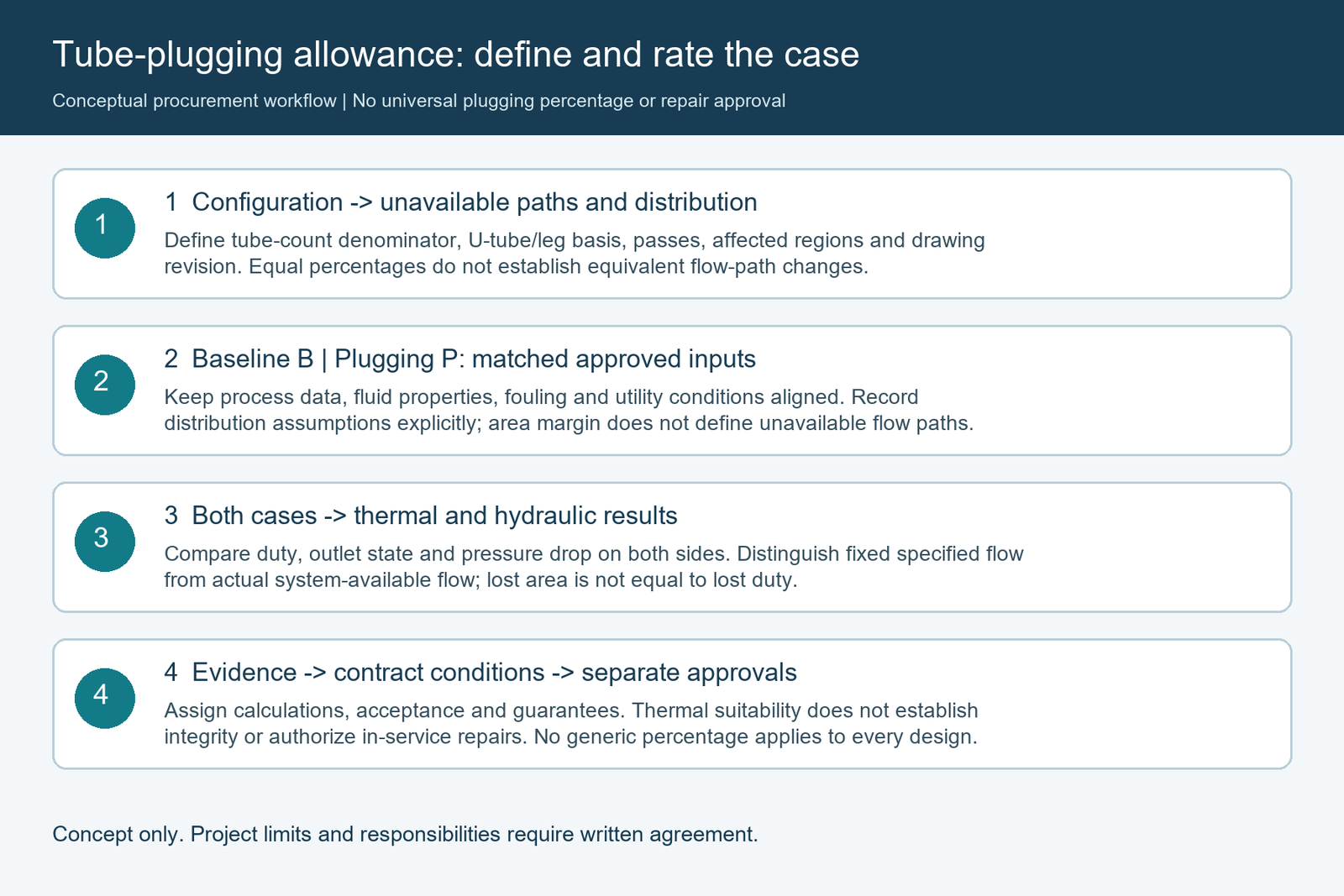
A useful enquiry identifies the operating cases first, then associates each applicable unavailable-tube assumption with those conditions. The following structure allows buyers to compare the same offered equipment rather than separate theoretical designs.
| Case | Equipment configuration | Process basis | Required review |
|---|---|---|---|
| B — baseline | All intended tubes available, unless the approved baseline states otherwise | Agreed reference conditions | Duty, outlet state and both-side pressure drops |
| P — specified plugging case | Same offered geometry; unavailable paths explicitly defined | Same reference conditions and fouling assumptions as B | Direct thermal and hydraulic comparison against B and acceptance limits |
| A — alternative distribution | Same geometry; another approved unavailable-path pattern | Comparable inputs to P | Sensitivity to location or pass distribution, where relevant |
| L — other governing load | Approved tube configuration for this case | Validated alternative process or utility conditions | Case-specific duty, hydraulic and operability assessment |
| S — system-limited case | Approved configuration | Confirmed available system head or pressure and associated flow conditions | Demonstration of actual system compatibility, where required |
These labels are examples of document organization, not mandatory operating cases or actual project results. A minimum-load case, an alternate utility condition or another operating point should be included when the responsible process team determines it is relevant. Do not combine unrelated extremes simply because they are listed in different rows of a datasheet.
Keep input revisions and results aligned
Each rating should reference the same equipment tag, geometry revision and corresponding case definition. The input conditions should distinguish operating pressure from mechanical design pressure and state the pressure reference where necessary. Phase fraction, composition and flow basis must be consistent with the property method used. A standard volumetric flow for gas is not interchangeable with actual volumetric flow at exchanger conditions without the relevant conversion basis.
If suppliers propose different tube counts, layouts or pass arrangements, compare each design against the same approved functional requirements and the project’s defined allowance basis. If that basis refers to a percentage of installed tubes, the actual tube counts may differ between bids. The decision should therefore consider the results achieved by each complete design and any restrictions on its assumed distribution.
Request a comparable performance schedule
The table below may be issued as a blank vendor response sheet for each operating case. The case definitions and acceptance criteria must be supplied or approved before commercial comparison.
| Input or output | Baseline B | Plugging case P | Acceptance basis / source |
|---|---|---|---|
| Equipment and rating revision | To be supplied | To be supplied | Approved drawing and calculation |
| Tube configuration and distribution | To be supplied | To be supplied | Tube map and pass arrangement |
| Shell/tube fluid composition and phase | To be supplied | To be supplied | Process data revision |
| Shell/tube mass flow (kg/h or agreed units) | ___ | ___ | Approved operating case |
| Shell/tube inlet temperature (°C) | ___ | ___ | Process and utility basis |
| Shell/tube inlet operating pressure and reference | ___ | ___ | Process and utility basis |
| Fouling resistance by side (m²·K/W or agreed units) | ___ | ___ | Approved thermal basis |
| Required duty (kW or MW) | ___ | ___ | Process acceptance target |
| Predicted achievable duty (same units) | ___ | ___ | Vendor rating result |
| Required / predicted outlet state | To be supplied | To be supplied | Temperature, phase or other agreed requirement |
| Allowable / predicted tube-side pressure drop (kPa) | ___ / ___ | ___ / ___ | Same agreed boundary |
| Allowable / predicted shell-side pressure drop (kPa) | ___ / ___ | ___ / ___ | Same agreed boundary |
| Other applicable constraints | To be supplied | To be supplied | Approved velocity, wall temperature or other service-specific criteria, if applicable |
| Model assumptions and deviations | To be supplied | To be supplied | Technical clarification log |
| Guarantee status | To be agreed | To be agreed | Contract performance schedule |
The calculation may need additional properties, local thermal results or other service-specific information. Ask for enough documentation to understand the limits of the prediction even if the supplier does not disclose its proprietary calculation model.
If the supplier cannot model the specified distribution, record the method limitation and seek an acceptable alternative review from the responsible engineering parties. A favorable result for one simplified representation should not be entered as an unconditional pass for a more demanding configuration.
What Should the Buyer Verify Beyond the Thermal-Hydraulic Rating?
A satisfactory thermal rating confirms only the performance evaluated within that calculation’s scope. It does not establish the condition of the pressure boundary, the suitability of an actual repair, or the remaining service life of the equipment.
For new equipment, the responsible mechanical designer should determine whether the specified unavailable-tube cases introduce additional design considerations. Depending on the arrangement and service, these may include internal differential pressure, local temperature conditions, stresses, tube support or the implications of changed flow for equipment integrity. The appropriate checks and their acceptance criteria must be defined by qualified engineering personnel, not inferred from a passing duty calculation.
For an existing exchanger, an actual plugging decision also depends on the inspection findings, relevant degradation mechanisms, approved repair basis and applicable post-construction requirements. ASME PCC-2, Repair of Pressure Equipment and Piping, addresses repair of in-service pressure equipment within its scope. The project and jurisdiction determine its applicability and relevant edition. Inspection, flaw assessment and fitness-for-service decisions require their own appropriate basis.
These distinctions also apply when a proposed exchanger is a replacement for an existing unit. The buyer may have detailed operating data and an actual unavailable-tube history, but that history must be translated into requirements for the replacement design rather than automatically adopted as its allowable limit.
How Can EPC Buyers Turn the Rating into an Enforceable Procurement Requirement?
A supplier should identify whether its plugged-tube rating is a preliminary estimate, a design review result or a contractual performance commitment. These categories are not interchangeable. The buyer must also know which party is responsible for setting the inputs, confirming system capability and resolving deviations.
Specify deliverables and responsibility before the purchase order
| Requirement | Evidence to request | Typical responsible party, subject to contract |
|---|---|---|
| Process conditions and performance targets | Approved operating cases and datasheet | Owner / EPC process engineering |
| Desired plugging provision | Approved count basis, case and distribution assumptions | Owner / EPC, with thermal designer input |
| Offered geometry | Equipment drawing, tube and pass configuration | Equipment supplier |
| Thermal-hydraulic compliance | Matched baseline and plugging-case ratings with deviations | Contracted thermal designer / supplier |
| Available utility and process flow | System hydraulic review for governing conditions | EPC or plant system engineer |
| Additional design or integrity review | Applicable engineering assessment and approval | Contracted mechanical / integrity specialists |
| Modification of proposed basis | Revision log and disposition of technical changes | Originating party and designated approver |
| Contractual guarantee and verification | Agreed acceptance conditions, tolerances, method and responsible party | Buyer and contracted guarantor |
This allocation is a starting point for defining interfaces. The actual contract may allocate thermal design and mechanical fabrication to different parties. In that case, the purchase documents should identify how the approved rating and geometry information are transferred and how a design change triggers re-review.
Preserve the distinction between calculation and acceptance testing
The existence of a calculated plugging-case rating does not establish that the hypothetical case has been physically tested. Standard factory fabrication inspection, pressure testing and dimensional checks do not demonstrate the full thermal performance of a unit under simulated future tube unavailability.
The agreed performance verification may involve an approved calculation review, a suitable test program, site performance verification or another contractual method. The parties should establish which evidence is required and feasible, including the applicable measurement uncertainty, permitted deviations from reference conditions and any agreed method for assessing results. Do not assume that a test at the unrestricted baseline can verify every plugging case.
A proposed guarantee should be expressly linked to the operating case, equipment configuration, utility conditions and other defined constraints. Any remaining limitation should stay open until it is resolved or formally accepted as a deviation. It should not become an implied performance guarantee simply because the supplier’s datasheet contains a plugging percentage.
Send a complete enquiry, not a percentage alone
When requesting a quotation from Weihai Shidao Heavy Industry (WSHI) for a custom industrial exchanger, provide the process datasheet, baseline and proposed unavailable-tube cases, the allowed pressure drops, the required performance evidence and the intended division of design and verification responsibilities. Clearly identify data that remain provisional.
This information provides the basis for discussing complete-equipment supply and the scope of technical work. The availability of specialty assessments and any performance guarantee must be confirmed for the specific enquiry.
Frequently Asked Questions
What percentage of tubes can be plugged in a heat exchanger?
There is no single percentage that establishes acceptable performance and integrity for every shell-and-tube heat exchanger. The permissible configuration depends on the specific equipment, location and distribution of unavailable tubes, required process duty, pressure-drop constraints, actual condition and applicable engineering approvals. A new-equipment RFQ should define a plugging case and require its assessment rather than rely on a general percentage.
Does an area margin establish a plugging allowance?
No. Extra installed area may contribute to the ability to meet a specified plugging case, but an area margin alone does not establish the remaining flow paths, thermal performance or hydraulic suitability. An explicit case rating is needed where the plugging provision is a purchase requirement.
Does higher velocity in the remaining tubes compensate for lost surface?
Not necessarily. A change in velocity can influence the heat-transfer coefficient, but it can also increase hydraulic resistance and create other service-specific constraints. The available system flow may change. The overall result must be assessed for the defined configuration and operating conditions.
Can the supplier guarantee the same duty in every plugging pattern?
A guarantee should cover only the defined and accepted configurations and conditions. If the buyer requires performance across a broader range of distributions, the request must specify that range and the engineering basis for demonstrating compliance. A result for an evenly distributed assumption should not be interpreted as proof of every possible pattern.
Can an original plugging allowance be used to approve repairs years later?
It can be relevant historical design information, but it is not a repair approval. The actual tube condition and configuration, current operating requirements and applicable integrity and repair requirements must be reviewed by the responsible specialists.
References
- Electric Power Research Institute (EPRI). Comprehensive Tube Plugging Guidelines, 2016, report 3002008015, Chapter 5. Technical reference for nuclear plant heat exchangers other than steam generators; not a universal industrial plugging standard.
- Curtiss-Wright EST Group. Heat Exchanger Tube Plugging to Reduce Tube Capacity/Increase Flow Rate, February 1, 2021. External industry case with a specific flow assessment, not a general allowance recommendation.
- Hydraulic Institute. Combined Pump & System Curves. General pump/system interaction principles for applicable pumped systems.
- ASME. PCC-2: Repair of Pressure Equipment and Piping. Official scope information; applicability and edition depend on the project.