
A batch reactor may have sufficient cooling capacity for its intended production cycle but still require additional process-safety evaluation before the complete equipment can be specified.
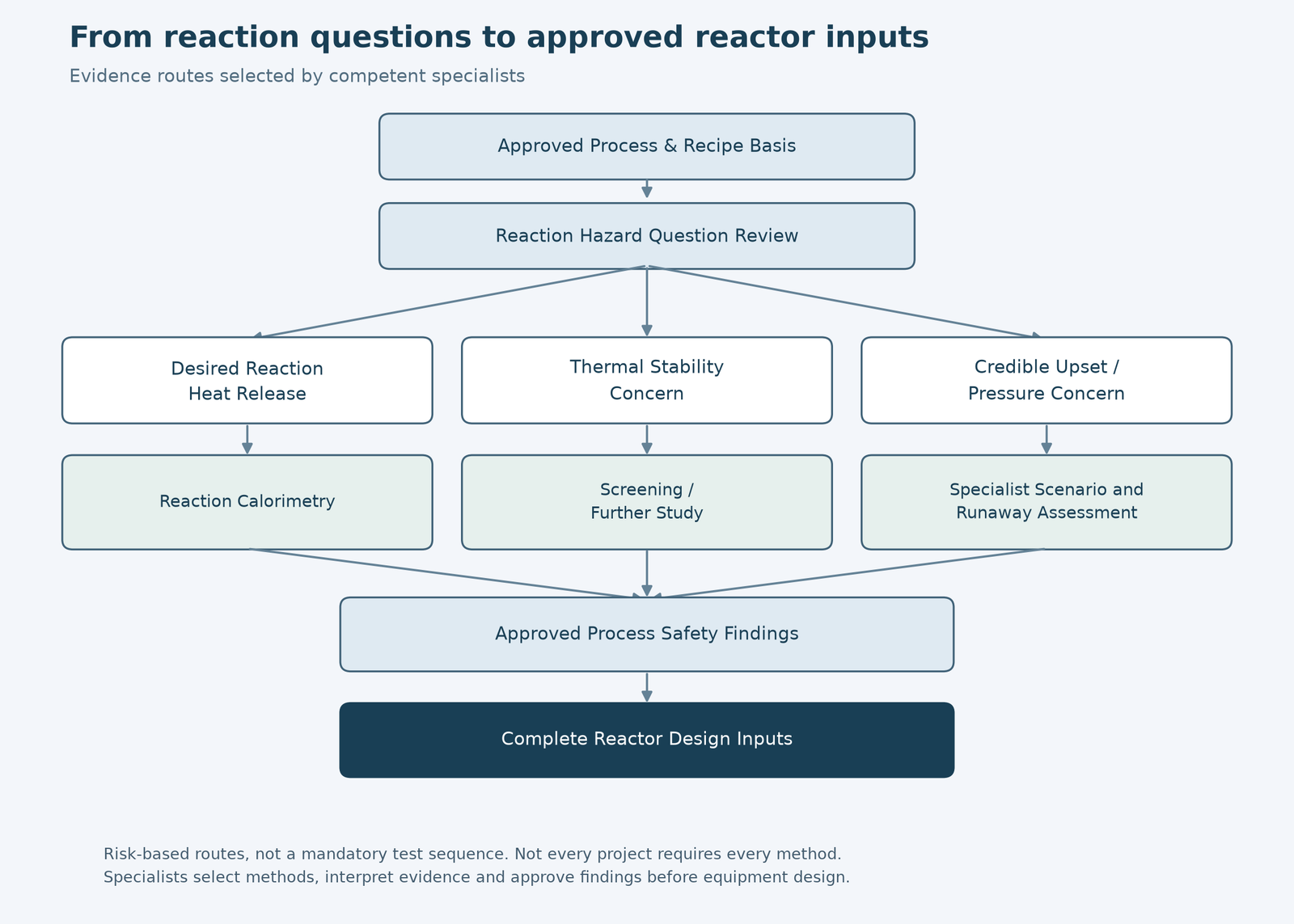
Before ordering an industrial batch reactor, buyers should confirm three distinct types of evidence: the heat released during the intended reaction, the thermal stability of relevant materials and reaction mixtures, and the potential consequences of credible abnormal conditions. Approved reaction calorimetry and hazard-assessment results must then be translated into the reactor’s thermal duty, mechanical design basis, operating interfaces, and protective-system requirements.
A normal cooling-duty calculation alone does not establish that a reaction process is safe.
This guide is intended for chemical plant owners, process engineers, process-safety specialists, and EPC equipment buyers preparing a complete industrial reactor specification. It explains what information should be reviewed and transferred to equipment suppliers without prescribing hazardous experiments or replacing a competent reaction-hazard assessment.
Why Is Normal Cooling Duty Insufficient for Reactor Procurement?
Normal reactor cooling duty describes the heat that the selected equipment must remove under an agreed operating basis. It is an important thermal-design input, but it is not a complete description of reaction risk.
An exothermic reaction may release heat at a rate that changes substantially during a batch. Some materials may also undergo secondary reactions or decomposition under conditions outside normal operation.
If the heat generated exceeds the heat removed, the reaction mixture may heat further. In some systems, rising temperature can accelerate additional heat generation and create the potential for thermal runaway.
The UK Health and Safety Executive (HSE) explains these concerns in its guidance on chemical reaction hazards and thermal runaway.
Separate the Normal Thermal Duty From the Hazard Assessment
EPC buyers should distinguish the following engineering questions.
| Design question | Relevant evidence | Why it matters to the reactor specification |
|---|---|---|
| How much heat is released by the intended reaction? | Appropriate reaction calorimetry and a validated process basis | Supports normal heat-removal requirements |
| When is heat released during the batch? | Heat-release profile associated with the relevant batch stages | Helps establish time-dependent thermal demands |
| Could materials or mixtures undergo additional exothermic reactions? | Thermal stability screening and specialist interpretation | Identifies whether further investigation is needed |
| What happens under credible deviations? | Approved scenario assessment and appropriate hazard-test evidence | Identifies process and equipment protection requirements |
| Can gas generation or vaporization create a pressure hazard? | Relevant experimental and process-hazard data | Supports specialized pressure-protection assessment |
| What equipment conditions have been approved? | Process-design basis and documented engineering decisions | Establishes the contractual equipment requirements |
Editorial procurement framework, not a prescribed chemical reaction safety procedure.
The thermal duty used for normal production must not be silently treated as the maximum credible heat generation under every abnormal scenario.
Conversely, a hypothetical severe scenario should not automatically be converted into a normal equipment-duty requirement without engineering evaluation.
Each requirement should be defined by the responsible process or process-safety authority.
Review Heat Release Across the Whole Batch
The total heat released by a reaction and the rate at which it is released are different types of information.
A reactor may experience different thermal demands during the initial charge, heating, reactant addition, reaction progression, holding, and other applicable process stages.
The relevant heat-release profile depends on the approved process and its actual operating conditions.
For procurement, the owner or EPC team should identify which thermal data apply to each required stage instead of providing only one nominal cooling-duty number.
Detailed comparison of a reactor jacket and an external circulation heat exchanger belongs in the separate jacketed reactor versus external heat exchanger guide.
The purpose of the present article is to establish the experimental and engineering evidence needed before either cooling arrangement is finalized.
What Do Different Reaction Calorimetry Tests Actually Establish?
Different methods answer different questions about the intended reaction, thermal stability, and possible abnormal behavior.
No single calorimetry test establishes every aspect of reaction safety.
The required investigation must be selected and interpreted by competent personnel who understand the chemistry, experimental limitations, and intended industrial process.
Match the Evidence to the Engineering Question
| Evidence or test category | Main purpose | What it does not establish by itself |
|---|---|---|
| Literature and preliminary thermochemical review | Identify known reactions, relevant materials, and initial concerns | Does not prove that the actual process mixture has been adequately evaluated |
| Thermal stability screening, including DSC | Identify potentially important thermal events and possible decomposition behavior | Does not automatically establish industrial-scale runaway behavior or a universal safe operating limit |
| Reaction calorimetry under representative process conditions | Characterize the intended reaction’s heat release and relevant thermal behavior | Does not necessarily characterize secondary decomposition or credible loss-of-control scenarios |
| Appropriate adiabatic or near-adiabatic testing | Investigate selected abnormal or runaway behavior, where justified | Does not remove the need for scenario selection and industrial-scale interpretation |
| Relevant gas-generation or pressure-development studies | Provide information needed for defined pressure-hazard questions | Does not independently complete a protective-system design |
| Integrated process-hazard assessment | Review scenarios, consequences, and required prevention or mitigation | Requires reliable process and experimental evidence; it is not merely another instrument test |
The testing scope is risk-based. Not every project requires every method listed.
The HSE Reaction / Product Testing guidance distinguishes preliminary reviews, thermal screening, abnormal-scenario assessment, adiabatic testing, and the selection of protective measures.
Its separate INDG254 guidance identifies screening, isothermal calorimetry, adiabatic calorimetry, and specialized relief-related testing as different sources of technical evidence.
Thermal Stability Screening: Identify Questions for Further Investigation
Differential scanning calorimetry (DSC) is commonly used as an initial screening method for thermal behavior.
For a relevant material or mixture, a specialist may use screening information to identify thermal events that require further assessment.
However, a screening result is sensitive to the sample and the test conditions.
A DSC onset temperature must not be copied directly into a reactor datasheet as a universally safe operating-temperature limit.
A small-sample screening experiment may not reproduce the heat transfer, mass distribution, reaction accumulation, or other conditions of an industrial batch.
The appropriate conclusions must be stated by the qualified testing or process-safety specialist.
Reaction Calorimetry: Characterize the Intended Reaction
Reaction calorimetry can provide information on the thermal behavior of the intended chemical reaction under a defined process basis.
Depending on the study and measurement method, relevant outputs may include:
- Heat associated with the intended reaction.
- The measured or derived heat-release profile.
- The applicable temperature and composition conditions.
- Relevant reaction progression and accumulation information.
- Observations that may affect interpretation of the proposed batch process.
- Uncertainty and limitations in applying the results to industrial design.
The buyer should identify whether the evidence covers the actual production route rather than assume that a published heat-of-reaction value describes the complete batch.
The distinction between intended-reaction heat release and subsequent decomposition is also discussed in Mettler Toledo’s public technical overview of runaway reaction prevention.
This is an external instrument supplier’s technical discussion, not evidence that the reactor manufacturer offers the same testing services.
Adiabatic and Related Studies: Assess Selected Abnormal Behavior
When the process-hazard review identifies significant unresolved runaway or pressure-generation questions, the competent specialist may determine that additional testing is appropriate.
Relevant studies may investigate heat release, temperature development, gas evolution, or pressure behavior under specified conditions.
Their results require careful interpretation before industrial application.
A test performed on a small or differentially confined sample does not automatically reproduce a full-scale reactor. Equally, the absence of a particular event during one experiment does not prove that every credible abnormal scenario has been eliminated.
Any specialized relief-system testing and design must be performed within the project-approved process-safety scope.
How Should Samples and Batch Operating Conditions Be Represented?
A technically accurate measurement can still be a poor procurement basis if the tested material does not represent the proposed production batch.
Sample composition, process stage, impurities, and operating assumptions should be traceable to the approved industrial recipe or process description.
Identify the Actual Process Basis
The testing and engineering package should identify:
- The intended reaction and relevant reaction pathways.
- Main reactants, solvents, catalysts, and other applicable constituents.
- The required feed or raw-material quality specifications.
- Identified impurities and potential by-products relevant to the assessment.
- Batch composition and concentration basis.
- The production stages relevant to heat generation and material stability.
- The applicable production scale and batch inventory.
- The origin and revision of the recipe or process-design data.
- The conditions that the available experiments do not represent.
The required level of detail depends on the reaction.
Not every industrial process requires the same analytical program, and not every constituent will have the same influence on the hazard assessment.
Confirm That the Samples Represent Relevant Material States
A sample representing freshly mixed raw materials may differ from an intermediate mixture, a product-containing mixture, or material associated with a later stage of the process.
Those differences can matter when evaluating reaction heat, decomposition, contamination sensitivity, and gas generation.
The process-safety specialist should determine which materials and conditions need to be examined.
The buyer should verify that reports clearly identify what was tested.
| Sample or process information | What the report should establish |
|---|---|
| Sample identification | Material identity, source, and traceability |
| Composition | Applicable ingredients, concentrations, and analytical basis |
| Impurity information | Known relevant impurities and any uncharacterized fraction |
| Process stage | Which point in the batch the sample represents |
| Test objective | The specific thermal or chemical uncertainty under investigation |
| Test conditions | Conditions relevant to interpreting the approved report |
| Data quality | Analytical uncertainty, repeatability, or other stated limitations |
| Applicability | Which design cases are supported and which remain unverified |
Editorial report-review checklist. It is not an experimental preparation procedure.
Testing institutions should determine appropriate sampling, handling, testing, and safety arrangements within their competence.
This article does not provide experimental recipes or instructions for conducting reactive or potentially hazardous tests.
Keep Track of Formula and Process Revisions
Changes to a raw-material supplier, impurity profile, process composition, or reaction route can affect the relevance of earlier test results.
The project should maintain an approved revision history linking the evidence to the intended manufacturing process.
A report prepared for a previous formulation should not automatically be carried forward if the responsible specialist determines that the changed conditions could affect reaction behavior.
The same principle applies when production scale or the sequence of batch stages changes.
A reactor quotation based on an earlier process version should clearly identify which assumptions remain valid and which require confirmation.
Which Abnormal Scenarios Require Specialist Review?
Reaction-hazard investigations should consider credible departures from intended operation that could influence temperature, heat generation, gas formation, or pressure development.
Scenario selection is a process-safety responsibility. Equipment purchasers should not independently invent a worst-case process event or decide the adequacy of protective measures from general guidance.
Confirm That Deviations Have Been Evaluated
The HSE identifies cooling failure, loss of agitation, reactant-addition deviations, and changes to reactant temperature among the issues relevant to batch and semi-batch reactor assessments.
Depending on the actual process, the competent team may also need to consider equipment failures, utility interruptions, composition changes, and other credible deviations.
| Scenario category | Question for the responsible process team | Potential procurement interface |
|---|---|---|
| Loss or reduction of cooling | Has the thermal consequence been assessed for the approved process? | Cooling-system and protection-related requirements |
| Mixing or agitation deviation | Could the process behavior change materially? | Agitation, instrumentation, and mechanical interfaces |
| Reactant-addition deviation | Has the impact of credible deviations been evaluated? | Feed-control and agreed protective interfaces |
| Raw-material or composition variation | Does the approved evidence cover relevant material changes? | Process limitations and design-input clarification |
| Secondary reaction or decomposition | Has the possibility of additional heat or gas generation been reviewed? | Mechanical design and process-protection basis |
| Gas formation or overpressure | Have credible pressure-generating scenarios been assessed? | Approved pressure-protection requirements and interfaces |
| Changes during other batch stages | Are relevant non-steady conditions represented? | Operating-envelope and design-case documentation |
These are questions for a qualified hazard study, not instructions for initiating or reproducing abnormal reactions.
Recognize the Limitations of Normal Cooling Performance
A reactor that meets its specified normal cooling requirement may still be vulnerable to a separate reaction hazard if cooling is lost, mixing changes, or a secondary reaction occurs.
Similarly, an oversized jacket or heat exchanger is not automatically an adequate substitute for independently evaluated protective measures.
The protection philosophy should be developed and approved by the responsible process-safety team.
HSE guidance identifies inherently safer process choices, preventive controls, and protective measures as distinct parts of reaction-hazard management.
The complete reactor specification should incorporate the selected requirements without treating any one feature as a universal solution.
Keep Relief-System Evaluation Separate
Reaction-related overpressure can involve different physical and chemical mechanisms, depending on the actual process.
A construction-code design pressure is not, by itself, a complete analysis of an abnormal pressure-generating reaction.
Where a relief or containment assessment is required, the competent engineering team should supply the relevant scenario and design requirements for the equipment interfaces.
The manufacturer should not be asked to size a reaction-runaway relief system from a normal heat-duty figure or an incomplete test report.
Likewise, this article does not calculate vent dimensions, prescribe emergency response steps, or determine the effectiveness of a particular protection system.
How Should Test Results Be Converted Into Reactor Design Requirements?
The practical outcome of reaction calorimetry and hazard assessment should be an approved set of engineering inputs.
A laboratory report alone is not a complete reactor procurement specification.
The process team must interpret the results, resolve the required risk controls, and communicate the applicable consequences to the equipment designer.
Translate Findings Into Defined Equipment Interfaces
| Approved evidence or finding | Possible engineering implication | Procurement deliverable |
|---|---|---|
| Intended reaction heat-release profile | Normal thermal duty and relevant time-dependent demand | Approved thermal-design basis |
| Validated batch conditions | Applicable charge, operating, and design configurations | Reactor process datasheet |
| Relevant physical-property data | Heat-transfer, inventory, and equipment-rating assumptions | Process-property and equipment design inputs |
| Identified mixing dependency | Agitation and process-operability review | Approved mixing requirements and mechanical interfaces |
| Credible temperature excursions | Required mechanical and protection-related assessment | Approved temperature design cases and interface conditions |
| Credible pressure-generating scenarios | Specialist review of pressure protection and containment | Approved pressure-design inputs and safeguard interface specification |
| Gas-evolution evidence | Process and safety evaluation of pressure or venting requirements | Approved gas-handling or pressure-protection design basis |
| Selected protective measures | Functional and mechanical integration requirements | Interfaces, responsibility matrix, and approved design documents |
| Unresolved testing or model uncertainty | Further assessment or design restrictions | Technical hold-point and clarification register |
The table describes possible information transfers. It does not assert that every reaction requires every measure.
Each technical requirement should identify its source document, applicable process condition, approval status, and responsible engineering authority.
Distinguish the Reactor Body From the Complete Process System
For an industrial batch reactor, procurement scope may include the vessel, heat-transfer surfaces, agitation equipment, nozzles, supports, and agreed related mechanical items.
However, some safety requirements may depend on the wider process system, including utility supply, control systems, feed arrangements, and plant-level protective facilities.
The RFQ should distinguish:
- Requirements incorporated within the manufactured reactor.
- Requirements supplied by other equipment or system contractors.
- Shared interfaces needing coordinated design.
- Process-safety obligations retained by the owner, licensor, or EPC.
- Outstanding decisions that affect the final mechanical arrangement.
If a supplier is contracted for additional process or safety engineering, that scope and its technical basis should be explicitly agreed.
The existence of a complete reactor manufacturing product range does not, by itself, prove that the manufacturer has performed the process’s chemical hazard study.
Ensure the Design Basis Is Approved
A proposed material, pressure rating, or heat-transfer configuration should be based on the approved service and mechanical requirements.
A laboratory observation should not be turned directly into a mechanical guarantee without the responsible engineering assessment.
Where the experimental evidence indicates that changes to the process route or safeguard concept may materially affect the reactor, the project should resolve those decisions before final equipment design.
The existing reactor purchasing specifications guide provides a wider overview of reactor procurement considerations.
This article addresses the narrower upstream question of which heat-release and reaction-hazard evidence must support those specifications.
What Should EPC Buyers Include in the Reactor RFQ?
A useful reactor RFQ should identify which thermal and safety-related inputs have been approved and which remain provisional.
This allows suppliers to compare complete equipment designs on a consistent basis and to identify missing information without independently assuming responsibility for the chemistry.
Recommended Data Handover
| RFQ category | Information to supply or reference |
|---|---|
| Process description | Intended reaction and approved process-design basis |
| Batch configuration | Relevant process stages, inventories, and operating cases |
| Feed and composition | Approved raw-material specifications and relevant composition ranges |
| Reaction calorimetry evidence | Report identification, scope, conditions, findings, and limitations |
| Thermal stability evidence | Applicable screening results and specialist conclusions |
| Abnormal-scenario assessment | Approved scenario register and relevant evaluated outcomes |
| Heat and material balances | Approved process data and normal thermal requirements |
| Gas and pressure hazards | Approved findings and required engineering interfaces |
| Reactor design conditions | Specified mechanical pressure and temperature requirements |
| Heat-transfer interfaces | Normal thermal duty, utility requirements, and agreed configuration basis |
| Agitation and process interfaces | Approved mechanical and operating requirements |
| Protective-system interfaces | Required integration points and responsibility boundaries |
| Construction requirements | Project-adopted pressure-vessel code, materials, inspection, and documentation requirements |
| Test and approval status | Report revisions, reviewers, outstanding tests, and design restrictions |
| Supplier scope | Complete reactor and agreed supporting mechanical equipment |
| Open technical items | Missing evidence, responsible party, deadline or required hold point |
Editorial EPC procurement checklist, not a mandatory standard form.

Establish an Explicit Responsibility Matrix
Owner or process licensor: Establishes the chemistry, process requirements, and intended operating envelope within the contracted process-design responsibility.
Process and process-safety engineers: Identify credible scenarios, select the necessary hazard-assessment basis, evaluate results, and approve the process-safety requirements.
Qualified laboratory or testing organization: Performs the contracted tests, documents the tested conditions, and reports results and limitations.
EPC mechanical and equipment engineers: Translate approved requirements into equipment datasheets, contractual interfaces, and mechanical design coordination.
Reactor manufacturer: Evaluates the approved equipment requirements, clarifies deviations, and provides the agreed manufacturing, inspection, and documentation scope.
The exact responsibilities depend on the contract. No party’s scope should be assumed from its company name alone.
Define the Procurement Decision Gates
Before proceeding to a firm equipment design, buyers should establish whether the critical evidence has been accepted.
A practical review may classify the design basis as:
- Approved: Required evidence has been reviewed and the relevant equipment design inputs have been accepted.
- Conditional: Engineering may proceed for a defined purpose using documented assumptions, with specific technical hold points.
- Unresolved: Missing or contradictory information could materially change the reactor or its protective-system interfaces and must be closed before the affected design is released.
A budgetary quotation can be requested with qualified assumptions. Such assumptions must not silently become final process-safety guarantees.
For a complete industrial reactor enquiry, buyers can refer to the manufacturer’s industrial reactors product range and submit an approved process datasheet together with the reaction calorimetry and hazard-assessment conclusions applicable to the equipment.
The scope of reactor manufacture, associated heat-transfer equipment, instrumentation interfaces, and any additional engineering services should be confirmed for the specific project.
Frequently Asked Questions
Can a single DSC result establish whether an industrial batch reactor is safe?
No. DSC can support thermal stability screening, but its results are limited by the tested sample and conditions. A competent specialist must decide whether additional reaction calorimetry, abnormal-scenario studies, or other evidence is required for the industrial process.
Does a reaction calorimetry report automatically establish the reactor’s pressure-relief requirements?
No. Data from the intended reaction may help establish the normal heat-release basis, but pressure-relief requirements depend on the approved hazard scenarios and an appropriate specialist engineering assessment. The relevant results must be interpreted and transferred into the equipment design requirements.
What if the reaction recipe changes after the reactor has been quoted?
The process owner should determine whether the change affects the validity of previous tests and approved design assumptions. If it does, the affected process and equipment requirements should be reviewed before the revised design is accepted.
Can the vessel manufacturer perform the reaction-hazard assessment?
Only if that service is explicitly within its verified technical capabilities and contractual scope. Manufacturing a complete reactor does not automatically mean the supplier owns a calorimetry laboratory, provides a process license, or assumes responsibility for the full chemical reaction hazard assessment.
Conclusion
Industrial batch reactor procurement requires more than a vessel size, design pressure, operating temperature, and normal cooling-duty calculation.
The owner and EPC team should establish whether the intended reaction has been adequately characterized, whether relevant materials require thermal stability screening, and whether credible abnormal scenarios have been assessed by competent specialists.
The approved findings must be converted into practical equipment inputs: thermal duty, process design cases, mechanical pressure and temperature requirements, and the interfaces to the selected protection systems.
The best procurement outcome is not the largest possible cooling system or the longest list of laboratory tests. It is a complete reactor specification supported by the right evidence, clearly assigned responsibilities, and closed critical technical uncertainties.
Before requesting a firm industrial batch reactor quotation, provide the approved process-design basis, representative batch information, relevant calorimetry and hazard-study conclusions, utilities, and a defined scope of manufacture and engineering responsibility.
References
- UK Health and Safety Executive (HSE). Reaction / Product Testing. Public technical guidance covering preliminary reviews, screening tests, abnormal-scenario assessments, adiabatic studies, and reactor protection considerations. https://www.hse.gov.uk/comah/sragtech/techmeasreaction.htm
- UK Health and Safety Executive (HSE). (August 2014). Chemical Reaction Hazards and the Risk of Thermal Runaway, INDG254(rev1). Public safety guidance distinguishing thermochemical review, screening, isothermal calorimetry, adiabatic calorimetry, and competent interpretation. This UK guidance is not a universal legal requirement for international projects. https://www.hse.gov.uk/pubns/indg254.pdf
- Mettler Toledo. Prevent Runaway Chemical Reactions. Public technical overview discussing intended reaction calorimetry, accumulation, and the need to investigate secondary reactions separately. Manufacturer-specific testing equipment and services are not attributed to the reactor supplier. https://www.mt.com/us/en/home/applications/L1_AutoChem_Applications/Process-Safety/Prevent-Runaway-Chemical-Reactions.html