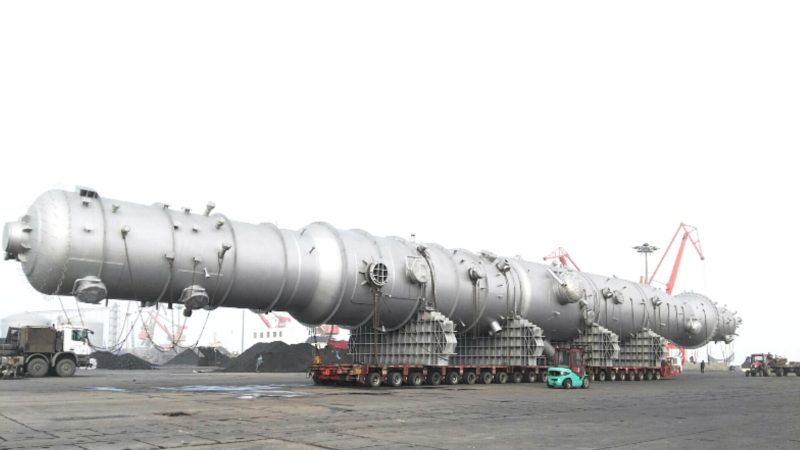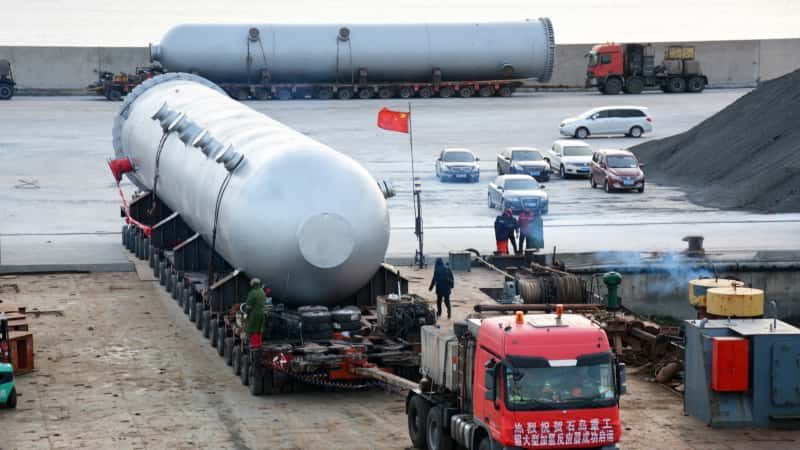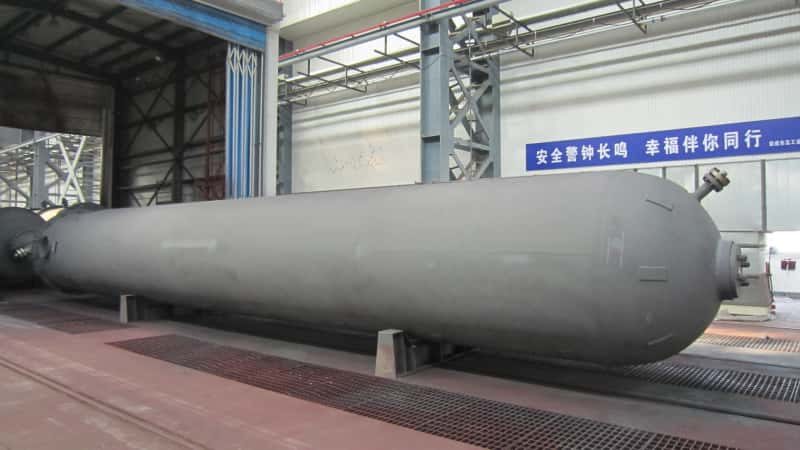

A storage tank advertised with a nominal capacity of 60 m³ does not necessarily provide 60 m³ of liquid that can be transferred during normal operation. Its usable volume depends on the tank geometry, specified liquid levels, product characteristics, and operating restrictions.
For oil and chemical storage tanks of 10 m³ and above, buyers should define the required working capacity first, identify the maximum and minimum normal operating liquid levels, and then verify the tank’s corresponding geometric and rated volumes. Nominal capacity alone is not sufficient to establish usable inventory.
The correct sizing basis should connect the site’s receipt and consumption schedule with the tank’s actual liquid-level range. This article explains how EPC buyers can translate those requirements into comparable specifications for complete industrial storage tanks.
What Is the Difference Between Nominal, Gross and Working Capacity?
Industrial storage tank quotations may refer to nominal, gross, geometric, maximum, net or working capacity. These expressions should not be assumed to mean the same thing.
The first procurement question is not simply how many cubic meters a tank contains. It is which volume the supplier is quoting and whether that volume is available within the agreed operating limits.
Define Each Capacity Before Comparing Quotations
| Capacity term | Practical meaning | What the buyer should verify |
|---|---|---|
| Nominal or stated capacity | A descriptive or commercially designated tank size | Which physical or operating volume does the supplier mean? |
| Gross geometric capacity | Internal geometric volume within specified physical boundaries | Which shell, heads, roof, bottom and internal-volume assumptions were used? |
| Maximum or rated liquid capacity | Liquid volume associated with a defined design or rated liquid level | What maximum level and governing requirements apply? |
| Normal maximum operating inventory | Volume corresponding to the highest liquid level intentionally used in routine operations | Is the upper operating level below applicable protection limits? |
| Minimum operating inventory | Volume remaining when the normal minimum usable liquid level is reached | Does it include pump limits, retained inventory or other restricted stock? |
| Net working or usable capacity | Liquid volume available between the defined upper and lower operating limits | Can the tank deliver the requested inventory without exceeding either limit? |
Capacity terminology must be confirmed in the purchase documents. “Nominal capacity” is not assumed here to be a universal code-defined value.
For a given tank, the normal usable capacity can be expressed as:
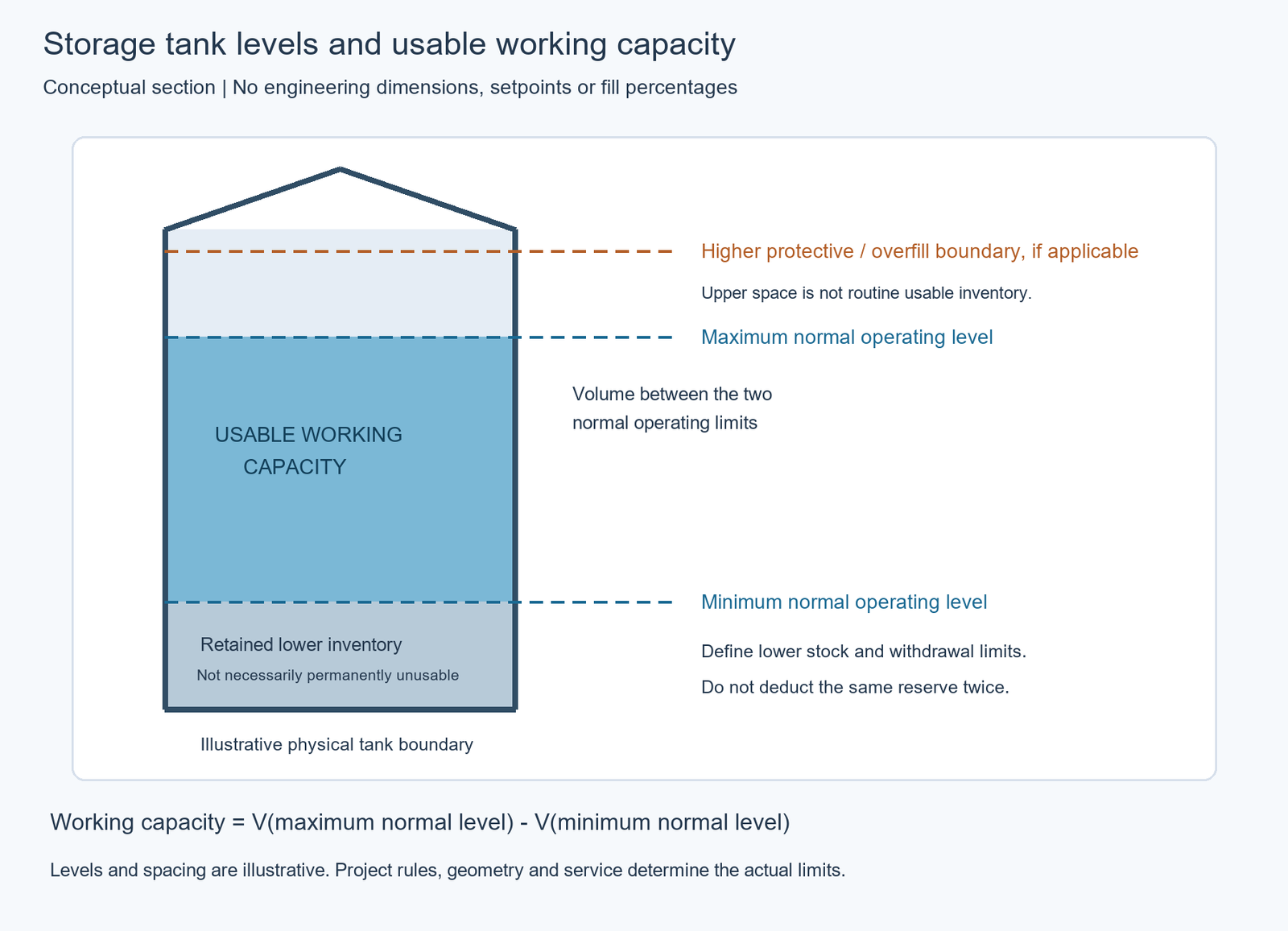
Working capacity = Volume at maximum normal operating level − Volume at minimum normal operating level
This calculation uses the volume corresponding to each level, not necessarily the ratio of liquid height to overall tank height.
The public capacity provisions in an API Standard 650 addendum distinguish maximum capacity from net working capacity, accounting for minimum operating volume and the space required for overfill protection. The applicable project edition must be consulted before using any specific code provision as a contractual requirement.
Why a Nominal Capacity Label May Be Misleading
Consider two manufacturers quoting a “50 m³ tank.”
One may be describing the gross internal geometric volume. Another may be referring to a capacity associated with a defined liquid level. Neither description independently proves that 50 m³ can be withdrawn between the agreed normal operating limits.
For a fair comparison, ask both suppliers to declare:
- The basis of the stated capacity.
- The proposed internal geometry and volume calculation.
- The maximum normal operating level and corresponding volume.
- The minimum operating level and corresponding volume.
- The resulting net working capacity.
A nameplate, quotation or catalog description should not be treated as a substitute for these defined values.
Which Liquid Levels Define Usable Tank Capacity?
The usable storage volume is bounded by operating liquid levels. Both the upper limit and the lower limit matter.
A tank may have physical space above its normal maximum operating level, but that space should not automatically be counted as everyday inventory capacity. Similarly, liquid remaining below the minimum normal operating level may not be available for routine withdrawal.
Establish the Upper Operating Limit
For applicable liquid-storage services, the upper capacity review may involve several distinct levels:
- Normal maximum fill level: The highest level intended under routine transfer control.
- High-level alarm or protective setpoints: Levels associated with the site’s agreed overfill-prevention strategy.
- Rated or safe fill level: A project-defined upper limit under the applicable design and operating basis.
- Overfill or loss-of-containment limit: A boundary beyond which the tank may be damaged or lose containment.
These are not interchangeable operating targets.
The UK Health and Safety Executive’s HSG176 guidance, Figure 9, differentiates normal fill level, rated capacity and overfill level, with alarm and response arrangements between them. The guidance concerns its defined scope of flammable liquids stored at or near atmospheric pressure; it should not be applied indiscriminately to every chemical or pressure-rated tank.
The actual space required above the normal operating level may depend on liquid expansion, transfer rates, shutdown or diversion response, instrumentation, tank design and the applicable project requirements.
No universal maximum fill percentage can be assigned to all industrial storage tanks.
Establish the Lower Operating Limit
The minimum normal operating level may reflect:
- Pump suction and hydraulic limitations.
- Liquid retained below an outlet or draw-off point.
- Sediment, water-bottom or other product-specific restrictions.
- Required operating or contingency inventory.
- Tank or internal-component limitations.
- Other conditions documented in the operating philosophy.
The term heel often describes a retained bottom quantity, but not all liquid below a given operating level is necessarily permanently unusable.
For example, contingency stock may be physically withdrawable but reserved under the owner’s operating policy. Buyers should state whether their requested “usable inventory” includes or excludes this reserve.
A retained volume must not be subtracted twice merely because it is described both as minimum inventory and as a safety reserve.
Use the Volume–Level Relationship
Let V(h) represent the actual liquid volume at level h.
The working inventory between the normal upper level hupper and lower level hlower is:
Vworking=V(hupper)-V(hlower)
For a vertical cylindrical tank with constant effective cross-sectional area over the relevant range, the relationship may be straightforward.
For a horizontal cylindrical tank, a vessel with formed heads, a sloped bottom or significant internals, liquid volume does not necessarily increase linearly with measured height.
Buyers should therefore request an appropriate volume–level calculation or tank calibration table instead of assuming that 50% liquid height always represents 50% of the usable tank volume.
How Should Inventory Demand and Replenishment Set the Capacity Requirement?
Tank sizing should start with the volume the facility must hold or deliver under its intended operating schedule, rather than with a convenient catalog capacity.
For large oil terminals and chemical plants, the same annual throughput can produce very different storage requirements depending on the frequency and size of incoming deliveries, production demand, dispatch cycles and permitted interruptions.
Define the Inventory Function
The buyer should first identify whether the tank is primarily intended for:
- Buffering continuous consumption between intermittent deliveries.
- Receiving discrete truck, rail, pipeline or marine transfer batches.
- Holding intermediate chemical products between process stages.
- Maintaining a defined operational reserve.
- Segregating products or batches under the facility’s inventory strategy.
These uses may require different normal operating ranges and tank arrangements, even for the same liquid.
Review the Demand and Supply Basis
| Input | Procurement question |
|---|---|
| Withdrawal or consumption rate | What volume leaves the storage system during the relevant period? |
| Delivery interval | How long may the facility operate between reliable replenishments? |
| Delivery batch size | Must the tank accommodate an entire incoming batch while retaining existing inventory? |
| Simultaneous receipt and withdrawal | Do incoming and outgoing flows overlap, and on what basis? |
| Supply interruption | What disruption period must the specified inventory cover? |
| Reserved inventory | Which quantity must remain available for contingency use, and when may it be withdrawn? |
| Product segregation | Can different batches or media share a tank, or are separate tanks required? |
| Operating cases | Which routine, peak and relevant exceptional scenarios determine the required capacity? |
Editorial inventory planning checklist for complete industrial storage systems.
For a simplified case involving constant withdrawal and no replenishment during the selected interval:
Vdemand=qwithdrawal × tcoverage
This provides the volume consumed during that interval. It does not automatically equal the gross tank capacity.
A real terminal with variable receipt and dispatch schedules may require an inventory balance over time rather than a single demand-rate multiplication.
Avoid Double-Counting Inventory Reserves
A frequent error is to add a safety-stock allowance to the required inventory and then subtract the same reserve again when calculating the tank’s working capacity.
For example, if the agreed minimum operating inventory already includes the contingency stock that must remain in the tank, it should not be entered as a second independent deduction without justification.
The project should distinguish:
- The liquid that must be delivered during the selected operating cycle.
- The inventory required to remain at the lower operating level.
- The space or volume excluded by upper operating and protection limits.
- Any additional requirement not already represented by those boundaries.
The result should be a single, internally consistent inventory and liquid-level basis.
How Do Buyers Convert Required Working Capacity into Tank Size?
The working-volume requirement should be translated into a physical tank arrangement by establishing a feasible upper and lower operating level.
A simple numerical example illustrates the relationship without imposing a universal fill percentage.
Illustrative 60 m³ Tank Calculation
Assume a vertical, flat-bottom, constant-cross-section cylindrical tank with the following hypothetical dimensions and limits:
| Item | Assumed value |
|---|---|
| Effective internal cross-sectional area | 20 m² |
| Internal straight-side height | 3.0 m |
| Gross geometric volume | 60 m³ |
| Normal maximum liquid level | 2.5 m |
| Minimum normal liquid level | 0.5 m |
| Volume at normal maximum level | 50 m³ |
| Volume at minimum operating level | 10 m³ |
| Net working capacity | 40 m³ |
Under these idealized assumptions:
Vworking=(2.5-0.5) × 20=40 m³
The tank has a gross volume of 60 m³ but an illustrative normal working capacity of only 40 m³.
The 10 m³ below the minimum normal level and the 10 m³ between the upper normal level and the geometric top serve different roles. They are not both available for normal product withdrawal.
Suppose the project requires a withdrawal rate of 8 m³/day for five days without replenishment:
Vrequired=8 × 5=40 m³
On this simplified basis, the illustrative 40 m³ working range could cover the stated requirement.
Important: These figures are mathematical assumptions, not a real project, recommended operating levels or a verified fabrication design. The example ignores internals displacement, roof and bottom details, uncertainty, liquid expansion and other service-specific requirements. The selected levels and mechanical design require separate project verification.
Why a Percentage Shortcut Can Be Misleading
An equation such as “working capacity = 80% of nominal volume” is only meaningful when that percentage comes from defined project assumptions.
It is not a universal sizing rule.
A real 60 m³ tank with different operating levels, geometry, fluid properties or withdrawal arrangements may have a different usable capacity.
The buyer should therefore work from verified volume–level boundaries, rather than applying several generic deductions for freeboard, heel, thermal expansion and operational buffer.
If those allowances overlap, summing their percentages may significantly misstate the actual inventory requirement.
How Do Geometry, Product and Service Conditions Change the Result?
Working capacity cannot be determined independently of the tank configuration and stored product.
A large atmospheric petroleum tank, a horizontal chemical storage vessel and a pressure-rated storage tank may be governed by different mechanical and operating considerations. A single filling percentage or design standard should not be assigned to all three.
Confirm the Tank Geometry
Geometric capacity depends on the defined internal dimensions and applicable shape.
For example:
- Vertical cylindrical tanks require the appropriate effective cross-section and internal height basis.
- Horizontal cylindrical tanks have nonlinear liquid-height-to-volume relationships.
- Dished heads, sloped bottoms and internal components can affect actual liquid volume.
- Floating roofs or other internal arrangements may introduce additional operating constraints.
- Multiple tanks may be needed where batch separation or uninterrupted operations require independent storage units.
A quoted volume must therefore be associated with a defined arrangement, not just a nominal diameter or overall length.
Review the Product and Temperature Basis
Stored-media properties can affect the upper and lower operating boundaries.
| Service consideration | Question for the equipment specification |
|---|---|
| Liquid composition | Which product and relevant impurities are included in the design basis? |
| Temperature range | What normal and relevant extreme temperatures affect liquid volume or equipment operation? |
| Thermal expansion | What allowance is needed for the actual product and credible temperature change? |
| Vapor or pressure behavior | Which containment, vapor management and pressure-design requirements apply? |
| Sediment or phase separation | Is a minimum retained volume or special withdrawal arrangement needed? |
| Corrosion or material compatibility | Which material and corrosion assumptions support the selected storage arrangement? |
| Operating mode | Are receipt, storage, heating, circulation and withdrawal conditions properly defined? |
These are project-review considerations, not universal requirements for every stored chemical.
For example, thermal expansion can increase liquid volume after filling. The appropriate allowance depends on the liquid’s properties and the expected temperature change; it should not be represented by a fixed percentage without a supporting basis.
Confirm the Applicable Design Framework
The selected code and operating requirements depend on tank type, design conditions, location and contractual scope.
API 650 may be relevant to covered welded oil-storage tanks, while other storage arrangements may require different standards or pressure-vessel rules.
HSE HSG176 provides useful information about fill-level management for its defined flammable-liquid storage scope, but it is not an automatically applicable US regulation and should not be generalized to all pressurized or chemical storage applications.
The purchaser and responsible engineering team should establish the actual applicable code and edition before finalizing the design.
What Should Buyers Specify in a Large Storage Tank RFQ?
A technically comparable tank quotation should state both the required inventory function and the supplier’s proposed physical capacity.
The RFQ should not leave “capacity” as an undefined single number.
Capacity and Equipment Specification Checklist
| RFQ field | Required clarification |
|---|---|
| Storage purpose | Product receipt, process buffer, dispatch, reserve or other function |
| Required working volume | Usable quantity needed over the defined operating cycle |
| Capacity terminology | Exact meaning of nominal, geometric, maximum and working capacity |
| Operating liquid levels | Normal maximum and minimum levels and corresponding volumes |
| Level protection interfaces | Required measurement and protection boundaries, as applicable |
| Stored medium | Composition, density, relevant impurities and product properties |
| Operating temperature | Normal and applicable limiting temperatures |
| Tank configuration | Vertical or horizontal arrangement, relevant internal geometry |
| Pressure and design basis | Operating conditions, design conditions, governing code and edition |
| Receipt and withdrawal | Flow rates, batch sizes, connection requirements and inventory schedule |
| Mechanical and site constraints | Available footprint, height, installation and transportation limitations |
| Capacity evidence | Calculations, drawings and applicable volume–level or calibration information |
| Commercial scope | Complete tank, included equipment interfaces, exclusions and documentation |
Editorial RFQ checklist. Actual contractual deliverables depend on the agreed project requirements.
Request Comparable Capacity Evidence
For each supplier’s proposal, request confirmation of:
- The exact capacity definition used in the quotation.
- Proposed geometric and rated capacities.
- Normal maximum and minimum operating liquid levels.
- Calculated net working capacity.
- The geometry and assumptions supporting those quantities.
- Relevant service limitations or outstanding inputs.
Where project circumstances require a tank calibration or strapping table, confirm who will provide it and at what stage.
Instrumentation and high-level protection requirements should be coordinated with the tank’s operating philosophy. They are relevant interfaces to complete tank procurement, not a reason to turn this enquiry into a purchase of stand-alone level instruments.
For suitable industrial applications, the site’s custom industrial storage tank product range provides the starting point for discussing complete equipment manufacture. The actual proposed capacity, materials, configuration and compliance scope must be confirmed for each project.
Frequently Asked Questions
How big is a 20,000-gallon industrial storage tank?
First confirm whether “gallon” means US liquid gallons or Imperial gallons.
20,000 US liquid gallons are approximately 75.7 m³, whereas 20,000 Imperial gallons are approximately 90.9 m³, using the published conversion factors in the NIST Guide to the SI.
Neither figure establishes the tank’s diameter, length or height. Those depend on geometry and design. Buyers should also specify whether the stated gallon capacity means gross geometric volume or usable working inventory.
Can nominal tank capacity be equal to working capacity?
Only if the defined capacity basis and operating boundaries support that equivalence. In many practical designs, the working volume is smaller than the physical or rated volume because liquid levels are restricted at both ends. The supplier should provide the actual volume–level calculation rather than assume the two capacity labels are interchangeable.
Does a larger tank always provide more usable inventory?
Not necessarily in the proportion implied by its nominal size. A larger tank may have a different minimum withdrawal level, internal arrangement, operating restrictions or liquid-level policy. Buyers should compare actual net working volumes under the same service and inventory requirements.
Conclusion
For industrial oil and chemical storage tanks, capacity selection should begin with the volume the facility must reliably store or deliver—not a nominal tank-size label.
The engineering review should then identify the upper and lower operating liquid levels, establish the corresponding volumes, verify product and geometry assumptions, and confirm that the proposed complete tank provides the required usable working inventory.
When requesting a quotation for a storage tank of 10 m³ or larger, provide the product, operating temperature, demand and replenishment schedule, inventory policy, required working capacity, site constraints and relevant design requirements. Ask suppliers to explain how their proposed nominal and geometric capacities translate into the working volume available to the project.
References
- American Petroleum Institute (API). API Standard 650 — Welded Tanks for Oil Storage, public addendum to the Twelfth Edition, including capacity terminology. Historical public material; apply the project-adopted edition. https://www.api.org/~/media/files/publications/addenda-and-errata/650_e12%20addendum%202.pdf
- UK Health and Safety Executive (HSE). (2015). The Storage of Flammable Liquids in Tanks, HSG176, Second Edition, especially Figure 9 and the discussion of tank level measurement. Applies within its stated near-atmospheric flammable-liquid storage scope. https://www.hse.gov.uk/pubns/priced/hsg176.pdf
- UK Health and Safety Executive (HSE). HSG176 Publication Information and Scope. https://www.hse.gov.uk/pubns/books/hsg176.htm
- National Institute of Standards and Technology (NIST). Guide to the SI: Appendix B.9 — Conversion Factors by Quantity. https://www.nist.gov/pml/special-publication-811/nist-guide-si-appendix-b-conversion-factors/nist-guide-si-appendix-b9