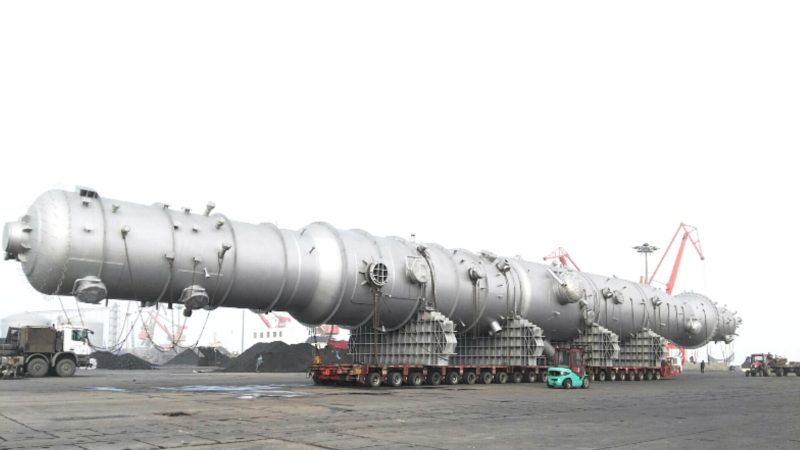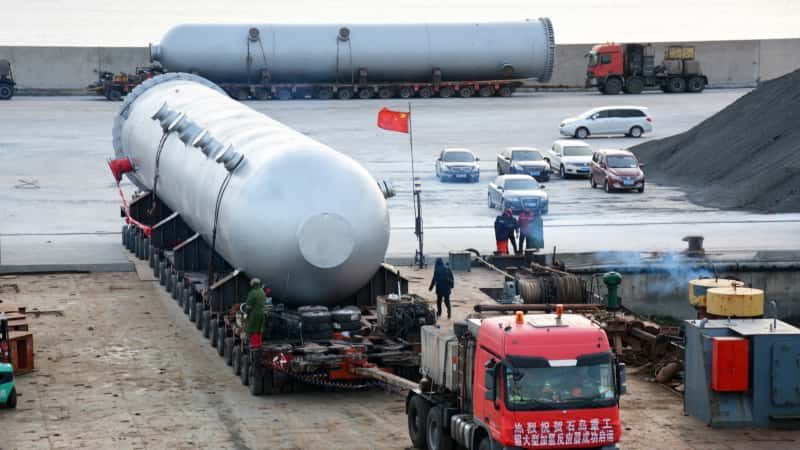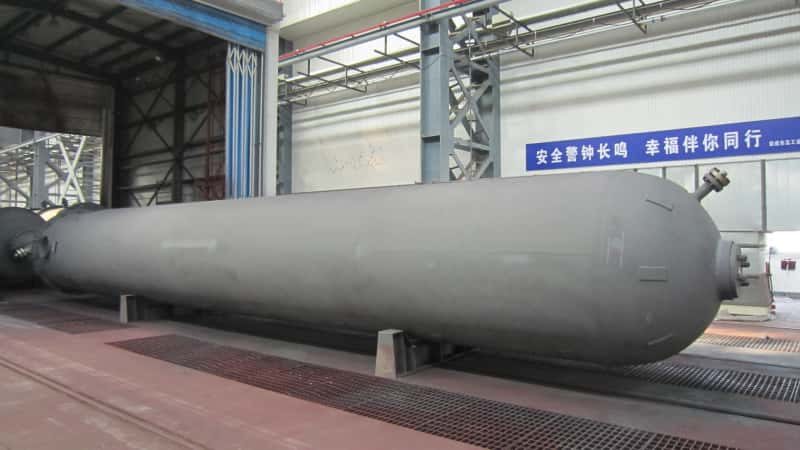

A process simulation may predict that a distillation column can achieve the required separation, but the reliability of that prediction depends on the underlying vapor-liquid equilibrium (VLE) data, thermodynamic model, feed characteristics, and operating assumptions.
Before ordering an industrial distillation column, EPC buyers should review whether the available VLE data and property model have been validated for the actual mixture and operating range. Additional laboratory measurements or pilot testing become important when uncertain phase behavior, impurities, foaming, thermal sensitivity, or demanding product specifications could materially affect the design. Not every separation requires a pilot test, but unresolved process risks should be identified and assigned before full-scale equipment fabrication.
The objective is to select the evidence needed for a defensible process design—not to conduct testing for its own sake. This article explains how chemical plant owners, process licensors, and EPC teams can choose an appropriate validation path and turn the results into usable specifications for a complete industrial distillation column.
When Can Existing VLE Data and Models Support a Column Order?
Existing VLE data and process models may provide a sufficient basis for ordering a distillation column when the mixture is well characterized, the operating conditions fall within a defensible model range, and the consequences of remaining uncertainty are acceptable to the responsible process engineer.
The critical question is not whether simulation software can produce a converged column model. It is whether the property information supporting that model is reliable for the proposed separation.
Understand What the VLE Data Represent
Vapor-liquid equilibrium describes how the components of a mixture distribute between vapor and liquid phases at equilibrium under specified temperature, pressure, and composition conditions.
For distillation, this information helps determine separation feasibility, vapor-liquid composition relationships, and the predicted behavior of the process.
Depending on the mixture, a process model may use established thermodynamic equations, fitted interaction parameters, experimental equilibrium data, or estimated properties.
However, the availability of a model does not automatically establish its accuracy.
The NIST ThermoData Engine distinguishes experimental information, predicted properties, and critically evaluated data. These categories should not be treated as equivalent evidence without reviewing their sources and limitations.
Check the Model Against the Actual Process Basis
Before relying on an existing model, the process engineering team should establish:
| Review question | Evidence to check |
|---|---|
| Is the mixture fully characterized? | Major components, relevant minor components, and identified impurities |
| Are reliable VLE data available? | Published measurements, proprietary validated data, or other traceable experimental sources |
| Is the thermodynamic method appropriate? | Documented model selection and its suitability for the relevant mixture |
| Is the operating range supported? | Applicable temperatures, pressures, and compositions |
| Are model parameters traceable? | Parameter sources, fitting basis, and validation status |
| Are separation limitations understood? | Relevant non-ideal behavior, azeotropes, or other phase-equilibrium constraints |
| Is the remaining uncertainty acceptable? | Sensitivity analysis and an engineering assessment of the design consequences |
Editorial review checklist, not a universal certification of model accuracy.
A model may be reliable for a familiar binary system under established conditions but less reliable when additional components or different operating pressures are introduced.
NIST’s research on phase-equilibrium data quality emphasizes experimental consistency checks and the validation of data used to develop prediction and correlation models.
When Existing Evidence May Be Enough
A project may be able to proceed without new laboratory or pilot testing when the responsible process team can demonstrate that:
- The actual components and important impurities are adequately characterized.
- The data and model are relevant to the required operating conditions.
- The chosen separation process has a credible engineering or operating basis.
- Sensitivity checks do not expose an unresolved design-critical uncertainty.
- The specified product requirements and process risks can be supported by the available evidence.
These conditions do not form an automatic approval rule. They establish what the process engineer should review before accepting the model as the design basis.
Where the main challenge is accommodating already understood changes in feed composition, the separate distillation column variable-feed guide addresses the operating-case requirements. The present article focuses on whether the underlying separation predictions need additional experimental validation.
Which Separation Risks Justify Additional Validation?
Additional validation becomes valuable when the consequences of an uncertain separation prediction could materially alter the process route, required equipment size, product quality, or long-term operability.
Different risks require different evidence. Missing equilibrium information may call for property measurement, while uncertain foaming or continuous operating behavior may be better addressed through practical separation trials.
Identify the Uncertainty Before Selecting a Test
| Potential risk | Why it matters | Evidence that may be needed |
|---|---|---|
| Missing or poorly supported VLE data | Predicted phase behavior may be unreliable | Targeted equilibrium measurements or defensible model validation |
| Strongly non-ideal mixtures | Activity effects, azeotropes, or other limitations may affect achievable separation | Experimental phase-equilibrium evidence and process feasibility review |
| Unidentified impurities or by-products | Small constituents can alter product quality or operating behavior | Representative feed analysis and targeted laboratory assessment |
| Foaming, suspended solids, or fouling tendencies | Real contacting and hydraulic behavior may not be represented by equilibrium calculations | Relevant bench or pilot observations |
| Heat-sensitive or reactive products | Heating and residence time may change product composition or quality | Product stability assessment under relevant exposure conditions |
| Demanding product purity | Small prediction errors can become important near a contractual product limit | Appropriate analytical validation and, where justified, separation trials |
| Uncertain mass-transfer or hydraulic performance | An equilibrium model does not establish industrial contacting efficiency | Appropriate column testing, correlations, and scale-up assessment |
The appropriate validation scope depends on project-specific uncertainty. No row independently establishes that pilot testing is mandatory.
Sulzer identifies impurities, foaming systems, solids-containing materials, uncertain equilibrium behavior, strict purity requirements, and sensitive products as reasons why additional distillation or absorption tests may be recommended. See its pilot plant testing information.
Distinguish a Thermodynamic Problem From an Operating Problem
An inaccurate VLE model can lead to incorrect predictions about separation feasibility or composition profiles.
However, a reliable VLE model does not necessarily capture every physical problem that can occur inside a working column.
Foaming, liquid entrainment, fouling, maldistribution, or product degradation may depend on hydrodynamics and operating history as well as thermodynamic behavior.
For example, a mixture may show acceptable calculated separation behavior but develop problematic foam during practical vapor-liquid contacting.
The appropriate response is not necessarily to commission new VLE measurements. The process team should choose a test capable of investigating the actual uncertainty.
High Purity Is a Risk Indicator, Not a Universal Pilot-Test Trigger
Very demanding product specifications may leave little room for model or analytical uncertainty.
But there is no universal purity percentage above which every distillation project must undergo pilot testing.
The validation decision depends on the separation difficulty, available evidence, analytical capability, proposed process arrangement, and contractual consequences of failing to meet the specification.
For a solvent recovery process with changing water content, the distinct feed and product specification issues are discussed in the variable-water-content solvent recovery guide. This article does not repeat that operating-case analysis.
What Is the Difference Between VLE Measurement, Lab Trials and Pilot Testing?
VLE measurement, laboratory separation trials, and continuous pilot testing are different forms of evidence.
They should be selected according to the question the engineering team needs to answer.
Choose the Smallest Appropriate Validation Scope
| Validation approach | Principal question it can answer | Important limitation |
|---|---|---|
| Review of published data and existing model | Is the available property basis credible for the proposed separation? | Does not create missing experimental evidence |
| Targeted physical-property or VLE measurement | What equilibrium or other property behavior is measured under defined conditions? | Does not by itself demonstrate complete column hydraulics or scale-up |
| Laboratory batch separation trial | Is the separation promising, and are there observable product-quality or handling issues? | May not reproduce steady continuous composition and residence-time profiles |
| Continuous laboratory or pilot-column trial | How does the selected separation behave under more representative continuous operating conditions? | Still requires interpretation and scale-up to industrial dimensions |
| Integrated pilot testing with recycles | Do interactions, recycle streams, and impurity accumulation affect the wider process? | Greater test scope does not automatically eliminate every full-scale uncertainty |
Decision-support comparison. Laboratory and pilot capabilities must be confirmed with the selected test provider.
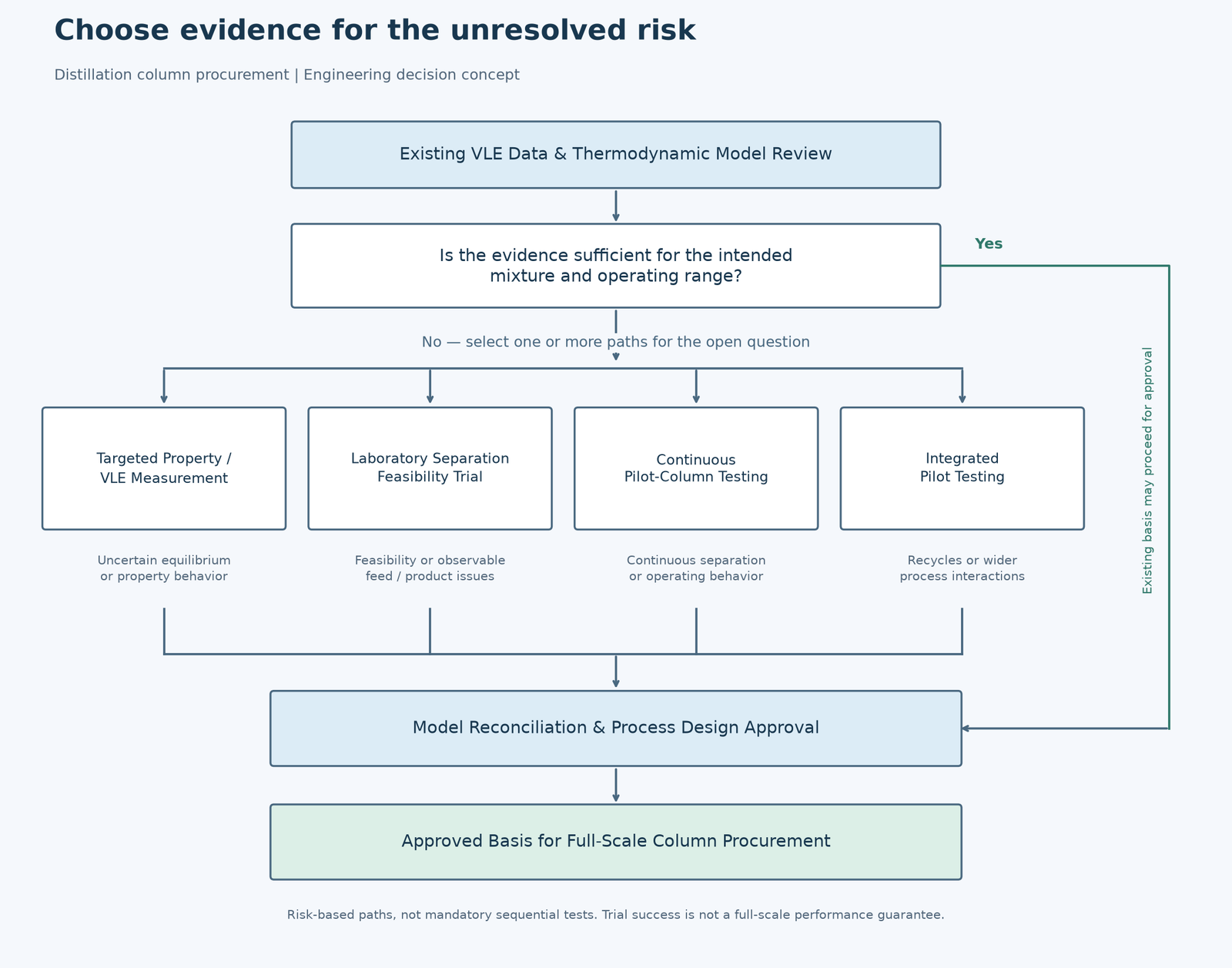
The technical article Experimental Methodologies to Verify Distillation Simulations distinguishes laboratory batch experiments, standalone continuous testing, and integrated pilot-plant trials.
It explains why different test arrangements provide different levels of representation for column composition profiles, residence time, and process interactions.
Targeted VLE Measurements: Verify the Property Basis
Where equilibrium information is missing or unreliable, the process team may commission measurements under conditions relevant to the proposed design.
The purpose is to improve or check the thermodynamic model, not to prove that a full-scale column will achieve its product specification.
The resulting data should identify the tested components, compositions, temperatures, pressures, analytical basis, and relevant measurement uncertainty.
The revised model should then be evaluated against the observations and checked for suitability across the required operating range.
Laboratory Separation Trials: Investigate Feasibility
A laboratory separation trial can help investigate whether the proposed separation route is plausible and whether the real feed exhibits unexpected behavior.
Depending on the test objective, useful observations may include product composition, residue behavior, foaming, visible fouling, or changes in sensitive material.
These observations must be interpreted within the limits of the laboratory arrangement.
A successful batch trial does not automatically demonstrate the steady-state operation or contacting performance of an industrial continuous distillation column.
Continuous Pilot Testing: Investigate Process Behavior
Continuous pilot testing may provide stronger evidence when the project needs to examine the interaction between separation performance, operating conditions, mass transfer, and fluid behavior.
Depending on the selected equipment and test scope, the study may examine product compositions, material and energy balances, pressure behavior, practical operating limits, and repeatability.
A pilot result is not a direct substitute for the final industrial design. Equipment geometry, internals, hydraulic loading, and scale-up assumptions must still be evaluated.
The AIChE article on distillation experiments discusses the role of experimental work in checking simulation predictions and separation feasibility.
How Should Representative Feed Samples and Test Cases Be Defined?
A test can be conducted correctly and still produce misleading design evidence if its sample does not represent the intended industrial feed.
Before arranging measurements or separation trials, the process team should establish what material will be tested, which operating scenarios matter, and how analytical uncertainty will be handled.
Define the Sample and Its Source
The test request should identify:
- The production or supply source of the feed.
- The relevant major components and identified impurities.
- The analytical method and composition reporting basis.
- Batch, campaign, or upstream process conditions represented by the sample.
- Known variations or degradation that can occur before testing.
- Any sample preparation or conditioning that could change its representativeness.
- The limitations of the available sample and any missing characterization.
For an existing plant, historical assays may reveal meaningful differences between batches or production periods.
For a new process, representative feed material may need to be obtained from a suitable upstream trial or a justified synthetic preparation. If a surrogate is used, the process team must document which behavior it is expected to represent and which behavior remains unverified.
An artificially clean mixture should not be assumed to represent a commercial feed containing trace impurities, residues, or other relevant constituents.
Match the Test Conditions to the Engineering Question
Representative testing does not mean that every conceivable operating combination must be reproduced.
The engineering team should identify the conditions that could materially change the separation result.
| Test-case input | Information to specify |
|---|---|
| Feed characterization | Composition and analytical uncertainty |
| Test purpose | Equilibrium-property validation, separation feasibility, or continuous operation |
| Temperature and pressure basis | Conditions relevant to the required property or process model |
| Product targets | Measurable product composition, recovery, or other acceptance objectives |
| Relevant operating range | The cases needed to address the unresolved design risk |
| Sensitive constituents | Impurities, degradation products, solids, or foam-promoting substances where relevant |
| Sampling and analysis | Agreed analytical methods and reporting basis |
| Interpretation limits | Conditions not represented and assumptions needed for scale-up |
Editorial test-request fields, not laboratory operating instructions.
The test provider should propose the appropriate experimental method and approved safety controls. This article does not prescribe operating procedures for handling hazardous substances or running pressurized or heated experiments.
Identify What the Test Does Not Cover
A useful test plan specifies exclusions as clearly as the selected test cases.
For example, data collected with one feed batch may not cover a different impurity profile. A short observation may not reveal slow fouling or accumulation effects. Results from a laboratory apparatus may not establish industrial tray or packing hydraulics.
These limitations must remain visible when the findings are passed to the process designer.
Sulzer’s process validation information describes the use of real-life customer samples and the incorporation of laboratory and pilot results into subsequent engineering work.
That example illustrates the importance of connecting experimental data to the design process. It does not establish that the equipment manufacturer receiving the final tower order provides those testing services.
What Must a Test Report Demonstrate Before Scale-Up?
The final value of experimental validation lies in whether its results can reduce uncertainty in the process model and guide engineering decisions.
A report containing only a statement that the trial was successful is not sufficient for a high-consequence industrial equipment decision.
Request Traceable Results and Limitations
For the agreed test scope, the report should document:
- The original technical question and validation objective.
- Feed identity, sample history, composition, and relevant uncertainties.
- The test arrangement and applicable operating conditions.
- Analytical methods and relevant measurement limitations.
- The measured results and material or energy balance information where applicable.
- Observed product behavior, including any material operating concerns.
- Comparisons between experimental findings and prior model predictions.
- Unresolved discrepancies and limits on applying the results elsewhere.
- Recommendations for revised calculations and further testing, if necessary.
The exact report content depends on the experiment.
A VLE measurement report should not be required to demonstrate full industrial column performance. A column trial, however, should provide enough process information to assess its relevance to the proposed design.
Close the Loop Between Testing and the Model
The responsible process engineer should compare the results with the original prediction and determine whether the model requires correction.
If parameters are adjusted using experimental data, the revised model’s predictive ability should be assessed independently where suitable data permit. Simply fitting the same measurements closely does not prove that the model extrapolates reliably beyond them.
NIST’s phase-equilibrium data-quality framework emphasizes consistency and data quality in building and evaluating thermodynamic models.
The revised process model should form part of the approved design basis, with its relevant assumptions and unresolved uncertainties identified.
Translate Findings Into Engineering Documents
| Validation output | Potential design consequence | Document to update |
|---|---|---|
| Revised VLE or property parameters | Updated separation feasibility and calculated compositions | Thermodynamic model and process-design basis |
| Experimental separation limits | Change in process route or required configuration | Process-flow diagram and design decision record |
| Measured product and residue behavior | Additional operating or quality constraints | Product specifications and operating assumptions |
| Observed foaming or fouling | Further hydraulic, contacting, or maintenance assessment | Column process specification and risk register |
| Relevant mass-transfer evidence | Revised internals performance or scale-up basis | Process rating and internals design criteria |
| Energy and material balance results | Revised reboiler, condenser, and associated utility duties | Heat and material balance and equipment datasheets |
| Unresolved test limitations | Additional data or approval required | Technical clarification and design hold-point register |
Illustrative engineering handover matrix. Updates must be approved by the responsible design authority.
Recognize the Limits of Pilot-to-Plant Scale-Up
Pilot testing may reduce uncertainty, but industrial scale introduces different equipment dimensions and operating characteristics.
The process engineer must still consider the relevance of the contacting geometry, mass-transfer performance, hydraulic limits, residence time, and proposed internals.
A successful trial should be described as evidence supporting a design decision, not as an unconditional guarantee of identical full-scale results.
If an unresolved uncertainty could change the separation route or materially alter the required column geometry, the project should assign a clear design hold point before releasing the complete tower for fabrication.
How Should Validation Results Be Transferred to the Column RFQ?
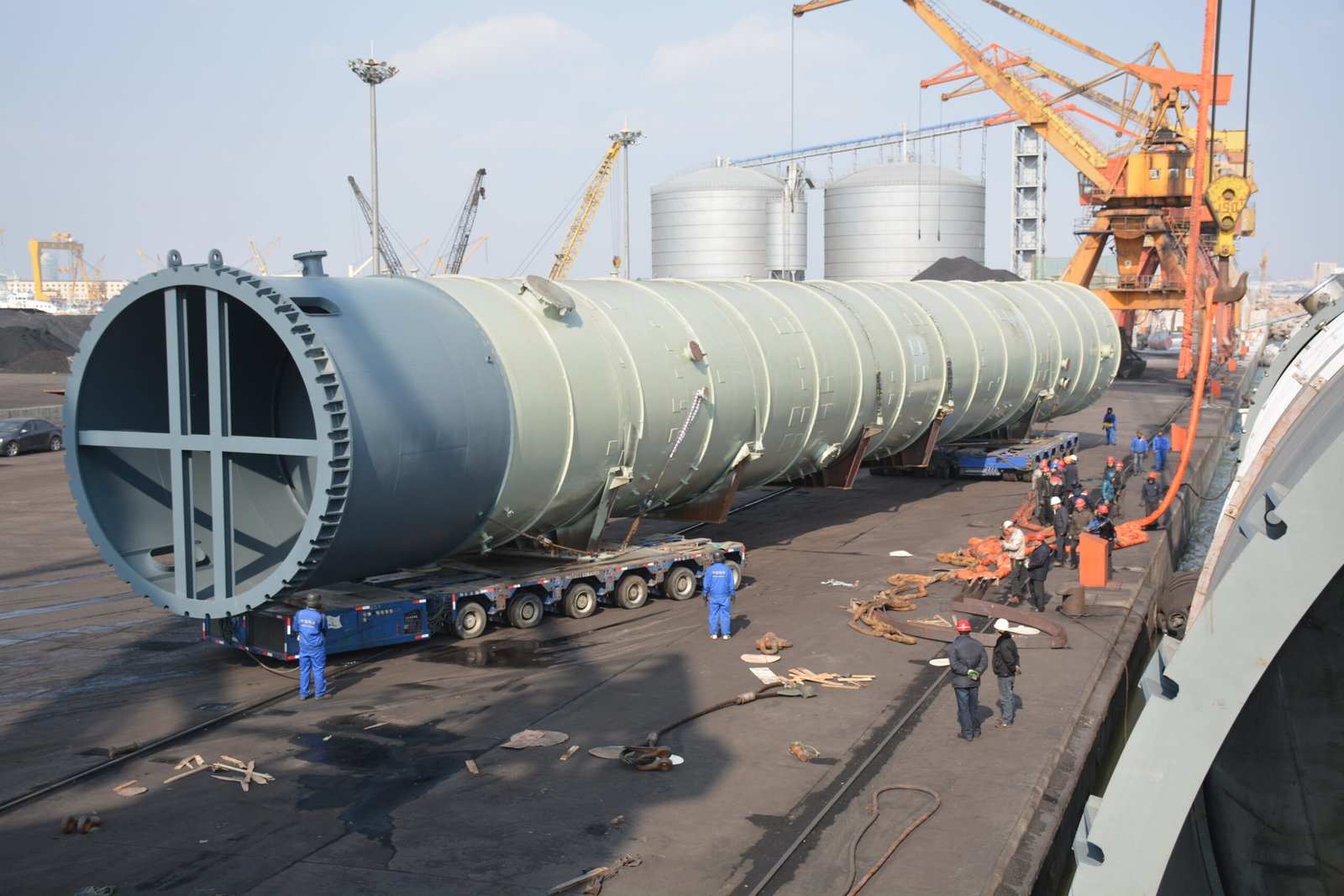
The column RFQ should be based on an approved process design package, not an unsupported separation claim or an unexplained simulation output.
The purchasing team needs to know which inputs are verified, which are estimated, and which remain subject to engineering confirmation.
Include the Approved Process Basis
A technically useful enquiry for a complete industrial distillation column should identify:
| RFQ field | Information required |
|---|---|
| Separation objective | Required products, applicable composition limits, recovery and throughput |
| Feed basis | Components, relevant impurities, physical conditions and defined operating cases |
| Property model | Thermodynamic method, data sources, validated range and limitations |
| Validation status | Existing-data review, new measurements, laboratory trials or pilot evidence |
| Model revision | Approved parameters and changes resulting from testing |
| Column process requirements | Design vapor and liquid loads, pressure range, temperature profile and other relevant duties |
| Equipment configuration | Proposed tower arrangement and responsible internals design scope |
| Related equipment | Reboiler, condenser and other process-interface responsibilities |
| Mechanical design basis | Applicable code and edition, design conditions, materials and fabrication requirements |
| Performance obligations | Which party is responsible for the process performance model and agreed guarantees |
| Open issues | Unverified inputs, technical deviations, design holds and responsible reviewers |
Editorial EPC procurement checklist for complete equipment, not a universal vendor datasheet.
The project should distinguish process-design requirements from mechanical fabrication requirements. A complete tower may include substantial integrated internals, but the procurement should remain focused on the finished industrial equipment rather than independent small-component sales.
Assign Responsibility Before Award and Fabrication Release
The process owner, process licensor, or appointed process engineer should normally establish the separation requirements and approve the thermodynamic and performance design basis.
A qualified testing organization should be responsible for the experiments and reports included in its contracted scope.
The tower manufacturer should evaluate the approved equipment requirements and confirm the mechanical, manufacturing, inspection, and other technical scope it proposes to supply.
Where the manufacturer is also contracted for process design or performance guarantees, those responsibilities must be stated explicitly and supported by agreed technical evidence.
The existence of a process towers and columns product range demonstrates a relevant equipment-manufacturing offering. It does not, by itself, prove ownership of pilot facilities, the ability to validate every chemical mixture, or an unconditional guarantee of any product purity.
Use a Decision Gate Before Committing to the Full Column
Before firm equipment award or release for fabrication, the responsible parties should record one of the following engineering dispositions:
- Validated basis: Available evidence adequately supports the approved process design for the contracted requirements.
- Conditional basis: The project may continue with defined assumptions, but a specific outstanding test, model review, or approval remains a hold point.
- Unresolved basis: A critical uncertainty could materially affect the process route or column design, so the relevant issue must be resolved before committing to the affected equipment configuration.
A budgetary quotation can still be requested while a validation question remains open. However, the offer should clearly identify provisional inputs and should not silently convert unvalidated assumptions into firm process performance commitments.
For a complete industrial distillation column enquiry, buyers should supply the feed composition and impurity information, separation objectives, available VLE or property evidence, test results if available, and the project design and responsibility boundaries.
Frequently Asked Questions
Do published binary VLE data eliminate the need to validate a multicomponent distillation model?
Not necessarily. Binary measurements may support a multicomponent property model, but the process engineer must assess whether its assumptions, interaction parameters, and available evidence are adequate for the actual mixture and operating range. Important impurities or non-ideal interactions may justify further review or measurement.
Can a successful laboratory batch distillation test replace a continuous pilot trial?
Sometimes a laboratory trial provides sufficient evidence for a specific feasibility or model-validation question. It does not automatically reproduce the composition profiles, residence times, hydraulic behavior, or recycle effects of a continuous industrial process. Whether additional testing is needed depends on the unresolved risks.
Can a tower manufacturer guarantee product purity based only on the buyer’s simulation?
A guarantee is a contractual matter that requires an agreed technical basis, defined feed and operating conditions, and clear responsibility for process design and performance. A simulation result alone does not establish that the manufacturer has independently validated the separation. The buyer should resolve responsibility and evidence requirements before accepting such a commitment.
Conclusion
Industrial distillation column procurement should begin with a clear understanding of the evidence supporting the separation design.
Reliable VLE data and an appropriately validated model may be enough for a well-understood process. Targeted property measurements, laboratory feasibility studies, or continuous pilot trials become more valuable when specific uncertainties could change separation performance or equipment requirements.
The practical objective is to identify the unresolved risk, select a suitable validation method, document its results and limitations, and incorporate the approved findings into the complete column design package.
Before requesting a firm manufacturing quotation, provide the actual feed and product requirements, available thermodynamic information, supporting test reports, and the agreed process-design responsibilities. This makes the eventual industrial tower specification more defensible and helps avoid transferring unresolved process uncertainty into equipment fabrication.
References
- National Institute of Standards and Technology (NIST). ThermoData Engine. Technical overview of experimental, predicted, and critically evaluated thermophysical property data. https://www.nist.gov/mml/acmd/trc/thermodata-engine
- NIST. Diky, V., et al. (2014). Algorithmic Framework for Quality Assessment of Phase Equilibrium Data. Journal of Chemical & Engineering Data. Public research abstract. https://www.nist.gov/publications/algorithmic-framework-quality-assessment-phase-equilibrium-data
- Sulzer. Pilot Plant Testing. Manufacturer information describing scenarios where laboratory or pilot validation can be beneficial. This is evidence of Sulzer’s testing approach, not a statement of this site’s manufacturer’s capabilities. https://www.sulzer.com/en/shared/services/pilot-plant-testing
- Sulzer. Process Validation. Public description of the purpose of validation, experimental reports, and subsequent process engineering. https://www.sulzer.com/en/shared/services/process-validation
- Graham, G., Pednekar, P., and Bunning, D. (2018). Experimental Methodologies to Verify Distillation Simulations. Chemical Engineering. Practical comparison of experimental validation approaches. https://www.chemengonline.com/experimental-methodologies-verify-distillation-simulations/
- Graham, G., Bunning, D., and Rader, J. (2020). Design and Operation Considerations for Distillation Experiments. AIChE Chemical Engineering Progress. Public article overview. https://publications.aiche.org/cep/2020/november/design-and-operation-considerations-distillation-experiments