
For a refinery, LPG terminal or industrial fuel-storage project, choosing between an above-ground, buried and mounded pressure vessel is not simply a matter of available land. The arrangement changes the loads on the vessel, the civil and corrosion-protection interfaces, the accessibility of equipment, and the evidence needed to plan inspection and maintenance.
For industrial LPG storage tanks of 10 m³ and above, EPC buyers should compare all three arrangements against the same approved storage duty, site conditions, mechanical design basis, ground and groundwater data, fire and leakage risk assessment, and lifecycle access requirements. No installation type is automatically the safest, lowest-cost or least-maintenance option for every project.
This guide concerns pressurized storage of liquefied petroleum gas (LPG)—such as propane, butane and their mixtures—at ambient-temperature service conditions, using complete industrial pressure vessels. It does not address small domestic propane tanks, refrigerated or cryogenic LNG storage, or ammonia storage. Refrigerated LPG concepts also require a separate assessment and are outside this comparison.
The article helps owners and EPC teams identify decision inputs and procurement interfaces; it does not provide site layout calculations, excavation procedures, separation distances, or authorization to construct an installation.
What Is the Difference Between Above-Ground, Buried and Mounded LPG Storage?
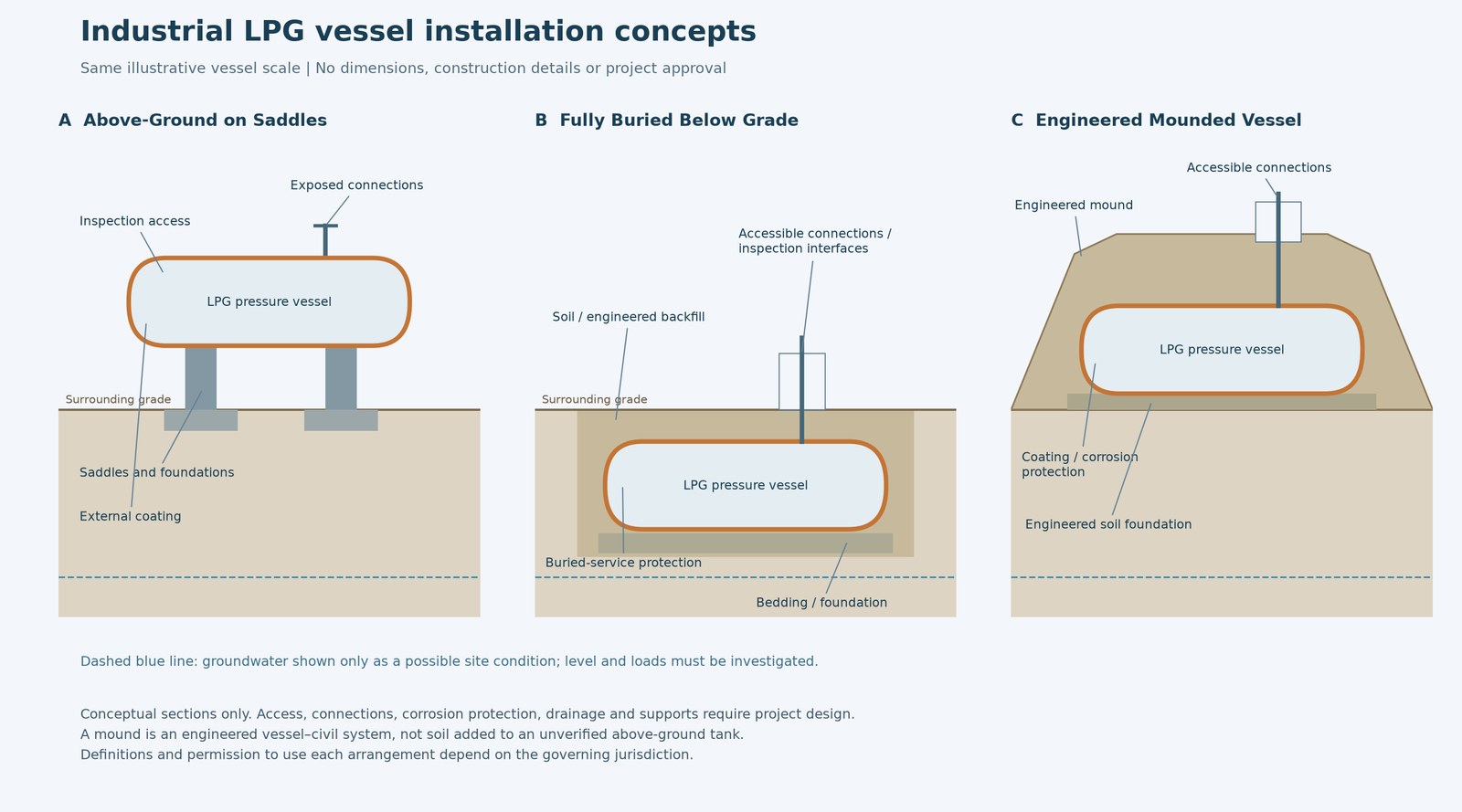
All three arrangements can be considered for industrial pressurized LPG storage where the applicable project requirements permit them, but they expose the pressure vessel to different surroundings and mechanical loads.
Above-Ground LPG Pressure Vessels
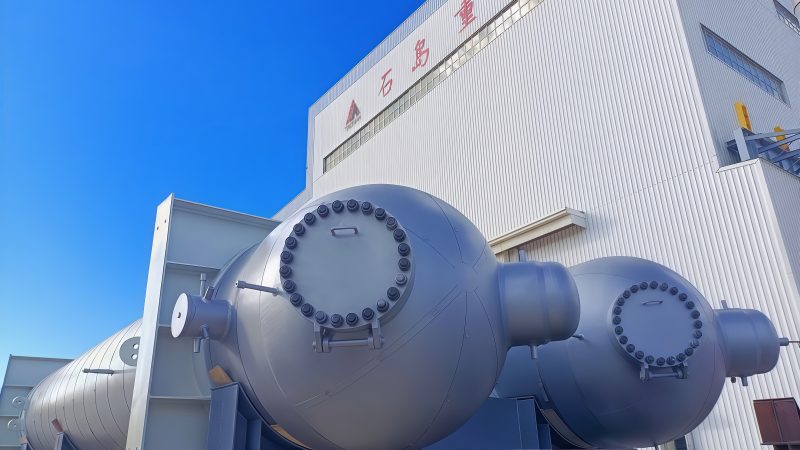
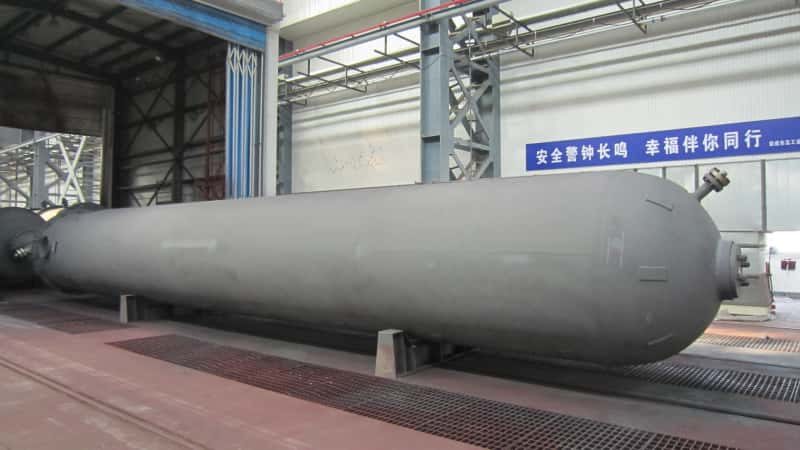
An above-ground LPG vessel is located above finished grade and supported by a defined foundation and support system. Horizontal pressure vessels, often called LPG bullet tanks, are common industrial configurations, though the suitable shape and arrangement depend on project requirements.
Because much of the vessel exterior is accessible, coating condition, supports, connections and visible abnormalities can be easier to inspect. The installation nevertheless requires a site-specific review of external fire exposure, potential impact, environmental conditions, hazardous-area considerations and emergency access.
Above-ground location does not mean that every external surface is easy to inspect. Contact points at saddles, insulation, adjacent equipment and other local features may still require a dedicated inspection strategy.
Buried LPG Pressure Vessels
A buried arrangement places the vessel below surrounding ground level, with its installation and interfaces engineered for the surrounding soil and groundwater conditions. The pressure boundary is less exposed to direct external events at the surface, but its shell is generally less directly accessible for external examination.
The project must account for soil and groundwater loads, corrosion-control provisions, support and bedding conditions, possible buoyancy, and access to required operating and safety-related interfaces.
Buried installation is not automatically permitted everywhere or appropriate for every vessel. Some jurisdictions impose separate authorization and installation requirements.
Mounded LPG Pressure Vessels
In a mounded arrangement, a horizontal pressurized LPG vessel is placed at or near ground level and covered by an engineered earth or suitable backfill mound. The mound provides a passive barrier between much of the vessel shell and external conditions, but it also creates sustained interaction among the vessel, supporting soil, backfill, groundwater and protective coating.
The EEMUA Publication 190 description specifically addresses horizontal cylindrical steel vessels storing pressurized LPG at ambient temperatures. Its scope includes soil investigation, foundation design, pressure containment, corrosion protection, inspection, testing and maintenance.
An engineered mound is not a decorative covering added to an otherwise unchanged above-ground design. Its structural, corrosion and monitoring requirements must be evaluated as an integrated system.
Installation Comparison at a Glance
| Evaluation factor | Above-ground | Buried | Mounded |
|---|---|---|---|
| Vessel surroundings | Exposed to ambient atmosphere and external events | Surrounded by soil below grade | Covered by engineered backfill at or near grade |
| External loads to evaluate | Vessel/support loads plus relevant environmental and accidental actions | Soil and groundwater actions, support, settlement and buoyancy as applicable | Mound and foundation actions, settlement, groundwater and relevant external conditions |
| Fire and impact considerations | Exposed shell requires project-specific safeguards | Soil can provide shielding, but openings and system interfaces remain relevant | Mound can provide passive shielding; exposed interfaces and plant-wide hazards still require review |
| External shell inspection | Often more accessible, subject to supports and obstructions | Access generally constrained by burial | Access constrained by mound design; monitoring and inspection provisions need early planning |
| Corrosion strategy | Atmospheric conditions, supports and surface protection | Buried-service coating and appropriate corrosion-control provisions | Coating, soil environment, corrosion protection and monitoring provisions |
| Civil works | Foundations and supports | Excavation, bedding, drainage, reinstatement and groundwater management | Soil investigation, foundation, backfill/mound construction and drainage |
| Cost conclusion | Requires a project-specific estimate | Requires a project-specific estimate | Requires a project-specific estimate |
This is a qualitative EPC comparison, not a ranking or a statement that any configuration meets local regulations without assessment.
What Site and Civil Engineering Data Should Be Compared First?
Installation form cannot be selected responsibly from tank capacity alone. Before requesting a firm vessel quotation, the owner and civil/EPC teams should identify which site conditions and loads will govern each option.
Establish the Ground and Foundation Basis
For a large pressure vessel, the geotechnical package may need to describe soil layers, bearing and settlement characteristics, anticipated groundwater conditions, site grading and relevant ground-improvement or foundation constraints.
The required study depends on the site's conditions and the proposed foundation concept. A mounded vessel may be supported by a compacted soil foundation; differential settlement can affect the vessel and its connections. The public scope of EEMUA Publication 190 specifically highlights soil settlement as an important concern for mounded storage.
Relevant interfaces include:
- Surveyed elevations, available footprint and grading restrictions.
- Geotechnical investigation results and unresolved subsurface conditions.
- Proposed foundation type, soil support and settlement assumptions.
- Permanent and construction-stage vessel and backfill loads.
- Wind, seismic and other site-specific actions where applicable.
- Excavation, neighboring foundations and underground services.
- Piping connections and allowable relative movements between structures.
- Construction access, lifting arrangements and delivery-route limitations.
No universal allowable settlement value, mound thickness or soil bearing capacity should be inserted into the vessel specification without a project-specific engineering basis.
Investigate Groundwater, Drainage and Buoyancy
Buried and mounded arrangements require careful attention to how water behaves around the vessel and its protective systems.
Depending on the installation, the engineering team may need to assess high and fluctuating groundwater levels, drainage paths, flood exposure, water-retaining backfill, hydrostatic effects and corrosion-environment changes.
A buried vessel can also require evaluation of uplift or buoyancy under relevant low-inventory and high-groundwater conditions. This is a structural design issue, not a reason to prescribe one anchoring method for every project.
For mounded vessels, water management is closely related to the mound's construction, corrosion protection, foundation and long-term inspection strategy. Poor drainage can undermine assumptions made about backfill conditions and corrosion exposure.
The required drainage, waterproofing and anchoring arrangements must be designed and approved for the site rather than selected from an online generic installation diagram.
Review Vessel Loads With the Civil Team
The complete pressure-vessel design basis should identify the load combinations relevant to the chosen configuration, including those associated with the vessel's supports, contents, internal pressure, piping, external soil or backfill, and applicable environmental or accidental actions.
For an above-ground bullet tank, saddle and support interfaces may be a prominent part of the civil exchange. For buried or mounded vessels, pressure-boundary and structural calculations may also need to address interactions with surrounding material and different construction stages.
Do not assume that a vessel designed for an above-ground saddle arrangement can be buried or mounded without redesign or formal verification. The manufacturer and the appointed engineering authority must assess the intended installation as part of the actual mechanical specification.
How Do Corrosion Protection, Leakage Monitoring and Inspection Access Differ?
The condition of the pressure boundary must remain manageable during the intended service period. Changes in accessibility and surrounding environment are therefore central to the installation decision—not optional details to resolve after the vessel is manufactured.
Above-Ground: Accessible Does Not Mean Maintenance-Free
An exposed vessel can offer relatively direct access to parts of its shell, supports, nozzles and external coating. That can simplify some visual examinations and planned maintenance.
However, atmospheric corrosion, coating degradation, moisture at contact locations, thermal or environmental exposure and damage at supports still require an appropriate inspection and maintenance program.
Adequate access around the complete unit should be reviewed at layout stage, including the movement of approved inspection and maintenance equipment.
Buried: Corrosion Protection Becomes an Integrated Design Requirement
For buried installations, the project should evaluate soil corrosivity, coating suitability, coating integrity, electrical interfaces, corrosion-protection measures and the means of checking their continuing effectiveness.
Cathodic protection or other measures may be required by the adopted standard and jurisdiction; the exact design and monitoring requirements must be established by competent corrosion engineers.
In a buried installation, the difficulty of direct external access also matters. Owners should identify how pressure-boundary integrity will be assessed and which access, monitoring or approved inspection arrangements will be necessary throughout operation.
Mounded: Passive Shielding Does Not Eliminate Monitoring
Mounded vessels can benefit from passive shielding against some external exposures. However, the mound can make shell inspection more complicated and can introduce a long-term need to monitor corrosion protection, backfill condition, settlement and drainage.
The EEMUA 190 published scope explicitly includes in-service inspection, testing and maintenance, as well as foundation design and corrosion protection.
In other words, mounded storage is not maintenance-free. Buyers should request a documented inspection and corrosion-monitoring philosophy that is practicable for the agreed installation.
Leakage Detection and Access to Interfaces
LPG leakage creates a different concern from the mere visibility of the tank shell. The layout must address credible releases, gas movement and accumulation, ventilation, drainage features, detection provisions and system-level protective arrangements.
In particular, exposed connections, instrument interfaces, relief arrangements and equipment operating access still need evaluation for buried and mounded designs. A soil covering cannot be assumed to protect every connection or prevent all releases.
The manufacturer's supply boundary should identify the complete vessel's relevant nozzles and interfaces, while the owner/EPC determines the wider piping, controls, detection and emergency arrangements unless a larger contractual scope is expressly agreed.
Identify the Inspection Plan Before Finalizing Layout
| Question | Why it matters |
|---|---|
| Which parts of the pressure boundary will be inaccessible after installation? | Changes how inspection and future integrity assessment can be planned |
| What corrosion-protection system will be adopted and verified? | Connects material selection, coating, soil environment and monitoring |
| How will groundwater, drainage and settlement be monitored where relevant? | Keeps the original civil assumptions under review |
| Can required valves, instruments and connections be reached safely? | Supports maintainability and emergency planning |
| Which inspection records must be retained? | Enables lifecycle traceability and regulatory review |
| Who owns inspections and monitoring after handover? | Prevents gaps between equipment supply and plant operation |
The specific examination methods, intervals and acceptance criteria must be set by the applicable regulation, standard and responsible integrity team. This article does not prescribe field leak testing, cathodic-protection setpoints or excavation procedures.
Does Buried or Mounded Storage Offer Better Fire Protection or Overall Safety?
Soil or engineered backfill can provide passive shielding, but passive protection is only one part of the installation's overall risk assessment. It does not establish that every buried or mounded installation is safer than every above-ground arrangement.
Separate Passive Barrier Benefits From Full-Site Risk
For an above-ground vessel, the shell may have greater direct exposure to external fires, vehicle impact or other events. The project must evaluate credible external exposure and the necessary protective measures.
For a buried or mounded vessel, surrounding material can reduce exposure of covered surfaces to some external events. Nevertheless, the system remains a pressurized LPG installation with potential leakage paths, operational connections and other hazards.
The full assessment should account for:
- The installation's relationship to nearby process units, buildings and site boundaries.
- Credible fire, impact, leakage and other relevant scenarios.
- Access for operations, emergency response and planned maintenance.
- Vapor movement, low-lying areas and relevant drainage pathways.
- Required relief, isolation, detection and protective interfaces.
- Geotechnical and groundwater-related risks.
- Regulatory and permitting constraints.
EEMUA's official summary describes mounded LPG storage as generally safer than other methods in its intended application, while simultaneously identifying greater sensitivity to soil settlement and the need for appropriate pressure-containment, corrosion and foundation engineering. This is not a blanket approval or a project-specific quantitative risk conclusion.
Local Regulations Can Change the Available Options
One arrangement may be technically feasible but not acceptable under the rules that govern a specific facility.
For example, California Code of Regulations, Title 8, Section 477 distinguishes above-ground, mounded and underground LP-Gas containers. The published provision imposes separate authorization and installation conditions for mounded and underground installations and includes restrictions on partially underground or partially mounded containers.
That California regulation is a jurisdiction-specific example, not a global rule. It should not be applied automatically to facilities in other U.S. states or countries, nor does it establish the approval status of a particular overseas project.
For industrial LPG facilities, API Standard 2510 addresses the design, construction and location of LPG storage and handling installations. The NFPA 58 standard page identifies the Liquefied Petroleum Gas Code and its current edition information. Whether and how these documents apply depends on the contract, regulatory adoption and installation jurisdiction.
EEMUA Publication 190 provides a specialist guide for mounded horizontal cylindrical steel vessels; its use also depends on project adoption and compatibility with other governing requirements. None of these references, viewed only through public summaries, is a substitute for the purchased standard and approved engineering design.
Do not set one universal burial depth, mound cover, separation distance or fire-protection arrangement for all industrial LPG sites. Those requirements must come from the applicable local framework and project design.
How Should EPC Buyers Compare Lifecycle Cost and Project Execution?
Installation cost depends on much more than the price of the fabricated steel vessel.
An above-ground arrangement may reduce some excavation and backfill activities, but it can require a different site footprint, support system and protective arrangements.
A buried arrangement may involve more extensive excavation, groundwater management and corrosion-protection interfaces. A mounded arrangement adds engineered fill and mound construction, with its own foundation and lifecycle monitoring considerations.
Neither underground nor mounded storage should be described as categorically more expensive or cheaper without a comparable project estimate.
Compare the Same Project Scope
| Cost or execution category | Questions for the EPC comparison |
|---|---|
| Vessel manufacture | Is the proposed vessel specifically engineered for the intended installation? |
| Foundations and groundworks | What geotechnical work, civil design, excavation, foundation and backfill are included? |
| Corrosion control | Which coating, protection, monitoring and verification provisions are required? |
| Site safety and permitting | What project-specific studies, interfaces and approvals apply? |
| Inspection access | What permanent access or approved alternative inspection arrangements must be provided? |
| Construction logistics | What transport, lifting, access, sequence and commissioning interfaces are anticipated? |
| Operating expenditure | What inspection, monitoring, repair-access and maintenance costs are reasonably expected? |
| Future modifications | Could access or civil works materially change the cost of future interventions? |
Economic comparisons should use the same design life assumptions, site conditions, scope boundaries and approved project risk criteria. If those data are not available, any cost ranking is preliminary.
Avoid Unsupported Industry Percentages and Payback Claims
Industry-wide claims such as “most refineries use one configuration,” “mounded vessels save a fixed percentage of insurance,” or “underground tanks always provide a better return on investment” require a defined data source and population.
No such universal percentage or payback figure is supplied here. Site conditions, regulations and scope allocation can reverse an apparent cost advantage.
Coordinate the Manufacturer and Civil Contractor Early
A complete vessel may be fabricated before major site construction is finished. Nevertheless, its supports, external loads, coating, access and interfaces must be based on the approved installation concept.
Late changes from above-ground to buried or mounded installation can affect mechanical calculations and the contractual manufacturing scope. Project teams should therefore freeze the installation basis and identify unresolved interface items before releasing the affected pressure-vessel design for fabrication.
What Should Buyers Include in an Industrial LPG Tank RFQ?
The RFQ should identify both the LPG storage duty and the site-engineering basis that makes the proposed installation possible.
For general decisions about tank capacity, storage service and normal vessel selection, see the site's LPG storage tank selection guide. This article concentrates on installation arrangements and their interfaces.
Recommended Installation-Selection Data Register
| Data group | Owner / EPC information to provide | Required clarification |
|---|---|---|
| Application and capacity | Industrial LPG service, proposed number of vessels, nominal geometric volume of each vessel (at least 10 m³ for this article) | Confirm that vessel volume is not confused with usable LPG inventory or allowable filling quantity |
| Product composition | Propane, butane or approved LPG mixture and relevant impurities | Confirm the actual design and corrosion basis |
| Pressure and temperature | Approved operating and design conditions | Identify the project pressure-vessel construction requirements |
| Installation option | Above-ground, fully buried, engineered mounded or alternatives under review | Identify which layouts are legally and technically permissible |
| Site location and jurisdiction | Country, facility, regulatory authority and adopted standards | Confirm applicability and editions |
| Geotechnical and groundwater | Site survey, soil data, settlement and groundwater conditions | Define civil and vessel external-load assumptions |
| Foundation and support concept | Proposed supports, bedding, mound or excavation basis | Allocate structural calculations and interface responsibility |
| Corrosion protection | Soil/environmental data, coating, protection and monitoring concept | Assign design, installation and verification responsibility |
| Safety and layout | Approved risk basis, nearby facilities, access and relevant release scenarios | Establish required separation and safeguarding by project analysis |
| Operations and inspection | Access needs, required equipment interfaces, inspection philosophy | Show how maintenance and integrity review will be possible |
| Construction logistics | Delivery, lifting, assembly, excavation or backfill sequencing | Align manufacturer and civil contractor deliverables |
| Scope of supply | Pressure vessel, integrated connections and agreed accessories | Identify site piping, civil work, instruments and protections supplied by others |
| Approval status | Open inputs, deviations, technical owners and hold points | Prevent assumptions from silently becoming final design requirements |
This is an editorial EPC handover checklist. The project's governing documents establish actual contractual deliverables.
Clarify Engineering Responsibilities
Owner and process team: Define the LPG service, capacity basis, composition, operating envelope, process hazards and intended plant operation.
EPC, civil and geotechnical engineers: Evaluate site layouts, subsurface conditions, groundwater, foundation design, soil/backfill actions, settlement and relevant construction interfaces.
Materials and corrosion engineers: Establish suitable corrosion-protection, coating and monitoring requirements for the actual exposure.
Mechanical design authority and pressure-vessel manufacturer: Confirm the applicable mechanical requirements, proposed vessel construction, external loads, supports, documentation, manufacturing and inspection scope.
Owner's safety, inspection and regulatory teams: Confirm site-specific safety requirements, permitting, maintainability and the inspection/monitoring strategy.
This responsibility allocation may vary by contract. A manufacturer should not be presumed responsible for terminal-wide engineering or local permits unless that scope has expressly been agreed.
Verify the Exact Vessel Supply Scope
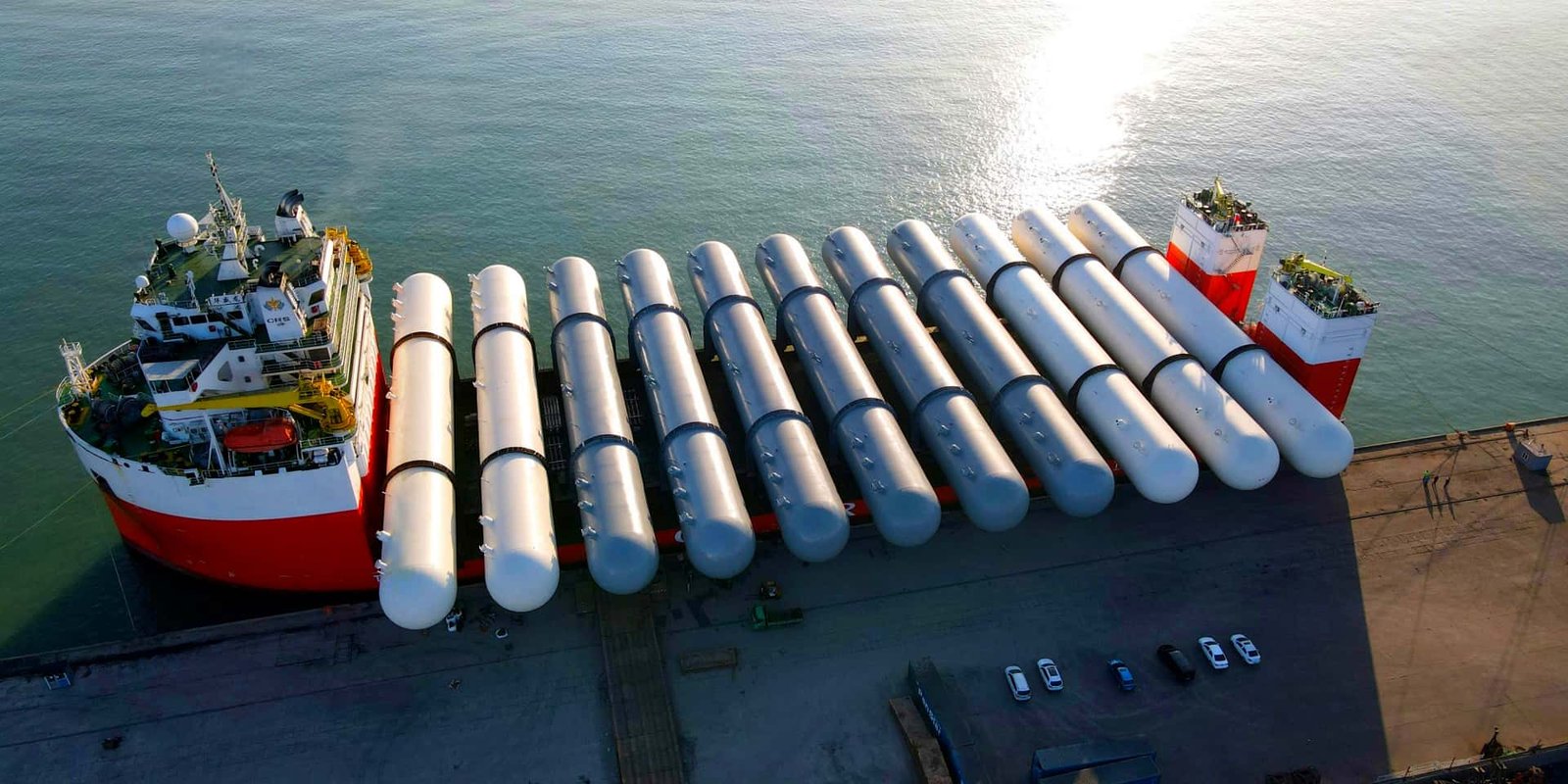
The website's industrial liquefied-gas storage tank product range shows an established product category relevant to large pressure-vessel enquiries.
However, a general product category does not establish that every above-ground, buried or mounded configuration is offered or qualified by a particular factory. The feasibility, applicable codes, installation-specific structural design, corrosion system and division of supply must be confirmed for the actual project.
For a technical enquiry, buyers should submit their approved LPG service data, vessel capacity and quantities, site location, shortlisted installation concepts, geotechnical basis and intended scope of manufacture. Where site data are incomplete, suppliers should identify assumptions and hold points rather than provide unsupported installation guarantees.
Frequently Asked Questions
Can an industrial LPG pressure vessel be installed underground?
A buried installation may be technically considered where the local regulatory framework permits it and the vessel and installation are specifically engineered for that service. Soil, groundwater, corrosion protection, structural loads, access and monitoring all require assessment. An ordinary above-ground vessel should not be buried without appropriate design verification.
Is a mounded LPG vessel maintenance-free?
No. Mounded storage may provide useful passive shielding, but it still requires an appropriate corrosion-protection, inspection, drainage and foundation-monitoring strategy. EEMUA Publication 190 explicitly includes in-service inspection and maintenance in its stated scope.
Is a buried or mounded LPG tank always safer than an above-ground tank?
No universal ranking is valid. Mounding or burial can reduce some external exposures, while also creating different civil, corrosion, leak-detection and accessibility considerations. Overall safety depends on the full project risk assessment and applicable requirements.
How deep should a large LPG vessel be buried?
There is no appropriate universal depth for all industrial LPG projects. The required arrangement depends on the applicable jurisdiction, approved engineering design, groundwater, soil conditions, loads, inspection provisions and other project-specific factors. This article does not provide burial or excavation instructions.
Is mounded storage the same as a fully buried vessel?
No. A mounded vessel is placed at or near grade and covered by a designed mound or backfill system; a fully buried vessel is located below surrounding ground. The detailed distinction and acceptability must follow the project-adopted definitions and local rules.
Can these LPG installation recommendations be applied to LNG or ammonia tanks?
No. This guide concerns ambient-temperature pressurized LPG vessels. LNG is typically associated with cryogenic storage engineering, and ammonia introduces different fluid hazards and project requirements. Those services need their own design and regulatory reviews.
What information should an EPC provide before comparing installation options?
At a minimum, the EPC should provide the LPG service and volume basis, approved operating conditions, jurisdiction, site layout, geotechnical and groundwater data, expected loads, safety and inspection requirements, and a clear division between vessel manufacture and site works.
Conclusion
Above-ground, buried and mounded LPG storage vessels can represent different engineering responses to the same industrial storage duty, but the installation choice changes the civil works, corrosion protection, access and operational risk profile.
Above-ground equipment usually offers more direct access to much of the exposed shell. Buried arrangements require close consideration of surrounding soil, water and external accessibility. Mounded arrangements combine engineered soil cover and pressure containment with foundation, settlement and long-term monitoring responsibilities.
For industrial LPG pressure vessels of 10 m³ and above, the responsible choice is the arrangement that can meet the approved project requirements with a traceable mechanical, civil, corrosion and safety basis—not the option advertised as universally safer, cheaper or maintenance-free.
Before issuing a firm RFQ, owners and EPCs should align the process conditions, site investigation, local requirements, inspection strategy and supplier scope. This permits technically comparable complete-vessel proposals while leaving final design approval with the appropriate engineering authorities.
References
- Engineering Equipment and Materials Users Association (EEMUA). EEMUA Publication 190 — Guide for the Design, Construction and Use of Mounded Horizontal Cylindrical Vessels for Pressurised Storage of LPG at Ambient Temperatures. Official public publication summary; scope includes geotechnical/foundation considerations, corrosion protection, inspection and maintenance. Full paid text has not been reviewed. https://www.eemua.org/products/publications/digital/eemua-publication-190
- American Petroleum Institute (API). API Standard 2510, 9th Edition — Design and Construction of LPG Installations. Official public scope describing LPG storage-installation design, construction and location. The paid standard's detailed requirements have not been reproduced. https://www.api.org/products-and-services/standards/important-standards-announcements/standard2510
- National Fire Protection Association (NFPA). NFPA 58 — Liquefied Petroleum Gas Code. Official standard-development page, showing the edition and related updates; specific project applicability depends on local adoption and contractual requirements. https://www.nfpa.org/codes-and-standards/nfpa-standard-development/58
- California Department of Industrial Relations. California Code of Regulations, Title 8, Section 477 — Installation of Containers. Jurisdiction-specific example of different provisions for above-ground, mounded and underground LP-Gas installations. Not an international or nationwide default. https://dir.ca.gov/Title8/477.html
- Engineering Equipment and Materials Users Association (EEMUA). EEMUA Publications Catalogue, April 2026. Public summary describing the scope and settlement-related considerations of Publication 190. https://www.eemua.org/getmedia/c9facca4-e0df-4c23-8945-b4d28acda850/EEMUA-Publications-Catalogue_web_April-2026.pdf