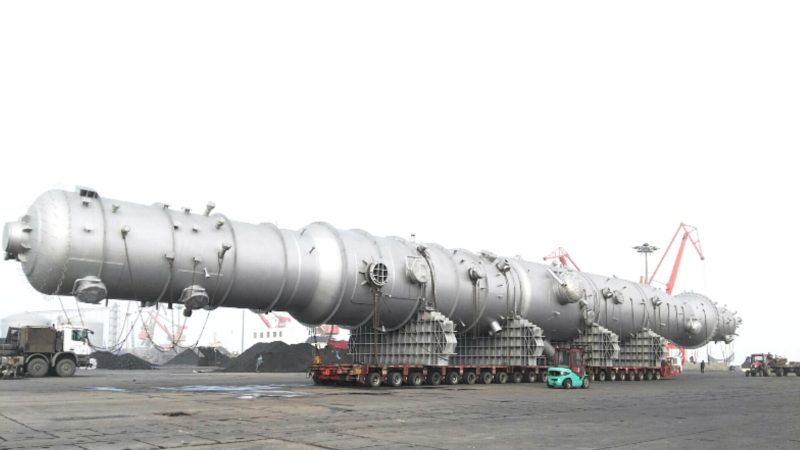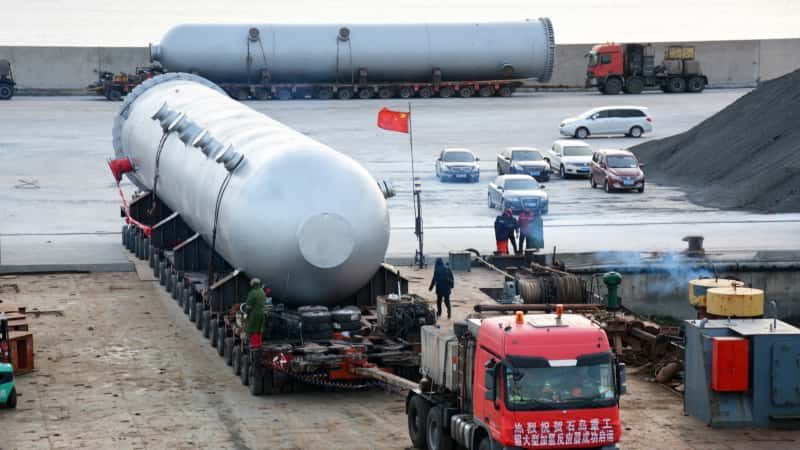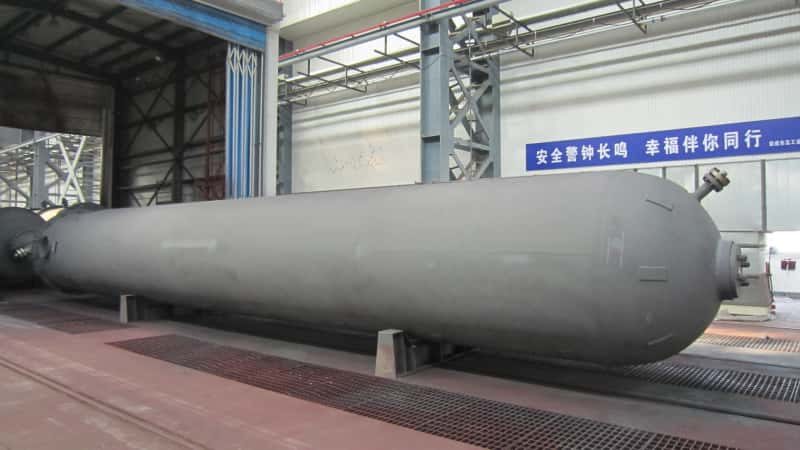

What Documents Should Buyers Request Before Pressure Vessel Shipment?
Before a pressure vessel leaves the manufacturer’s workshop, EPC buyers should confirm that the required shipment documents are complete, consistent and aligned with the purchase order. For overseas projects, missing documents can delay customs clearance, site receiving, installation acceptance or final project handover.
Pressure vessel shipment documents are not only administrative files. They are part of the equipment quality record. They help verify material traceability, welding control, non-destructive examination, pressure testing, coating quality, packing condition and delivery scope.
This guide explains what EPC buyers, procurement managers and project engineers should request before shipment of custom pressure vessels, separators, heat exchangers, process towers, large storage tanks and other fabricated process equipment.

A pressure test certificate alone is enough for pressure vessel shipment acceptance.False
A pressure test certificate is important, but EPC buyers should also review drawings, material traceability, welding records, NDE reports, dimensional checks, coating records, packing lists and the final data book.
Pressure vessel shipment documents are part of the delivered equipment scope.True
For EPC projects, the documentation package supports site receiving, client handover, regulatory review, future maintenance and final acceptance.
Shipment document reconciliation checks whether the files describe the equipment actually delivered. File completeness alone does not prove correct equipment identity or accepted revision status.
Why Shipment Documents Matter for Pressure Vessel Procurement
A pressure vessel may be physically complete, but it is not truly ready for delivery if the documentation package is incomplete. For EPC projects, documents support quality verification, client inspection, regulatory review, site acceptance and future maintenance.
For buyers sourcing custom pressure vessels, shipment documents help answer several practical questions:
- Were the correct materials used?
- Were the welds inspected according to the agreed scope?
- Was the pressure test completed and recorded?
- Was the coating inspected before delivery?
- Are the final drawings consistent with the fabricated equipment?
- Are the packing list and shipping marks correct?
- Is the delivery boundary clear?
A good document review before shipment can prevent expensive problems after the vessel arrives at site.
Pressure Vessel Shipment Document Checklist
| Document category | Typical records to request | Why EPC buyers need it |
|---|---|---|
| Drawings | Approved drawings, nozzle orientation, lifting drawings and as-built drawings where required | Confirms the delivered vessel matches the project interface |
| Material traceability | Material certificates, heat numbers, material list and traceability records | Verifies that pressure-retaining parts match the specification |
| Welding and NDE | WPS, PQR, welder qualifications, weld map, NDE reports and repair records if applicable | Supports quality review of welded joints and inspection scope |
| Testing and inspection | Pressure test report, dimensional inspection, heat treatment records and final inspection report | Confirms acceptance activities before shipment |
| Packing and delivery | Packing list, shipping marks, loading photos, dimensions, weights and delivery note | Supports export delivery, site receiving and logistics planning |
1. Approved Drawings and Final As-Built Drawings
The approved drawing package is the foundation of pressure vessel delivery. Before shipment, buyers should confirm that the latest approved drawings match the fabricated vessel.
Important drawings may include:
- General arrangement drawing
- Fabrication drawing
- Nozzle orientation drawing
- Nozzle schedule
- Support or saddle drawing
- Lifting arrangement drawing
- Nameplate drawing if required
- As-built drawing if required by the contract
For large vessels, drawing consistency is especially important because nozzle orientation, lifting points, support locations and overall dimensions affect field installation. If the as-built condition differs from the approved drawing, the change should be documented and accepted through the project procedure.
Buyers can also review WSHI’s pressure vessel manufacturing scope when preparing a complete documentation requirement.
2. Material Certificates and Traceability Records
Material traceability is one of the most important parts of the pressure vessel data book. Buyers should request material certificates for pressure-retaining parts and other items defined in the project specification.
Typical records may include certificates for:
- Shell plates
- Heads
- Forgings
- Nozzles
- Flanges
- Pipes
- Welding consumables where required
- Bolting or gasket materials where included in the complete supply scope
The material certificate should be traceable to the actual vessel. Heat numbers, plate numbers or identification marks should be consistent with the material list and inspection records.
For vessels used in petrochemical, oil and gas, fertilizer, hydrogen, LPG, wastewater or chemical service, material selection should be reviewed according to the medium, pressure, temperature, corrosion risk and project standard. Buyers working on chemical process units can review petrochemical pressure vessels as part of the equipment planning scope.
3. Welding Records and Welder Qualification Documents
Welding quality is central to pressure vessel manufacturing. Before shipment, buyers should confirm that required welding documents have been collected and reviewed.
Depending on the project requirements, the document package may include:
- Welding procedure specification
- Procedure qualification record
- Welder qualification record
- Welding consumable records
- Weld map
- Weld visual inspection record
- Weld repair record if applicable
The weld map is particularly useful because it links weld joints to inspection records. If any repair was performed, the repair process and re-inspection records should be included according to the agreed inspection plan.
For buyers working with a large-scale pressure vessel manufacturer, the purpose of reviewing welding documents is not to duplicate the manufacturer’s quality work. It is to confirm that the project’s traceability and acceptance requirements are complete before delivery.

4. Non-Destructive Examination Reports
Non-destructive examination, often called NDE or NDT, may include radiographic testing, ultrasonic testing, magnetic particle testing, penetrant testing or other methods required by the design code and project specification.
Before shipment, buyers should confirm:
- Which welds were examined
- Which NDE methods were used
- Whether reports match the weld map
- Whether acceptance results are clear
- Whether repair and re-test records are included
- Whether inspector signatures and dates are complete
The exact NDE scope should follow the latest applicable standard, project specification and inspection and test plan. Buyers should avoid assuming that one inspection level applies to every pressure vessel. ASME BPVC Section VIII is a common pressure vessel construction reference, while API Standard 510 is often reviewed for in-service inspection context. The final applicable code and inspection requirements must be confirmed for each project.
5. Pressure Test Report or Pressure Test Certificate
The pressure test report is one of the key documents buyers should request before shipment. It confirms that the vessel has been tested according to the agreed requirements.
A pressure test report may include:
- Test method
- Test medium
- Test pressure
- Holding time
- Test temperature if required
- Pressure gauge information
- Inspection result
- Witness information if applicable
- Test date and responsible personnel
Hydrostatic testing is common for many pressure vessels, while pneumatic testing may be used only when permitted and properly controlled under the applicable requirements. The test method and acceptance criteria should be confirmed by the project specification and code requirements.
For export projects, the pressure test certificate should be included in the data book and checked before loading.
6. Heat Treatment Records If Applicable
Some pressure vessels may require post-weld heat treatment or other heat treatment depending on material, thickness, service condition and project code. If heat treatment is required, buyers should request the relevant records before shipment.
These records may include:
- Heat treatment procedure
- Furnace chart or temperature record
- Holding time record
- Thermocouple arrangement if required
- Final inspection after heat treatment
Not every vessel requires heat treatment. The requirement should be determined by the design code, material, wall thickness and project specification.
7. Dimensional Inspection Report
Dimensional inspection helps confirm that the fabricated vessel matches the approved drawings. This is especially important for large equipment, because site installation depends on actual dimensions.
The report may cover:
- Overall length
- Diameter
- Straightness
- Nozzle location
- Nozzle projection
- Support or saddle spacing
- Flange face orientation
- Lifting lug location
- Manway location
- Nameplate position if required
For process towers and columns, dimensional control is also important for transport and site erection. Buyers sourcing process towers and columns should review dimensional records together with orientation drawings and site installation requirements.
8. Surface Treatment and Coating Inspection Reports
Coating is often checked too late in the procurement process. For outdoor, coastal, chemical, wastewater or export projects, coating damage or incomplete coating records can create site acceptance issues.
Before shipment, buyers should request:
- Surface preparation record
- Paint system information
- Dry film thickness report
- Coating inspection report
- Holiday test report if required
- Repair record if applicable
- Final visual inspection photos if included in the contract
If internal coating or lining is required, it should be documented separately. The coating specification should come from the project requirements and the stored or processed medium. For tank projects, buyers can review industrial storage tanks as part of the complete equipment scope.
9. Packing List, Shipping Marks and Loading Records
For overseas EPC projects, packing and loading documents are essential. Large pressure vessels may require special supports, flange protection, nozzle protection, lifting instructions, export packing and port delivery coordination.
Buyers should check:
- Packing list
- Gross weight and net weight
- Overall shipping dimensions
- Shipping marks
- Center of gravity information if required
- Lifting points
- Temporary support arrangement
- Photos before loading
- Loading record
- Delivery note
- Commercial documents required by the contract
The delivery term should be clearly defined. For international trade, Incoterms 2020 published by the International Chamber of Commerce are commonly used to define responsibility boundaries, but the exact contract terms should be reviewed by the buyer’s commercial team.

10. Final Pressure Vessel Data Book
The pressure vessel data book should organize the final documents into a complete package. For EPC buyers, this package is often required for client handover, site acceptance and future maintenance.
A practical data book may include:
- Document index
- Approved drawings
- As-built drawings if required
- Material certificates
- Weld map
- Welding records
- NDE reports
- Pressure test report
- Heat treatment records if applicable
- Dimensional inspection report
- Coating report
- Final inspection report
- Packing list
- Nameplate record
- Declaration or certificate required by the contract
The data book format should be agreed before fabrication begins. Some projects require hard copies, digital copies or both. File naming, language, stamping and signature requirements should also be defined in the purchase order. Buyers can download the pressure vessel catalog before preparing the procurement and documentation scope.
How to Reconcile Vessel Identity, Document Revisions and Shipment Scope
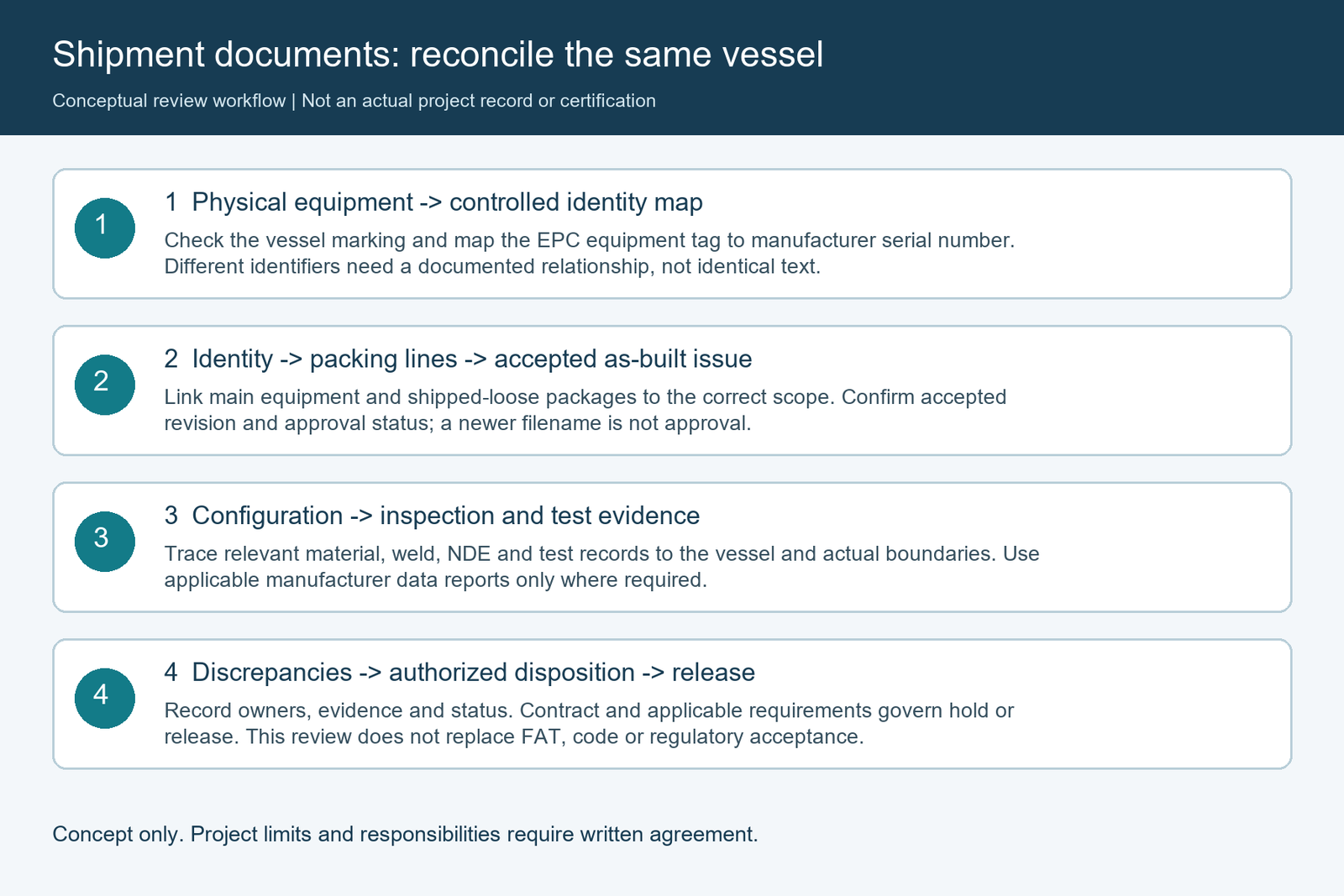
Start with a controlled identity crosswalk. Use the actual nameplate or other approved marking, the purchase order/equipment schedule, the packing list and the final document index. Review related records by a stable mapping rather than relying on a folder’s file names alone.
| Reconciliation point | Buyer question | Evidence to request | Typical unresolved discrepancy |
|---|---|---|---|
| Physical equipment identity | Which delivered vessel does this marking identify? | Legible actual marking/nameplate evidence and project equipment register | Project tag differs from manufacturer serial mapping |
| Packing-line connection | Which main item and packages belong to that vessel? | Final packing list, shipping-mark list, agreed scope schedule | Shipped-loose assembly cannot be assigned to a vessel |
| Drawing control | Which accepted revision reflects the delivered configuration? | Document register, as-built drawing, approved change records | Drawing revision is superseded or status is unclear |
| Manufacturer’s record | Which report/certification applies to this vessel? | Applicable data report or equivalent contract/jurisdiction records | Serial or drawing field does not match mapped item |
| Fabrication evidence | Which weld/NDE/repair records belong to it? | Weld map, test report index, relevant final records | Report references a different tag or outdated weld map |
| Final testing | Which equipment and pressure boundary were tested? | Final pressure-test record and boundary reference | Test result is not tied to the shipped vessel |
| Release and handover | Have the responsible parties addressed open matters? | Discrepancy register, approved dispositions and release status | Open item has no owner or accepted disposition |
Editorial reconciliation matrix. It is not an ASME form, a universal statutory checklist or evidence from an actual project.
What Should a Discrepancy Register Record?
When a mismatch appears, the project document controller and responsible technical team should record at least the affected vessel, conflicting identifiers/documents, specific revision or record entries, potential consequence, action owner, required evidence, disposition authority, target closure point and current status. A status such as open, under review, corrected and awaiting approval or accepted/closed must correspond to the project’s real document-control procedure.
A purely clerical correction can be managed differently from an unresolved material, fabrication or certification discrepancy, but the person writing the shipping checklist cannot unilaterally declare either acceptable. The contract and applicable requirements determine whether shipment must be held, whether a formally approved exception is possible and who can authorize release. A data-book reconciliation does not replace fabrication release, code inspections, FAT or regulatory acceptance.
A Practical Pre-Shipment Sequence
- Freeze the review basis: Confirm the purchase order, controlled tag/serial register, document index and accepted revisions.
- Walk the physical scope: Reconcile actual marking and package identities, including separately shipped items.
- Sample or fully review the links as specified: Connect as-built drawings, applicable manufacturer reports and quality records to the identified vessel and relevant test boundaries.
- Register mismatches: Assign an owner and obtain corrected records or a technically and contractually authorized disposition.
- Record the release decision: Preserve sign-off, open-item status and the version of the package released for shipment; update the site handover copy if a controlled later issue is permitted.
The review depth and release point should be agreed in advance. It is not necessary to invent an additional universal hold point for every project.
For a more detailed account of data-book organization, see the site’s pressure vessel manufacturing data book guide.
Documents by Equipment Type
Separators and Process Drums
For gas-liquid separators, knock-out drums, surge vessels and other process drums, buyers should pay special attention to drawings, pressure test reports, NDE reports, coating records and nozzle orientation. Any internal configuration should be treated only as part of the complete separator supply scope, not as a standalone product focus.
Related project scope: pressure vessels for oil and gas.
Heat Exchangers
For shell and tube heat exchangers, buyers should review tube material records, tube-to-tubesheet welding or expansion records where applicable, pressure test records for shell side and tube side, dimensional reports and final drawings.
Related equipment: shell and tube heat exchanger.
Large Storage Tanks
For large storage tanks above 1,000 liters, the document package should include material certificates, welding records, dimensional inspection, coating reports, test records and delivery documents. For LPG or pressurized gas storage tanks, additional project-specific requirements may apply.
Related equipment: LPG storage tanks.
Common Mistakes Before Shipment
Reviewing Documents After the Vessel Has Shipped
Once the vessel leaves the factory, correcting missing or inconsistent documents becomes more difficult. Buyers should complete document review before loading.
Checking Only the Pressure Test Certificate
The pressure test report is important, but it is not the whole data book. Material, welding, NDE, coating and dimensional records are also important for project acceptance.
Ignoring Shipping Dimensions
Large vessels can create transport problems if the final shipping dimensions differ from the logistics plan. Buyers should confirm size and weight before shipment.
Not Defining Language and Copy Requirements
Overseas projects may require English documents, signed PDF files, stamped hard copies or specific document formats. These requirements should be agreed in advance.
Check identity and accepted revisions, not file counts
Map the equipment tag and manufacturer serial number across the physical marking, package lines, accepted drawings and relevant inspection records. Register discrepancies and obtain authorized dispositions before the agreed release point.
Conclusion
Pressure vessel shipment documents help EPC buyers confirm that the equipment is ready for delivery, site receiving and project handover. A complete package should cover drawings, material traceability, welding, NDE, pressure testing, coating, dimensional inspection, packing, loading and final data book records.
For buyers sourcing custom pressure vessels, separators, heat exchangers, process towers or large storage tanks, document review should be part of the procurement process, not an afterthought.
If you are preparing to purchase or ship custom pressure vessels for petrochemical, chemical, oil and gas, new energy or environmental projects, you can share your drawings, specifications and delivery requirements with WSHI. Our engineering and manufacturing team can help discuss the required documentation, fabrication scope and export delivery boundary. Contact our engineering team to discuss your project requirements.
FAQ
What documents should be included before pressure vessel shipment?
Buyers should request approved drawings, material certificates, welding records, NDE reports, pressure test reports, dimensional inspection reports, coating records, packing list, loading records and the final data book.
Is a pressure test certificate enough for shipment acceptance?
No. A pressure test certificate is important, but EPC buyers should also review material traceability, welding records, NDE reports, coating records and final drawings.
When should buyers review the pressure vessel data book?
The data book should be reviewed before shipment. This helps identify missing or inconsistent documents before the vessel leaves the workshop.
Do overseas projects need special shipment documents?
Usually yes. Overseas projects may require packing lists, shipping marks, dimensions, weight records, loading photos, commercial documents and contract-specific handover documents.
Can WSHI support document preparation for EPC pressure vessel projects?
WSHI can support project-based pressure vessel manufacturing documentation according to agreed purchase order, inspection and project requirements, including drawings, material records, inspection reports, test records and delivery documents.
Equipment Identity and Revision Questions
Does having every shipment document prove it belongs to the delivered vessel?
No. Each document should be traceable to the correct equipment identity, approved configuration and applicable record or test boundary. Completeness and correct attribution are separate checks.
Should the manufacturer serial number and EPC equipment tag always be identical?
No. They can be different identification systems. The project should maintain a controlled mapping, and the relevant documentation should use the identifiers consistently or explain their relationship.
Can a draft drawing with a higher revision number replace an accepted as-built drawing?
Not merely because the revision is higher. Use the project’s document-control status and approved change process to identify the correct deliverable issue.
Does the shipment-document review replace FAT or legal certification?
No. It checks the links between physical items and records. Code inspections, contractual acceptance, authorized certification and fabrication-release decisions remain governed by their own requirements.
What documents are required for international shipping?
The commercial and transport documents depend on the shipment, contract, delivery terms and destination jurisdiction. They should be coordinated with, but not confused with, the vessel manufacturing and quality data book.