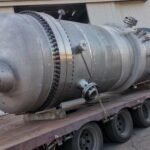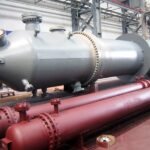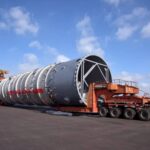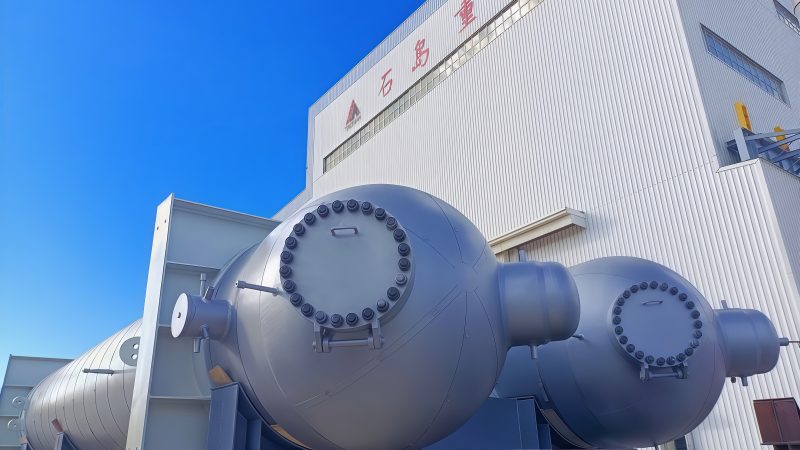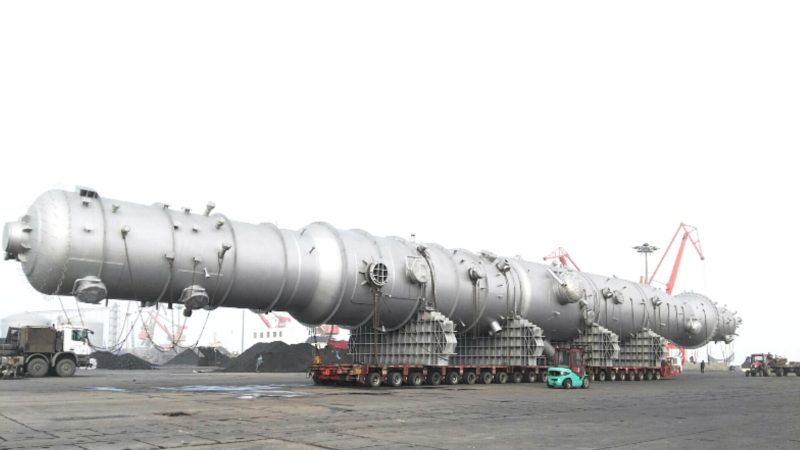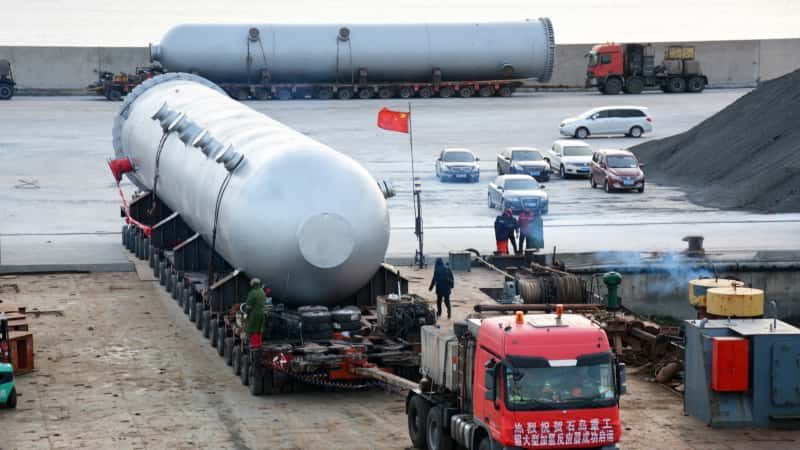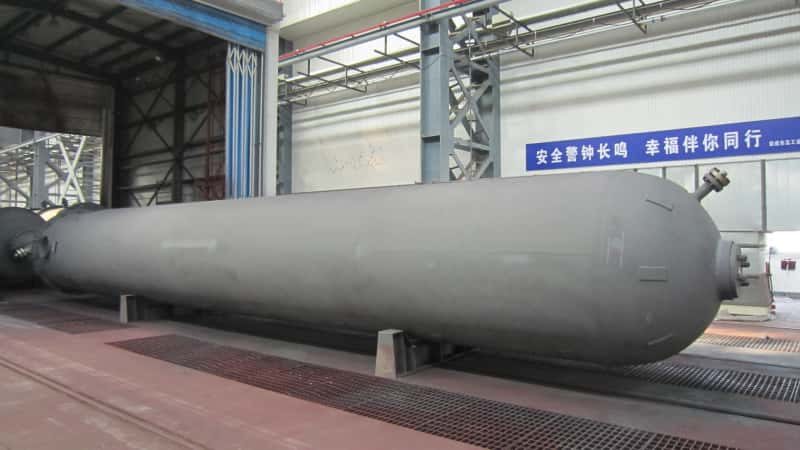

A tall vertical pressure vessel does not necessarily experience the same internal pressure at every elevation. When liquid is present, the pressure at a lower component can include a hydrostatic contribution from the liquid above it. That contribution depends on the liquid level, fluid density and vertical distance between the liquid surface and the component—not merely on the vessel’s nominal gas-space or design pressure.
For EPC buyers, the critical task is to define the pressure reference elevation and the credible combinations of liquid level, density, temperature and gas-space pressure before the manufacturer prepares the mechanical design. Otherwise, two quotations may use different assumptions about the local loads on lower shell courses, heads, nozzles and other pressure-retaining parts.
This article explains the static-head concept and turns it into a practical enquiry checklist for complete industrial vertical vessels, including process towers, separators, reactors and large liquid-containing pressure vessels. It does not prescribe a universal design-pressure increment or replace a project-specific calculation under the applicable construction code.
What Is Liquid Static Head, and Why Does Elevation Matter?
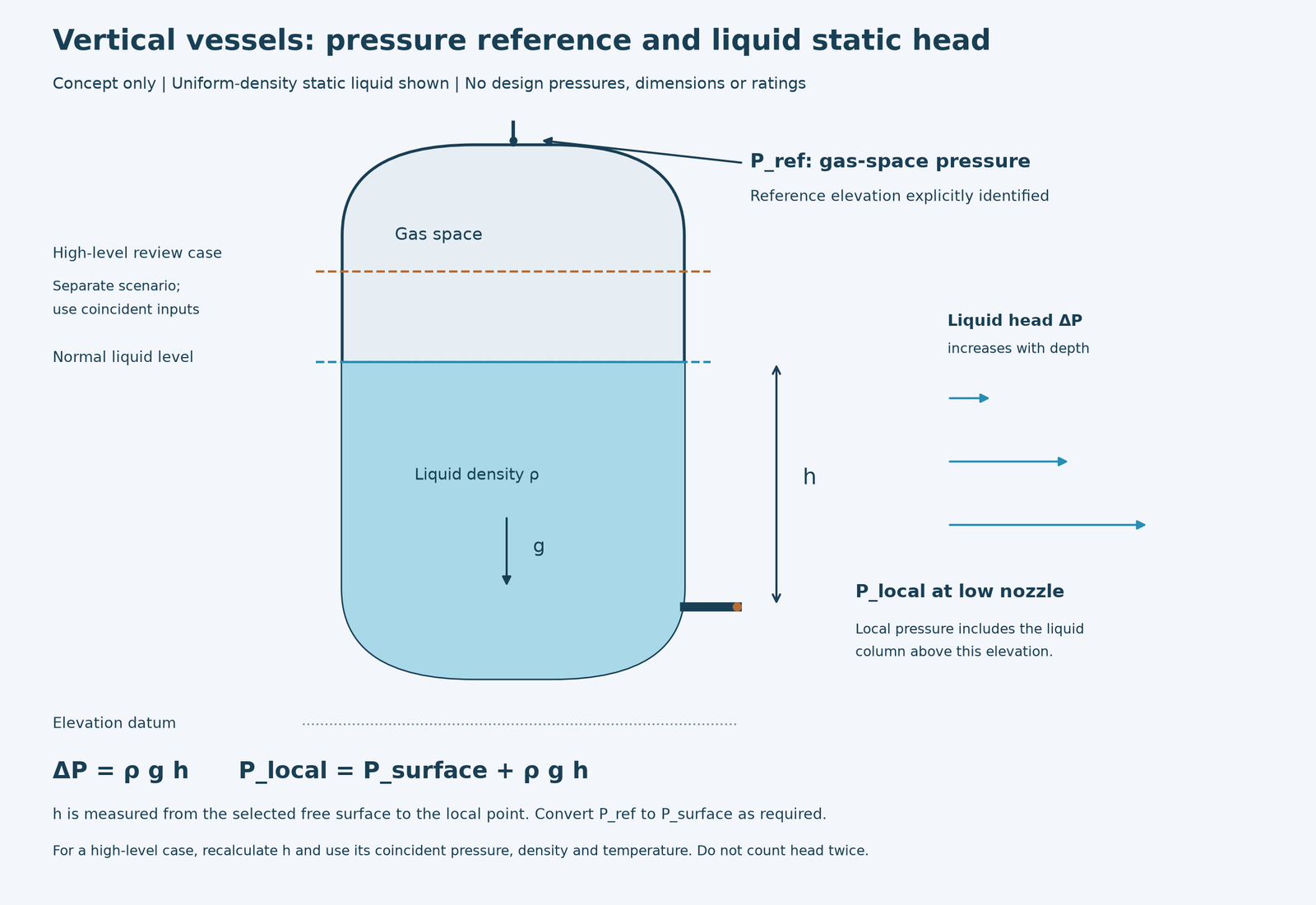
Liquid static head is the pressure contribution generated by the weight of a liquid column in a gravitational field. In a stationary, continuous liquid of approximately uniform density, the pressure difference between two elevations can be expressed as:
ΔP = ρ × g × h
where:
- ΔP is the hydrostatic pressure difference between two elevations, in pascals when SI units are used;
- ρ is the liquid density, in kg/m³;
- g is gravitational acceleration, in m/s²; and
- h is the vertical liquid height between those elevations, in metres.
The expression describes a pressure difference, not a complete pressure-vessel design rule. It assumes a static liquid column and an appropriate density representation. For significant density variation with elevation, the engineering calculation must account for that variation rather than assume one constant value.
Gas-Space Pressure and Local Liquid Pressure Are Different Quantities
Consider a vertical vessel containing gas above a liquid inventory. If the reference pressure is defined at the liquid surface, then—under the simplified uniform-density, static condition—the liquid pressure at a lower location is:
P(local) = P(at liquid surface) + ρ × g × h
The lower the location is beneath the liquid surface, the greater the hydrostatic contribution. A nozzle above the liquid level does not have that same liquid column above it, while the lower shell or bottom head may experience a materially different local pressure.
The expression must not be applied without checking where the quoted reference pressure is measured. A pressure value measured at a low-level instrument tapping, for example, may already include part of the liquid head. Adding that same contribution again would double-count it.
Similarly, if the stated gas pressure is measured at an upper nozzle rather than at the liquid surface, the appropriate pressure relationship must be established by the responsible engineer. A procurement datasheet should therefore identify both the pressure value and its reference elevation.
Density, Specific Gravity and Temperature Belong Together
Static head increases with liquid density for the same vertical height. But density is not always a fixed property:
- Composition or concentration may change between campaigns or batches.
- Temperature can change liquid density.
- The vessel may contain more than one liquid layer.
- A process mixture may have uncertain or changing liquid-phase properties.
- Different operating scenarios may involve different liquids or inventories.
A supplier should not assume that a single room-temperature density describes every relevant condition.
If specific gravity is supplied instead of density, the reference basis should be stated so that the corresponding density can be evaluated consistently. For mixtures, stratified liquids or significant density gradients, the process or mechanical engineering team should determine the applicable model and conservative cases.
The useful procurement question is not “How much static head should we always add?” It is “Which pressure, liquid-level and density conditions occur together, and where is each pressure defined?”
How Does Liquid Static Head Relate to Design Pressure and MAWP?
For a complete pressure vessel, the distinction between design pressure, local pressure and maximum allowable working pressure (MAWP) matters.
Design pressure is a specified mechanical design condition established for the equipment according to the project requirements. MAWP is the allowable pressure rating determined for the completed vessel under the applicable rules and specified coincident temperature. A local pressure is the pressure that a particular part of the vessel experiences at its elevation for a given condition.
These values should not be treated as interchangeable.
The site’s Design Pressure vs MAWP guide discusses the broader relationship among operating pressure, design pressure, MAWP, relief protection and test pressure. The present article addresses the more specific problem of converting liquid levels and pressure reference locations into usable procurement information.
A Top-Referenced Pressure May Not Represent Every Component’s Load
A specified vessel pressure may be referenced to the top or another defined elevation. If the vessel is filled with liquid below that point, lower components can experience the reference pressure plus the hydrostatic contribution associated with their location.
This can influence the mechanical evaluation of:
- Lower cylindrical shell courses and transition regions.
- Bottom heads and bottom-connected nozzles.
- Flanged joints and closures at low elevations.
- Local reinforcement and other pressure-boundary details.
- Pressure boundaries separating chambers with different fluid inventories.
Which part controls the completed vessel’s allowable pressure is a question for the applicable mechanical calculation; it cannot be determined from overall height alone.
Codeware’s public technical explanation of liquid-level calculations and UG-98 describes elevation-specific hydrostatic effects and separate levels and specific gravities for multiple pressure chambers. That is a software developer’s explanation of an engineering issue, not a substitute for the purchased construction code or the manufacturer’s certified calculations.
A publicly accessible U.S. regulatory text, 46 CFR §54.10-5, reproduces relevant ASME Section VIII UG-98 MAWP principles and expressly addresses differences in static head between vessel components and the top of the vessel. That regulation applies within its own U.S. maritime regulatory scope; it is cited here to illustrate the technical principle, not as a universal legal requirement for all export projects.
Avoid Counting the Same Head Twice
Static head can enter an RFQ in several ways. For instance, a datasheet may state:
- A gas-space pressure at a named top reference elevation;
- A bottom pressure already inclusive of the liquid column;
- A specified mechanical design pressure at the vessel top; or
- A local pressure envelope already calculated at several elevations.
If these definitions are not clear, one bidder might calculate the liquid head from the top pressure, another might treat the bottom figure as a new top pressure, and a third might add the liquid contribution twice.
The buyer should request a documented pressure-reference convention and an explicit statement of where hydrostatic head has already been included. The manufacturer should identify the basis used for component calculations and flag contradictions before design approval.
Design Cases Are Not the Same as Test Cases
A liquid-filled hydrostatic test can create an elevation-dependent pressure distribution, but it is a separate temporary test condition established under the applicable construction code and approved test procedure. Test-liquid density, fill elevation, test pressure reference point, vessel position and the applicable test rules may all matter.
Do not assume that a process-fluid static-head calculation automatically defines the hydrotest condition, or that the hydrotest pressure becomes the equipment’s allowable operating pressure. These distinctions should be reviewed independently in the design and inspection documentation.
Which Liquid Levels, Densities and Pressure Conditions Should Buyers Provide?
A useful RFQ includes coincident operating scenarios, rather than a list of unrelated maximum numbers.
For each scenario, the owner or EPC team should identify the pressure at a stated reference location, the actual or credible liquid level, the fluid composition and density basis, and the relevant temperature.
Define the Level Datum Before Stating a Liquid Height
Terms such as normal liquid level, high liquid level and full vessel can become ambiguous when they are not tied to an elevation datum.
The datasheet and arrangement drawing should indicate:
- The reference datum, such as a specified equipment elevation or project coordinate.
- The elevation of the pressure reference point or pressure tap.
- Normal, minimum and maximum relevant liquid levels, with their elevations.
- Whether a stated level refers to an operating target, control action, alarm, trip or mechanically evaluated condition.
- The elevation of the lowest relevant wetted component and other critical design locations.
- Any vessel section, chamber or operating configuration that has a separate inventory.
A level instrument indication alone may not establish the physical liquid elevation unless the instrument range, datum and measurement basis are understood.
Compare Credible Scenarios, Not Arbitrary Combinations
The following is an editorial example of an RFQ scenario register. It contains no assumed project pressures, densities, heights or safety limits.
| Scenario to evaluate | Pressure reference to state | Liquid inventory to define | Density and temperature basis | Key issue for engineering review |
|---|---|---|---|---|
| Normal steady operation | Normal gas-space pressure and reference elevation | Normal operating level | Normal fluid composition and coincident temperature | Baseline local-pressure profile |
| High-liquid-level operation | Pressure coincident with the identified high-level condition | Credible high level and duration, if relevant | Density under that same scenario | Increased hydrostatic load at lower elevations |
| Startup or shutdown | Relevant pressure history or bounding pressure condition | Possible filling, draining or temporarily retained liquid | Fluid properties at the relevant stages | Whether a temporary liquid inventory changes local loading |
| Changed fluid grade or concentration | Pressure for the applicable product or process case | Level applicable to that case | Highest relevant density supported by the process basis | Different head for the same level |
| Credible abnormal or upset condition | Approved process pressure condition and datum | Credible maximum or alternative liquid inventory | Coincident composition and temperature | Whether the condition governs an affected component |
| Separate chamber or section | Pressure and elevation reference for each chamber | Individual chamber levels | Chamber-specific fluid properties | Differential pressure and distinct hydrostatic profiles |
| Hydrostatic test | Test pressure and its specified reference point | Test fill condition and orientation | Actual test liquid and temperature | Separate temporary code-defined test loading |
All scenarios require project-specific screening. The table is not a statement that every vessel has every listed event or that all variables attain their maxima simultaneously.
Explain the Status of Each Input
For quotation comparison, mark important values as:
- Confirmed: Based on an approved process datasheet, drawing or other verified record.
- Preliminary: Proposed by the owner/EPC and awaiting technical confirmation.
- Supplier assumption: Used only for a conditional quotation and requiring explicit approval.
- Open/TBD: Not yet established; responsible party and resolution date to be identified.
A bidder’s unannounced assumption about maximum liquid level or fluid density can have a real effect on local pressure loads and the mechanical design. It should not be buried inside a general quotation note.
How Should Buyers Handle Density Variation, Multiple Chambers and Abnormal Conditions?
The simple relation ΔP = ρgh is useful for understanding a static liquid column. Real equipment may require additional engineering definition before that expression represents an adequate design basis.
Variable Density or Stratified Liquids
An industrial vessel may contain liquids of different composition or temperature, or liquid layers with different densities. In such situations, a single specific gravity may not correctly represent the pressure distribution.
For a continuous static liquid column with density varying along its height, the hydrostatic contribution is obtained from the density distribution over the relevant vertical range. The process team should establish credible properties, phase behavior and stratification assumptions; the mechanical designer should use an appropriate representation of those properties for the local design load.
Do not infer that every vessel needs a complicated variable-density model. The need depends on the actual service and the uncertainty of the liquid properties.
Multiple Chambers and Differential-Pressure Boundaries
Some vessels have separate compartments, chambers or connected volumes that may not share the same liquid level or pressure reference. A component separating two spaces can experience a pressure difference governed by conditions on both sides.
The RFQ should identify chamber-specific:
- Pressures and pressure reference elevations.
- Liquid levels and density bases.
- Operating and design temperatures.
- Credible simultaneous pressure combinations.
- Relevant external-pressure or vacuum conditions.
The applicable construction rules and manufacturer calculations determine how these loads are combined. An individual chamber’s static head should not be silently applied to the entire vessel.
Abnormal Levels Must Be Tied to a Process Basis
A normal level-controller setpoint is not necessarily the highest physically credible liquid level. Conversely, the vessel’s full geometric height is not automatically the governing liquid column for every design case.
The owner/EPC process and safety teams should identify credible scenarios, including relevant overfill, blocked-flow, isolation, shutdown or other inventory conditions where applicable. Required combinations with pressure and temperature should be reviewed, documented and approved under the project design philosophy.
It is not sound practice to combine a maximum pressure from one event, a maximum density from another and a maximum level from a third without documenting whether that combined case is intended and technically justified. Equally, credible coincident adverse conditions must not be excluded merely because they are uncommon.
Static Head Is Not the Only Liquid-Related Load
Liquid inventory can also affect equipment weight, supports, foundations and other loads. Dynamic fluid loads, movement, seismic conditions or other project effects may require separate evaluation.
A purchaser should not assume that specifying the pressure gradient alone completes the structural design input package. The responsible engineers must distinguish internal pressure loads from weight, support and other applicable loads.
What Should an EPC Include in a Vertical Vessel Static-Head RFQ?
The most useful deliverable is not a single static-head number. It is a package that allows all bidders to understand the same process scenarios and pressure reference conventions.
Procurement Input and Evidence Matrix
| RFQ item | Required definition or evidence | Primary information owner | Supplier clarification or deliverable |
|---|---|---|---|
| Vessel service and arrangement | Process function, orientation, general arrangement and compartments | Owner / EPC process and mechanical teams | Confirm equipment configuration and scope |
| Pressure-reference datum | Exact elevation and pressure location; gauge or absolute basis | Owner / EPC process team | State the datum used in calculations |
| Normal and design pressures | Applicable pressure conditions with coincident temperatures | Owner / EPC process team | Identify any conflicting values and confirm design basis |
| Liquid levels | Normal, low, high, and other design-relevant levels with physical elevations | Owner / EPC process team | Confirm how levels enter local-pressure calculations |
| Fluid and density basis | Composition, phase, density or specific gravity and corresponding temperature | Owner / EPC process team | State any density assumptions and their source |
| Operating scenarios | Normal, startup/shutdown, and credible abnormal cases as applicable | Owner / EPC process and safety teams | Confirm cases included and flag exclusions |
| Multiple chambers | Independent pressures, levels, fluids and credible combinations | Owner / EPC process team | Confirm chamber-specific treatment |
| Mechanical construction basis | Applicable code, division, edition, materials and other specified requirements | Owner / EPC mechanical team | State adopted code basis and deviations |
| Elevation-dependent evaluation | Local pressure conditions at relevant shell, head, nozzle and other locations | Manufacturer / qualified mechanical designer | Provide agreed calculation summary or supporting documentation |
| Hydrostatic test conditions | Applicable test requirements, test fluid, reference location and orientation | Mechanical specification and manufacturer procedure, subject to approval | Submit approved test procedure and records as applicable |
| Other liquid-related loads | Liquid weights, support/foundation interfaces and relevant site loading | EPC structural/mechanical teams and manufacturer as contractually assigned | Define interface data and design responsibilities |
| Review and approvals | Datasheet revision, open inputs, purchaser review and design sign-off | Owner / EPC / manufacturer by agreement | Maintain comment and deviation register |
Responsibility allocations are illustrative. The signed project contract and applicable requirements determine the actual obligations.
Five Clarifications to Resolve Before Technical Bid Comparison
1. Where is the quoted pressure defined? Request the actual reference elevation and whether the value is a gas-space pressure, local measured pressure or code design input.
2. Which liquid level is being used? Require a level tied to a physical elevation, not an undefined term such as “full” or “normal.”
3. Which density belongs to that case? Confirm fluid composition, units, temperature and whether specific gravity is being used consistently.
4. Has the hydrostatic contribution already been included? Obtain an explicit statement of the pressure convention used in each bidder’s design basis to avoid omission or double-counting.
5. What remains provisional? Ask suppliers to list assumptions, excluded scenarios, required purchaser approvals and any design implications before final quotation acceptance.
What Should Be Reviewed at the Design Handover?
At an appropriate design-review stage, the buyer should expect a consistent link among:
- The approved process datasheet and operating-case register.
- The vessel general arrangement and elevation references.
- Relevant process property calculations or data sources.
- The mechanical design report and identified pressure cases.
- The agreed inspection and test plan, where applicable.
- The technical deviations and outstanding approvals register.
A drawing that shows liquid levels but no pressure datum, or a calculation that assumes a density not found in the process specification, should trigger a clarification rather than an automatic acceptance.
For complete vessel procurement, the industrial pressure vessel product overview and process towers and columns range can serve as starting points for discussing equipment type and fabrication scope. These pages do not establish that the manufacturer has independently validated a particular process pressure profile or undertaken site-specific safety analysis.
How Can Buyers Compare Suppliers’ Static-Head Design Assumptions?
A technically comparable quotation should show which operating scenarios and elevation references each supplier used. This is particularly important when the project datasheet is preliminary or different bidders are proposing different vessel arrangements.
Use an Assumptions-and-Deviations Comparison
| Potential bid difference | Why it affects technical comparison | Clarification to request |
|---|---|---|
| Supplier A uses a top-referenced pressure; Supplier B uses a lower tapping | The same numerical pressure could represent different local conditions | Identify the pressure datum and show how it is converted to local component pressure |
| One bidder uses normal liquid level; another uses a higher inventory case | Lower shell and head pressure loads may differ | Identify each level’s elevation and approved design-case status |
| Bidders use different liquid densities | Static-head contributions may differ even at the same level | Provide source, composition, temperature and units for density or specific gravity |
| One bid includes hydrostatic head in a stated local pressure; another adds it separately | Risk of double-counting or omission | State whether quoted design inputs include hydrostatic head and at which location |
| Different assumptions about startup, shutdown or multiple chambers | Different cases and differential loads may be included | List cases evaluated, excluded cases and responsible approval party |
| Different temporary test conditions | Test loading or documentation scope may not match | State the code edition, pressure reference and separately approved test basis |
Illustrative comparison of quotation assumptions, not actual offers, calculations or vendor performance claims.
Require a pressure-basis declaration from every bidder
For each proposal, request confirmation of the following:
- The adopted code, division and contract edition, with the exact equipment scope.
- The pressure reference elevation and gauge/absolute basis.
- The operating and abnormal cases screened, including their level and property assumptions.
- Which specified pressures already include hydrostatic head—and which do not.
- Any excluded, provisional or supplier-generated loading assumptions.
- The mechanical evidence or design deliverable that will close remaining questions.
If a supplier has been given a bottom local pressure already incorporating the liquid column, the bid should not silently apply that entire value as a new top design pressure. Conversely, a top reference pressure should not be used unchanged for lower parts if the design basis requires the hydrostatic effect to be considered. The correct convention and component evaluation remain matters for qualified engineering review.
Resolve the Basis Before Treating Two Prices as Equivalent
A lower equipment quotation may simply reflect a different assumed liquid level, density, pressure reference or mechanical documentation scope. It cannot be judged technically equivalent until the discrepancies are understood.
For each bid, request a short statement confirming the agreed pressure-reference datum, all liquid-head scenarios included, the mechanical code and edition, unresolved inputs, and the documents to be submitted for design review. If an assumption remains preliminary, record its owner and the conditions under which the quotation could change.
An accepted supplier assumption should become part of the controlled design basis—not an undocumented interpretation of a pressure number on an RFQ sheet.
Who Should Approve Changes to the Static-Head Design Basis?
An otherwise sound quotation can become obsolete when the project revises the maximum liquid level, pressure datum, density, internal arrangement or permissible service. This is why the revision trail matters as much as the initial RFQ table.
Establish a case-by-case input approval register
For each controlling condition, record the case ID, source document and revision, whether the data are confirmed or preliminary, the responsible owner, the required approval and the closure status. A supplier’s assumption is not an owner-approved process basis merely because a quotation has been issued.
| Controlled item | Minimum approval evidence | Typical change that triggers review |
|---|---|---|
| Gas-space pressure and reference | Approved datasheet value, datum and case ID | A relocated tapping or revised pressure convention |
| Liquid level envelope | Elevation-based level schedule linked to case register | Higher permitted inventory or revised high-level trip philosophy |
| Density/property model | Fluid property source, composition and temperature range | New product grade, concentration or stratification assumption |
| Vessel configuration | Current general arrangement and chamber definition | Changed head geometry, compartment, nozzle or elevation |
| Code/design basis | Contract code edition and approved mechanical specification | Revised governing requirement or specified design condition |
| Supplier calculation scope | Marked technical bid and design-review record | Additional process case, changed local load or new exclusion |
A practical approval sequence has four decisions: (1) EPC process approval of the coincident scenarios and property data; (2) EPC mechanical confirmation of the drawing datums and applicable construction basis; (3) supplier acknowledgement of the adopted case register and technical deviations; and (4) documented resolution of design-impacting changes before final manufacturing release. These are recommended project controls, not a universal code-mandated approval process.
Changes should be checked for consequences to pressure-boundary design, commercial quotation, schedule and documents. An earlier calculation or quotation must not be treated as still valid unless the affected assumptions have been reviewed. Responsibility and signatures follow the executed contract and approved project procedures.
Frequently Asked Questions
How do you calculate static head pressure in a vertical vessel?
For a stationary liquid of approximately uniform density, the pressure difference over a vertical liquid height is ΔP = ρgh. To determine a local vessel pressure, the applicable pressure at a known reference elevation must also be established. A complete vessel design requires the relevant pressure cases and code-based engineering evaluation.
What does static head pressure mean in pressure vessel design?
It is the contribution to pressure arising from the weight of a liquid column. Lower components can experience greater local pressure than upper components when liquid is present above them.
Should liquid head always be added to the specified design pressure?
No. First determine the reference location and whether the specified pressure already incorporates the liquid head. Adding it again without checking the basis could double-count the same load. The responsible engineering team must establish the required design-pressure convention and local load cases.
Is the highest liquid level always the worst-case design condition?
Not automatically. The local pressure depends on the coincident pressure, level, density and other applicable loads. A high level may be important, but another credible pressure–temperature–inventory combination can control a particular component. The project design basis must establish the governing cases.
Can one specific gravity be used for all operating conditions?
Only if it adequately represents the relevant fluid conditions and uncertainty. Changes in composition, temperature or stratification may require separate density inputs or an appropriate density profile.
Is the hydrostatic test liquid head the same as operating liquid head?
Not necessarily. Hydrostatic testing is a temporary, code-governed condition that may use a different liquid, fill configuration, pressure reference and temperature. It should be evaluated separately from normal and abnormal process operating conditions.
Does the MAWP on a nameplate equal the pressure at the bottom of the vessel?
Not as a general rule. Under the ASME Section VIII concepts discussed here, vessel MAWP is a rating referenced to the top in the normal operating position at its specified temperature, while the pressure at a lower liquid-filled location can include additional static head. The actual rating and local limits must be confirmed from the vessel’s approved documentation.
Conclusion
Liquid static head is straightforward as a physical principle but easy to specify incorrectly in a vertical pressure vessel purchase enquiry.
A meaningful design basis needs more than a maximum pressure and a nominal liquid density. It needs an identified pressure-reference elevation, physical liquid-level elevations, density and temperature data for relevant scenarios, and a clear record of which pressure values already include hydrostatic head.
For EPC buyers, these inputs make technical quotations more comparable and allow the qualified mechanical designer to evaluate the pressure-retaining components at the elevations that matter. They also help separate normal operating conditions, credible abnormal inventories and temporary pressure-test cases.
Before requesting a complete vertical vessel quotation, provide a consistent process scenario register, general arrangement, pressure datum and fluid-property basis—and require each supplier to state its assumptions and open technical questions. The final mechanical design, MAWP, pressure testing and approval remain subject to the applicable code, project requirements and competent engineering review.
References
- Codeware. UG-98, MAWP and Liquid Static Head Calculations. Technical discussion of elevation-dependent liquid pressure, level and specific gravity input, and multiple vessel chambers. https://www.codeware.com/products/compress/liquid-level-calculations/
- American Society of Mechanical Engineers (ASME). Boiler and Pressure Vessel Code (BPVC). Official overview of published editions and code resources. https://www.asme.org/codes-standards/bpvc-standards
- United States Code of Federal Regulations. 46 CFR §54.10-5 — Maximum Allowable Working Pressure (reproduces UG-98). Public regulatory reproduction of ASME Section VIII MAWP principles. Its legal application is jurisdiction- and equipment-specific. https://www.law.cornell.edu/cfr/text/46/54.10-5