
Executive summary. When specifying an industrial liquid–liquid extraction column, buyers should define which liquid is intended to be continuous, which is dispersed, how each stream’s flow and composition can change, and what experimental evidence supports the proposed operating range. A feed-to-solvent ratio is not a measurement of dispersed-phase holdup, and neither ratio establishes a universal phase-inversion limit. The procurement question is not simply whether the column reaches its target separation at the design point. It is whether the process design and equipment offer remain valid across the agreed minimum, normal, maximum and composition-disturbance cases—and which party is responsible for proving that validity.
A liquid–liquid extraction column must achieve two functions together: transfer the target component between largely immiscible liquid phases and discharge those phases with acceptable separation and carryover. Its hydraulic behavior depends on the particular liquid system, contacting equipment and operating conditions. The same nominal solvent-to-feed ratio can produce different droplet behavior, phase retention and interface stability when composition, temperature or total loading changes.
This guide is written for process engineers, EPC teams and technical buyers evaluating a complete industrial extraction column, rather than purchasing standalone internals. It concentrates on the phase-continuity assumption, variable operating envelope and evidence needed before an equipment quotation is accepted. For the basic countercurrent sequence, see our step-by-step extraction column guide; the following sections focus on the additional decisions required in an RFQ.
1. Why the continuous-phase choice belongs in the procurement design basis
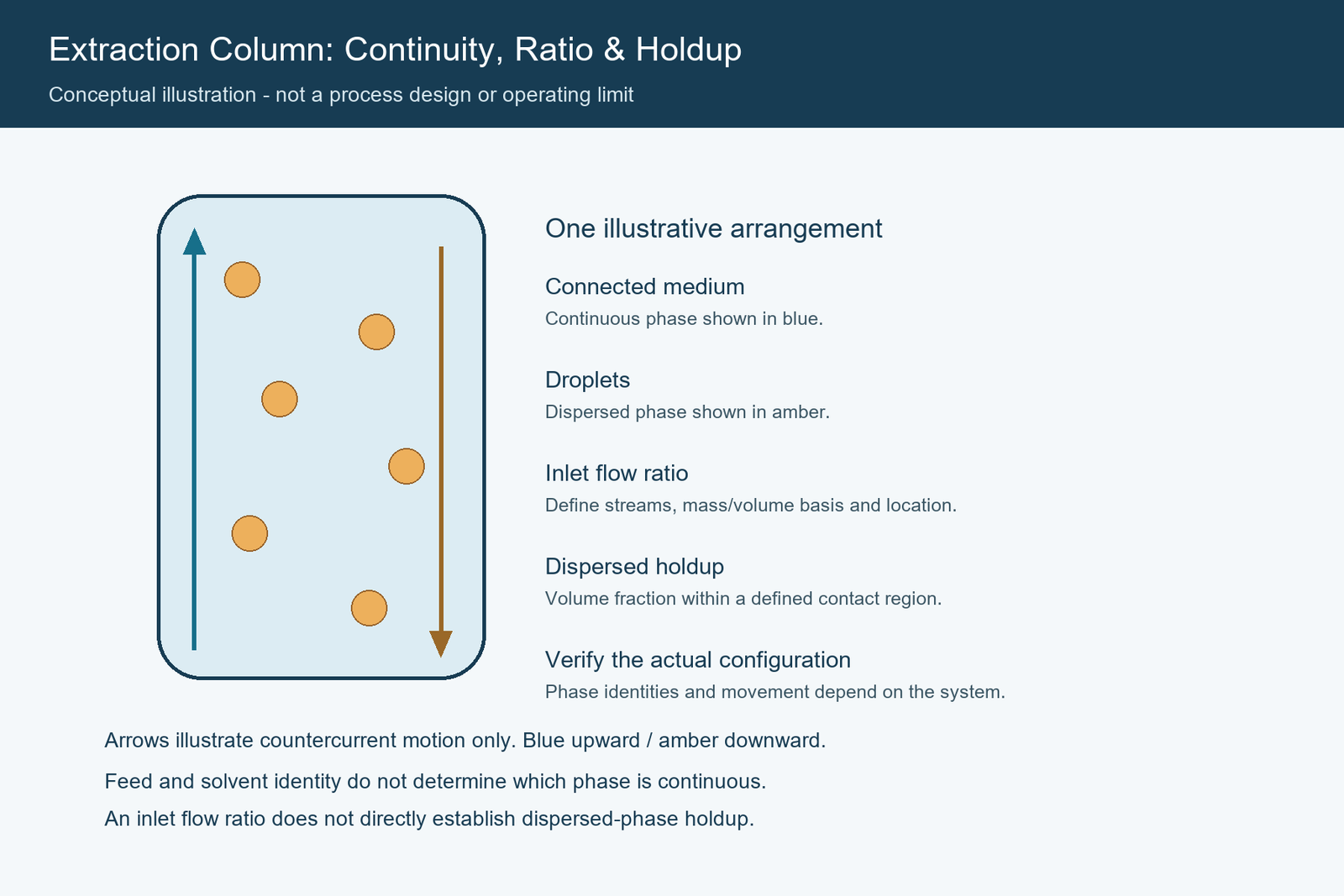
In a two-liquid contacting zone, the continuous phase forms the connected liquid medium through which droplets of the dispersed phase move. Both phases can exchange solute. Their identities are hydraulic descriptions; they are not synonyms for feed and solvent, extract and raffinate, or light and heavy liquid.
In gravity-driven countercurrent contact, density differences influence whether a droplet tends to rise or fall. They do not establish a universal rule that the lighter liquid must be dispersed. The intended phase continuity depends on the extractor configuration and the behavior of the actual chemical system, including wetting, dispersion, coalescence and how the liquid interfaces are controlled. Research comparing intentionally different phase configurations in a pulsed sieve-plate extraction column illustrates why the choice must be tied to the equipment and test conditions, not inferred from density alone [1].
For procurement, the first question is: Which phase is the process designer asking the proposed column to keep continuous at each specified operating case? An answer such as “organic dispersed, aqueous continuous” is useful only after the organic and aqueous compositions, operating temperature and relevant flow range have been identified. An aqueous stream at the column inlet may not have the same composition as the aqueous liquid leaving at the other end.
An explicit design-basis statement should identify:
- The stream names, phase identities and intended contact configuration at the reference operating point.
- Which liquid is intended to remain continuous, which is dispersed, and how the assumption was selected or verified.
- The liquid property data and any experiment, plant history or validated method that support that choice.
- Any alternative continuous-phase configuration actually evaluated, with a reason for adopting or rejecting it.
- The contractual boundary of any claim about steady operation, separation efficiency, carryover or turn-down.
A planned phase-continuity selection is not the same as an unintended phase inversion during operation. An engineer may deliberately design and validate one arrangement rather than another. A plant that unexpectedly switches from one arrangement to the other, however, may experience changes in droplet movement, holdup, coalescence and outlet phase separation. Purchasing documents should preserve that distinction.
Phase inversion, flooding and poor separation are related—but not identical
Phase inversion means a reversal in which liquid forms the connected medium and which forms droplets. In a column, it may be associated with accumulation, coalescence or changed flow conditions. Flooding describes a hydraulic capacity limitation in which the intended countercurrent movement and disengagement are no longer maintained. Depending on the system and extractor, inversion can accompany or precede a flooding-like condition, but the two labels should not automatically be treated as interchangeable.
Loss of product purity, cloudy outlets or an unstable interface is also not, by itself, proof that inversion occurred. The same observation may arise from changed equilibrium, entrainment, emulsification, inadequate contact or a measurement problem. A supplier report that simply states “no phase inversion observed” should explain the conditions, measurement method and other failure modes checked.
A peer-reviewed study of multistage extractors showed that dispersed-phase holdup profiles can provide information about operating proximity to flooding and phase inversion [2]. This supports monitoring the phase behavior rather than making an assumption solely from inlet flow ratio. It does not provide a transferable limit for a different liquid system or extractor.
2. Define phase ratio, feed-to-solvent ratio and holdup separately
Several quantities are easily confused because each describes “how much of one liquid” is present. The RFQ should define their basis, location and units rather than using an undefined phrase such as phase percentage.
| Quantity | Meaning in a procurement document | Information needed | What it does not establish |
|---|---|---|---|
| Feed-to-solvent flow ratio | Flow of the named feed stream divided by flow of the named solvent stream, on a declared mass or volumetric basis | Stream identities, measurement location, rate units, reference temperature and whether recycle is included | Which phase is continuous or what volume fraction is retained in the column |
| Dispersed-to-continuous flow ratio | Flow of the selected dispersed phase divided by the selected continuous phase, at a defined location and basis | Actual phase assignment, phase flow estimates and operating conditions | The dispersed-phase holdup or a universal inversion boundary |
| Total hydraulic loading | Combined phase throughput, often expressed using column cross-sectional area for equipment assessment | Each phase flow, fluid density, geometry and the selected basis | Validity of a single phase-ratio assumption across all loads |
| Dispersed-phase holdup | The fraction of the relevant active contacting volume occupied by dispersed liquid under a defined operating condition | Measurement or validated estimate, equipment geometry, steady-state method and location | Direct equality to the inlet dispersed-flow fraction |
| Phase-continuity state | Which phase forms the connected fluid medium in the specified region and case | Test observation, qualified measurement or established design evidence | A guarantee that the same continuity persists during every disturbance |
For example, an RFQ may specify that a feed flow is twice the solvent flow. That is a ratio of two inlet streams; it does not imply that two-thirds of the contacting volume is filled with the feed, that the feed is continuous, or that operation is close to an inversion threshold. Residence behavior, drop motion, coalescence, internal geometry and other process conditions determine the actual holdup. The example is illustrative only, not a design criterion.
Use symbols carefully when reporting a ratio. A statement such as F/S = 2 is ambiguous unless the document establishes whether F and S mean mass flow, volumetric flow or molar flow, whether the values are measured on the same time basis and whether each stream includes circulating material. If the intended design calculation uses volumetric phase flows, document the density and temperature basis for converting from the process mass balance.
Furthermore, feed and solvent are stream labels, not fixed phase identities everywhere inside the column. As solute transfers, both phases may change composition. The plant’s recycle streams can also alter the composition entering the column compared with a laboratory experiment using fresh liquids. The process engineer should reconcile inlet, outlet and relevant internal composition estimates before interpreting test results.
Why does this matter to a buyer? Two quotations may both show an acceptable solvent/feed ratio while one assumes an aqueous-continuous contact region and the other assumes organic-continuous operation. They are not demonstrably comparable until the basis and supporting tests are reconciled.
3. What changes when feed rate, solvent rate or composition moves away from design?
A useful operating envelope is a set of defined, simultaneously possible operating conditions, not a wide range of isolated values that never occur together. Each case should preserve the corresponding flows, compositions, temperatures and equipment settings.
Consider three types of change.
Changing the feed rate at a nominally fixed solvent flow. The phase-flow ratio and total hydraulic loading change together. The available mass-transfer driving force, phase retention and droplet traffic may change as well. An exchanger-like “percentage turn-down” cannot be transferred to an extraction column without considering how both liquid streams behave. The minimum feed case may be as important as the maximum case if suitable dispersion is lost or the control arrangement becomes unstable.
Changing the solvent flow at a fixed feed rate. This can alter both the equilibrium-related solvent requirement and the hydraulic environment in which droplets are formed and separated. More solvent does not always translate into proportionally better separation; the operating point may move toward an entrainment or capacity constraint. Less solvent may worsen extraction even if the phase arrangement appears hydraulically stable.
Changing composition while maintaining the same indicated flow ratio. Recycled solvent can contain more solute or impurities than fresh solvent. The feed may vary in dissolved salts, water content, trace surface-active material or other constituents. Density, viscosity, interfacial tension, equilibrium partitioning and coalescence characteristics may change. Thus two apparently identical flow-ratio cases may not be physically equivalent.
The temperature range matters for the same reason: it can change both phase equilibrium and hydrodynamics. A single property table measured at room temperature should not be presumed valid for the full operating range. Likewise, measurements on fresh binary liquids may not represent an actual multicomponent process mixture.
Build a coupled case matrix, not a list of independent maxima
| RFQ operating case | Process inputs to provide | Hydraulic or separation question | Evidence to request |
|---|---|---|---|
| Normal continuous operation | Both phase flows, actual feed/solvent compositions, temperature, product specification | Is the intended continuous phase stable at the selected design point? | Tested or otherwise substantiated phase behavior and separation results |
| Minimum feed / specified solvent condition | Coupled flow values and control settings | Does dispersion and separation remain acceptable at this actual turn-down case? | Low-load observation or justified model with stated limits |
| Maximum feed / specified solvent condition | Combined flows and composition | Is adequate hydraulic capacity retained without excessive holdup or carryover? | Loading or capacity evidence for the applicable system |
| Minimum and maximum permitted solvent ratio | Feed and solvent flows, clear ratio basis | Can the selected continuity and separation targets be maintained? | Tests or validated assessment at relevant range boundaries |
| Solvent-recycle composition excursion | Expected impurity/solute/water content and other property changes | Could property and interfacial-behavior changes invalidate the reference test? | Representative-property measurements and risk review |
| Feed-composition or temperature excursion | Maximum/minimum credible composition and temperature combinations | Does phase disengagement or target separation deteriorate? | System-specific comparison of physical properties and observations |
| Start-up, stop or transition | Agreed sequences as design cases, without operating instructions | Is a change in phase inventory or continuity credible during transitions? | Process-engineering review, control philosophy and validation plan |
Important: These rows are a template for proposing cases, not proof that every row is relevant to every project. The process owner and EPC must identify credible, simultaneous combinations. A vendor should not simply combine unrelated maximum values into a fabricated “worst case,” or silently omit unfavorable combinations to make the offered envelope appear wider.
The supplier should return a completed case table stating which cases were assessed, which are inside the supported range, which need tests and which remain outside the proposed guarantees.
4. Which fluid-property and equilibrium data support the selected phase continuity?
The buyer’s data package should start with the actual two-liquid system, rather than a generic water–organic designation. For the expected feed, extraction solvent, recycled solvent and relevant outlet compositions, request the property information needed by the responsible process engineer and test specialist.
| Data category | Project input or record | Procurement significance |
|---|---|---|
| Component composition | Component identities, concentrations, impurities and analysis basis for each relevant stream | Prevents fresh-solvent test data being substituted for actual recycled or contaminated service |
| Liquid–liquid equilibrium (LLE) | Tie-line or distribution information at relevant temperature/composition, where available | Establishes whether the proposed extraction duty is thermodynamically feasible and how compositions evolve |
| Density of each phase | Values across relevant temperature and composition conditions | Informs countercurrent motion, phase separation and applicable hydraulic analyses |
| Dynamic viscosity of each phase | Values on a stated measurement and temperature basis | Affects droplet motion, liquid flow and phase disengagement |
| Interfacial tension | Measured or justified values for representative phase pairs | Relevant to drop formation, breakage and coalescence; varies with contamination and chemistry |
| Phase-separation behavior | Laboratory observations, emulsions, settling/disengagement and any time dependence | Helps identify systems where simple hydraulic assumptions may be unreliable |
| Solids, surfactants and trace contaminants | Representative ranges and test provenance where applicable | May change interfacial behavior or create additional equipment concerns |
| Thermal and chemical stability | Known degradation, solvent condition and expected operating exposure | Indicates whether properties used for design remain valid over time |
A generic property value from a handbook may provide an initial screening estimate. It is not automatically an acceptable final design input for a multicomponent system with uncertain impurity levels. The process designer should identify critical missing data and decide whether measurement, existing validated experience or a justified model is adequate.
Sulzer’s public test-center information identifies LLE, density, viscosity and interfacial-tension measurement as part of its experimental approach, and reports investigating dispersion and disengagement for extraction applications [3]. This is an example of the information an industrial design team may need, not a claim that Taishan Group or WSHI offers Sulzer’s laboratory or pilot-plant services.
The test report should identify sample origin, sampling date or batch, representative composition, analysis method and the range over which values were obtained. A decision based on data from an unrepresentative substitute liquid should be marked as provisional.
5. How should phase-inversion risk and hydraulic capacity actually be verified?
There is no sound universal “critical solvent-to-feed ratio” that can be prescribed for every extraction column. Phase-continuity behavior depends on the liquid pair, operating composition, contacting device, wetting characteristics, agitation or pulsation, loading and other design details. Published experiments show that changing either the liquid system or the equipment conditions can change holdup and capacity behavior; a correlation derived for one extractor should not be elevated to an unconditional purchase guarantee.
One open-access investigation published in Chemie Ingenieur Technik presents a performance map for a studied extraction column, relating flow combinations and operating settings to holdup, flooding distance and separation-performance estimates [4]. The strength of this approach is its explicit, bounded operating domain—not the transfer of any illustrated flow-ratio values to unrelated equipment.
A separate experimental paper on a pulsed sieve-plate extraction column compares the two intentional phase configurations and measures hydraulic responses under specified test settings [1]. Such work demonstrates a useful engineering principle: the column, fluid system and setting must accompany the stated result. It does not validate an unseen project.
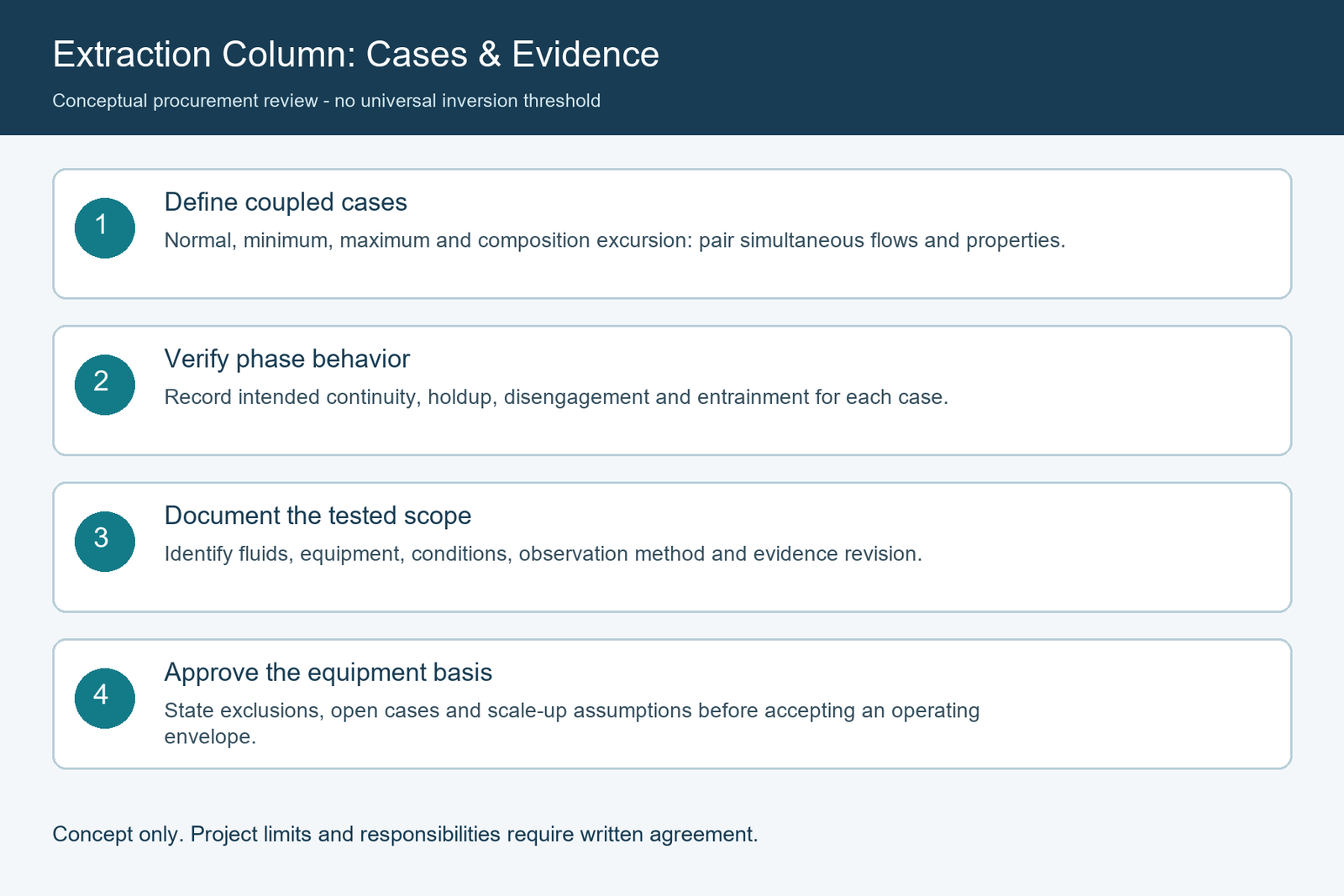
The minimum evidence trail
A defensible assessment should show how the proposed operating envelope was derived:
- Define the initial assumption. Record the selected continuous and dispersed phases, equipment type, internals or contact mechanism and the expected interface arrangement.
- Establish representative fluid data. Use the process composition and property ranges needed for the process and hydraulic evaluation, including credible impurities.
- Define the coupled test matrix. Specify relevant combinations of both phase flows, composition and temperature—not merely an isolated maximum loading or one ratio.
- Record phase behavior. Describe how phase continuity and dispersion were identified, whether the observation was direct or inferred, and where in the equipment it applied.
- Record hydraulic and separation indicators. Depending on configuration, these may include dispersed-phase holdup, liquid levels or interfaces, outlet entrainment, capacity trends and outlet compositions.
- Identify transitions and boundaries. Document whether suspected inversion, unstable behavior, flooding or loss of disengagement occurred; preserve the conditions and uncertainty rather than substituting a generic threshold.
- Check repeatability. Where the risk warrants, repeat material cases, particularly near an observed boundary or with representative solvent-recycle conditions.
- Explain scale-up. State how laboratory or pilot observations are used in the proposed full-size geometry, and which uncertainties remain open.
This is a procurement evidence framework, not a substitute for qualified experimental design. A buyer should not instruct plant personnel to provoke inversion, flooding or unstable operation to establish a limit. The testing program and any safe test procedure belong to competent engineering and laboratory teams.
What must an “inversion not observed” statement contain?
At minimum, the report should identify the actual liquid system and temperature, the phase configuration, the tested flow combinations, the apparatus and observation method. It should also state whether the claimed safe envelope extends beyond directly measured points and what supports that extension. A test that was stopped before instability occurred does not identify the exact point at which instability would begin.
Conversely, an observation of poor outlet clarity does not prove inversion. If carryover, emulsification or altered mass transfer occurred, the report must describe the diagnostic evidence before assigning a mechanism.
Published experiments with pulsed sieve-plate extractors also study how droplet characteristics respond to pulsation intensity, interfacial tension and the velocities of each liquid phase [6]. The resulting observations belong to the tested systems and do not define universal phase-inversion criteria.
Laboratory or pilot work can reduce uncertainty but does not remove all scale-up risk. Sulzer publicly describes pilot testing as normal practice for countercurrent liquid–liquid extraction and identifies phase ratio, loading and turn-down among relevant trial variables [5]. The broader lesson is to specify which evidence is needed for this project and who is contractually responsible for producing or reviewing it.
6. Convert the verified operating envelope into a comparable whole-column RFQ
Two offers are not directly comparable simply because their nominal diameter, throughput and quoted separation efficiency look similar. One bidder may have evaluated an extensive flow/composition range; another may have designed only for a nominal solvent ratio. The RFQ should make those differences visible without dictating unsupported equipment geometry.
A practical RFQ schedule should include the following fields for each relevant operating case:
| RFQ item | Required buyer/process information | Supplier response or clarification |
|---|---|---|
| Separation objective | Target component, feed and solvent identities, raffinate/extract specifications, analytical basis | Confirm whether whole-process separation performance is within contract scope |
| Coupled material balances | Normal, minimum, maximum and specified excursions with two-phase flows and compositions | Identify accepted balance, unanswered data and calculated assumptions |
| Phase configuration | Intended continuous/dispersed phase and relevant interface arrangement | Confirm adoption or deviation; provide design and evidence basis |
| Flow-ratio convention | Feed/solvent or dispersed/continuous ratio, with mass/volume basis and units | Use the same convention in calculations and guarantee schedule |
| Property and equilibrium package | Densities, viscosities, interfacial tension, LLE and sample provenance, as applicable | List substituted values, methods and validity range |
| Hydraulic operating envelope | Coupled loading, turn-down, temperature and composition cases | Show assessed, supported, excluded and test-pending cases |
| Phase-inversion and flooding assessment | Risk-review scope and available laboratory/pilot evidence | Explain methods, observations, residual uncertainty and basis for margins, if any |
| Disengagement and carryover | Product purity, permitted entrainment or interface constraints, when defined | State test/analysis basis and responsibility for outlet performance |
| Complete equipment scope | Column shell and mechanically integrated items, design interfaces and inspection scope | Clearly define equipment inclusions, exclusions and interface points |
| Test and acceptance evidence | Needed report format, agreed test conditions, process guarantee boundaries | Identify data owner, testing party, reviewer, acceptance criteria and exceptions |
A useful supplier answer is not “phase inversion is impossible.” It is a documented statement of the phase-continuity assumptions, supported cases, verification basis and exclusions. The buyer can then see whether both quotations cover the same operating envelope and whether any missing process information makes the comparison premature.
Separate mechanical delivery from process-performance responsibility
The project must distinguish responsibility for (a) solvent selection, LLE and process balances; (b) column hydraulic and mass-transfer assessment; (c) any bench or pilot tests; (d) mechanical design and fabrication of the complete equipment; and (e) final process acceptance. These scopes may be held by different parties or combined under an expressly agreed contract, but they cannot be assumed from the word manufacturer.
| Responsibility | Typically needs to be assigned by the project | Evidence to request |
|---|---|---|
| Owner / process licensor / EPC | Fluid compositions, production objectives, credible cases, process constraints and guarantees | Approved process basis, operating-case matrix and test requirements |
| Process designer / qualified test provider | Required equilibrium/hydraulic methods, validation data and scale-up justification | Property records, test reports, assumptions, limitations and approval |
| Complete column supplier | Mechanical equipment design and fabrication consistent with accepted process/mechanical inputs and contracted scope | Equipment datasheet, scope boundaries, drawings and deviations |
| Integrated process guarantor, if appointed | Agreed recovery, purity, entrainment and operating-envelope guarantees | Written guarantee schedule, measurement methods and acceptance conditions |
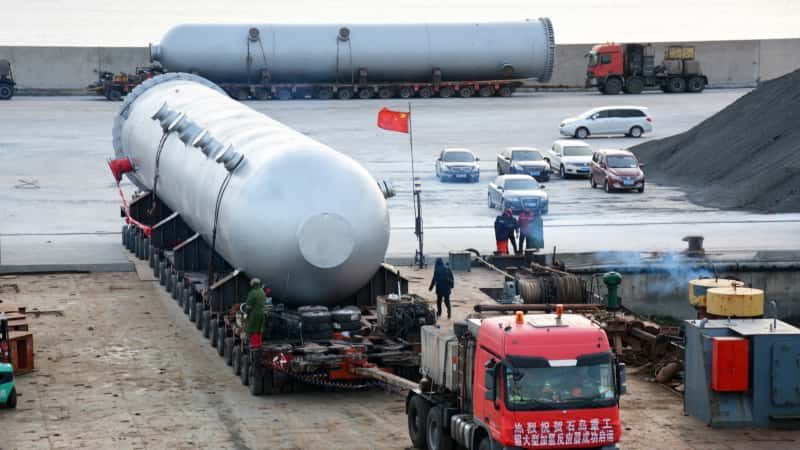
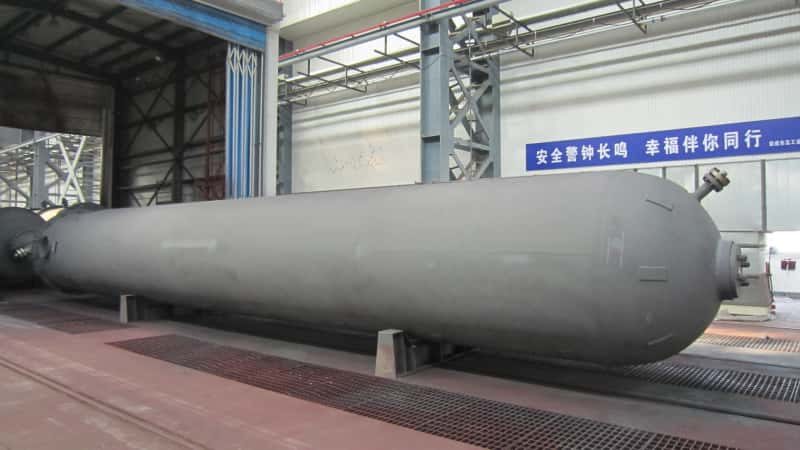
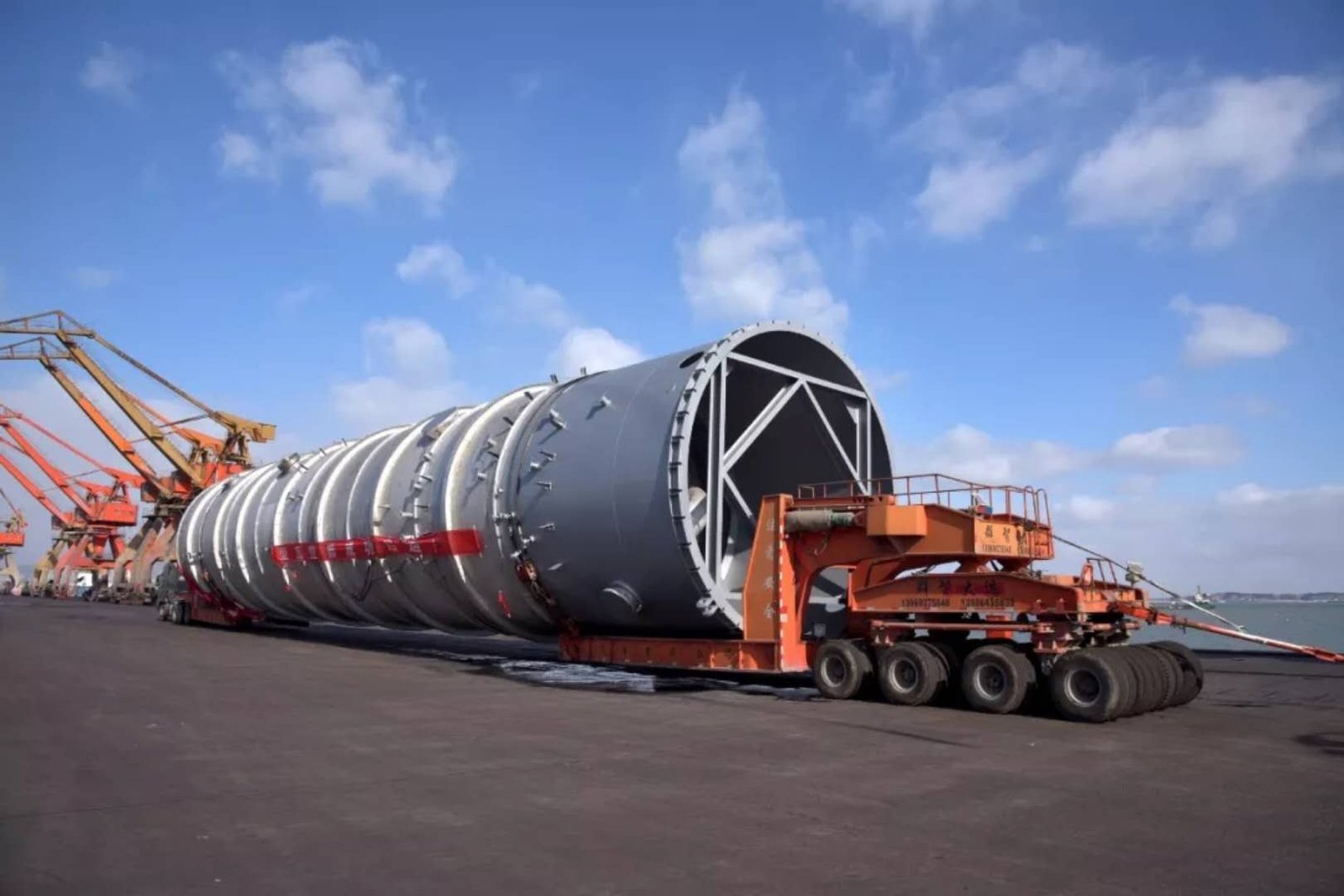
For the company equipment scope, Taishan Group’s WSHI site lists process towers and columns among its complete industrial products. That product listing is not evidence of a universal phase-inversion threshold, a dedicated extraction pilot-plant service, or a guarantee for every solvent system. Specific process-design responsibility and verification work must be confirmed for each quotation.
Questions to send back before accepting a bid
- Which liquid is continuous at normal load, and how was that determined for our actual liquid pair?
- What happens to this assumption at the agreed minimum and maximum feed and solvent rates?
- Are the quoted “phase ratios” mass-flow ratios, volume-flow ratios or measured holdup values?
- Which compositions—including recycle impurities—were included in the hydraulic assessment?
- How do density, viscosity, interfacial tension and LLE data change across the accepted operating range?
- What evidence supports the stated turn-down and loading limits, and what is outside the tested range?
- Were phase inversion, flooding, emulsification and excessive entrainment evaluated as distinct potential outcomes?
- Where are assumptions, data gaps and proposed further tests recorded?
- Who would arrange, pay for, own and approve any missing test data?
- Which performance claims apply to the complete column, and which apply only to the wider licensed process?
The final quotation should cross-reference the answers and flag outstanding items, rather than allowing broad marketing language to replace the design basis.
7. What buyers should conclude before scale-up or equipment award
It is possible to satisfy a nominal extraction target and still lack sufficient evidence for stable operation across a plant’s required production range. A single point may show adequate solute transfer while missing changes in droplet behavior, phase disengagement or hydraulic capacity at other credible flow and composition combinations.
Prior to equipment award, ask the responsible technical parties to classify each case into supported, conditional on further assessment, or outside the quoted scope. This avoids turning untested conditions into implied guarantees. Where pilot work is necessary, confirm what is actually measured and how the results inform full-scale design; do not treat one favorable laboratory observation as a universal scale-up rule.
The final procurement decision is made on the combination of process feasibility, evidence quality, equipment suitability, test/guarantee responsibility and documented exceptions. That is a stronger basis than choosing an extractor solely by nominal capacity, a preferred set of internals or a supposedly universal phase-inversion ratio.
Frequently Asked Questions
Is the lighter liquid always the dispersed phase?
No. Density affects buoyancy and the preferred direction of droplet movement, but phase continuity is determined by the specific liquid system, extractor arrangement and verified hydraulic behavior. The lighter or heavier liquid can be selected as dispersed in an appropriately evaluated design.
Is the feed-to-solvent flow ratio the same as dispersed-phase holdup?
No. A flow ratio compares the rates of identified inlet streams. Holdup is the fraction of the relevant contacting volume occupied by the dispersed phase under an operating condition. Both may be dimensionless, but they are different physical quantities with different reference bases and cannot be equated without a system-specific model and data.
Does a change in solvent-to-feed ratio always cause phase inversion?
No. A ratio change can alter extraction driving force, loading, droplet behavior and phase retention; it does not automatically reverse phase continuity. Whether a risk arises depends on the actual liquids, composition, geometry and operating conditions. No universal critical ratio should be assumed.
Is phase inversion the same as flooding?
Not necessarily. Phase inversion reverses which liquid is continuous. Flooding describes a hydraulic limitation of intended countercurrent transport or phase disengagement. They can occur together in some systems, but their mechanisms and observed evidence should be reported distinctly.
Can a pilot study prove every full-scale operating case?
Not without an adequate, justified scale-up basis. Pilot studies can provide evidence for specified liquids, flow cases and equipment settings; the full-scale design still needs a documented assessment of geometry, hydrodynamics, uncertainty and untested conditions.
Must an extraction column supplier also guarantee solvent recovery and product purity?
Only if those guarantees and the associated process responsibility are expressly agreed. An equipment manufacturer may supply the complete mechanical column while the licensor, EPC or another process provider retains responsibility for solvent selection, extraction process design and overall performance.
What should a buyer do when physical-property or LLE data are missing?
Flag the missing inputs in the RFQ, identify who must obtain or validate them and treat the affected operating cases as provisional. It is not sound to fill missing values with unexplained handbook estimates and then present the result as a firm equipment or phase-inversion guarantee.
Can cloudy raffinate or extract alone confirm phase inversion?
No. Poor disengagement, entrainment, an emulsion or changed process composition may explain cloudy outlet streams. A phase-inversion claim requires evidence of an actual change in phase continuity, not merely an off-spec outlet appearance.
Conclusion: Specify the operating envelope, not a generic inversion threshold
For an industrial extraction column, phase continuity, flow ratios and phase holdup are different pieces of design information. Buyers should identify their precise definitions, provide representative two-liquid properties, describe simultaneously credible operating cases and request a traceable basis for the proposed phase-inversion and hydraulic-capacity assessment. A reliable quotation explains the supported operating envelope, the scale-up limitations and exactly which party stands behind each performance claim.
If you are evaluating a complete extraction tower or column, send the project team the two-phase composition and property data, material balances, minimum/normal/maximum flow combinations, separation targets and any available pilot reports. These inputs allow the process engineer and equipment supplier to clarify suitability and supply scope before a technical offer is finalized.
References
- Comparison of normal phase operation and phase reversal studies in a pulsed sieve plate extraction column. Chemical Engineering Research and Design (2013). Research abstract; configuration-specific findings. https://www.sciencedirect.com/science/article/abs/pii/S0263876212004303
- Tsouris, C., and Tavlarides, L. L. Control of dispersed-phase volume fraction in multistage extraction columns. Chemical Engineering Science 46 (1991), 2857–2865. ORNL publication record and abstract. https://impact.ornl.gov/en/publications/control-of-dispersed-phase-volume-fraction-in-multistage-extracti/
- Sulzer. Test center services. Public description of extraction testing, liquid–liquid equilibrium and physical-property measurements; third-party service information. https://www.sulzer.com/en/shared/services/test-center-services
- Weber, B., Meyer, C., and Jupke, A. Performance Map for the Design of Liquid-Liquid Extraction Columns. Chemie Ingenieur Technik (2019). Open-access, specific studied column. https://onlinelibrary.wiley.com/doi/full/10.1002/cite.201900057
- Sulzer. Pilot plant testing: Liquid–liquid extraction. Public manufacturer description of test objectives, phase ratio, loading and turn-down. https://www.sulzer.com/en/shared/services/pilot-plant-testing
- Ardestani, F., et al. Mean drop behavior in the standard liquid–liquid extraction systems on an L-shaped pulsed sieve-plate column: experiment and modeling. RSC Advances 12 (2022), 4120–4134. Experimental paper; results apply to the studied configurations and systems. https://pubs.rsc.org/en/content/articlehtml/2022/ra/d1ra08723a