
A purchase order is not necessarily an instruction to cut plate, form a head, or start welding. For a large custom pressure vessel, the fabrication release should identify exactly which manufacturing activities are authorized, which engineering documents control them, and which outstanding issues could still change the vessel.
This pressure vessel fabrication release checklist is intended for EPC engineering, procurement, and quality teams working after purchase-order placement. Its purpose is to prevent a seemingly routine approval from becoming an uncontrolled commitment to materials, pressure-boundary geometry, welding, or inspection. The checklist is an editorial project-control tool—not a universal code-mandated form. Release authority, document-status terminology, and required approvals must follow the contract and the applicable construction code.
1. What Does “Released for Fabrication” Actually Authorize?
Fabrication release is an authorization for a defined scope of work against an identified technical baseline. It should not be inferred from an issued purchase order, a returned drawing, or a verbal indication that the design is nearly complete.
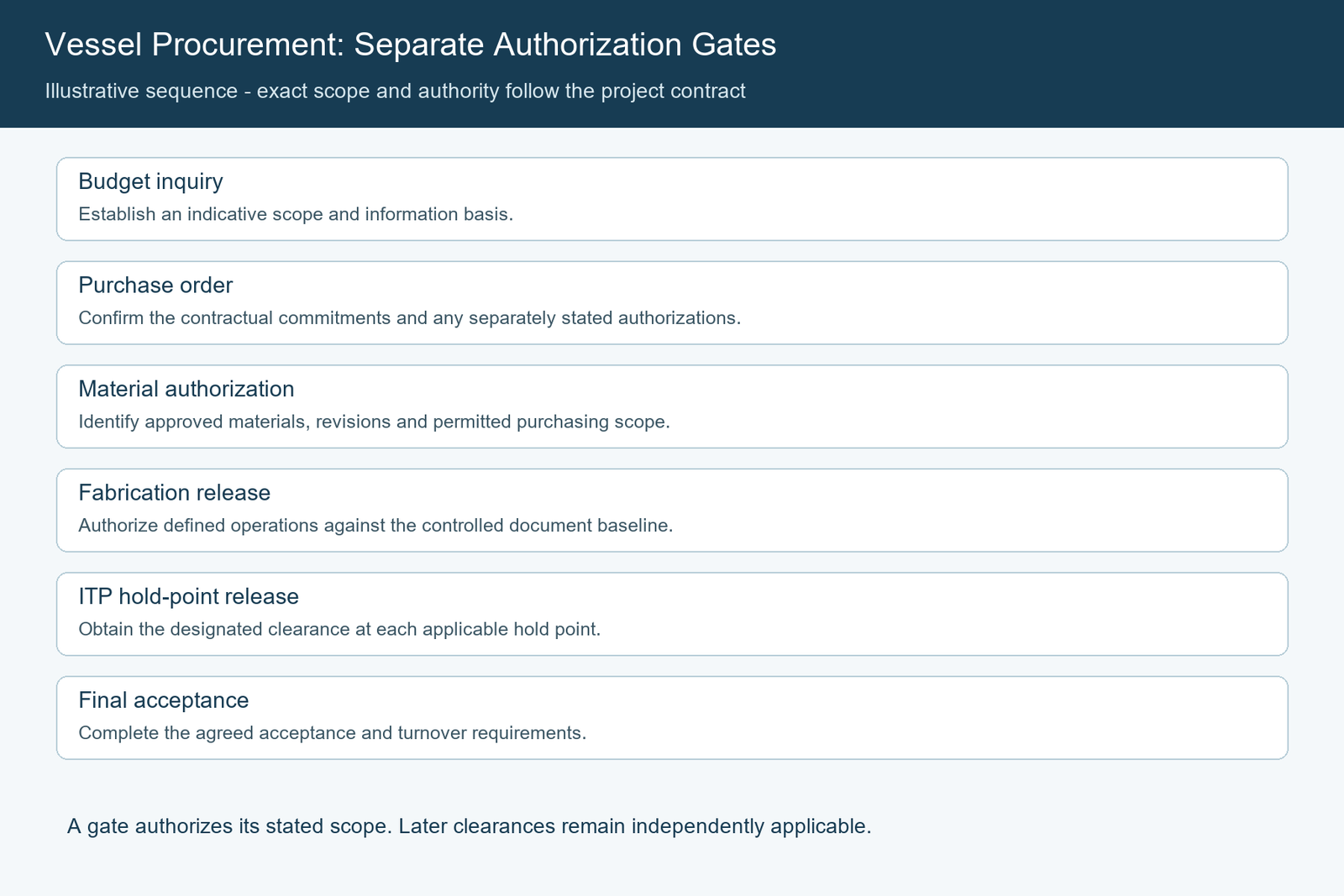
Different commitments need different decisions:
| Project decision | What the decision permits | What it does not automatically permit |
|---|---|---|
| Budget inquiry or technical clarification | Supplier review, preliminary pricing, and engineering discussion | Material ordering or fabrication |
| Purchase-order placement | The commercial scope and obligations specified in the order | Unrestricted manufacture, unless the contract expressly says so |
| Material procurement authorization | Purchase of identified material grades, forms, quantities, and specifications within the stated scope | Cutting, forming, or welding before the relevant release |
| Fabrication release | The defined shop operations against approved documents and stated conditions | Work outside that scope or progression through later inspection hold points |
| Subsequent inspection or test release | Progression past a particular witness/hold point when its requirements are satisfied | Final equipment acceptance or permission to ship |
A project can authorize long-lead material before every nozzle detail is final, provided the released material is demonstrably unaffected by open design questions and the contract allows this staged approach. Conversely, approval to purchase a shell plate must not be treated as approval to roll and weld it.
For the earlier commercial and engineering decisions, see the separate guide to refinery equipment procurement before design freeze. This article deals with the later, document-controlled release gate.
2. Do the Approved Drawings and Datasheet Define One Consistent Baseline?
Before issuing a fabrication release, the EPC team should reconcile the equipment tag, purchase-order requirements, drawing revisions, calculation basis, and applicable specifications. A document may have been reviewed by several parties without having reached the status required for the next operation.
Check the technical design inputs, not just the drawing stamp
For the operations being released, confirm the relevant approved versions of:
- Mechanical/process datasheet: design and operating conditions, service and fluid information, corrosion allowance, applicable vacuum or external-pressure cases, minimum design metal temperature where applicable, and agreed special requirements.
- General arrangement and fabrication drawings: pressure-boundary dimensions, head details, thicknesses, nozzle schedule and orientation, manways, supports, lifting and transport features, and interfaces affecting fit-up.
- Design calculations or design report: the approved engineering basis for applicable pressure, temperature, external loads, local reinforcements, and other relevant load cases.
- Project specifications and deviation register: agreed technical additions, approved deviations, and contract changes affecting the equipment.
- Controlled drawing register: document number, revision, status, date, responsible approver, and any restrictions on use.
The release baseline should not mix, for example, a revised datasheet with an older fabrication drawing that still specifies the superseded nozzle location. Where a calculation or detail is not yet required for an authorized limited operation, that exclusion needs explicit engineering justification and a documented work boundary.
“Reviewed” is not the same as “approved for manufacture”
Labels such as For Review, Approved with Comments, Approved for Construction, and Released for Fabrication are commonly encountered, but their precise meanings depend on the project’s document-control procedure. A drawing marked “reviewed” may indicate that comments were returned rather than that the buyer has authorized manufacture. The release record should therefore state the required status and the person or organization entitled to grant it, instead of relying on an ambiguous stamp.
3. Are Code, Welding, and Inspection Requirements Ready for the Released Work?
For custom pressure vessels, the construction basis affects more than the final nameplate. It can determine material acceptability, fabrication and examination rules, testing, inspection responsibilities, and the evidence needed to demonstrate compliance.
Before the relevant work starts, confirm the contractually applicable code and edition, jurisdictional requirements, owner specifications, and any special service provisions. ASME BPVC Section VIII, Division 1 is one possible construction basis; its scope includes design, fabrication, inspection, testing, and certification, but the ASME public overview is not a substitute for the purchased code text or project engineering review.
The fabrication release review should identify:
- Welding readiness: applicable welding procedure specifications (WPS), supporting procedure qualification records (PQR), and welder/welding-operator qualification arrangements for the work about to begin. Where ASME rules apply, the relevant Section IX requirements and construction-code provisions must be reviewed together.
- Heat-treatment requirements: whether post-weld heat treatment or other thermal processing applies, who has approved the basis, and whether it changes the proposed manufacturing sequence.
- Examination and testing basis: relevant NDE methods, extent and acceptance criteria, pressure-test requirements, inspection procedures, and any project-specific additions.
- Inspection and test plan (ITP): the activities, governing documents, responsible parties, notification periods, required records, and defined review, witness, and hold points.
- Inspection authority: whether the applicable construction code, jurisdiction, and contract require an Authorized Inspector, third-party inspector, or buyer representative at particular stages.
A hold point restricts progression until the prescribed release or waiver is obtained; a witness point typically concerns notice and opportunity to observe an activity. Their exact definitions, notification requirements, and waiver mechanisms are controlled by the project ITP and contract. EPC drawing approval does not by itself waive an inspector’s required hold point.
An actual purchaser specification from Mercer Peace River illustrates one contractual approach: it requires review and acceptance of the design basis, construction drawings, engineering calculations, welding procedures, and ITP before pressure-vessel fabrication. That example supports the value of a documented release gate; it is not an ASME-wide approval checklist or a requirement imposed on every project.
4. Has Material Procurement Been Authorized on a Traceable Basis?
Material release is a distinct decision from fabrication release. Before ordering long-lead plate, forgings, heads, or other pressure-boundary material, confirm the approved specification, grade, product form, relevant condition, required examinations, and permitted substitution rules. Procurement should use the same material identifiers and revisions as the design and drawing register.
A practical material-release review asks:
- Is the material designation unambiguous for each affected pressure-boundary item?
- Are critical size, thickness, corrosion allowance, and heat-treatment assumptions sufficiently established for the purchase being authorized?
- Are material certificate, identification, and traceability expectations defined in the purchase specification and manufacturer quality plan?
- Is there an agreed process for handling nonconforming material or a proposed grade substitution?
- Does the release identify what may be purchased but not yet cut, formed, or welded?
Material test reports and actual heat-number records are usually generated or obtained as the material is produced and received; buyers should not describe unavailable future records as already approved. What must be ready at material authorization is the specification and the traceability/verification plan. Before material is consumed in fabrication, the manufacturer must verify the delivered material under its approved controls and applicable requirements.
5. Which Open Items Block Release—and Which Can Be Controlled?
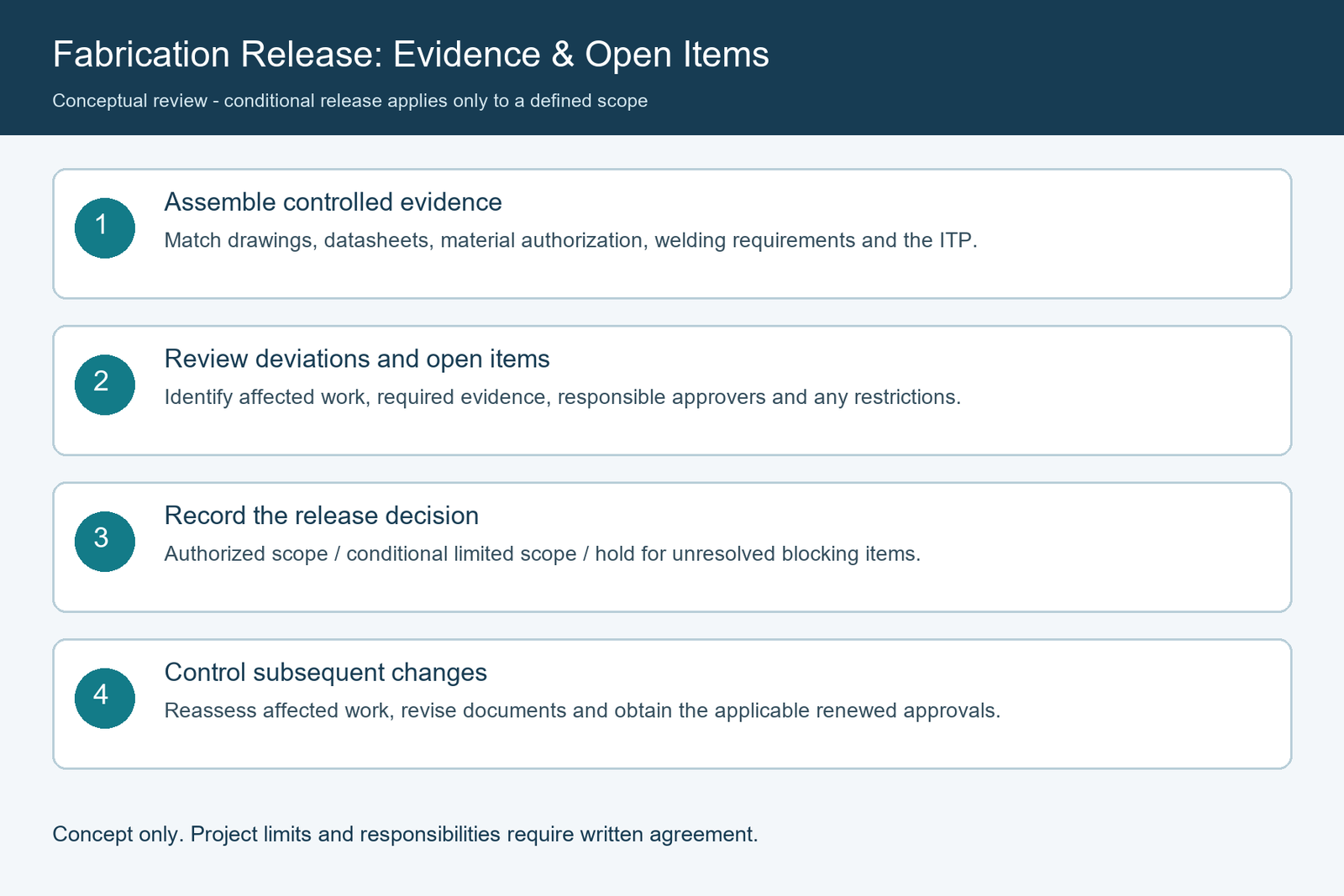
A zero-item punch list is not always necessary for every limited authorization. The real question is whether an unresolved item could invalidate the released work or the basis on which it is being performed.
Use an open-item register with a documented engineering disposition:
| Open-item category | Example | Appropriate release response |
|---|---|---|
| A — Release blocker | Unapproved pressure-boundary material grade; unresolved design pressure; changed nozzle reinforcement requirement affecting shell cutting | Hold affected work until engineering approval and controlled document revision |
| B — Conditional, scope-limited | A lifting detail remains under review but is demonstrably unrelated to authorized material purchase | Permit only the expressly bounded activity if the responsible authority approves the condition |
| C — Administrative / non-impacting | A document index formatting correction with no effect on the released technical content | Record the correction and due date without misrepresenting its significance |
These categories are proposed project-management labels, not standard ASME classifications. An item belongs in Category B or C only after someone with the designated authority has assessed its technical and contractual impact. A condition cannot override a mandatory code requirement, unresolved safety issue, or statutory inspection obligation.
For every open issue, record the equipment tag, document and revision, description, affected work, owner, due date, disposition, approval reference, and closeout evidence. “To be confirmed later” is not an engineering disposition when later confirmation could require scrapping material or reworking a pressure boundary.
6. What Should the Fabrication Release Record Actually Contain?
An auditable release notice is more useful than an email stating “please proceed.” At minimum, it should make the authorization testable by the project team and the shop.
| Release-record field | What to capture |
|---|---|
| Equipment identity | Project, purchase-order reference, vessel tag, and manufacturer |
| Authorized work | Specific operations, material lots, or drawing areas released; explicit exclusions |
| Technical baseline | Datasheet, drawings, calculations, specifications and their exact revisions/status |
| Inspection controls | ITP revision, applicable hold/witness points and required notifications |
| Open conditions | Issue IDs, approved dispositions, affected work boundaries and due dates |
| Authority | Named approving function/person, approval date and the contractual basis for authorization |
| Communication | Controlled distribution to procurement, document control, quality and shop planning |
| Revision control | Release number and how a later revision supersedes or changes the earlier authority |
The approval matrix should distinguish design responsibility, buyer acceptance, manufacturer quality control, and independent inspection where applicable. These roles can overlap in communication but should not be conflated in authority. A purchaser’s acceptance of a drawing does not transfer the manufacturer’s responsibility to build in accordance with the applicable code.
Suggested release statement (illustrative, not a company form): “Fabrication release FR-___ authorizes only the operations listed in Scope A against drawing register revision . Operations affected by open items OI- remain on hold. ITP hold points remain effective.”
7. How Should Changes Be Managed After Fabrication Release?
A release establishes a controlled starting point, not a guarantee that the design will never change. Once material has been ordered or fabrication has started, the cost of a revision depends on which work has become irreversible.
When a new requirement arrives, the EPC team and manufacturer should record:
- What changed: the technical requirement, affected tag and drawing/data-sheet revisions.
- What has already happened: material purchased, plate cut, forming performed, welds completed or examinations recorded.
- Engineering disposition: whether existing material/work remains acceptable, needs rework or requires replacement, with qualified review where necessary.
- Quality and inspection impact: revised WPS/ITP scope, additional examinations, altered hold points or document updates, if applicable.
- Commercial and schedule impact: cost, manufacturing sequence and delivery consequences, approved under the contract’s change process.
- Shop communication: withdrawal of obsolete instructions and issue of a traceable revised release before affected work continues.
For example, if a nozzle orientation changes after a shell opening has been cut, revising only the general arrangement drawing is insufficient. The affected work needs an engineering disposition that addresses the existing opening, local reinforcement, fabrication feasibility and required inspection; this is a hypothetical illustration, not a WSHI project claim.
8. Pressure Vessel Fabrication Release Checklist for EPC Teams
The table below summarizes the post-PO release gate, rather than repeating the earlier RFQ input list. Mark each line Approved, Conditional, Open / Hold, or Not Applicable, with a linked evidence reference. A “conditional” result is not permission to proceed unless the release authority has accepted the bounded scope.
| Release-gate question | Evidence to reference | Decision owner (project-specific) |
|---|---|---|
| Is the authorized operation explicitly stated? | Release notice and permitted-work scope | Contract-designated release authority |
| Are drawings, datasheet and calculations mutually consistent? | Controlled revision register, design review disposition | EPC/design authority |
| Is the construction code and contract edition fixed? | Purchase specification and approved technical basis | Engineering and purchaser |
| Are materials and substitutions controlled? | Material list, specifications and procurement approval | Engineering, procurement and manufacturer QA |
| Are interfaces affecting released work settled? | GA/nozzle/support drawing approvals, interface register | Mechanical/process/interface leads |
| Are welding/heat-treatment provisions ready for the affected work? | Approved welding and process documents, qualification evidence | Manufacturer welding/quality functions and applicable reviewers |
| Are inspection and hold points defined? | Approved ITP, notification and inspection-responsibility matrix | Manufacturer QA, buyer/inspector as required |
| Have deviations and technical queries been dispositioned? | Deviation register, TQ responses, change approvals | Authorized engineering/purchaser roles |
| Are any open conditions bounded and traceable? | Open-item register, exclusion list, sign-off | Release authority |
| Has the shop received the correct revision? | Controlled transmittal and superseded-document withdrawal | Manufacturer document control/production |
If a required approval is missing, do not assume that silence or an overdue review constitutes acceptance. Apply the contract’s explicit approval and escalation procedure. For a separate discussion of the information needed before an order is placed, refer to the pressure vessel RFQ documents guide.
Frequently Asked Questions
Does “reviewed” mean approved for manufacture?
Not necessarily. Document statuses are defined by the project. A reviewed drawing may still carry comments or be suitable only for coordination. Fabrication should follow the contractually defined release status and a clear authorization for the affected work.
Can a purchase order authorize material procurement but not fabrication?
Yes, when the contract or subsequent release notice explicitly distinguishes those activities. The material specification and authorization must be sufficiently mature for the purchase, while cutting, forming and welding can remain on hold pending further approvals.
Must every open item be closed before a vessel is released?
Not every administrative issue necessarily blocks all work. However, unresolved items affecting code compliance, material suitability, pressure-boundary geometry, safety, or the operation being authorized must be resolved or handled under a formally approved limited release that does not bypass mandatory requirements.
Is an approved drawing enough to bypass an ITP hold point?
No. Drawing approval and inspection-point release serve different purposes. Any required notification, inspection, approval or written waiver must follow the applicable ITP, contract, code and jurisdictional requirements.
Who is responsible if an approved drawing changes after fabrication starts?
The contract and project responsibility matrix determine who approves the revision, while the qualified engineering team evaluates technical impact and the manufacturer controls work in the shop. The change record should address existing material and completed work, inspection implications, cost, schedule and revised release instructions.
Conclusion: Release the Right Work Against the Right Evidence
A defensible fabrication release connects a clearly defined operation to a controlled design baseline, required approvals, inspection obligations, and a visible record of unresolved issues. It is not simply the next date in a procurement schedule.
For a complete custom vessel, EPC teams can provide the approved datasheet, controlled drawings, technical deviation log, applicable project specifications, ITP requirements, and intended release scope to the manufacturer for clarification. WSHI’s pressure vessel product range provides the relevant equipment context; specific release responsibilities and technical acceptance remain subject to the actual contract and engineering review.
References
- ASME — BPVC Section VIII, Division 1: Rules for Construction of Pressure Vessels. Official public scope description; the full applicable code edition must be consulted for mandatory requirements.
- ASME — Section IX Welding, Brazing and Fusing Qualifications (course overview). Public description of procedure and personnel qualification scope; not a substitute for the code.
- Mercer Peace River — Pressure Equipment Standard Purchasing Clauses, Exhibit 26, Revision 2 (2019), §8.1. Example of a purchaser’s project-specific pre-fabrication acceptance requirements; not a universal regulatory standard.