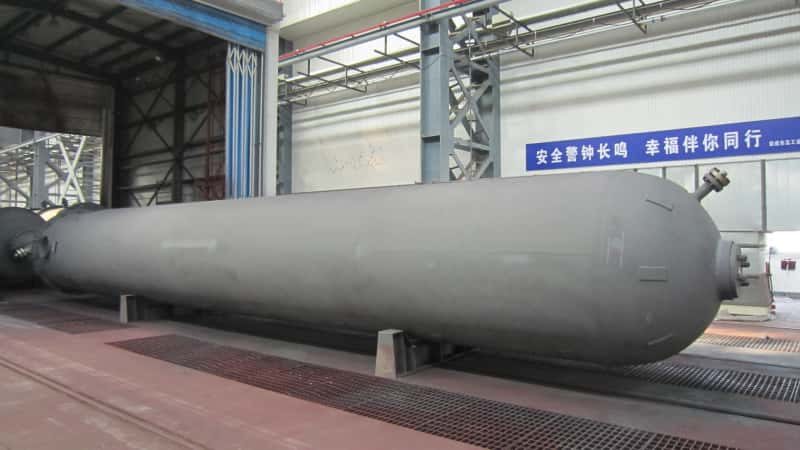

A pressure vessel material substitution is not approved simply because a supplier describes another grade as “equivalent.” Once a vessel’s material specification has been approved, changing the specification, grade, product form, or delivery condition can affect its design basis, service suitability, welding procedures, inspection requirements, and contractual documentation. EPC and owner teams need a traceable change review, not just a grade cross-reference.
Executive summary: Before accepting a proposed substitute for a large custom pressure vessel, buyers should (1) identify the exact approved material and all supplementary requirements; (2) obtain a documented, item-by-item comparison of the proposed material; (3) have the responsible disciplines check code permission, design properties, damage mechanisms, toughness, fabrication and quality implications; and (4) record the approval decision and revise controlled documents before affected procurement or fabrication is released. A mill test report supports material identification and compliance claims; it does not, by itself, authorize a design or contractual change.
The approach below applies to new-build pressure vessels and process equipment ordered to a defined project specification. It is an engineering procurement review framework, not an independent material approval, an in-service alteration procedure, or a substitute for the applicable construction code.
1. Why an “Equivalent Grade” Is Not Automatically an Approved Substitute
An EPC team may receive a message such as: “The specified plate is unavailable within the requested delivery window; we can offer an equivalent material.” The proposal may be commercially reasonable, but the word equivalent does not identify which characteristics have been compared.
At least three questions must remain separate:
- Commercial similarity: Do the two grades have similar market names, nominal composition, or commonly cited cross-references?
- Technical suitability: Does the proposed material meet the actual vessel’s design, process, manufacturing, inspection, and service conditions?
- Code and project acceptance: Is that exact material specification, product form, condition, and use permitted by the adopted construction code and edition, and has the change been accepted under the project’s contractual approval process?
A grade cross-reference can help locate candidates for review. It is not proof that all three questions have been answered. Even comparable room-temperature tensile properties do not establish identical elevated-temperature design values, low-temperature toughness, corrosion behavior, welding qualification coverage, or inspection requirements.
This article starts after the original material choice has been approved. For the earlier selection stage, see Pressure Vessel Material Selection: Why Pressure Rating Alone Is Not Enough.
2. Reconstruct the Approved Material Baseline First
A supplier cannot demonstrate a justified deviation against an incomplete baseline. Before reviewing a proposed replacement, retrieve the latest approved vessel data sheet, drawings, material requisition, project material specification, and relevant technical clarifications.
| Approved-baseline item | What the buyer should be able to identify |
|---|---|
| Item and function | Vessel tag, component affected (shell, head, nozzle, reinforcement, or other pressure-retaining part), and the extent of substitution |
| Complete material designation | Issuing standard/specification, edition if contractually specified, grade, class/type and any applicable supplementary requirements |
| Product form | Plate, forging, pipe, tube, fitting or another specified form—not merely an alloy family |
| Dimensional range | Nominal and ordered thicknesses, sizes, tolerances, and any form-specific limits applicable to the item |
| Supply condition | Required heat treatment or delivery condition, and any restrictions on subsequent fabrication heat treatment |
| Design and service basis | Governing construction code and edition, design temperature range, pressure/load cases, minimum design metal temperature where applicable, fluid service and corrosion allowance/requirements |
| Additional project requirements | Impact testing, supplementary chemistry or testing, NDE, traceability, welding limitations, owner specifications and documentation |
| Approval baseline | Controlled document numbers, revisions, dates and any already-approved concessions |
The buyer does not need to redo the vessel’s engineering calculations. The buyer does need to provide the responsible engineer with an unambiguous original requirement. If the baseline is itself unresolved, record that gap rather than treating the supplier’s offer as a clean substitution.
3. What a Complete Material Substitution Request Should Contain
Ask the manufacturer to submit a formal material deviation request or project-defined technical change request referencing the vessel tag, component and approved baseline revision.
A reviewable submission normally includes:
- Reason for the proposal: availability, scheduling or other stated commercial cause, with the proposed delivery effect identified as an estimate or supplier commitment only when supported.
- Full substitute designation: material standard, grade/class/type, product form, dimensions, supply/heat-treatment condition and proposed supplementary tests—never only a trade name.
- A line-by-line comparison: original versus proposed requirements, indicating same, different, or not established; include actual supporting specification references.
- Material evidence: available producer data, specification scope, sample certificates or actual heat/batch-specific records when material has been procured. Clearly distinguish representative data from records for the proposed production lot.
- Impact assessment: affected vessel components, design calculations, corrosion/materials review, toughness, welding/filler materials, forming/PWHT, NDE and inspection/test plans.
- Document and schedule consequences: drawings, data sheets, bills of materials, material take-offs, procurement documents, inspection records and any proposed change to cost or delivery.
- A defined approval request: decision required, approvers under the project procedure, outstanding questions and a proposed hold point before affected work is released.
If the supplier cannot specify the actual replacement product and condition, the correct response may be request more information, not approval or rejection of an unidentified grade.
4. Five Technical Reviews That Must Stay Distinct
4.1 Confirm code permission and design-property implications
The design authority should check the specific adopted code, edition and applicable material rules against the proposed specification, product form, size and temperature range. For ASME construction, the Boiler and Pressure Vessel Code addresses construction rules and material properties across related sections; it is not sufficient to confirm that a designation resembles an ASTM or EN grade. ASME’s own BPVC publications distinguish Section II material specifications/properties, Section VIII vessel construction and Section IX welding qualification.
The engineering review may need to examine allowable design stresses at relevant temperatures, physical properties used in design, component thickness, external-pressure or other load cases, joints and any project-specific calculation assumptions. Some substitutions have no calculated consequence; others may require revised calculations. Only the responsible qualified design function can determine which applies.
Do not assume the most recently published code edition governs an existing order: confirm the contractually adopted edition, jurisdictional requirements and any agreed amendments or code cases.
4.2 Recheck process-fluid compatibility and damage mechanisms
Nominal alloy labels do not resolve suitability for an actual service environment. Obtain input from the responsible process/corrosion or materials specialist on the fluid composition, contaminants, operating and upset temperatures, cleaning chemicals, corrosion allowance and plausible damage mechanisms.
A replacement can be attractive on one dimension yet introduce uncertainty elsewhere—for example, corrosion resistance in a specific environment or susceptibility under the specified thermal or process conditions. Do not infer a universal alloy ranking from a generic table. For broader background rather than a substitution decision, see Corrosion in Chemical Pressure Vessels: Material Specification Considerations.
4.3 Verify minimum-temperature and toughness requirements
Check the lowest relevant metal-temperature condition, required impact-test provisions, material thickness, supply condition and the governing code’s exemptions or test requirements as applicable to the project. Grade names and room-temperature strength do not establish adequate toughness at the required low-temperature condition.
If evidence is incomplete, record the item as unresolved pending the responsible engineer’s review. Avoid assigning a blanket minimum-temperature rating to a family of grades.
4.4 Reassess welding qualifications and consumables
Changing the base material may affect WPS/PQR coverage, welding consumable selection, preheat, postweld heat treatment or production-weld testing. Welding groupings or ASME P-Numbers are tools used within defined qualification rules; they do not certify materials as interchangeable for vessel design or corrosion service. TWI’s technical discussion of base-metal grouping systems explains the grouping purpose and limits, while its welding procedure guidance addresses the importance of essential variables and qualification records.
Have the manufacturer’s welding coordinator and project welding/quality authority review the exact proposed form and condition, relevant qualified procedure ranges, dissimilar-material joints if any, and the actual production route. A material grouping match is not a substitute for that review.
4.5 Evaluate fabrication, examination and traceability effects
Material changes can alter the feasibility or qualification of forming, cutting, machining, heat treatment, repair procedures and inspection. The revised quality plan should identify whether material examinations, production tests, inspection points or acceptance records change under the adopted code and purchase specification.
For traceability, verify that the delivered material identity, heat or lot references, certificates, purchase order, physical markings and fabrication records reconcile. A mill test report or inspection certificate is evidence about material supplied, not permission to change an approved engineering baseline. Any additional test requirement must be established by the adopted specification and project agreement rather than invented as a universal rule.
5. Do Not Conflate ASME Material Rules With the EU PED Pathway
The project’s destination and conformity route matter. An ASME-stamped vessel proposal and a vessel subject to the EU Pressure Equipment Directive (PED) cannot be evaluated by one universal “equivalency certificate.”
For an ASME-based project, the responsible team must examine the contractually adopted BPVC requirements, allowed material specifications, design values and applicable fabrication/qualification rules. A change may also need owner acceptance under the purchase contract.
For a project within the scope of EU Directive 2014/68/EU, the material conformity pathway must be assessed against the PED and the applicable conformity assessment route. The European Commission identifies routes and supporting material guidance, including European approvals for materials (EAMs) and particular material appraisals (PMAs). The Commission also states that its PED guidelines support interpretation but are not legally binding. See the European Commission’s PED portal and the Directive itself.
Neither an ASTM-to-EN cross-reference nor an ASME material designation, by itself, proves that every PED essential safety requirement and conformity obligation is satisfied. Conversely, a PED material assessment does not automatically establish eligibility under an unrelated construction code. The applicable route must be confirmed by the project manufacturer and responsible conformity/engineering parties.
6. Use a Difference-and-Decision Register Instead of a Grade Cross-Reference Alone
The following is an illustrative buyer-side review register, not a mandatory code form and not an approval of any material. Actual results depend on the vessel, contract and evidence reviewed.
| Review field | Approved baseline | Proposed change / evidence needed | Impact owner and decision record | Status |
|---|---|---|---|---|
| Specification and product form | Approved plate specification, grade and edition | Proposed plate specification and scope; full material designations and specification comparisons | Materials + code/design engineer | Pending |
| Thickness and condition | Approved thickness range and heat-treatment state | Supplier’s ordered dimensions, condition and applicable limits | Mechanical + fabrication | Pending |
| Design values | Approved design basis and calculations | Applicable allowable stresses/properties at design temperatures; calculation impact | Design authority | Pending |
| Service environment | Approved fluid, operating cases and materials basis | Corrosion and damage-mechanism assessment | Process/materials | Pending |
| Minimum temperature | Approved MDMT/toughness requirements | Relevant impact qualification or permitted exemption review | Mechanical/materials | Pending |
| Welding | Approved WPS/PQR and consumables | Qualification coverage, filler selection and heat-treatment effects | Welding/quality | Pending |
| Inspection and records | Approved ITP and material certification requirements | Revised examinations/tests, marking, heat traceability, certificate requirements | QA/QC | Pending |
| Commercial effect | Approved scope, price basis and delivery | Clarified impacts and quotation deviations | Procurement/contracts | Pending |
| Controlled release | Baseline documents at approved revision | Written disposition, approvers, new revisions and closure of hold points | Project document control | Not released |
Replace every placeholder with project data. A field marked not applicable should include a reason and the responsible reviewer; it should not be left blank to imply acceptance.
7. Who Approves the Change, and When Can Fabrication Continue?
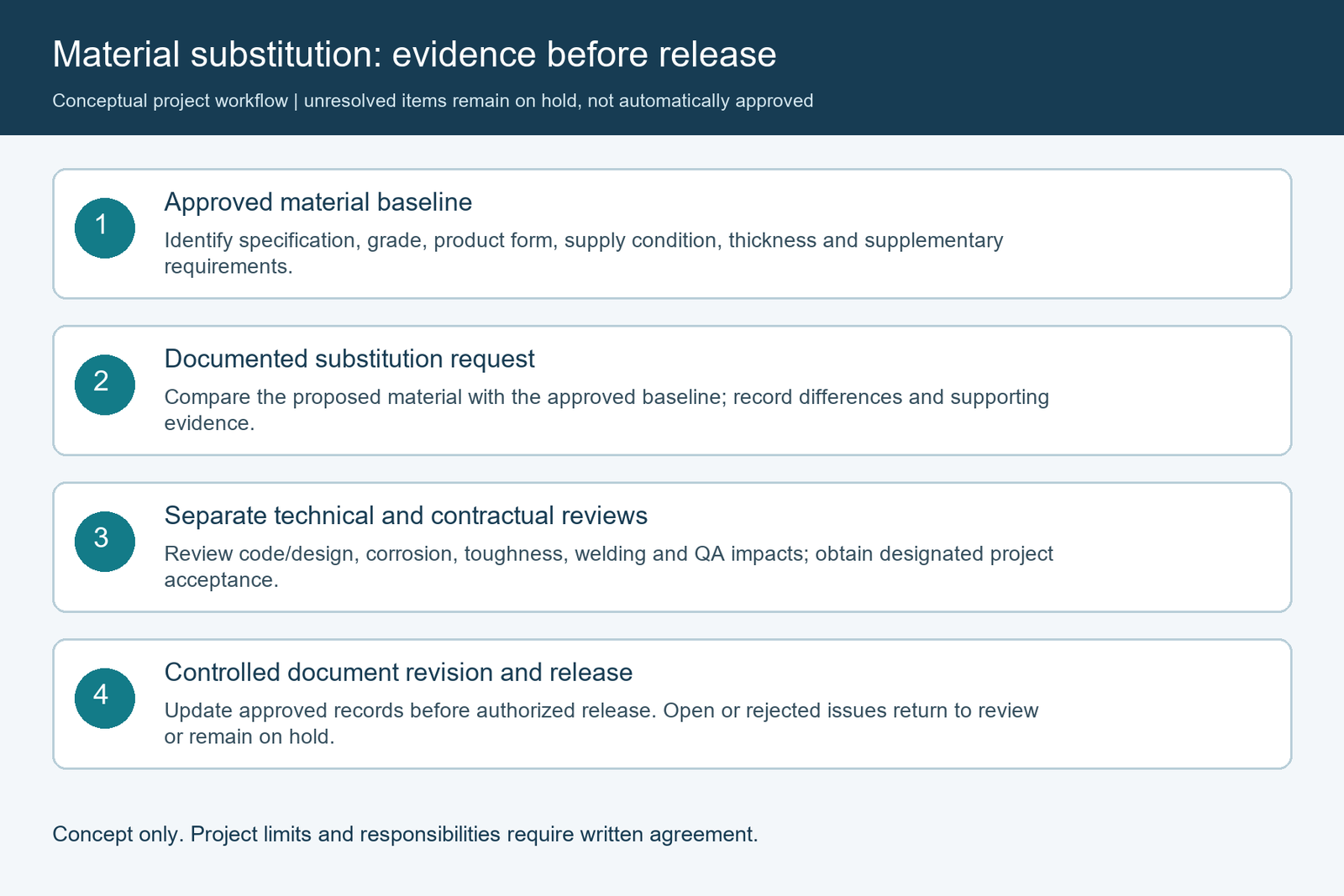
Approval responsibilities differ by contract, certification scheme and project organization. A workable workflow separates technical recommendation, contractual acceptance and manufacturing release:
Gate 1 — Register the request. Assign a unique deviation number, affected vessel tags/components, the original document revision and the supplier’s proposed product. If work has not started, identify the proposed hold point. If materials have already been ordered or fabricated, escalate the disposition; do not assume the change is administratively reversible.
Gate 2 — Obtain discipline dispositions. Have designated design, process/materials, welding, QA/QC and other required reviewers record approval, rejection, requested clarification or conditional disposition. Conditions must identify the evidence needed and the party authorized to close them.
Gate 3 — Secure required project and compliance acceptance. Confirm the specific owner/EPC, manufacturer’s design authority, inspector/notified-body interface or other acceptance required under the contract and applicable regulatory/conformity route. An email asserting “equivalent” from purchasing alone should not bypass these controls.
Gate 4 — Revise the controlled record. Update the approved data sheet, material specification, drawings, bill of materials, calculations if affected, WPS/ITP references, procurement requisition and manufacturer documentation as necessary. Clearly identify superseded revisions and communicate the accepted substitution to the shop and material supplier.
Gate 5 — Release only the affected scope with documented closure. Manufacturing or procurement release should reference the approved change and all required conditions. A conditional technical opinion is not a release authorization unless the project’s documented procedure explicitly makes it one and the conditions for that release are satisfied.
This is a post-approval material change workflow, not a full account of procurement before the project’s original design freeze. For that earlier decision boundary, see Refinery Equipment Procurement Before Design Freeze.
8. Example: A Shell-Plate Alternative Proposed to Protect the Schedule
Illustrative scenario only; no actual grade equivalence or manufacturer performance is implied.
An EPC has an approved material specification for a large vertical process vessel’s shell plates. The fabricator proposes a different national-standard grade because the original procurement route may miss the planned shop start date. Both grades are marketed as broadly similar in strength.
The buyer should not choose between “accept the substitute” and “accept the delay” based solely on that sales description. Instead, the project asks for the exact replacement plate specification and delivery condition, comparison against the approved requirements, code-material eligibility at the design temperatures, material/service compatibility, toughness basis, WPS/PQR coverage, inspection changes and revised commercial terms.
Suppose the design reviewer requests additional evidence regarding the proposed plate’s temperature-dependent properties, while the welding team requires a qualification-range check. The decision register remains pending; the affected shell plate is not released merely because the proposed schedule looks attractive. If the required evidence and approvals are subsequently obtained, the project issues the correct revised document set and release instruction. If not, the proposal is revised or rejected.
The value of this process is not that substitutions always fail or always succeed. It is that the final vessel is built to a reviewed, identifiable and controlled set of requirements.
9. Buyer Checklist: Evidence to Request Before Material Release
Use this short checklist when a manufacturer proposes an equivalent grade for a custom pressure vessel:
- Approved material baseline and revision identified for each affected component
- Full substitute specification, grade, product form, dimensions and delivery condition received
- Supplier provided a specific requirement-by-requirement difference table
- Adopted construction code/edition and material permission checked by the design authority
- Design-temperature properties and calculation impacts resolved
- Service conditions, corrosion/damage concerns and minimum-temperature toughness reviewed
- Welding, forming, heat treatment, NDE and inspection implications reviewed
- Actual material certification/heat traceability plan defined; available lot-specific records checked where relevant
- Supplier’s price, delivery and scope effects documented separately from technical approval
- Required project/conformity approvers and open conditions recorded
- Affected controlled documents revised and release authorization issued before the proposed material is used
A useful procurement instruction is: “Any proposed substitution to the approved material specification shall be identified by component and submitted with a complete specification comparison, relevant technical evidence, impact assessment and proposed document revisions. The substitute shall not be used for the affected work until the approvals and release conditions required by the contract and applicable code have been satisfied.” The final wording should be reviewed against the project contract.
Frequently Asked Questions
Does similar chemical composition prove two pressure-vessel grades are equivalent?
No. Chemistry is only one part of a material specification. Product form, supply condition, thickness range, temperature-dependent design properties, toughness, service suitability, fabrication qualification and the applicable code can all affect acceptance. Similar chemistry may justify further investigation, not automatic approval.
Is a mill test report enough to authorize material substitution?
No. A material test report may support identity, traceability and compliance with a stated material specification. It does not replace the project change request, engineering review, applicable code checks, or the approvals required to change the vessel’s previously accepted material.
Can an ASTM-to-EN grade cross-reference replace a formal review?
No. Cross-reference tables are screening aids. Buyers must verify the actual standards, product forms, supply conditions, design and service requirements, and the project’s relevant code and conformity pathway. The final decision must be documented by the authorized parties.
References and Further Reading
The resources below establish general code, material and welding context, not approval of a specific substitute. For binding requirements, use the full editions cited in the project contract and the governing jurisdictional rules.
- ASME — Boiler and Pressure Vessel Code, 2025 edition overview. Official ASME overview of the BPVC sections and material publications; a project may adopt another edition.
- ASME — Required Code Books for Pressure-Vessel Certification. Identifies relevant BPVC Sections II, V, VIII and IX in the certification context.
- European Commission — Pressure Equipment Directive (PED) portal. Official scope and EAM/PMA guidance links; the guidance is nonbinding.
- EUR-Lex — Directive 2014/68/EU. Official legislation for equipment within its scope.
- TWI — Base Metal Grouping System. Explains grouping in welding qualification, which must not be confused with design-material equivalence.
- TWI — Welding Procedure. Background on WPS/PQR and qualification variables.
Next step for buyers: Share the approved vessel material specification, the proposed substitute’s full designation, the construction code and edition, design/service conditions, and the supplier’s difference register with the responsible EPC, materials, design and quality reviewers. Request a recorded disposition before authorizing the affected material purchase or fabrication.