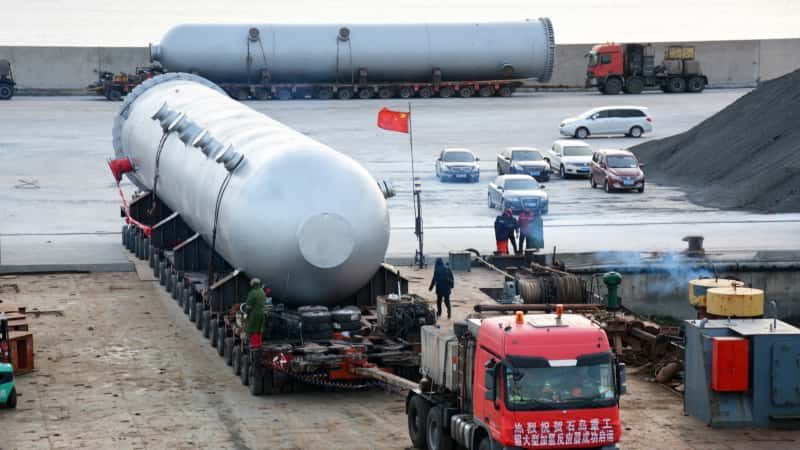

A shell-and-tube heat exchanger quotation may state that the unit has additional duty, a fouling allowance, and excess heat-transfer area. Those statements can sound reassuring, but they do not necessarily describe three independent safeguards. One allowance may already be included in the process datasheet or in the vendor’s thermal rating—and then be added again under a different name.
EPC buyers should ask what each heat exchanger design margin is intended to cover, which calculation basis was used, and whether that allowance has already been included elsewhere. A larger exchanger is not automatically more reliable, and a vendor’s stated percentage of overdesign does not establish performance at every operating condition.
The practical solution is a traceable margin register: separate required process duty, uncertainty allowances, specified fouling resistance, proposed excess area, and future expansion requirements. Then compare the same operating cases using the same thermal and hydraulic assumptions before accepting a supplier’s design or commercial offer.
This guide addresses procurement and design-review inputs for complete industrial shell-and-tube heat exchangers. It does not prescribe a universal percentage margin, calculate a specific exchanger, or replace the responsible thermal engineer’s approval.
What Does “Design Margin” Mean in a Heat Exchanger Specification?
The word margin is ambiguous unless the document names its purpose, reference value, and calculation method. Several different allowances may appear in a single enquiry.
Distinguish duty, uncertainty, fouling, area and expansion
| Term used in an RFQ | What it may represent | Reference or evidence to request | Potential double-counting problem |
|---|---|---|---|
| Required process duty | Heat transfer needed for the agreed process operating case | Approved heat and material balance, operating conditions, revision | A separately increased “design duty” may already incorporate the same peak case |
| Heat duty margin | Additional specified duty above a defined base case | Base duty, final required duty, reason, responsible approver | Process and vendor both uplift the same heat load |
| Process or property uncertainty | Allowance for uncertain flow, fluid composition, properties or utility conditions | Uncertainty source, assumed range, case definition | Worst-case input values plus an unexplained additional margin cover the same uncertainty |
| Fouling resistance / fouling allowance | Assumed added thermal resistance associated with deposits or other specified fouling condition | Shell-side and tube-side values, units, basis, source and intended service | Fouling is included in the rating and added again as a separate area percentage |
| Excess or overdesign area | Installed surface above the area required for a specified rating case | Required area, installed area, definition, relevant clean/fouled basis | “Excess area” is calculated against clean area, and then described as additional to fouling |
| Future capacity requirement | A later duty or operating state that the owner wants the equipment to accommodate | Future flow, composition, temperature, utility and pressure-drop conditions | Future capacity is embedded in the process case and also added as a generic duty uplift |
| Manufacturing or configuration allowance | Extra area resulting from discrete tube lengths, bundle geometry or available construction | Actual offered geometry and final thermal rating | An unavoidable geometry difference is represented as a separately requested risk allowance |
A good quotation identifies whether a percentage, when stated, applies to heat duty, theoretical area, installed area, or another variable. These quantities cannot be interchanged merely because they are all described as margins.
HTRI’s public abstract for Q13-5, Risk-Based Design Margin Selection for Heat Exchangers, describes separating the uncertainties contributing to an exchanger design margin. The published 2009 abstract supports a risk-based review approach; it does not provide a universal margin applicable to every EPC project.
Keep thermal margin separate from mechanical design allowances
A thermal margin is not the same as pressure-vessel corrosion allowance, allowable pressure drop, mechanical design pressure, or material thickness. Each has its own engineering basis and governing requirements.
A specification should avoid calling all of these “safety factors.” The buyer needs to know which technical discipline approved each requirement and what evidence will demonstrate compliance.
Define clean and fouled area comparisons before quoting an excess percentage
For an agreed rating case, one common way to express an installed-area surplus is:
Area surplus (%) = (installed heat-transfer area / required heat-transfer area − 1) × 100
This is only meaningful when required area has a clearly identified basis: the specified operating case, fluid properties, heat-transfer correlations, fouling assumptions and pressure-drop constraints. A ratio against a clean required area is not the same as a ratio against a fouled required area.
Likewise, a statement such as “the exchanger has additional capacity” requires a defined operating basis. An area surplus does not imply that heat duty can increase in the same proportion; the temperatures, available driving force, flow distribution, phase behavior and hydraulics may change as duty changes.
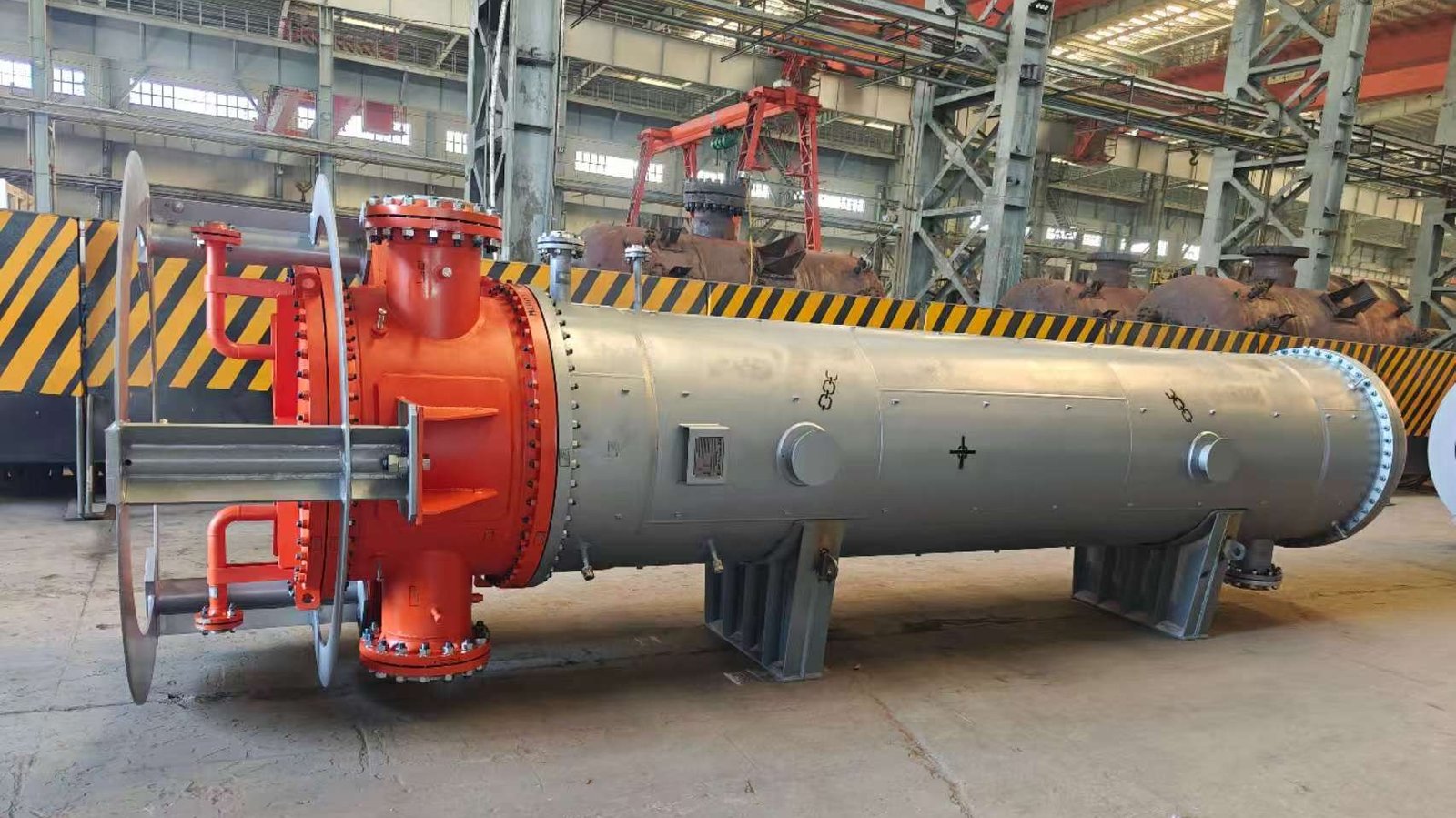
How Do Heat Duty Margin, Fouling Resistance and Excess Area Interact?
Thermal rating links heat duty to temperature driving force, the effective overall heat-transfer coefficient, and installed heat-transfer area. In an appropriate conventional rating formulation, the relationship is represented as:
Q = U × A × F × ΔTlm
where Q is the heat-transfer rate, U is an overall heat-transfer coefficient on a specified area basis, A is heat-transfer area, F is an applicable temperature-difference correction factor, and ΔTlm is the log-mean temperature difference. The treatment must be appropriate for the actual exchanger arrangement and service; more complex duties may require a different rating method.
This relationship is useful for distinguishing inputs, not for recommending a margin percentage.
A higher required duty is not the same as higher area
Increasing a contractual duty requirement changes the thermal target. The area needed to meet the revised target depends on the simultaneous process conditions, heat-transfer coefficients and temperature driving force.
For example, a buyer might approve a maximum-throughput operating case with a higher heat load than the normal case. If that higher case is already the rated design requirement, applying another vendor-added heat duty margin for the same maximum-throughput uncertainty can count the same need twice.
The engineering team should confirm whether the higher duty is a real, simultaneous operating case or only an arithmetic percentage added to a normal load. A heat duty and target outlet temperatures derived from a material and energy balance should remain internally consistent; they are not independent performance guarantees under arbitrary flow conditions.
Fouling resistance changes the rating, not by a fixed area percentage
Fouling assumptions usually enter an overall thermal-resistance model. Tube-side and shell-side fouling values must be identified separately when applicable, with compatible units and a stated surface-area basis. Their influence on the overall coefficient depends on the fluid-side film resistances, wall resistance, geometry and service conditions.
Consequently, a fouling resistance cannot be converted into one universal percentage of additional area for all exchangers. Nor does a specified fouling resistance predict the actual fouling rate, guarantee a cleaning interval, or prove that deposits will accumulate uniformly.
For a project that already specifies fouling resistances in the approved thermal datasheet, the vendor should use those assumptions in the required fouled rating and explain any additional area allowance separately. The buyer should not automatically add another percentage “for fouling” without first checking the calculated basis.
The TEMA standards resources explain that the 2026 edition includes an updated specification sheet. TEMA’s public specification-sheet resources include fields for fouling resistance, exchanger area, duty, thermal performance and pressure drop. These are useful for recording separate inputs; the public sheet is not a substitute for an approved project thermal calculation.
Distinguish a clean rating from a fouled design case
A clean-condition calculation removes the specified deposit resistance but does not necessarily use the same operating temperatures, controls or flow as the fouled design case. If the vendor reports “clean overdesign,” request the reference duty and what exactly was held constant in the comparison.
A clean rating can expose different temperature profiles, heat fluxes, utility requirements and control conditions. It should not be taken to prove that the exchanger will operate within all acceptable limits at clean startup or after cleaning.
For reboilers, the separately published clean-start-up thermal rating guide addresses surface-temperature and startup-specific concerns. This article focuses on preventing duplicate procurement allowances rather than repeating that analysis.
Future expansion is an operating case, not a vague percentage
If the owner anticipates a later throughput increase, define it as a future case with its own material balance, fluid properties, utilities, heat duty, allowable pressure drop and other relevant constraints.
The design team can then evaluate whether one proposed exchanger configuration meets both current and future requirements. A generic “future capacity margin” without the future flow and temperature conditions may be impossible to verify and may be inadvertently included in another margin.
Where Does Double-Counting Enter the EPC and Vendor Review?
Double-counting is often a documentation problem: an allowance is justified in one document, renamed in another, and added again during bid preparation.
Check the complete chain of assumptions
A useful review follows the calculation basis through four documents:
- Process design basis and heat balance: Define operating cases, utilities, data uncertainty and any formally approved duty uplift.
- Exchanger process datasheet: Carry the approved duty and process conditions forward, including both fluid sides, fouling resistance and pressure-drop limits.
- Vendor thermal rating and mechanical proposal: Show the duty used for the rating, clean/fouled assumptions, required area, installed area, actual configuration, and results for each case.
- Purchase order and performance schedule: Confirm the accepted basis, remaining deviations, stated guarantee conditions and responsible parties.
If the approved maximum-duty case already includes future throughput, the vendor should not relabel that same future throughput as a new contingency without a technical explanation.
If the fouled required area already incorporates the specified fouling resistances, an additional “fouling area margin” must be justified as a genuinely separate requirement—or removed.
An illustrative comparison with no assumed market prices
The following is an illustrative documentation example, not an actual project, design calculation or supplier quotation.
| Item | Approved process package | Vendor quotation A | Vendor quotation B | Buyer action |
|---|---|---|---|---|
| Required duty | Maximum validated operating case identified | Uses the approved case | Adds an unspecified uplift to the approved case | Ask B what new uncertainty or case the uplift addresses |
| Fouling basis | Both sides’ fouling resistances specified | Uses the same values in the rating | Uses the same values and adds “extra fouling area” | Ask B whether the extra allowance duplicates the rating assumption |
| Area comparison | Required fouled-area basis defined | Reports installed versus required fouled area | Reports installed versus required clean area | Recalculate or request a comparable area definition |
| Future capacity | Future case not yet approved | Lists as an open option | States “future-ready” without a future case | Do not treat B’s claim as a verified future-duty guarantee |
| Hydraulic results | Pressure-drop limits for both sides stated | Reports calculated values for each case | Reports only rated-duty pressure drop | Request B’s complete case-by-case hydraulics |
| Clean/low-load review | Required where relevant to service | Identifies the review basis | Not addressed | Record an open engineering clarification |
In this illustrative example, B’s larger quoted area is not proof of a superior technical offer. The offers cannot be compared fairly until the required duties, reference area, fouling assumptions and operating cases are aligned.
Use a margin register that identifies ownership
| Margin or design provision | Entered by | Approved reference case | Source or justification | Already reflected in | Open question / owner | Review status and decision reference |
|---|---|---|---|---|---|---|
| Process duty increment | Process team | Specific operating case and revision | Heat and material balance or uncertainty study | Datasheet duty field | Process engineer | Open / accepted / rejected; document the decision and reviewer |
| Property uncertainty | Process / property specialist | Composition and temperature range | Property method, sample or agreed assumption | Process cases or explicit allowance | Process engineer | Open / accepted / rejected; document the decision and reviewer |
| Fouling resistance—shell side | Process / thermal team | Identified fluid and service | Project fouling basis | Vendor thermal rating | Thermal engineer | Open / accepted / rejected; document the decision and reviewer |
| Fouling resistance—tube side | Process / thermal team | Identified fluid and service | Project fouling basis | Vendor thermal rating | Thermal engineer | Open / accepted / rejected; document the decision and reviewer |
| Additional installed area | Vendor / thermal designer | Agreed fouled rating | Offered geometry or separately justified reserve | Final area and configuration | Buyer / thermal engineer | Open / accepted / rejected; document the decision and reviewer |
| Future expansion | Owner / process team | Defined future operating case | Approved project plan | Future-case rating, if included | Owner / EPC | Open / accepted / rejected; document the decision and reviewer |
An unanswered row should remain an open technical clarification, not become an implicit acceptance condition.
Record the calculation location—not just the owner
For each item, require the preparer to answer: Is this uncertainty represented by a bounding input, by a separately increased heat duty, by an additional thermal resistance, by an area provision, or by a performance condition? If the answer names more than one location, state why the provisions are independent. If the reason cannot be demonstrated, flag a possible duplicate rather than simply deleting one provision without an engineering check.
Use the same case IDs, equipment tag, datasheet revision and units on the margin register and the vendor rating. A vendor’s commercial revision should also identify which technical revision it priced. Otherwise, two attractive offers can actually be based on different equipment duties.
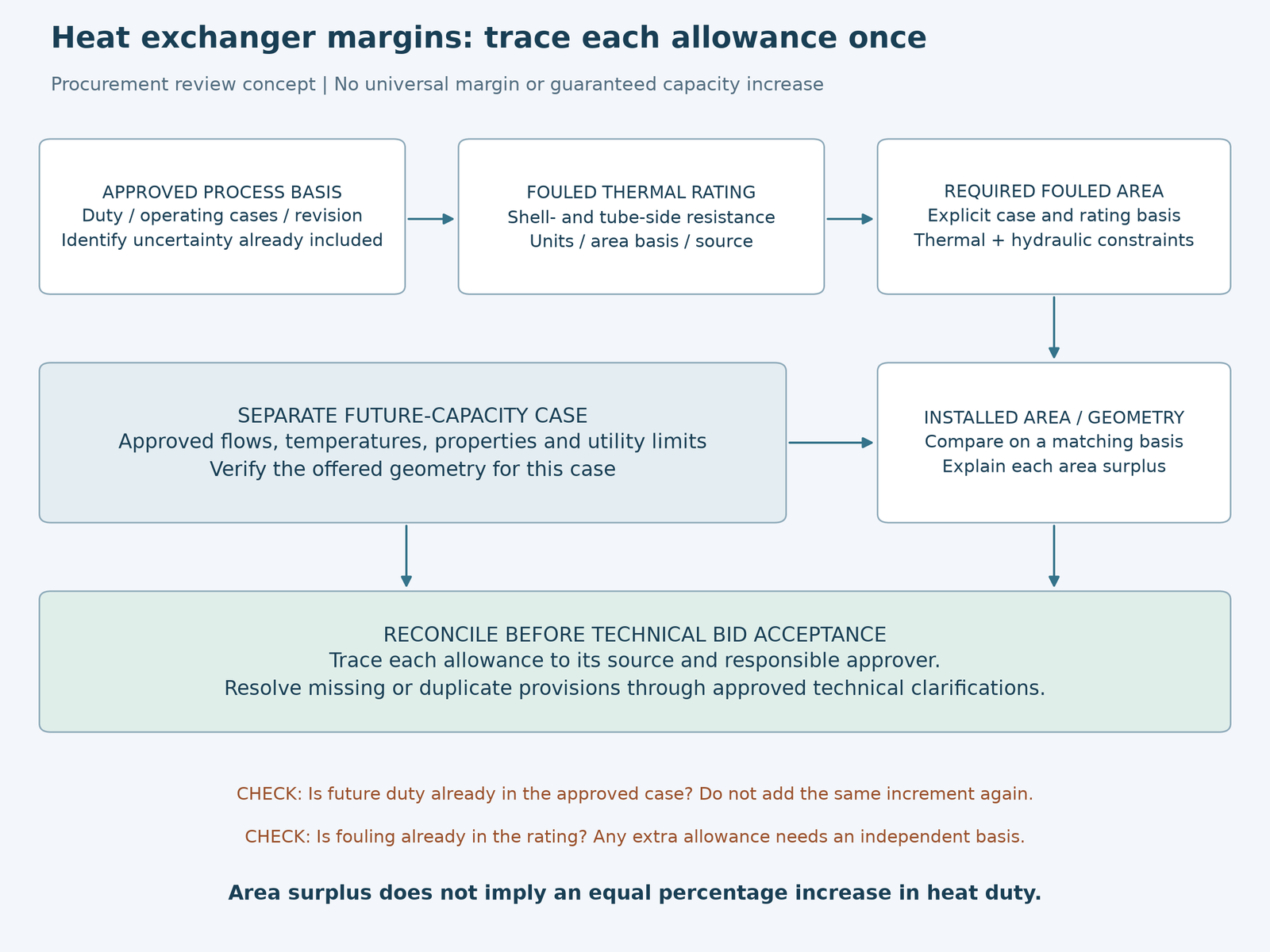
Which Operating Cases Must Be Checked Before Accepting Extra Area?
A single rated or maximum-duty point is not sufficient to establish whether the proposed margin improves the entire operating envelope. The correct cases depend on the process; they should not be constructed by combining unrelated extremes that could not occur together.
Normal operation
This case establishes what the equipment is expected to do most of the time. Review the representative flowrates, inlet temperatures, available utilities, pressure drops and controls. A design sized only for a rare maximum case should still be evaluated for normal efficiency and operability.
Maximum or governing duty
Identify the coincident combination of throughput, composition, inlet conditions, utility availability and target outlet conditions that produces the governing thermal requirement. “Highest flow” is not automatically the governing heat-transfer case in every service.
Distinguish the design requirement from a separate uncertainty allowance. If the governing case already represents the agreed upper end of the operating envelope, explain any additional provision rather than adding it by habit.
Minimum continuous load and turndown
At low throughput, changes in velocity, heat-transfer coefficients, pressure drop, phase behavior and control response may matter. Simply adding installed area does not establish acceptable turndown performance.
If a configuration change increases the number of flow passages or changes flow velocities, its hydraulic and fouling consequences need a specific review. It is not correct to assume that every area increase necessarily decreases velocity: the effect depends on the actual arrangement.
Clean and specified fouled conditions
The vendor should state whether each rating uses clean surfaces or the approved fouling resistances. Relevant clean-case reviews may be needed for hot-side temperature control, local surface conditions, condensate handling or other service-specific limits.
This does not mean every exchanger needs a particular transient or detailed fatigue analysis. The responsible engineer should identify what the equipment and applicable project requirements warrant.
Future-capacity and changed-service cases
A future service may have different flows, inlet temperatures, feed properties, utility constraints or allowable pressure drops. These require their own technically consistent inputs.
A “designed for expansion” quotation should state which future conditions have been evaluated and what remains subject to redesign, additional equipment or confirmation. It should not promise an unspecified increase in capacity based only on an installed-area percentage.
Case matrix for bid evaluation
| Operating case | Buyer-supplied basis | Required vendor result | Why margin alone is insufficient |
|---|---|---|---|
| Normal | Coincident process and utility conditions | Duty, outlet targets, pressure drops, controlling assumptions | Larger area may change control behavior or actual geometry |
| Governing maximum | Approved limiting scenario | Adequacy of rated thermal and hydraulic performance | A nominal extra duty percentage may duplicate that case |
| Minimum/turndown | Lowest credible continuous flow or load | Thermal and hydraulic suitability; control interfaces as relevant | Extra area does not guarantee low-load operability |
| Clean / after cleaning | Clean thermal condition plus relevant operating controls | Appropriate clean-condition rating and any service-specific checks | Fouled performance does not prove clean-condition limits |
| Specified fouled | Defined shell- and tube-side fouling inputs | Rating at agreed duty and pressure drops | An additional generic fouling percentage may duplicate the model |
| Future expansion (if required) | Approved future process and utility basis | Separate future-case rating and qualifications | Area percentage is not a substitute for a future duty model |
The supplier may not own all process-side evaluations. The contractual responsibility matrix should identify who prepares and approves each result.
Why Can Additional Heat-Transfer Area Create Other Design Trade-Offs?
Extra area increases the available heat-transfer surface, but its value depends on the way it is provided and how the system operates. It is not a direct measure of guaranteed capacity or reliability.
Geometry, flow and pressure drop
A larger shell, more tubes, longer tubes, additional passes or another arrangement can affect local velocities, pressure drop, flow distribution, vibration considerations, cleaning access and mechanical layout. These changes are configuration-specific.
Some geometry changes can reduce velocity in a particular flow path and alter fouling behavior; others may increase pressure drop or change distribution. Buyers should require the final thermal and hydraulic calculations rather than infer the result from total area alone.
Steam-heated services and condensate removal
In some steam-heated exchangers with modulating steam-side control, additional surface may permit the same process duty at a lower steam-space temperature and pressure. This can reduce the available driving pressure for condensate removal, especially at low load or with a pressurized return.
Spirax Sarco’s Oversized Heat Exchangers tutorial illustrates this behavior for a particular steam-heating arrangement. Its worked numerical example is not a recommended design margin for other equipment.
For such projects, ask the system designer to review controls, steam-space conditions and condensate-return interfaces over the operating range. The site’s steam heat exchanger condensate stall guide examines that specialized system issue; this article does not repeat the drainage design method.
Clean startup and local temperatures
Fouling reduces heat transfer under the stated rating assumptions, but an exchanger may operate clean after fabrication or maintenance. Depending on the service, local temperature and heat flux under clean conditions can require a separate review. This is particularly important for temperature-sensitive reboiler duties, not a universal claim that clean operation is unsafe.
Do not use the fact that a fouled calculation meets duty as proof that every clean startup or control scenario has been approved.
Cost, operation and mechanical scope
Additional installed area may change material quantities, weight, dimensions, supports, fabrication requirements and shipping arrangements. The effect cannot be assigned a universal cost ratio without actual bids.
Likewise, an apparently cheaper design with less area is not necessarily inadequate. Technical acceptability must be established first using the same process, thermal, hydraulic, mechanical and commercial basis.
What Should EPC Buyers Require in a Comparable Thermal Bid?
A technically comparable quotation must show which assumptions are identical and which remain different. Request evidence that makes the thermal margin auditable rather than accepting a single “overdesign” figure.
Request a complete basis-of-design statement
A useful enquiry package includes:
- Approved process datasheet and heat and material balance, with revisions.
- Shell- and tube-side stream composition, flow, temperature, pressure and relevant phase information for each required case.
- Fluid-property method and source, including material uncertainties that may change the rating.
- Clearly identified required duty and any already-approved process duty increment.
- Shell- and tube-side fouling resistance, units, source and intended applicability.
- Allowed pressure drops and measurement boundaries for both sides.
- Current, low-load, clean, fouled, maximum and future operating cases as required by the service.
- Relevant process and utility control limits, including steam and condensate interfaces if applicable.
- Applicable mechanical construction requirements, TEMA edition and document submittals where specified.
- Clear division of thermal rating, mechanical design, performance guarantee and review responsibilities.
The public TEMA exchanger specification resources can help structure the datasheet, but project-specific attachments are still needed for nonstandard operating cases and uncertainty assumptions.
Request the vendor’s margin reconciliation
For each bid, ask the supplier to identify:
- The required duty and exact operating case used for sizing.
- Whether the process duty already contains any margin or future-capacity increment.
- The shell- and tube-side fouling values used in the thermal model.
- The area required under the stated clean and fouled assumptions, with each reference clearly labeled.
- The installed surface area and actual exchanger configuration.
- The definition and basis for every reported percentage of excess area or overdesign.
- The calculated pressure drop, duty and relevant operating conditions for each required case.
- The configuration and control consequences of added area, where material.
- Any assumptions, exclusions or deviations from the purchaser’s datasheet.
- The calculations, report revisions and responsible design parties supporting each statement.
Ask the vendor to identify a single traceable source for each allowance rather than merely confirming that a “safety margin” was applied.
Do not confuse design evidence with a performance guarantee
A thermal rating is a prediction based on specified assumptions. A contractual performance guarantee requires agreed conditions, parameters, acceptance methods and responsibility for deviations.
The site’s heat exchanger performance guarantee guide covers acceptance criteria, clean/fouled testing bases and measurement uncertainty. Those topics should remain separate from the present article’s margin-definition and duplicate-counting review.
Likewise, mechanical pressure testing, material certification and fabrication inspection provide different forms of evidence; they do not prove the quoted thermal margin at the operating site.
Clarify open items before technical bid acceptance
| Clarification to issue | Buyer question | Evidence to close it | Responsible reviewer |
|---|---|---|---|
| Unlabeled duty uplift | Which approved uncertainty or case does this increment cover? | Heat balance revision and design-basis note | Process engineer |
| Unclear fouling basis | Which values were used for each side, and were they already in the thermal model? | Datasheet and rated calculation | Thermal engineer |
| Excess-area claim | Is the comparison against clean required area or specified fouled required area? | Area and rating summary with calculation basis | Thermal engineer / EPC |
| Unspecified future capacity | Which future-case inputs and limits are guaranteed? | Approved future case and rating | Owner / process engineer |
| Pressure-drop mismatch | Are calculations based on the same flow, property and equipment boundaries? | Case-by-case hydraulic report | Process / thermal engineer |
| Missing low-load check | What control or hydraulic issues require review? | Low-load rating and interface assessment | Process / controls team |
| Steam-side oversizing concern | Were low-load steam pressure and condensate return conditions checked where relevant? | System-level review with defined interfaces | Steam / mechanical specialist |
| Performance guarantee ambiguity | Which conditions and verification method are contractually covered? | Accepted performance schedule | EPC / purchaser |
A clarification should be closed through an approved technical revision, not by an informal statement that the exchanger has “enough margin.”
What Approval Gate Prevents Uncontrolled Margin Changes?
A practical additional safeguard is a margin-reconciliation gate before technical bid acceptance. This is a project-management recommendation, not a code-prescribed approval sequence.
Gate 1 — Establish the reference basis. The EPC process engineer confirms approved operating cases and identifies any duty uplift or uncertainty already embedded in them. The owner approves future service requirements where they change the procurement obligation.
Gate 2 — Reconcile the thermal model. The thermal engineer confirms the property method, side-specific fouling inputs, pressure-drop constraints and clean/fouled required-area definition. The vendor shows which exact configuration it has rated and the formula behind any quoted excess-area figure.
Gate 3 — Resolve overlaps and deviations. Each disputed allowance is either justified as independent, removed through an approved calculation revision, or carried as an explicitly open qualification. An unexplained vendor margin should not silently become a contractual requirement.
Gate 4 — Align the offer and guarantee. Procurement checks that the priced configuration, required thermal performance, case schedule and exclusions refer to the same accepted documents. The guarantee is defined by its own agreed verification and acceptance criteria—not by the mere existence of excess installed area. For the detailed acceptance boundary, see the heat exchanger performance guarantee guide.
Gate 5 — Control post-award changes. If feed composition, flow, utility conditions, fouling assumptions or future-service commitments change, identify the affected register rows. The responsible engineers should then determine whether the thermal rating, mechanical arrangement, quotation, delivery schedule or performance schedule requires revision. Retain the superseded and accepted documents rather than replacing assumptions without an audit trail.
A brief clarification log can make the gate enforceable in routine bid meetings:
| Change or concern | Required action | Evidence of closure |
|---|---|---|
| Process duty raised after RFQ | Identify revised case, source and whether the increase replaces a prior allowance | Approved process basis plus revised vendor rating |
| Fouling value changed on one side | Reconcile required fouled area and hydraulics | Revised datasheet and thermal calculation |
| Vendor reports more area but changes tube/pass arrangement | Assess duty, pressure drop, control and relevant mechanical interfaces | Configuration-specific rating and reviewed drawing |
| Proposed future-capacity claim added | Define actual future operating case | Owner approval and future-case results |
| Guarantee revised without matching test basis | Align guaranteed parameter with operating and measurement conditions | Accepted guarantee schedule and contractual clarification |
Do not use an open item to imply tacit approval. Every final change should identify a version, decision, accountable reviewer and affected document.
Frequently Asked Questions
Is there a standard 10% or 20% heat exchanger design margin for every project?
No. A universal percentage cannot account for different process uncertainty, fouling assumptions, utility constraints, configuration choices and operating cases. Any required margin should have a stated purpose and be approved for the specific service. Numbers appearing in a manufacturer’s example are not general procurement instructions.
Is fouling allowance the same as an extra percentage of heat-transfer area?
No. Fouling resistance is a thermal-model input, generally recorded separately for the relevant fluid sides and on a defined basis. Its effect on required surface area depends on the overall resistance and rating conditions. A separate area allowance must be justified and should not repeat the same fouling provision.
What is the difference between heat duty margin and area overdesign?
Heat duty margin changes the specified thermal requirement relative to a named base case. Area overdesign describes installed area relative to the area calculated for a named rating case and clean/fouled basis. They are not directly interchangeable percentages.
Does more area guarantee future expansion capacity?
No. Future capacity requires a defined future operating case and adequate thermal, hydraulic, mechanical and utility conditions. An exchanger can have spare nominal surface but still be constrained by pressure drop, fluid behavior, temperature approach or associated systems.
Can excess exchanger area make operation more difficult?
It can under certain configurations or services. The effects depend on geometry, flow, controls and the operating range. In some modulated steam-heated systems, excess area can reduce steam-space pressure and complicate condensate removal. That is not a universal result for all exchanger types.
Which documents should the vendor provide to explain the quoted design margin?
Request the approved process basis, case schedule, fouling assumptions, thermal and hydraulic ratings, required and installed areas, the formula used for reported overdesign, deviations, and a signed or otherwise approved clarification record showing who owns each assumption.
Does an exchanger with a large stated margin automatically meet its performance guarantee?
No. A margin is a design provision evaluated under certain assumptions. A performance guarantee is a separate contractual obligation tied to specified operating conditions, evidence and acceptance criteria.
Conclusion
The purpose of a heat exchanger design margin is not to make a quotation appear more conservative. It is to address a clearly identified process, fouling, manufacturing or future-service requirement without introducing hidden duplication.
Before approving a complete shell-and-tube exchanger, EPC buyers should reconcile the process duty, operating-case limits, fouling resistances, clean and fouled ratings, required area, installed area and any future-capacity claims on one documented basis. Then the responsible engineers can assess the real trade-offs in performance, hydraulics, control and mechanical design.
If you are preparing a complete industrial shell-and-tube exchanger enquiry, provide the approved operating-case envelope, fluid-property basis, fouling assumptions, applicable codes, pressure-drop limits and the project’s definitions of each allowance. The shell-and-tube heat exchanger product page provides a starting point for discussing the manufacturing and procurement scope; any thermal-design or performance-guarantee responsibility must be explicitly agreed for the actual project.
References
- Heat Transfer Research, Inc. (HTRI). Shilling, R. L., Rudy, M. P., and Rudy, T. M. (2009). Q13-5 Risk-Based Design Margin Selection for Heat Exchangers. Public abstract; the membership report and its worked examples were not reviewed. https://www.htri.net/q13-5
- Tubular Exchanger Manufacturers Association (TEMA). TEMA Standards: 2026 Edition Overview. Official notice of updated exchanger specification sheet and other changes; not the paid standards text. https://tema.org/standards/
- TEMA. Standards Support: Specification Sheet and Nomenclature Resources. Public resources for documenting exchanger service and design requirements. https://support.tema.org/
- Spirax Sarco. Oversized Heat Exchangers. Learn About Steam / Condensate Removal. Manufacturer technical tutorial concerning steam-heated systems with specific control and condensate-removal arrangements; its example is not a universal oversizing recommendation. https://www.spiraxsarco.com/learn-about-steam/condensate-removal/oversized-heat-exchangers?sc_lang=en-GB