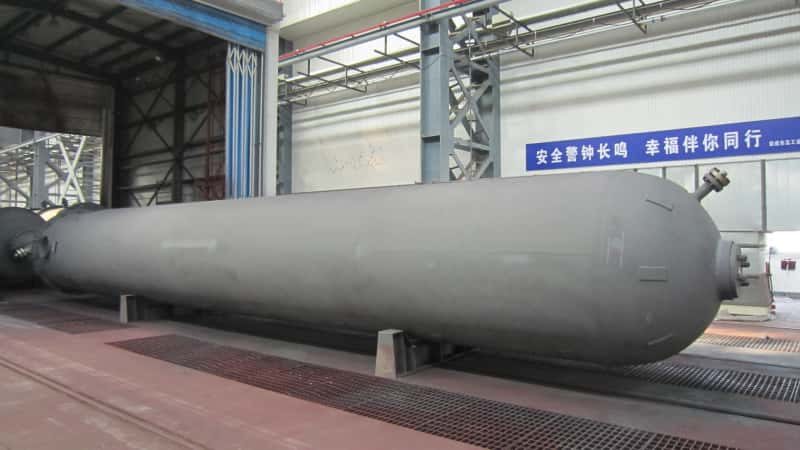

Executive summary. Two suppliers may propose industrial reactors with the same nominal volume and installed motor rating yet offer different mixing performance, thermal behavior, and contractual scope. Motor nameplate power indicates a drive’s rated capability under defined conditions; it does not, by itself, establish the power actually transferred to the process fluid, the flow pattern inside the vessel, or whether a required batch-quality target will be met.
For an EPC team comparing a high-viscosity chemical reactor, the practical question is not simply “How many kilowatts are installed?” It is: Can the proposed complete reactor package meet the specified process objectives throughout the relevant stages of the batch, and what evidence supports that claim? This article gives buyers a stage-by-stage evaluation framework, without treating any particular mixer configuration, power density, or performance result as universally valid.
What Does a Reactor Motor Rating Tell a Buyer—and What Does It Not?
An industrial agitated reactor combines several engineering functions. The pressure boundary contains the process; the mixing system moves material within the available working volume; heat-transfer surfaces or connected equipment exchange thermal energy; and the plant’s controls, utilities, and other systems support the intended operation. These functions interact but are not described by one motor number.
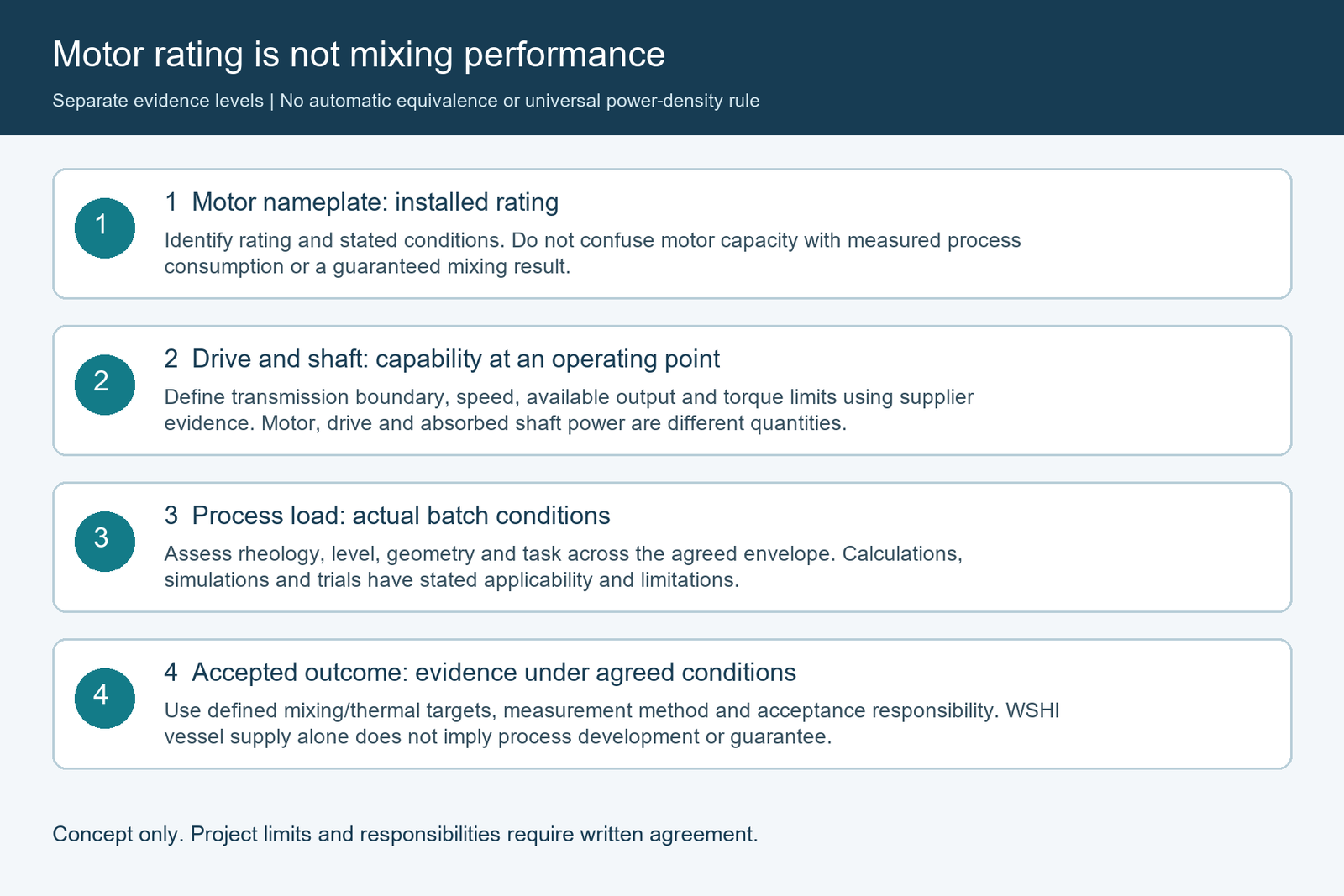
A motor nameplate generally identifies rated electrical-machine characteristics, including a rated output under specified conditions. It does not establish the mechanical load occurring at the agitator shaft at each batch stage. When evaluating offers, request that suppliers distinguish the following quantities and their boundaries:
| Term used in a quotation | What it describes | What the purchaser should clarify |
|---|---|---|
| Installed motor rating | Rated drive capacity under its specified operating conditions | Rating basis, operating limits, duty definition, and relevant manufacturer data |
| Available output at the mixing shaft | Mechanical capability after the actual drive and transmission arrangement | Which location is rated, the allowable operating envelope, and the equipment assumptions |
| Predicted or measured absorbed shaft power | Mechanical power associated with the process load at a stated operating point | Batch state, rotational speed, fluid behavior, method, and uncertainty or design allowance |
| Shaft torque and speed | Mechanical loading and rotational operating condition | Required versus available range, transient/loading cases, and limits of the complete drive train |
| Mixing-process outcome | Achievement of a defined process objective | Acceptance criterion, valid operating case, verification method, and responsible party |
Editorial distinction for bid clarification; definitions and rating boundaries must be confirmed against each supplier’s actual technical documentation.
Electrical input, rated motor output, gearbox output, and power absorbed by the fluid are not interchangeable numbers. Nor does a higher installed rating automatically establish faster blending, better circulation near a wall, satisfactory solids distribution, or a uniform reactor temperature. Conversely, drive capacity and torque remain critical constraints: a process target cannot be met reliably if the installed mechanical system cannot safely sustain the required operating conditions.
The important point is that motor rating is one item of evidence, not the definition of mixing performance. Sulzer’s published discussion of industrial agitation emphasizes defining the process need and flow behavior instead of selecting mixers on power-per-volume alone. See How to Optimize Agitators.
Why Must a High-Viscosity Reactor Be Reviewed Across the Entire Batch?
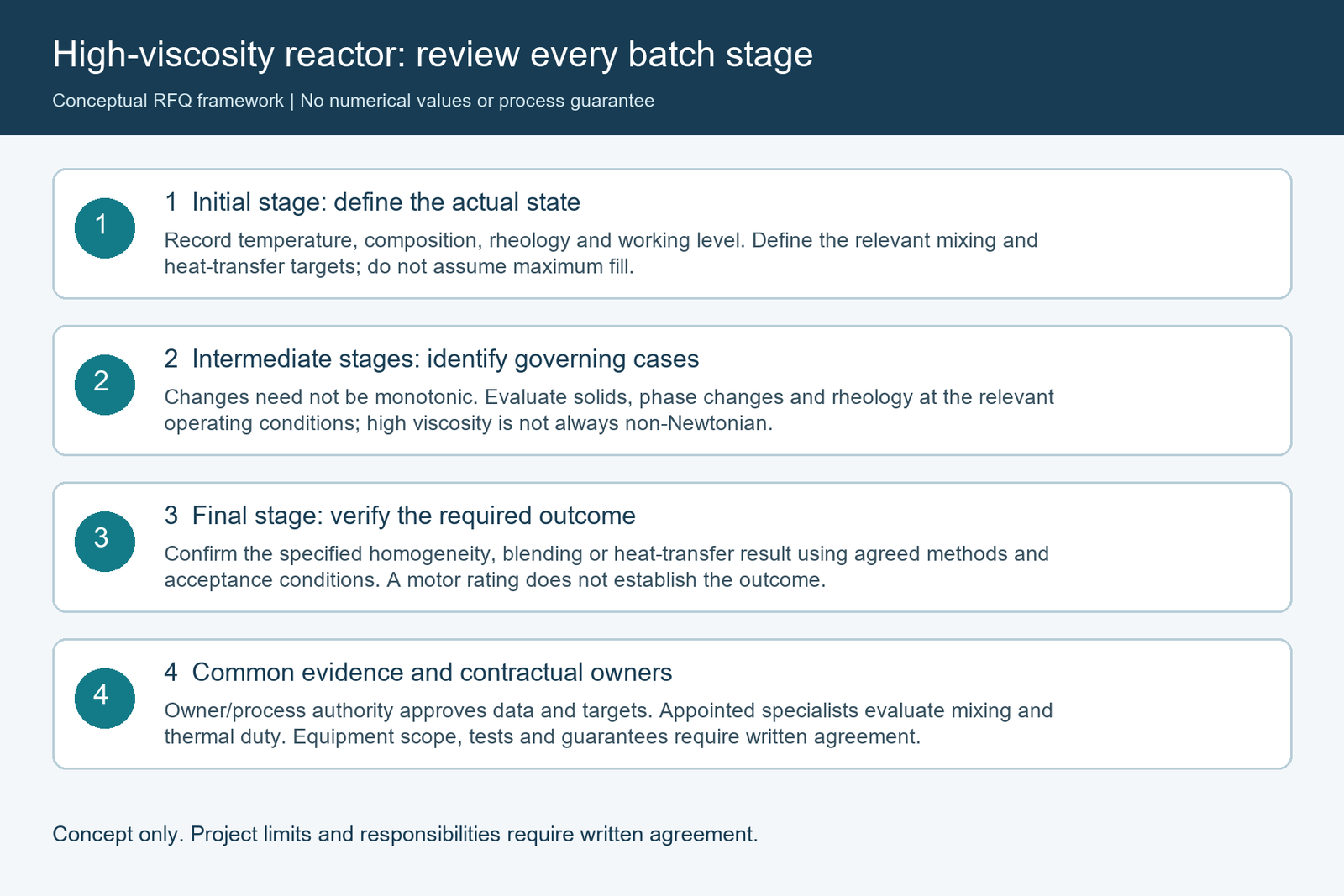
A batch specification often contains a single “normal viscosity,” a nominal vessel size, and a stated motor power. That may conceal the conditions that actually control the equipment design.
During one batch, the charge volume, temperature, concentration, solids content, phase distribution, and apparent resistance to motion may change. Viscosity can rise, fall, or pass through a difficult intermediate stage; a buyer should not assume that the final state is necessarily the only demanding one. Some mixtures are Newtonian over the relevant conditions, while others are shear-dependent or time-dependent. High viscosity does not automatically mean non-Newtonian behavior. If the mixture exhibits such behavior, the approved material description and supplier evaluation method need to represent it appropriately rather than relying on a single isolated laboratory value.
Identify the actual stages, not a hypothetical standard cycle
The responsible process team should define the relevant stages for its particular chemistry. The following is an illustrative information structure, not a prescribed sequence for operating a chemical reactor:
| Batch stage to assess | Information that may change | Relevant procurement question |
|---|---|---|
| Initial or partial charge | Working liquid level, fluid composition, temperature, phase distribution | Is the proposed mixing system suitable at the actual initial fill condition? |
| Intermediate processing | Composition, viscosity, solids or dispersed phase, heat-release or heat-removal demand | Has the supplier evaluated the stage with the most demanding combination of mixing and thermal requirements? |
| Late-stage or final batch | Rheological state, product concentration, effective circulation and working inventory | Can the required result be demonstrated at the approved endpoint rather than inferred from the initial charge? |
| Relevant permitted transitions | Changes in load, level, utility availability, or phase behavior | Are any additional operating limits or engineering reviews required? |
Do not convert this editorial table into a universal operating procedure. A polymerization, a specialty-chemical blending process, and a filled resin formulation may each have different stages and acceptance criteria.
The agitator manufacturer EKATO describes the role of agitation in blending, multiphase mass transfer, and heat transfer, including additional difficulties in high-viscosity service. Its chemical-industry technical overview supports evaluating the process task and the operating state together. EKATO’s polymerization overview also illustrates how fluid behavior and the required thermal or mixing objective can change with a process stage. These are third-party engineering examples, not proof of this site’s manufacturer’s proprietary mixing technology or performance guarantees.
Record working volume rather than nominal vessel capacity alone
A quoted gross vessel volume does not establish the liquid height at which mixing must work. Actual working volume, fill fraction, internal geometry, feed entry locations, and relevant internals can affect the moving fluid region and circulation paths. Buyers should state the normal and limiting permitted liquid levels, with a clear distinction between mechanical vessel capacity and the process working inventory.
A supplier comparison based on nominal volume alone may therefore conceal fundamentally different design assumptions.
Define the Process Result Before Asking Suppliers to Confirm Power
The specification should identify what the mixing must accomplish, not merely that an agitator is present. Different processes need different results. A mixing target suitable for dissolving a component may be irrelevant to a service controlled by heat removal or solid suspension.
Possible objectives include:
- Blend uniformity: an accepted concentration or temperature distribution at specified sampling locations or under an agreed measurement method.
- Time to a defined mixing endpoint: a process-specific acceptance criterion and permitted evaluation interval, when the contract actually requires one.
- Solids management: the degree of suspension or distribution necessary for the approved process, if solids are present.
- Dispersion or phase contact: a relevant outcome for gas–liquid, liquid–liquid, or other multiphase service, if applicable.
- Thermal consistency: the required process-temperature behavior during relevant heating, cooling, or reaction stages.
- Product-quality-related criteria: only where measurable acceptance definitions, test conditions, and contractual responsibility have been agreed.
These are alternatives or combinations to be selected by the process owner—not a compulsory checklist of guarantees for every reactor. Each target needs a specified batch condition, a test or evaluation method, an acceptance basis, and a statement of what falls outside the supplier’s control.
For example, a purchaser might require evidence of acceptable temperature uniformity during a high-viscosity stage. A statement that the drive is “sufficiently powerful” would not show where temperature is assessed, what mixing and utility conditions were assumed, or whether the supplier’s prediction covers the approved working level. Likewise, quoting a blend time without defining the mixture, volume, tracer or sampling basis, and acceptance criterion does not establish a meaningful contractual obligation.
A useful performance statement takes the form: process objective + defined batch case + evaluation method + acceptance criterion + supply/utility boundary. Where any of those elements remain unresolved, the bid should identify them as assumptions or open items rather than implying a confirmed guarantee.
How Do Mixing and Heat Transfer Interact in Viscous Batch Service?
Industrial reaction equipment frequently must move material and exchange heat at the same time. As viscosity or phase behavior changes, fluid motion near the vessel’s heat-transfer surfaces may change, potentially affecting temperature distribution and the rate at which heat can be transferred under the actual process conditions.
The project should compare these responsibilities without conflating them:
- Process thermal requirement: The owner, licensor, or appointed process engineer supplies the relevant heat-load profile and accepted process conditions. The required duty may vary during the batch.
- Mixing contribution: The agitation specialist evaluates the circulation and fluid movement relevant to the selected mixing and temperature objectives, within the limits of the input data and methods used.
- Mechanical and heat-transfer equipment: The equipment design team evaluates the supplied surfaces, material and pressure-boundary requirements, internal arrangements, and agreed utility interfaces.
- Installed system: The EPC and owner confirm that available utility conditions, controls, instrumentation and other plant systems match the assumptions used to assess the complete package.
A predicted ability to turn a shaft at a particular speed is not equivalent to verified process-temperature uniformity. Similarly, a nominal heat-transfer surface area does not prove an approved temperature profile if the process-side circulation and real material properties have not been evaluated.
The equipment quotation should therefore state the thermal cases that were assessed alongside the mixing cases: relevant heat demand, working levels, fluid properties, available utility conditions, and any process restrictions. Where a calculation or study covers only a clean, homogeneous, single-phase condition, that limitation should be visible if the project may involve solids, changing rheology, or other behavior.
This article does not select between jackets and external circulation exchangers. For a separate equipment-arrangement discussion, see the site’s jacketed reactor versus external heat exchanger guide. Nor is this an instruction for reaction-hazard testing; process safety must be evaluated by competent specialists using the project’s approved study basis.
What Makes Two Complete Reactor Offers Technically Comparable?
Two bids should first be assessed against one agreed set of process cases. Ask each supplier to identify whether it evaluated the same batch stages, working inventory, fluid properties, thermal requirement and intended mixing endpoint. A matching motor rating is not a substitute for this check.
The table below can be copied into a technical-bid clarification register. Every entry is a field to complete, not a claimed project result. Leave unknown values as TBC (to be confirmed); do not invent a viscosity, mixing time, power consumption or production guarantee merely to fill a quotation comparison.
| Batch case and status | Properties and working level | Process target | Supplier evaluation method | Validity or operating limit | Verifiable evidence | Responsible reviewer / open item |
|---|---|---|---|---|---|---|
| Initial charge — TBC | Composition, T, rheology, liquid level — TBC | Defined initial-stage objective — TBC | Prediction, trial, model or reference — TBC | Evaluated volume, phase, temperature — TBC | Calculation/record ID and revision — TBC | Process / mixing / mechanical — TBC |
| Intermediate stage — TBC | Changing composition, viscosity or solids — TBC | Relevant homogeneity or thermal target — TBC | Stage-specific assessment — TBC | Assumptions on fluid behavior — TBC | Study or test evidence — TBC | Process / mixing — TBC |
| Final batch — TBC | Final fluid state, density and level — TBC | Approved endpoint criterion — TBC | Calculation or representative trial — TBC | Scale and equipment configuration — TBC | Approved report / exceptions — TBC | Process / QA — TBC |
| Limiting approved case — TBC | Specified relevant high-load conditions — TBC | Contract-defined acceptable result — TBC | Agreed assessment method — TBC | Utility/drive/system limits — TBC | Deviation or acceptance register — TBC | EPC / owner / supplier — TBC |
Editorial procurement comparison matrix; not an industry-standard mandatory form or a real project datasheet.
Compare the complete mixing envelope, not a preferred operating point
Request a supplier-specific explanation of predicted or demonstrated mechanical demand at each relevant batch state. The supplier should identify the rating location and basis for installed motor power, available shaft torque and speed, and predicted absorbed power where those quantities are part of its agreed technical assessment. Where the method relies on empirical assumptions, simulations, or analog equipment, require the limits of applicability.
An apparent difference between two quotes may reflect different process assumptions rather than better equipment: one proposal may evaluate a representative viscous endpoint; another may assume the initial low-viscosity condition. One may include a mixing-study deliverable and commissioning acceptance activity; another may supply only the fabricated reactor shell with mechanical provisions for a separately procured agitator.
Compare scope and exclusions with the same care as calculated performance
Ask both bidders to clarify which of the following fall inside the quoted complete-equipment boundary: fabricated reactor vessel; agreed heat-transfer surfaces; mechanical interface for agitation; actual agitation-system supply; drive arrangement; necessary mechanical integration; instruments and control interfaces; approved design calculations; documentation; shop inspections; packing and delivery; and any contracted performance verification.
A missing item is not necessarily a defect if the EPC intends to purchase it separately. The problem is comparing total project solutions while silently counting different supply scopes.
Which Supplier Evidence Is Strong Enough for a Procurement Decision?
Technical evidence is only useful if its conditions match the stated claim. The word validated should not appear in a technical bid without an explanation of what was validated, against what acceptance criterion, and at which equipment or process scale.
A useful review distinguishes four evidence types:
| Evidence offered | What it may support | What it does not prove on its own |
|---|---|---|
| Equipment and drive datasheets | Ratings, mechanical arrangement, declared operating boundaries | Mixing time, homogeneity, product yield or heat-transfer duty throughout the batch |
| Engineering calculations or specialist models | Predicted performance within stated geometry and material assumptions | A measured result under conditions outside the model’s scope |
| Pilot or laboratory trials | Observed behavior for the tested recipe, equipment, scale and measurement method | Automatic performance equivalence in a larger vessel or altered batch process |
| Reference installation or operating history | Evidence of experience in a defined application and operating window | A contractual guarantee for a different fluid, working level, process objective or supply boundary |
For a practical illustration of why a mixing objective and actual product properties matter, the industrial mixing supplier ITT Flow Technologies describes a customer assessment in which laboratory work revealed a higher actual viscosity and inadequate motion in part of a tank; the solution required a revised mixing arrangement rather than relying on the original assumptions. See Yours, Mine and Ours. This is a third-party example; it is not a WSHI project, benchmark, or performance promise.
If evidence does not cover the most demanding approved stage, record the limitation and agree whether additional specialist review, testing, or a conditional bid assumption is necessary. Do not treat every project as requiring the same test campaign. The appropriate level of evidence depends on technical risk, process novelty, contractual guarantees, available data and the responsibilities established by the owner and EPC.
Who Is Responsible for Mixing Performance in a Reactor Package?
A large reactor vessel can be mechanically compliant while the surrounding process system still requires an independent mixing or thermal-performance demonstration. Buyers should prevent this ambiguity before placing the order.
| Project function | Typical question to allocate | Required contract clarification |
|---|---|---|
| Owner / process licensor / EPC process engineer | What fluid properties, stage sequence and process results are required? | Approved process cases, acceptance criteria, data sources and revision control |
| Mixing specialist or contracted agitation designer | How is the proposed mixing system evaluated for the defined stages? | Scope of calculations, test or reference basis, rated mechanical limits and exceptions |
| Reactor mechanical designer / fabricator | Which vessel, pressure-boundary and internal-interface requirements are included? | Mechanical code, materials, agreed integration interfaces, fabrication and inspection deliverables |
| Heat-transfer specialist, if contracted separately | What thermal performance is evaluated for the approved cases? | Thermal input basis, utility interface, calculation method and stated exclusions |
| Controls / EPC integration party | Which instruments, power and utilities must be provided by the plant? | Battery limits, control interfaces, operating constraints, field responsibilities |
| Owner’s acceptance / quality team | Which documents or tests demonstrate contractual completion? | Witness/hold points where agreed, acceptance records, deviations and closure authority |
Responsibilities vary by contract. This table does not assign WSHI unverified mixing, controls, testing, process-design or performance-guarantee services.
For a general overview of complete reactor equipment specifications, the site’s industrial reactor purchasing guide discusses materials, design conditions and procurement records. The present article addresses the narrower problem of verifying a high-viscosity batch’s mixing outcome against quoted power and complete-package boundaries.
What Should an EPC Team Close Before Releasing the Reactor Design?
A budgetary quotation may legitimately contain open assumptions. The critical point is to make them visible and prevent them from becoming unstated final design conditions.
Before design release or contractual acceptance, ask:
- Shared basis: Have all shortlisted bidders received the same approved batch-stage process information, working volumes and target results?
- Drive and load: Are motor rating, shaft capability, predicted process demand and permissible operating states identified without conflating them?
- Thermal interface: Are mixing requirements and approved heating/cooling duties aligned for the same relevant stage or stages?
- Evidence: Can the proposed performance be traced to a calculation, trial, model or suitably comparable operating reference, with its limits stated?
- Scope: Are actual agitator system supply, reactor fabrication, system utilities, controls, commissioning and performance verification explicitly allocated?
- Open items: Are unresolved data, deviations and any additional verification listed with an owner, due stage and hold point where appropriate?
If a critical fluid property or acceptance target is unknown, the responsible engineers should decide whether a conditional design or additional evidence is appropriate. The vendor should not be asked to infer a guaranteed mixing time, temperature uniformity or product specification from nominal volume and installed motor power alone.
Frequently Asked Questions
Can a larger motor alone solve poor mixing in a high-viscosity chemical reactor?
Not necessarily. More available drive capacity can help where genuine load limits exist, but mixing also depends on the vessel geometry, actual fluid behavior, working level, circulation pattern and the required process outcome. Buyers need a qualified assessment of the complete reactor and mixing arrangement, not only a higher nameplate rating.
Does the same motor power mean two high-viscosity reactors are equivalent?
No. They may operate at different shaft speeds, torque conditions, batch levels or mixing configurations and may have been evaluated against different process targets. Compare the approved process cases and the underlying supplier evidence before treating two bids as equivalent.
Must every viscous batch be treated as a non-Newtonian fluid?
No. High viscosity describes resistance to flow, but does not by itself define how viscosity changes with shear rate or time. Where non-Newtonian behavior is relevant to the process, the purchaser should provide or obtain appropriate validated information for the specialist assessment.
Who guarantees the final mixing result of a purchased industrial reactor?
Only the project party or parties that explicitly accept the relevant contractual responsibility, defined process conditions, acceptance criteria and verification method. Fabrication of the pressure vessel does not automatically mean the manufacturer guarantees blending time, process conversion, product quality or the complete plant’s performance.
Conclusion: Buy Evidence for the Process, Not Only a Motor Rating
For an industrial high-viscosity reactor, installed motor power is a necessary mechanical specification but an incomplete procurement decision criterion. Two bids that share the same motor rating and vessel capacity may still be based on different fluid assumptions, batch stages, mixing targets, heat-transfer requirements and supplied equipment boundaries.
The most defensible comparison starts with a process-approved stage-by-stage basis, asks suppliers to identify their actual mechanical and mixing evaluations, and requires a traceable statement of what is verified, assumed, excluded or still open. This reduces ambiguous quotations without imposing arbitrary universal speeds, power densities or mixing-time guarantees.
For a complete reactor enquiry, provide the intended stage-by-stage operating envelope, required process objectives, approved thermal duty, working levels and mechanical design requirements. Buyers can review WSHI’s industrial reactor product category and request a project-specific discussion of confirmed reactor manufacturing scope and interfaces. Any agitation-system integration, process engineering, pilot testing or mixing-performance guarantee must be separately established for the actual project.
References
- EKATO. Chemicals: Agitator Systems in the Processing of Chemical Products. Explains that blending, multiphase mass transfer and heat transfer create different agitation requirements; describes specialist high-viscosity applications and evaluation methods. Third-party technical background only.
- EKATO. Polymerization: Modern Mixing Solutions for Sensitive Processes. Illustrates why process stage, fluid behavior and thermal/mixing objective must be understood together. Its specific examples are not universal design figures or this manufacturer’s capabilities.
- Sulzer. How to Optimize Agitators. Discusses matching agitation to actual process needs rather than using motor power or simple power density alone.
- ITT Flow Technologies / SPX FLOW. Yours, Mine and Ours. A manufacturer-described example of changed viscosity assumptions, lab verification and the need to evaluate flow through the full vessel. Not a WSHI case or guarantee.