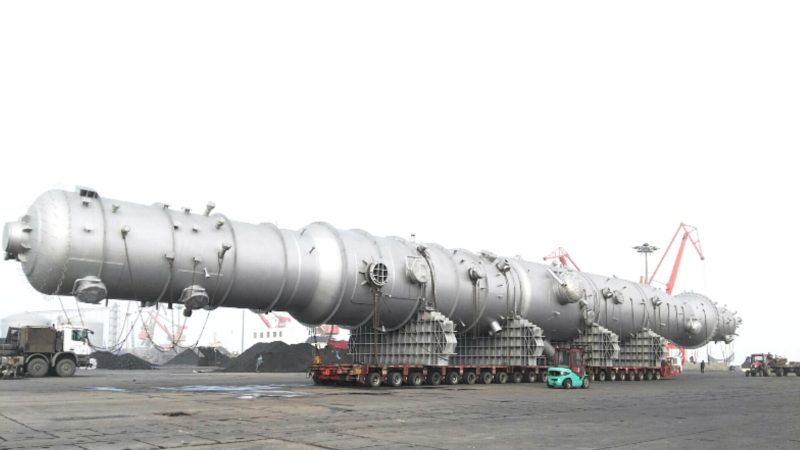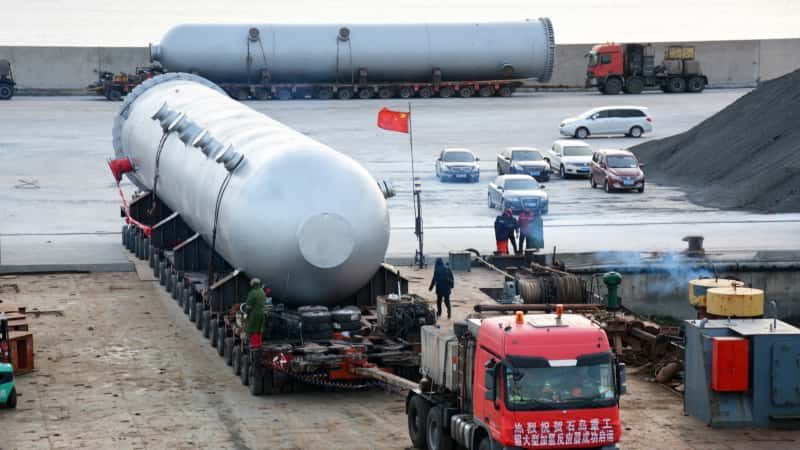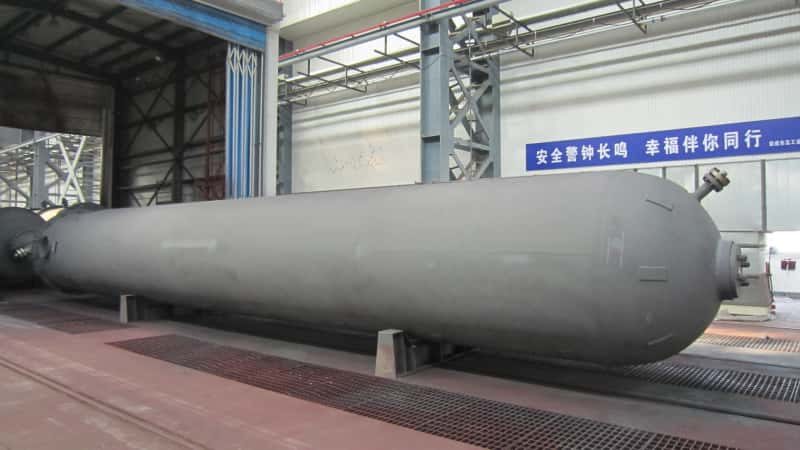

A large process vessel may operate at positive pressure for most of its service life yet encounter a very different load case during intermittent steam-out, shutdown, or cooling. Steam admitted for cleaning can condense after the supply is stopped. If the vessel cannot admit sufficient replacement gas, its internal pressure may fall below the pressure outside the shell. The engineering question is not simply whether the vessel is described as a “vacuum vessel,” but which pressure–temperature combinations can credibly occur at each stage and which of them must govern the mechanical design.
For EPC process engineers and buyers, the useful deliverable is an approved, time-sequenced design-case register. It should identify the starting condition, steam-out procedure, isolation and vent configuration, pressure and metal-temperature conditions, expected duration, protection assumptions, and responsibility for each unresolved value. This article focuses on those intermittent cases for complete custom pressure vessels, rather than repeating a general guide to vacuum vessel construction.
Why Steam-Out and Shutdown Need Their Own Design Cases
Normal operating pressure and temperature do not fully describe an intermittently cleaned process vessel. The vessel may pass through several different conditions during one maintenance or regeneration cycle:
- Preparation and isolation: residual process fluid, liquid inventory, vessel temperature, and connected piping determine the initial state.
- Steam admission and cleaning: steam supply conditions, flow, pressure control, open flow paths, and condensate removal influence the actual vessel pressure and heating profile.
- Steam termination and transition: supply valves change position, but the internal space may still contain substantial water vapor and condensate.
- Cooldown and condensation: cooling vapor can condense, reducing the internal vapor inventory. The resulting pressure depends on whether replacement gas enters and on the condition of connected systems.
- Hold, opening, or restart: isolation, draining, purging, inerting, and recommissioning may introduce additional pressure or temperature transients.
These are possible stages, not a prescribed operating procedure. The owner or EPC process team must supply the actual sequence and safeguards. A supplier cannot safely infer the valve line-up or heat-up and cooldown history from an equipment tag or a generic steam utility specification.
The February 2024 Process Safety Beacon from the Center for Chemical Process Safety (CCPS) identifies steam condensation in inadequately vented equipment as a vacuum hazard. Its discussion reinforces why intermittent cleaning and shutdown deserve explicit review even when the vessel’s usual duty is not under vacuum (see References).
Which Pressure–Temperature Combinations Can Occur During Steam-Out and Shutdown?
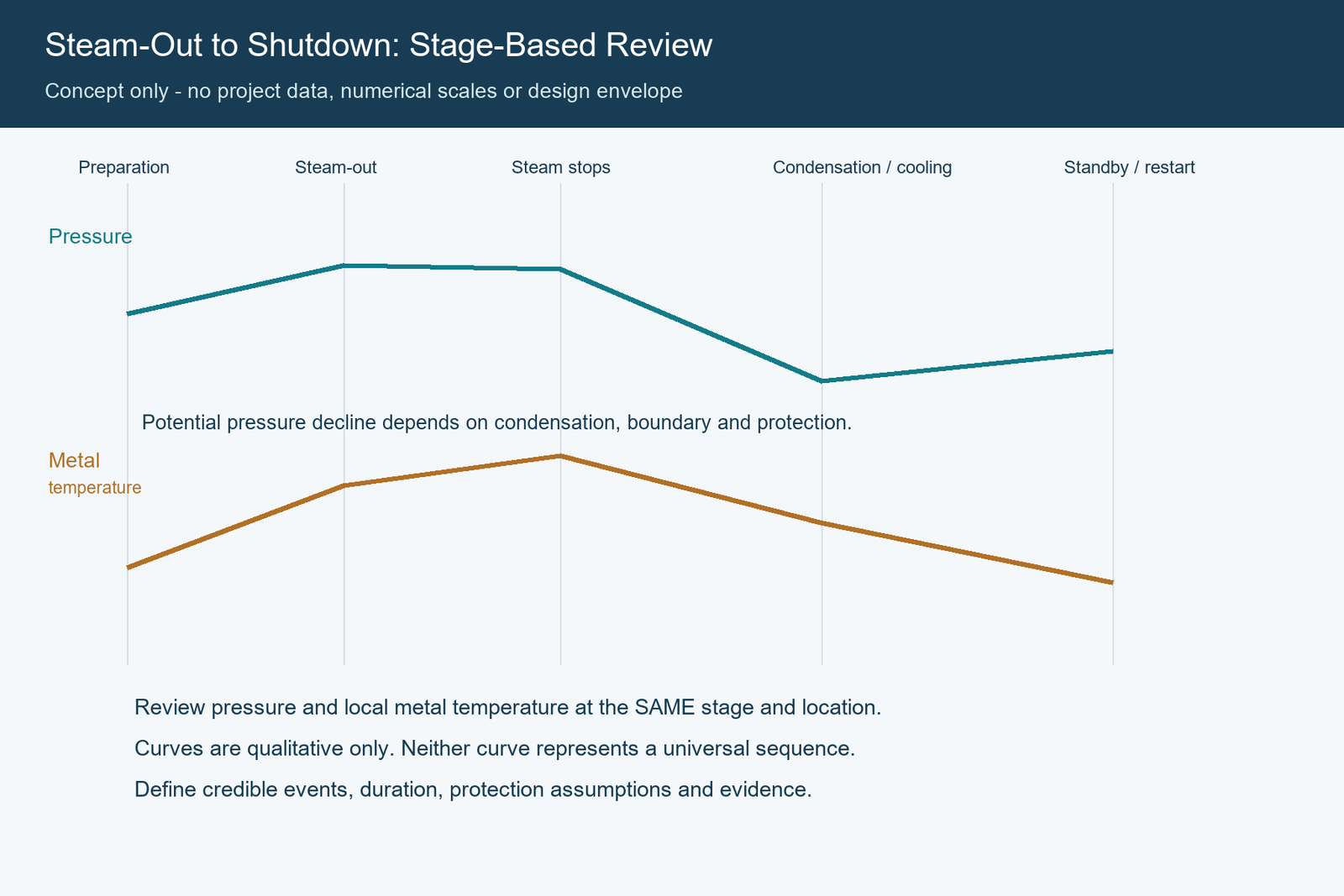
The mechanical designer needs credible coincident conditions, not two unrelated extrema copied from a process datasheet. An external-pressure case may coincide with an elevated vessel-metal temperature, an intermediate temperature during cooldown, or a cooler shutdown condition. Different parts of the vessel may respond at different rates. The hottest steam supply temperature does not automatically coincide with the lowest internal pressure.
Build a stage-by-stage case register
Use the following as an unpopulated project-input template, not a set of assumed operating values. Every cell marked “TBC” requires project-specific information or a documented engineering decision.
| Stage / case | Expected pressure mechanism | Pressure and temperature inputs to record | Time and approval information |
|---|---|---|---|
| Pre-cleaning condition | Residual operating pressure, inventory, or depressurization | Initial internal pressure and its basis; fluid composition; initial metal temperature; liquid inventory — TBC | Starting configuration and responsible process engineer — TBC |
| Steam admission / cleaning | Steam supply, flowing resistance, vent backpressure, possible blocked-in positive pressure | Vessel pressure, steam conditions at vessel inlet, representative metal temperatures and limits — TBC | Cleaning duration, steam routing, valve line-up and approved procedure — TBC |
| Steam shutoff / isolation | Steam supply changes; vapor and noncondensables remain | Internal pressure, metal temperature, external pressure, vent and isolation state — TBC | Transition sequence and isolation assumptions — TBC |
| Cooling / condensation | Vapor condensation and any replacement-gas inflow | Lowest credible internal absolute pressure, simultaneous external pressure and metal temperature, relevant thermal gradients — TBC | Cooling profile, time to vacuum, duration and scenario owner — TBC |
| Hold / drainage / restart | Draining, inerting, purging, vacuum-breaking, or reconnection | Revised pressure–temperature pairs and possible additional loads — TBC | Hold time, cycling frequency, operating and protection approvals — TBC |
The register must also state whether each case is normal, planned intermittent, credible abnormal, excluded by an approved safeguard, or still unresolved. For a case dismissed on the basis of protection, record the engineering evidence and approval; do not silently omit it from the quotation basis.
Express pressure in unambiguous terms
A vacuum level can be expressed as internal absolute pressure, internal gauge pressure, or external differential pressure. These are not interchangeable labels. For every applicable case, identify both the internal absolute pressure and the pressure outside the vessel (which may differ from site atmospheric pressure if, for example, a surrounding chamber or jacket applies a separate load). Specify the resulting differential pressure and units, including the reference basis.
“Full vacuum” and “partial vacuum” must therefore be defined in the approved project specification. Do not treat “vacuum service” or a negative gauge-pressure entry without units as a complete mechanical design instruction. Nor should design for positive internal pressure be assumed to demonstrate resistance to external-pressure buckling.
Record metal temperature, not just steam temperature
Steam temperature is a process input; design evaluation needs the vessel-metal temperature associated with the load case. Depending on the actual sequence, the metal can lag changes in fluid temperature, and localized thermal differences may require review. Specify representative or bounding metal temperatures and identify the engineering basis; if a transient assessment is needed, assign it to the responsible engineering team rather than inventing a temperature margin.
Time matters as evidence of the sequence: record stage duration, hold time, cooldown rate when available, and expected number of cleaning cycles. A short duration does not, by itself, make a credible external-pressure instability case acceptable. The qualified mechanical designer must establish which combinations and other loads require evaluation under the governing code and project specification.
How Can Steam Condensation Produce Vacuum—and When Might It Not?
Steam-out does not automatically mean full vacuum. The outcome depends on the amount of condensable vapor present, residual noncondensable gas, vessel volume, heat loss, condensate drainage, connected equipment, leakage, and the rate and reliability of gas admission. When steam condenses, the vapor inventory shrinks; if sufficient replacement gas cannot enter, the internal pressure can fall. If a validated, adequately sized and available protective flow path prevents that pressure reduction, the credible minimum pressure may be different. That conclusion still requires an engineering assessment.
The buyer should ask for the assumptions behind the proposed minimum-pressure case:
- How much steam, process vapor, liquid and noncondensable gas may be present when steam admission stops?
- Is the vessel isolated, vented, connected to a vacuum source, or connected to equipment that may itself be isolated?
- What happens if an isolation valve is closed earlier than intended, a vent is restricted, or the normal purge is unavailable?
- What site conditions and heat-transfer pathways control the cooldown and potential condensation rate?
- Can condensate accumulate, affect a flow path, or create another operating condition that requires review?
The answers need not appear as a detailed thermodynamic calculation in the RFQ. They do need to be captured as approved process-design assumptions, together with the calculation or assessment reference where the case depends on them. If the process team cannot yet justify a partial-vacuum limit, the design basis must remain openly unresolved, or a suitably conservative design case must be adopted and approved. The vessel vendor should not quietly assume that the worst event is impossible.
What Vacuum-Protection Assumptions Must the Owner or EPC Approve?
A vessel’s mechanical external-pressure capability and the process system’s vacuum protection are related, but different, engineering responsibilities. Protection may involve a designed admission route, vacuum-breaking device, inert-gas supply, controls, interlocks, or a combination appropriate to the service. No one device or open-to-atmosphere instruction is universally suitable, particularly when oxygen ingress, toxicity, flammability, contamination, or inerting requirements constrain the protection philosophy.
Before relying on protection to exclude a severe vacuum case from vessel design, the owner/EPC should document:
- Scenario and required capacity: what condensation, drainage, suction, or isolation event the protective arrangement must address, with its assessed pressure-reduction demand.
- Operating availability: valve line-up, permissible isolation, required utilities, instrument dependencies, and credible failures or unavailability considered in the hazard review.
- Setpoints and limits: allowable minimum pressure, actuation basis, the interface with the proposed vessel rating, and any required testing or maintenance evidence.
- Gas compatibility: whether air is acceptable or whether a suitably engineered inert or other gas supply is necessary.
- Battery limits: who supplies the device, piping, control signals, instruments and documentation, and who owns commissioning and periodic verification.
API Standard 521 is a recognized reference for pressure-relieving and depressuring system engineering in applicable industries, but the version and applicability must be established by the project. It is not a substitute for the vessel construction code or an automatic authorization to omit an external-pressure design case. For an ASME Section VIII, Division 1 vessel, the qualified designer must evaluate the approved external-pressure requirements using the edition specified by the contract.
A purchase specification that simply says “vacuum protection by others” leaves an important gap unless it also identifies the design case, the protected pressure limit, the protection interface, and the accountable approving party.
What Should Be Included in the EPC Design-Case Approval Package?
To compare technical quotations on the same basis, issue a steam-out and shutdown case register with the process datasheet and relevant P&IDs. It should be an agreed engineering input to the complete vessel, not a generic operating manual.
| Required input or decision | Typical origin / accountable reviewer | Evidence or clarification expected |
|---|---|---|
| Process fluid, residual inventory, initial vessel condition | Owner / EPC process | Service description, process data and starting-state assumption |
| Steam-out purpose, utility conditions and cleaning sequence | Owner operations / EPC process | Approved cleaning philosophy, procedure reference and steam source limits |
| Stage-specific valve, vent, purge, drain and isolation states | EPC process / controls, owner operations | P&ID revisions, operating sequence and cause-and-effect basis where applicable |
| Coincident internal pressure, external pressure and metal temperature | EPC process, reviewed with mechanical design | Numbered load-case register; pressure basis and engineering calculations where required |
| Minimum credible pressure, transient duration and cycle frequency | EPC process / process safety | Scenario assessment, operating history or simulation basis, unresolved assumptions |
| Vacuum-protection philosophy and device/system boundary | Owner / EPC process safety / controls | Hazard-review decisions, sizing responsibility, availability criteria and interface notes |
| Vessel design code, edition, site conditions and inspection requirements | Owner / EPC mechanical | Approved vessel specification, datasheet and project contractual requirements |
| External-pressure design verification and fabrication implications | Qualified vessel/mechanical designer / manufacturer | Code-based design output, drawings and documented deviations for review |
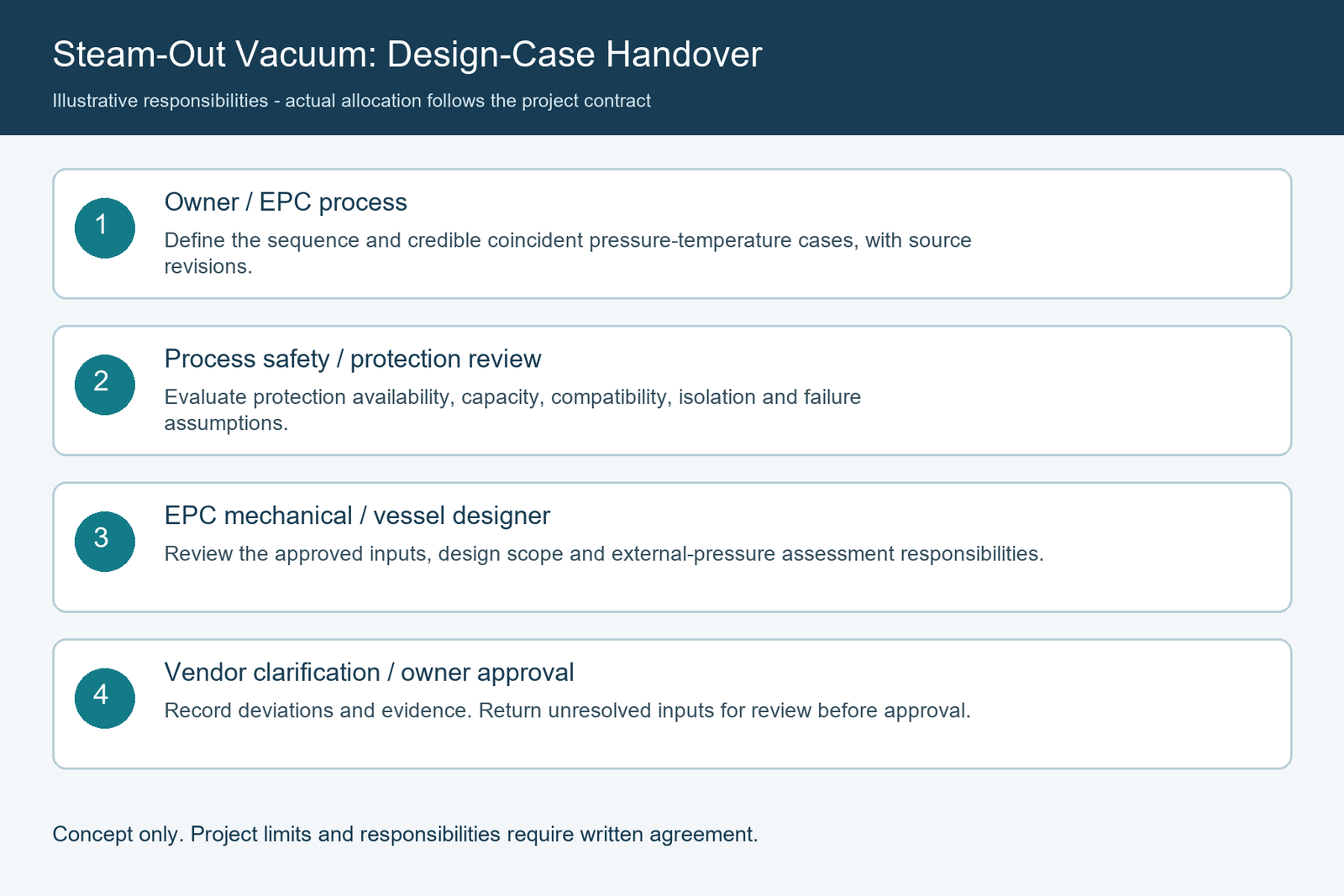
The owner/EPC should approve the process scenarios and protection assumptions; the vessel designer should then assess the mechanical envelope against that approved basis. The exact allocation of responsibility is contractual, so the project document register must identify names, organizations, revision levels, and sign-off authorities rather than assuming the manufacturer can make every process decision.
For a separate overview of vacuum vessel rating, geometry and inspection, see How Do EPC Buyers Specify Vacuum Conditions for Process Columns and Pressure Vessels?. General RFQ fields are addressed in What Information Should Buyers Provide Before Requesting a Pressure Vessel Quote?. The present register covers the narrower question of what happens across the steam-out and shutdown sequence.
How Should These Cases Be Translated into a Vessel Quotation?
A defensible quotation should state whether the offered vessel has been evaluated for the approved external-pressure cases at the corresponding metal temperatures, including any relevant geometrical and interface conditions. The response may require review of the shell and heads, unsupported lengths, stiffening, openings and other mechanical details. Those assessments belong to the qualified designer applying the contractual construction code; they cannot be replaced by a thickness rule of thumb or an article-level calculation.
Ask bidders to identify the exact load-case register revision on which their quotation is based. The technical bid comparison should then flag four items:
- Included design conditions: which steam-out, cooldown, shutdown and restart cases are covered, including internal/external pressure basis and corresponding temperature.
- Assumptions and exclusions: whether the offer assumes reliable venting or inert-gas admission, excludes a particular blocked-in case, or depends on a protection device supplied by others.
- Design and interface consequences: changes to vessel geometry, nozzles, supports, materials, fabrication, inspection or documentation, if justified by the engineering design.
- Open actions: missing process inputs, calculations, owner approvals or protection interfaces that must be resolved before a firm technical acceptance.
Do not accept “full vacuum suitable,” “steam-out capable,” or “protection by EPC” as self-contained answers without the corresponding temperature, applicable design basis and documented scope. Conversely, do not force a full-vacuum assertion merely because cleaning steam is used: determine whether it is an approved design requirement or whether a less severe case is technically supported and accepted.
The final equipment specification should identify who carries the consequence of a changed cleaning procedure or valve line-up after the design has been approved. Where such a change alters the envelope, it requires formal technical review before implementation.
Frequently Asked Questions
Does steam-out automatically mean the vessel must be designed for full vacuum?
No. Steam condensation can produce substantial vacuum if replacement gas cannot enter, but the actual credible minimum pressure depends on the approved scenario and protective arrangements. Full-vacuum design may be selected as the project basis; a partial-vacuum basis requires adequate engineering justification and approval.
Can the maximum steam temperature and maximum vacuum simply be combined?
Not automatically. Record the pressure and vessel-metal temperature that can occur together during each relevant phase. The engineering team must decide whether a bounding combination is required by the applicable construction code or project specification, including uncertainties and other loads. Do not assume unrelated extremes are coincident—or that a credible combination may be ignored.
Is a short vacuum episode unimportant for external-pressure design?
No. Duration belongs in the design-case record, but it is not a blanket exemption from external-pressure stability checks. The applicable code evaluation and engineering review determine acceptability.
Who should approve the steam-out vacuum assumptions before procurement?
The owner and EPC’s responsible process, mechanical and process-safety disciplines should approve the sequence, cases, safeguards and design basis according to the project responsibility matrix. The manufacturer then evaluates the complete vessel against those approved requirements and documents exceptions.
Conclusion
For an intermittently steamed-out process vessel, the design input is a sequence of credible pressure–temperature cases, not a single unspecified vacuum label. Record the initial state, steam-out and cooldown stages, simultaneous internal and external pressures, metal temperatures, durations, protection assumptions and approval responsibilities. Resolve exclusions explicitly before accepting the vessel quotation.
Project teams preparing an RFQ for a large custom pressure vessel can submit the service description, cleaning sequence, P&IDs and approved case register for manufacturer technical review. Final design loads, safeguards and code compliance must be established by the qualified project engineering parties.
References
- American Society of Mechanical Engineers (ASME). BPVC Section VIII, Division 1 — Rules for Construction of Pressure Vessels. Official product scope and editions: https://www.asme.org/codes-standards/find-codes-standards/bpvc-viii-1-bpvc-section-viii-rules-construction-pressure-vessels-division-1
- Center for Chemical Process Safety (CCPS), AIChE. Process Safety Beacon: Vacuum Can Put a Dent in Your Process! February 2024. https://ccps.aiche.org/sites/default/files/ccps-beacon/2024/2/202402beaconenglish.pdf
- American Petroleum Institute (API). Standard 521: Pressure-Relieving and Depressuring Systems. Official scope information: https://www.api.org/products-and-services/standards/important-standards-announcements/standard521
- Society of Petroleum Engineers, Journal of Petroleum Technology. Static Equipment: A Look Inside the How and Why of Specification. https://jpt.spe.org/static-equipment-look-inside-how-and-why-specification
Technical scope note: These public references support the general design-basis and hazard discussion. No project-specific vacuum rating, steam-out condition, equipment capability or code compliance claim is established by this article. Applicable construction-code text and edition, vessel calculations, transient scenario assessments, and approved project documents govern actual engineering decisions.