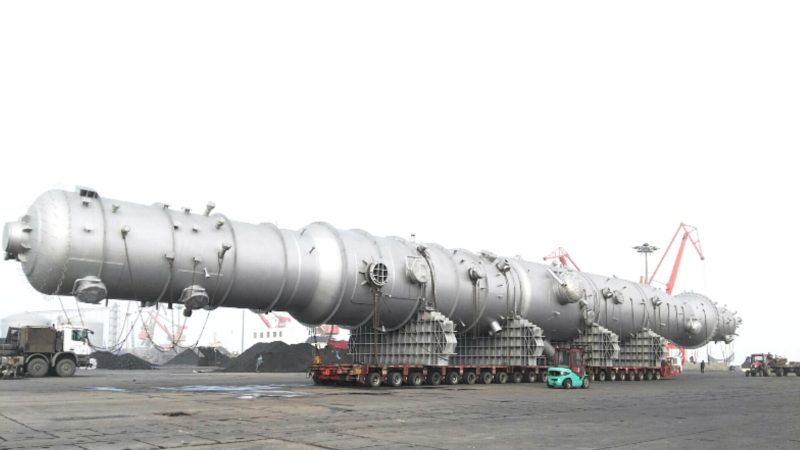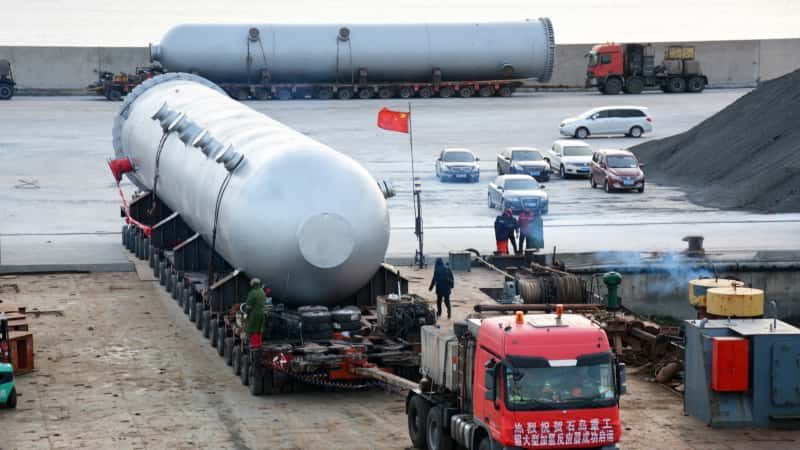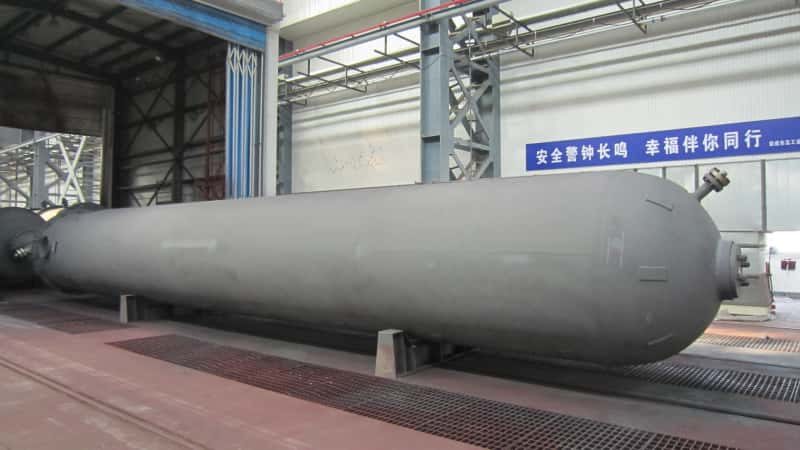

For EPC engineers, plant owners and industrial equipment buyers
A stainless steel grade on a material certificate does not tell a buyer whether the finished pressure vessel is free from fabrication-related contamination. Welding, cutting, grinding, handling and testing can leave heat tint, oxide scale, embedded iron, oils or other residues on the surfaces that will eventually contact the process fluid. Those conditions must be evaluated separately from the vessel’s mechanical design and the chemical suitability of its base material.
For a complete industrial vessel, the purchasing decision is not simply whether to add the words “pickled and passivated” to an RFQ. It is which surfaces need which treatment, what final condition is required, how that condition will be verified and who is responsible for preserving it until handover.
Quick answer: Specify the stainless grade and service environment; identify the internal, external and difficult-to-reach areas in scope; define which fabrication residues must be removed; agree whether cleaning, descaling/pickling, a separate passivation treatment or another qualified finish is appropriate; approve the proposed process and acceptance methods; and require traceable inspection and protection records. Do not assume that chemical passivation removes heavy weld scale, that every stainless surface requires acid treatment or that a successful appearance check alone proves every cleanliness requirement.
This guide concerns complete industrial pressure vessels, including process vessels and large stainless steel storage vessels where relevant. Storage-vessel enquiries discussed here are for industrial projects of 10 m³ or greater. It is not a chemical treatment manual, a service for individual parts or a substitute for project-specific corrosion engineering.
1. Why a Stainless Steel Material Certificate Is Not Enough
The corrosion resistance of stainless steel depends partly on a thin, chromium-rich passive surface film. On a suitably clean surface, this film can form naturally when the surrounding environment permits it. The British Stainless Steel Association (BSSA) therefore cautions against treating a separate chemical passivation step as automatically necessary for every stainless steel application.
However, the supplied material grade and the as-fabricated surface condition are different matters. A material test certificate documents specified material properties and composition; it is not evidence that grinding dust, weld oxidation, iron deposits or cleaning residues were removed from every wetted area after fabrication.
Consider three surfaces on the same vessel:
- A plate surface may be relatively clean, with the specified mill finish intact.
- A nearby weld may carry visible heat tint or oxide scale from fabrication.
- A nozzle or lifting-contact area may have transferred iron contamination from tools or handling equipment.
All three can be made from the same stainless grade but call for different surface assessments. Welding heat tint, for example, can affect local corrosion performance in certain aqueous environments, including through chromium depletion immediately below an oxidized surface. The significance depends on the service; it cannot be assessed from colour alone for every application. BSSA’s post-weld cleaning guidance explains why internal weld faces deserve attention even when they are not visible from the outside.
Likewise, brown staining on stainless steel is not necessarily evidence that the specified alloy is intrinsically unsuitable. In some cases the rust comes from transferred carbon-steel particles. The BSSA discussion of iron contamination identifies mixed-metal tooling, grinding dust and handling equipment as potential sources.
Procurement implication: Do not use “stainless steel, therefore no further surface acceptance needed” as a closing statement. Ask the fabricator to declare the finished condition of each service-relevant area and the evidence supporting that declaration.
Material choice, corrosion mechanisms and sacrificial wall thickness remain separate decisions. For background on the latter, see our discussion of pressure vessel corrosion allowance. A corrosion allowance does not replace removal of unacceptable fabrication contamination.
2. Cleaning, Pickling and Passivation: Different Purposes, Different Evidence
These terms are often grouped together in equipment enquiries, but the treatment objective matters more than the label.
| Term used in an RFQ | Primary objective | What buyers should not assume | Evidence to request |
|---|---|---|---|
| Pre-cleaning / degreasing | Remove oils, grease, loose dirt and other substances that interfere with subsequent treatment or service | It necessarily removes oxide scale or embedded metallic iron | Identified areas, approved cleaning approach and post-cleaning inspection |
| Descaling / pickling | Remove specified oxide scale, weld heat tint and affected surface layers where necessary | It is required everywhere, or that it produces an agreed final surface texture automatically | Treated-area map, method approval, visual or other agreed verification |
| Chemical passivation | Promote a suitable passive condition on an appropriately clean stainless surface and address specified surface contamination | It is equivalent to removing heavy weld scale, or guarantees corrosion immunity | Applicable material/treatment route, selected verification and inspection records |
| Mechanical finishing | Remove or modify localized surface conditions and achieve a required finish, when qualified | Any abrasive or tool is safe for stainless steel, or leaves no iron contamination | Tool segregation/cleanliness controls, finish acceptance and any follow-up treatment |
| Electropolishing or specialty finish | Meet a specifically defined surface-finish objective where justified | It is automatically part of ordinary vessel supply | Explicit commercial scope, technical criteria and evidence of capability |
The sequence is not universal. Pre-cleaning may be required before an acid treatment because acid pickling or passivation is not a substitute for degreasing. An appropriately fabricated and cleaned surface may not require every subsequent treatment. Conversely, a weld with unacceptable scale may require removal before a passivation step can be meaningful.
This distinction is consistent with both worldstainless’ surface-treatment resources and BSSA guidance. It is also reflected in the publicly available scope of ASTM A380/A380M-25, which addresses cleaning, descaling, pickling and passivation of stainless steel equipment and systems.
Pickling is not simply another name for passivation
Pickling is associated with removal of oxide scale and an affected surface layer. Chemical passivation addresses the clean surface’s passive condition and surface contamination under a selected treatment route. A correctly cleaned, freshly pickled surface can also develop its passive film without a separately specified passivation operation. Whether a separate operation is necessary must follow the material, fabrication condition and service specification—not a generic sales promise.
“Passivation” must not be interpreted as a guarantee against corrosion
No treatment makes an inappropriate alloy suitable for every corrosive fluid. Chloride exposure, temperature, crevices, process contaminants and the particular stainless grade remain material-selection and service-design issues. Nor will routine surface treatment repair a mechanical defect, an unacceptable weld or established deep pitting.
The standard cited matters—but so does its contractual status
ASTM A380/A380M-25 is a standard practice covering cleaning and related surface treatment recommendations for stainless steel parts, equipment and systems. ASTM A967/A967M-25 is a standard specification covering alternative chemical passivation treatments and qualitative verification methods for stainless steel parts. They are related, but they do not give a buyer permission to treat every named method or test as suitable for every vessel.
The supplier and purchaser must confirm which document, edition, treatment route, inspection method and acceptance criteria the contract actually invokes. These official catalogue pages describe scope; they are not a substitute for the purchased standards or the project’s controlled specifications. This article does not reproduce treatment recipes or proprietary standard procedures.
3. Which Vessel Surfaces and Fabrication Conditions Belong in the Scope?
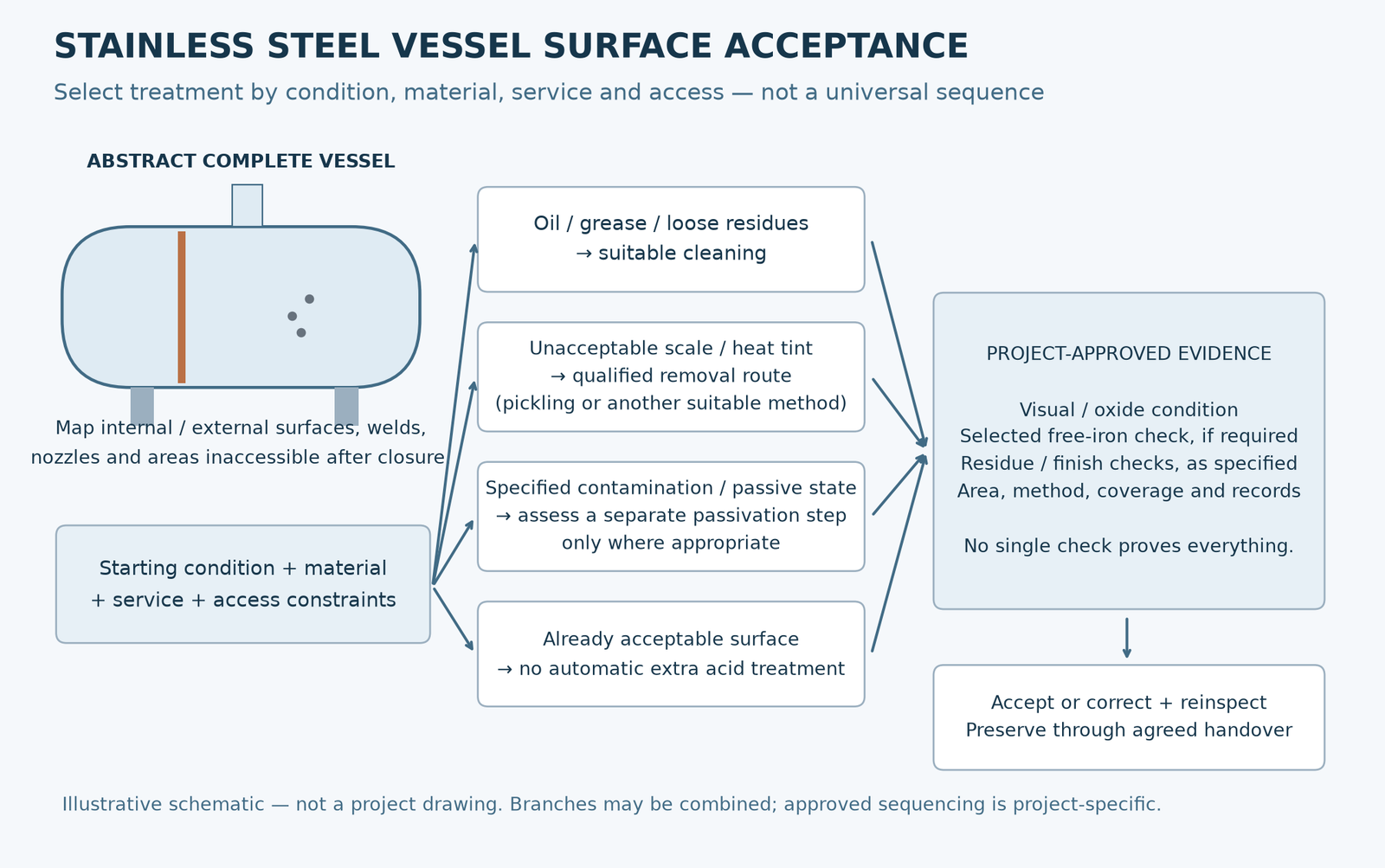
A statement such as “all stainless steel shall be passivated” can be both expensive and ambiguous. A useful specification identifies surfaces by function, condition and access. In a complete vessel, access and treatment feasibility can change as fabrication proceeds.
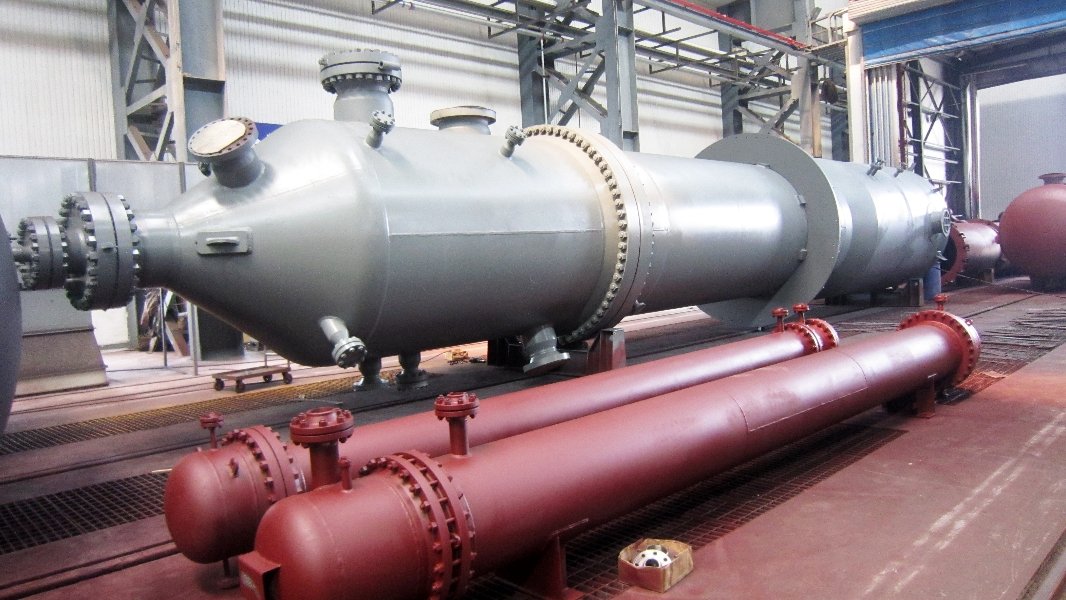
Start with process contact, not just appearance
The inside shell, heads, nozzles and connected process-wetted regions may matter more than a visually attractive exterior, depending on the service. Internal weld roots can be particularly difficult to see after assembly. External surfaces can also be relevant if exposed to corrosive atmospheres, insulation systems, washdown chemicals or handling contamination.
A buyer should distinguish stainless surfaces in contact with the process from carbon-steel supports, painted members, cladding, internal linings and other mixed-material features. A treatment selected for stainless steel must not be indiscriminately applied to incompatible materials, seals or installed components.
Create a surface-and-condition register
The following is an illustrative RFQ register, not evidence of a completed vessel or a prescribed treatment. Replace each entry with actual drawings and fabrication information.
| Surface / area | Conditions to review | Treatment decision required | Acceptance/access question |
|---|---|---|---|
| Internal shell and formed heads | Mill finish, forming marks, handling residues, weld seams | General clean or additional finish? | How will the full area be inspected after assembly? |
| Internal welds and heat-affected zones | Weld heat tint, oxide, grinding residues, inaccessible reverse faces | Is local or full-area descaling required? | What inspection access is available before closure? |
| Nozzle bores and necks | Narrow passages, fabrication deposits, treatment-fluid retention | Which pre-assembly and final checks are needed? | Can rinsing and inspection be demonstrated? |
| External stainless surfaces | Handling marks, nearby carbon-steel work, atmospheric exposure | Is a separate external treatment/finish specified? | What cosmetic and contamination criteria apply? |
| Connections and removable internals | Trapped zones, contact interfaces, dissimilar materials | Which areas are included or excluded from treatment? | Who records exceptions and assembly sequence? |
| Field-weld or site-modified areas | Later welding, grinding or installation damage | Who restores the specified surface condition? | What evidence is required after site work? |
The register should identify both scope inclusions and explicit exclusions. If the manufacturer proposes to treat a vessel before final assembly, the enquiry must establish whether later welding, installation, pressure testing or repairs can invalidate the earlier condition and trigger reinspection or local restoration.
Design for access before the vessel is closed
A method that works on an open shell may be unworkable inside a completed vessel. Large vessel dimensions do not guarantee effective access to all internal regions; narrow connections, support attachments, baffles and temporary closures may restrict inspection, drainage or rinsing.
The official public scope of ASTM A380/A380M specifically raises the need to consider areas that can trap dirt or treatment solutions during equipment design. It would be misleading to demand a nominal treatment name while leaving such constraints unresolved until the finished vessel is ready for shipment.
Ask the manufacturer for an area-by-area access and treatment proposal early enough to affect fabrication sequencing. The answer may be treatment before assembly, a qualified local method, a documented exception or a design change approved by the project team. Do not assume a single immersion or circulation method is feasible for every large pressure vessel.
4. How Should the Buyer Specify the Treatment Method and Responsibility?
Buyers should define the required final condition and ask the fabricator to propose a controlled, material-compatible route to achieve it. Treating an unreviewed chemical process as an automatic subcontract item creates technical and commercial risk.
The minimum technical inputs
Provide the vessel duty, process media and any relevant contaminants; operating and cleaning temperature ranges; applicable stainless grades (including any duplex or dissimilar materials); drawings and weld details; the desired service-contact and external finish; and any process-specific prohibition on residues or cleaning chemicals.
If a hygienic, high-purity or product-contact surface standard is important, the project must explicitly supply its own validated requirement. Ordinary industrial-vessel cleaning is not an implicit pharmaceutical-grade or sterile-surface guarantee. Surface roughness, bioburden and chemical extractables should not be introduced as acceptance commitments unless that service actually calls for them and test methods are agreed.
Require a supplier-proposed method statement
Before execution, request a method statement that identifies:
- Material grades and affected surfaces, including internal and inaccessible areas.
- The documented starting surface condition and targeted contaminants or oxides.
- The chosen treatment route and why it is suitable for the material and geometry.
- Segregation measures to avoid iron pickup from tools, abrasives, work areas or handling.
- Controls for compatibility with nearby non-stainless materials and installed equipment.
- How treatment media and residues will be removed or otherwise managed, with any necessary drainage and verification arrangements.
- Inspection stages, sample or test-area selection, acceptance criteria and corrective-action rules.
- Subcontractor and owner/EPC approval responsibilities, including records to be handed over.
This is a procurement documentation checklist, not an instruction to perform chemical surface treatment. Acid-based systems can present serious personnel, environmental and material-damage hazards and must be managed by qualified specialists under applicable site and environmental requirements. Concentrations, exposure periods and operating sequences are intentionally excluded here.
Clarify factory versus site responsibilities
A large vessel may have factory-completed areas, field welds, temporary openings, transport restraints and areas that become accessible only at a later construction stage. The purchase order should therefore say whether the manufacturer, an approved subcontractor or the EPC/site team performs each treatment and signs the corresponding inspection record.
| Decision or deliverable | Typically originated by* | Must be approved / agreed by |
|---|---|---|
| Required cleanliness and service-specific acceptance outcome | Owner/process team | Owner/EPC and responsible technical authority |
| Stainless material, mixed materials and mechanical scope | Equipment engineering | Project-design authority and manufacturer as allocated |
| Proposed accessible-area map and treatment method | Vessel manufacturer / specialist | Owner/EPC per contract and ITP |
| Surface verification method and witness points | Manufacturer QA with project QA | Contractually designated parties |
| Post-treatment preservation and dispatch protection | Vessel manufacturer / logistics party | Buyer/EPC at agreed custody transfer |
| Field weld restoration and final site acceptance | Site contractor / specialist | Site QA, owner/EPC and other contractually required parties |
*This matrix is a proposed allocation for RFQ discussion. Actual design, execution and approval responsibility must be assigned by contract; it is not automatically transferred to the vessel manufacturer.
5. What Should “Surface Acceptance” Actually Mean?
The most valuable procurement change is to replace a vague finish requirement with an inspection plan that tests the stated objective. Visual cleanliness, absence of free-iron contamination, weld-oxide removal and a specified surface texture are different acceptance questions.
Select checks according to the failure or contamination concern
| Acceptance concern | Possible evidence or inspection category | Limitation buyers must recognize |
|---|---|---|
| Visible scale, heat tint, rust staining or grinding residue | Documented visual inspection of identified accessible areas; photographs or inspection map | Visual acceptance does not show every invisible chemical film or embedded contaminant |
| Suspected free-iron contamination | A selected and approved qualitative contamination test suited to the material and location | Method suitability, sampling plan and interpretation require agreement; one negative local result does not inspect an entire inaccessible vessel |
| Oil films, cleaning media or other process-relevant residues | Agreed cleanliness or residue-verification method | No single visual or qualitative test proves all substances absent |
| Specified finish or surface texture | Approved finish designation or measurement method, if relevant to service | A polished or bright appearance alone does not demonstrate chemical cleanliness or corrosion immunity |
| Inaccessible internal areas | Pre-closure hold/witness records, qualified indirect inspection or agreed exceptions | Final inspection through one nozzle may not cover hidden surfaces |
| Condition after site repair or rework | Repair record plus repeat inspection of affected locations | An earlier factory acceptance certificate may no longer represent the altered area |
ASTM A380/A380M publicly describes several categories of cleanliness checks and notes the limitations of visual inspection; ASTM A967/A967M describes alternative qualitative tests for passivation-treatment effectiveness. It would be incorrect to require every listed test on every vessel, or to infer a universal pass/fail threshold from these catalogue summaries. The exact method, sample locations, witness status and acceptance criteria should be settled using the applicable controlled document and project-specific requirements.
For example, an approved inspection plan might require a documented visual review of weld areas and a selected free-iron check on agreed representative or risk-based locations. That example does not imply that the approach is sufficient for a specific project: critical services and restricted geometry may require different evidence, broader coverage or other acceptance requirements.
Integrate surface work into the inspection and test plan (ITP)
A technically complete ITP should make clear which activities are simply recorded, which require review and which are witness or hold points. Avoid treating all steps as mandatory hold points by default. Appropriate sequencing matters:
- Inspect and record the initial fabricated condition before it is obscured.
- Agree any inspections that need access before final vessel closure.
- Identify how pressure testing, washing, drying, handling, repair and field welding could affect previously accepted surfaces.
- Reinspect affected areas after corrective action or subsequent work where the contract requires it.
- Close identified nonconformities before the applicable delivery or site-acceptance milestone.
The required order of mechanical testing and final surface work is project-dependent. For example, if a hydrostatic test occurs after an earlier surface treatment, the project needs to assess test-water quality, drainage, drying and any resulting reinspection requirements. This article does not prescribe a single testing sequence or claim that one finishing process is compatible with all test arrangements.
What to do when an area fails inspection
The specification should say who determines the cause, selects the corrective method and approves the reinspection scope. A detected iron deposit, unacceptable heat tint, residual oil film or surface damage may require different remedies. Rework can itself change surface texture or create new contamination if performed with inappropriate tools.
An NCR (nonconformance report) or punch-list item should identify the location, problem, agreed repair and closure evidence—not merely the phrase “re-passivated.” If treatment cannot access a specified area, the issue should be raised as a deviation before acceptance, not hidden in a general cleaning certificate.
6. What Records and Preservation Measures Should Accompany Delivery?
A final surface may be acceptable in the workshop and then become contaminated during lifting, temporary assembly, packaging or storage. BSSA identifies iron pickup from shared equipment, steel tools and grinding dust as avoidable contamination risks. The surface-preservation boundary must therefore be clear at the moment responsibility changes hands.
Specify the handover file
For a vessel where surface treatment is contractually required, a practical record set may include:
- The approved cleaning/surface-treatment specification and revision.
- The surface-scope map identifying internal/external areas and exclusions.
- Fabrication-stage condition records, including relevant weld and inaccessible-area inspections.
- The manufacturer’s or approved subcontractor’s treatment method statement and execution report.
- Test/inspection reports listing method, location, result, date and responsible personnel where required.
- NCRs, repair records, concessions and reinspection evidence.
- Photos or other traceable evidence at agreed inspection stages.
- Final preservation, closure, packing and transport precautions.
- A list of work remaining after shipment or site assembly, with responsible parties.
Not every project needs the same document volume. The objective is traceability from a required surface outcome to a recorded acceptance decision, not paperwork for its own sake.
Prevent recontamination after acceptance
Agree the protection of process openings, contact surfaces, transport supports, temporary closures and lifting interfaces. If components will be handled in a mixed-metal workshop or construction site, the plan should address the potential for subsequent iron contamination. Any protective film, cover or packing material should also be suitable for the equipment’s finish and planned storage conditions.
Separate the factory’s delivery condition from subsequent custody. A vendor’s report cannot automatically guarantee that a vessel will remain in the same condition after field welding, prolonged laydown, unapproved cleaning or exposure during installation. Ownership of post-delivery restoration and final inspection should be written into the project’s handover matrix.
7. A Practical RFQ and Technical Bid Comparison Checklist
The following checklist is designed for complete industrial stainless steel pressure-vessel procurement. It is deliberately outcome-based rather than a ready-made acid-treatment procedure.
| RFQ question | Buyer/EPC input | Supplier response expected |
|---|---|---|
| What is being supplied? | Complete equipment tag, drawings and equipment boundary | Confirm included vessel, fabrication and finishing scope |
| Which stainless materials are present? | Grade specifications, mixed materials and any lined/clad areas | Confirm material compatibility and any treatment exclusions |
| Which surfaces matter? | Process-contact and external exposure requirements | Provide internal/external surface map and accessibility review |
| What initial conditions are unacceptable? | Defined weld oxide, contamination, roughness or residue concerns | Propose how to identify and correct them |
| Is pickling required, or is another qualified route suitable? | Required final condition, any mandated project procedure | State treatment method and limitations; explain alternatives |
| Is separate chemical passivation required? | Applicable contract document, material and service criteria | Confirm need, suitability and proposed verification |
| What are the acceptance tests? | Method, coverage and criteria, or the approval process for these | Provide ITP, sample locations, records and deviations |
| When is the work accepted? | Factory and site handover milestones | Identify hold/witness/review points and approvals |
| How is the finish preserved? | Transport, storage, closure and field-work conditions | State protection and reinspection responsibilities |
| What is excluded from price? | Clear commercial boundary | List exceptions, subcontracted work, site restoration and optional extras |
Compare two quotes on scope, not treatment labels
Illustrative comparison—no actual supplier bids are represented:
- Proposal A: “Stainless vessel, passivation included.” No surface register, weld-tint criterion, free-iron verification, access plan or post-treatment preservation statement.
- Proposal B: Identifies internal and external areas, states which weld discoloration will be removed, gives an approved method for each accessible zone, lists proposed checks and records, and identifies site repairs and shipping protection.
A buyer cannot conclude that Proposal A is technically equivalent simply because both bids mention passivation. Equally, Proposal B is not automatically compliant: its proposed methods and acceptance thresholds still require project approval. The fair comparison is whether each bid meets the same written surface-condition requirements and acknowledges the same exclusions and responsibilities.
Example contract language for technical clarification
The following is an illustrative procurement clause for engineering review, not a complete legal or standards-compliance provision:
The supplier shall identify stainless steel surfaces within the equipment boundary that require post-fabrication cleaning, scale/heat-tint removal, chemical passivation or other specified finishing. Before execution, the supplier shall submit the proposed area-specific methods, exclusions and inspection/acceptance plan for review under the project-approved specifications. The supplier shall provide traceable records for completed work, document deviations and corrective actions, and preserve the agreed surface condition through the defined delivery point. Any work required after field welding or installation shall be assigned explicitly in the project responsibility matrix.
The finished specification should name the controlled codes or project documents, their editions and the actual agreed criteria. Do not assume that merely citing ASTM A380 or A967 establishes an approved treatment, coverage or acceptance test for the entire vessel.
Frequently Asked Questions
Are pickling and passivation the same thing?
No. Pickling addresses oxide scale and an affected surface layer, whereas passivation concerns the surface’s passive condition and certain contaminants after appropriate cleaning. A surface may naturally repassivate once it has been properly cleaned and exposed to suitable conditions; a separate chemical passivation operation is not inherently required in every service.
Must every stainless steel pressure vessel be chemically passivated before shipment?
Not as a universal rule. The necessary surface treatment depends on the stainless grade, fabrication condition, process environment and applicable contract. Buyers should specify the desired outcome and require a justified, approved treatment and verification route where needed.
Can passivation remove weld heat tint?
A passivation step should not be treated as a substitute for effective removal of unacceptable weld scale or heat tint. Where such oxides must be removed, the project must define a suitable qualified removal and finishing process, followed by agreed verification.
How can buyers check for free-iron contamination?
A project can select a suitable, approved qualitative test for agreed locations, supplemented by fabrication controls and inspection records. ASTM A380/A380M and ASTM A967/A967M describe categories of tests. The selected method, material suitability, sampling plan and result interpretation must be confirmed; visual inspection alone may miss embedded iron or invisible contamination.
Should internal and external vessel surfaces have identical requirements?
Not necessarily. Wetted internal surfaces, internal weld roots, external stainless surfaces and difficult-to-reach regions may face different service environments and fabrication risks. The buyer should map each area, define the required outcome and resolve access limitations before fabrication closes those areas.
Does a bright or polished stainless finish prove adequate passivation?
No. Appearance, roughness, oxide removal and contamination status are different properties. A finish designation may be useful where the process requires it, but an attractive surface alone does not prove chemical cleanliness, a particular passive-film condition or resistance to every corrosive medium.
Is ASTM A380/A380M the same as ASTM A967/A967M?
No. A380/A380M is a broader practice covering cleaning, descaling and related surface treatment of stainless equipment and systems; A967/A967M addresses chemical passivation treatments and qualitative tests for stainless steel parts. The governing contract must specify the applicable editions, treatment route and acceptance criteria. Neither public summary alone demonstrates that a project complies with the complete standard.
What if a vessel needs field welding after factory treatment?
Assign responsibility for any affected-area cleaning, oxide removal, inspection and final acceptance. A pre-shipment treatment record may not cover new welds, grinding dust or handling contamination added later. The project should explicitly distinguish factory delivery acceptance from site handover.
Conclusion: Buy the Required Surface Condition, Not Just a Treatment Name
For industrial stainless steel pressure vessels, pickling and passivation should be treated as defined elements of complete-equipment quality assurance, not automatic evidence that every surface is acceptable. The successful RFQ establishes: what contamination or oxide must be removed, where treatment applies, which method is appropriate, how acceptance is demonstrated and how the condition is protected through delivery.
Before requesting a technical quotation, send the vessel datasheet, process medium and service conditions, stainless material specification, drawings, required surface finish or special restrictions, and the project inspection plan. Ask the manufacturer to identify any surface-treatment capability that is actually available, proposed subcontracted work, excluded or inaccessible areas, and the evidence it can provide for acceptance.
For complete equipment enquiries, refer to our industrial pressure vessel product range and request a project-specific technical clarification. Final method selection and acceptance must remain subject to review by the responsible engineering and quality teams.
References
- British Stainless Steel Association. Passivation of stainless steels. Technical guidance on natural passivation and the distinction from pickling.
- British Stainless Steel Association. Post weld cleaning and finishing of stainless steels. Technical guidance on weld heat tint and cleaning considerations.
- British Stainless Steel Association. Iron contamination and rust staining on stainless steel. Technical guidance on fabrication-related iron contamination.
- ASTM International. ASTM A380/A380M-25: Standard Practice for Cleaning, Descaling, Pickling, and Passivation of Stainless Steel Parts, Equipment, and Systems. Official public scope only; full standard not reviewed.
- ASTM International. ASTM A967/A967M-25: Standard Specification for Chemical Passivation Treatments for Stainless Steel Parts. Official public scope only; full standard not reviewed.
- worldstainless. Surface treatment. Industry resources on stainless finishes, pickling and passivation.